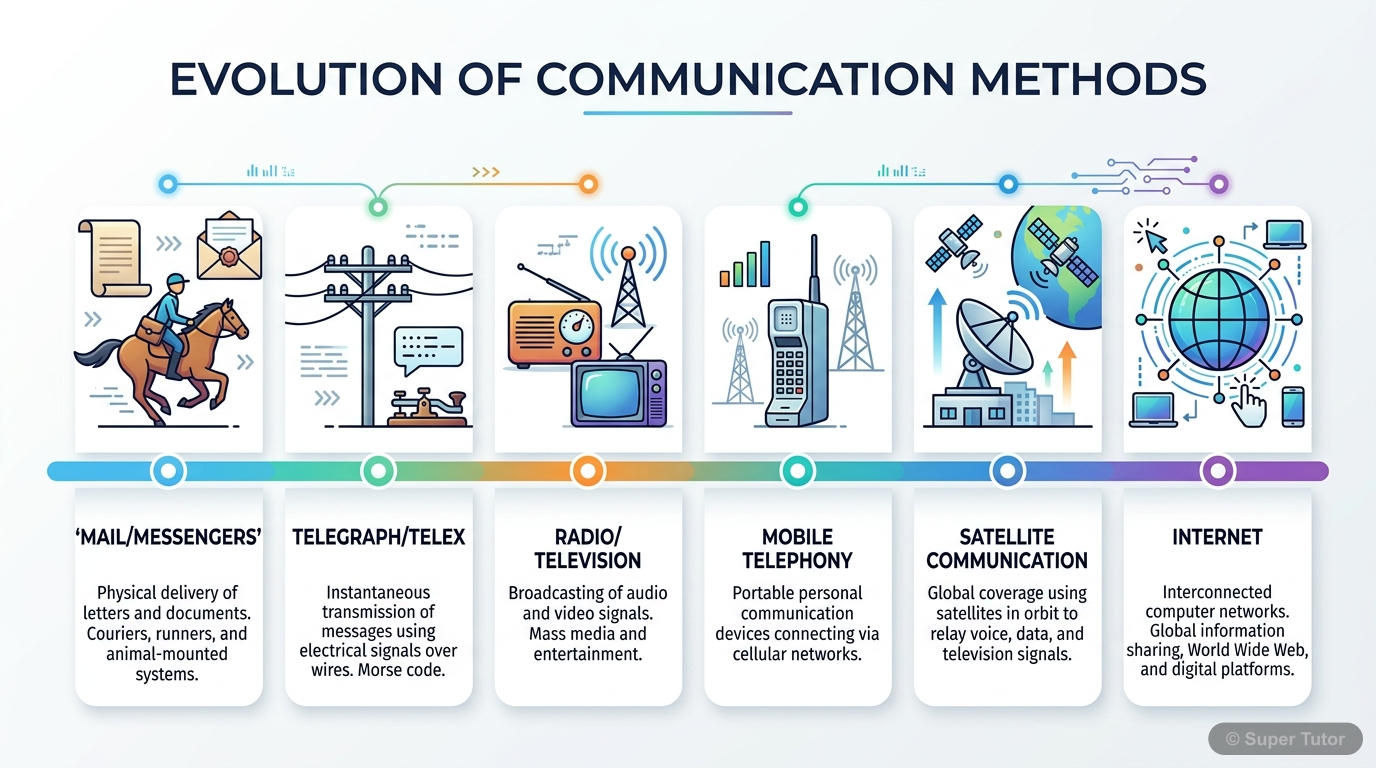
Transport and Communication
Bihar Board · Class 12 · Geography
NCERT Solutions for Transport and Communication — Bihar Board Class 12 Geography.
Interactive on Super Tutor
Studying Transport and Communication? Get the full interactive chapter.
Quizzes, flashcards, AI doubt-solver and a step-by-step study plan — built for ncert solutions and more.
1,000+ Class 12 students started this chapter today

Learn better with visuals Super Tutor has hundreds of illustrations like this across every chapter — all free to try.
Get startedEXERCISES
1(i)The Trans-Continental Stuart Highway runs between
(a) Darwin and Melbourne
(b) Edmonton and Anchorage
(c) Vancouver and St. John's City
(d) Chengdu and LhasaShow solution
Justification: The Trans-Continental Stuart Highway is an Australian highway that runs between Darwin (in the Northern Territory) and Melbourne (in Victoria), passing through Alice Springs. It is one of the most important north–south road links in Australia.
1(ii)Which country has the highest density of railway network?
(a) Brazil
(b) U.S.A
(c) Canada
(d) RussiaShow solution
Justification: The United States of America has the highest density of railway network in the world. The U.S.A. has an extensive rail network of over 3,00,000 km, which is the largest in the world, giving it the highest railway density among the given options.
1(iii)The Big Trunk Route runs through
(a) The Mediterranean – Indian Ocean
(b) The North Atlantic Ocean
(c) The South Atlantic Ocean
(d) The North Pacific OceanShow solution
Justification: The Big Trunk Route (also called the North Atlantic Sea Route) runs through the North Atlantic Ocean, connecting the highly industrialised regions of Western Europe and North-Eastern North America. It is the busiest oceanic trade route in the world.
1(iv)The Big Inch pipeline transports
(a) Milk
(b) Liquid petroleum gas (LGP)
(c) Water
(d) PetroleumShow solution
Justification: The 'Big Inch' is a famous pipeline in the United States of America that transports petroleum (crude oil) from the oil fields of the Gulf of Mexico region to the north-eastern states. It was originally built during World War II to supply oil to the eastern seaboard.
1(v)Which one pair of the following places is linked by Channel Tunnel?
(a) London – Berlin
(b) Paris – London
(c) Berlin – Paris
(d) Barcelona – BerlinShow solution
Justification: The Channel Tunnel (also called 'Chunnel') is a rail tunnel beneath the English Channel that links London (England) and Paris (France). It passes under the sea between Folkestone (UK) and Coquelles near Calais (France), making it one of the most important rail links in Europe.
2(i)What are the problems of road transport in mountainous, desert and flood prone regions?Show solution
Problems of road transport in different regions:
1. Mountainous Regions: Construction of roads is very difficult and expensive due to rugged terrain, steep slopes, and rocky surfaces. Roads are frequently damaged by landslides, avalanches, and heavy snowfall. Maintenance costs are very high.
2. Desert Regions: Roads are often buried under shifting sand dunes. Extreme temperatures cause the road surface to crack and deteriorate. Dust storms reduce visibility and damage road infrastructure.
3. Flood-Prone Regions: Roads are frequently washed away or submerged during floods. Waterlogging weakens the road base, leading to potholes and road damage. Bridges and culverts are damaged, disrupting connectivity.
In all these regions, road construction and maintenance is costly, and connectivity remains unreliable throughout the year.
2(ii)What is a trans-continental railway?Show solution
Definition: A trans-continental railway is a railway line that crosses an entire continent, connecting its two opposite ends or coasts, passing through several countries or regions.
Key Features:
- These railways run across the length or breadth of a continent.
- They connect important cities, ports, and economic centres.
- They facilitate the movement of passengers and bulk goods over long distances.
Examples:
- The Trans-Siberian Railway in Russia (Moscow to Vladivostok) — the longest railway in the world (~9,332 km).
- The Trans-Canadian Railway connecting Halifax on the Atlantic coast to Vancouver on the Pacific coast.
- The Union Pacific–Central Pacific line in the USA connecting the Atlantic and Pacific coasts.
These railways play a vital role in the economic integration of large countries and continents.
2(iii)What are the advantages of water transport?Show solution
Advantages of Water Transport:
1. Cheap and Economical: Water transport is the cheapest mode of transport for carrying heavy and bulky goods over long distances. It requires no construction of tracks or roads — natural waterways are used.
2. Large Carrying Capacity: Ships and barges can carry very large quantities of goods (e.g., coal, iron ore, petroleum, grain) in a single voyage.
3. Suitable for Bulky and Heavy Goods: Goods that are too heavy or bulky for road or rail transport can be easily transported by water.
4. Fuel Efficient: Water transport consumes less fuel per tonne-kilometre compared to road or air transport.
5. Environmentally Friendly: It causes less air pollution and carbon emission per unit of cargo compared to road transport.
6. International Trade: Ocean routes connect countries across the world, making international trade possible on a large scale.
7. No Land Acquisition Required: Natural rivers, lakes, and seas serve as ready-made routes, so no land needs to be acquired for building infrastructure.
3(i)Elucidate the statement– "In a well managed transport system, various modes complement each other".Show solution
Explanation:
Each mode of transport has its own strengths and limitations. In a well-managed transport system, these modes are integrated so that the weakness of one is compensated by the strength of another.
1. Road Transport: Best suited for short distances and door-to-door delivery. It connects farms, factories, and homes to railway stations and ports. However, it is not economical for very long distances or very heavy cargo.
2. Rail Transport: Ideal for carrying heavy and bulky goods over long distances at relatively low cost. However, railways cannot reach every village or remote area. Road transport feeds goods to railway stations and collects them at the other end.
3. Water Transport: The cheapest mode for carrying bulk goods internationally. Ships carry goods between continents, but they cannot go inland. Railways and roads then carry goods from ports to the interior.
4. Air Transport: The fastest mode, suitable for perishable goods, high-value items, and passengers over long distances. However, it is very expensive and cannot carry bulk cargo. Other modes handle the ground-level distribution.
5. Pipelines: Ideal for continuous transport of liquids (petroleum, natural gas) and slurry. They complement other modes by reducing the burden of transporting these materials by road or rail.
Example of Complementarity:
A container of goods may travel by road from a factory to a railway station → by rail to a port city → by ship across the ocean → by road again to the final destination. Each mode plays its specific role.
Conclusion: Thus, in a well-managed transport system, the various modes are not competitors but partners. They are integrated through terminals, ports, and logistics hubs to ensure efficient, cost-effective, and timely movement of goods and people. This multimodal approach is the hallmark of a developed transport network.
3(ii)Which are the major regions of the world having a dense network of airways?Show solution
Major Regions with Dense Airway Networks:
1. Western Europe:
- Western Europe has the densest air network in the world.
- Countries like the United Kingdom, France, Germany, Netherlands, and others have numerous busy airports.
- Major hubs: London Heathrow, Frankfurt, Paris Charles de Gaulle, Amsterdam Schiphol.
- High population density, economic prosperity, and international trade drive heavy air traffic.
2. Eastern United States of America (North-Eastern USA):
- The north-eastern corridor of the USA (New York, Chicago, Los Angeles, Washington D.C.) has one of the busiest air networks in the world.
- The USA handles the largest volume of domestic air traffic globally.
- Major hubs: Hartsfield-Jackson Atlanta, O'Hare Chicago, Los Angeles International, JFK New York.
3. South-East Asia:
- Countries like Japan, China, South Korea, Singapore, Thailand, and India have rapidly expanding air networks.
- Major hubs: Tokyo Haneda, Beijing Capital, Singapore Changi, Hong Kong International.
- Fast economic growth and large populations have led to rapid expansion of air travel.
4. South Asia:
- India has a growing network of domestic and international airports.
- Major hubs: Indira Gandhi International (Delhi), Chhatrapati Shivaji Maharaj International (Mumbai).
Characteristics of Dense Airway Regions:
- High levels of economic development.
- Large urban and industrial populations.
- Strong international trade and tourism.
- Advanced airport infrastructure.
Conclusion: The density of airways is closely related to the level of economic development, urbanisation, and international connectivity of a region. Western Europe and North-Eastern USA remain the most air-traffic-intensive regions in the world.
3(iii)What are the modes by which cyber space will expand the contemporary economic and social space of humans?Show solution
Cyberspace refers to the electronic world created by interconnected computers and communication networks — the Internet. It is the world of electronic computerised space.
Modes by which Cyberspace expands Economic Space:
1. E-Commerce and Online Business: Cyberspace enables buying and selling of goods and services online (e-commerce platforms like Amazon, Flipkart). Businesses can reach global markets without physical presence, expanding their economic reach enormously.
2. Electronic Banking and Financial Services: Internet banking, mobile banking, online stock trading, and digital payment systems (UPI, PayPal) allow financial transactions across the world instantly, reducing dependence on physical banks.
3. Work from Home / Remote Working: Cyberspace allows people to work from any location. IT professionals, writers, designers, and consultants can offer services globally without relocating, expanding the labour market.
4. Digital Industries: Software development, data analytics, digital marketing, and cloud computing are entirely cyberspace-based industries that generate enormous economic value.
5. Online Education and Skill Development: E-learning platforms (Coursera, BYJU'S, Khan Academy) allow people to acquire skills and education from anywhere, improving human capital and economic productivity.
Modes by which Cyberspace expands Social Space:
1. Social Networking: Platforms like Facebook, Instagram, Twitter, and WhatsApp connect billions of people across the world, creating virtual social communities that transcend geographical boundaries.
2. Communication: E-mail, video calling (Zoom, Google Meet), and instant messaging allow people to communicate with family, friends, and colleagues anywhere in the world at negligible cost.
3. Access to Information: The Internet provides access to news, research, culture, and knowledge from around the world, democratising information and reducing social inequalities in access to knowledge.
4. Cultural Exchange: Cyberspace facilitates the sharing of music, films, literature, and ideas across cultures, promoting global cultural understanding.
5. Healthcare and Telemedicine: Online medical consultations, health information portals, and telemedicine expand access to healthcare, especially in remote areas.
Conclusion: Cyberspace has become the fifth mode of human interaction after land, water, air, and space. It is rapidly expanding both the economic and social dimensions of human life by breaking down barriers of distance, time, and geography. It is transforming the way people work, communicate, trade, and socialise, making the world a truly interconnected global village.
Stuck on a step?
Ask Super Tutor AI to explain any solution on this page in a simpler way — free, 24x7.
Ask a Doubt FreeFrequently Asked Questions
What are the important topics in Transport and Communication for Bihar Board Class 12 Geography?
How to score full marks in Transport and Communication — Bihar Board Class 12 Geography?
Where can I get free NCERT Solutions for Transport and Communication Class 12 Geography?
Sources & Official References
Content is aligned to the official syllabus. Refer to the board website for the latest curriculum.
More resources for Transport and Communication
Important Questions
Practice with board exam-style questions
Syllabus
What topics to cover
Revision Notes
Key points for last-minute revision
Study Plan
Step-by-step plan to ace this chapter
Flashcards
Quick-fire cards for active recall
Formula Sheet
All formulas in one place
Chapter Summary
Understand the chapter at a glance
Practice Quiz
Test yourself with a quick quiz
Concept Maps
See how topics connect visually
For serious students
Get the full Transport and Communication chapter — for free.
Quizzes, flashcards, AI doubt-solver and a step-by-step study plan for Bihar Board Class 12 Geography.