Water Resources
Bihar Board · Class 12 · Geography
NCERT Solutions for Water Resources — Bihar Board Class 12 Geography.
Interactive on Super Tutor
Studying Water Resources? Get the full interactive chapter.
Quizzes, flashcards, AI doubt-solver and a step-by-step study plan — built for ncert solutions and more.
1,000+ Class 12 students started this chapter today

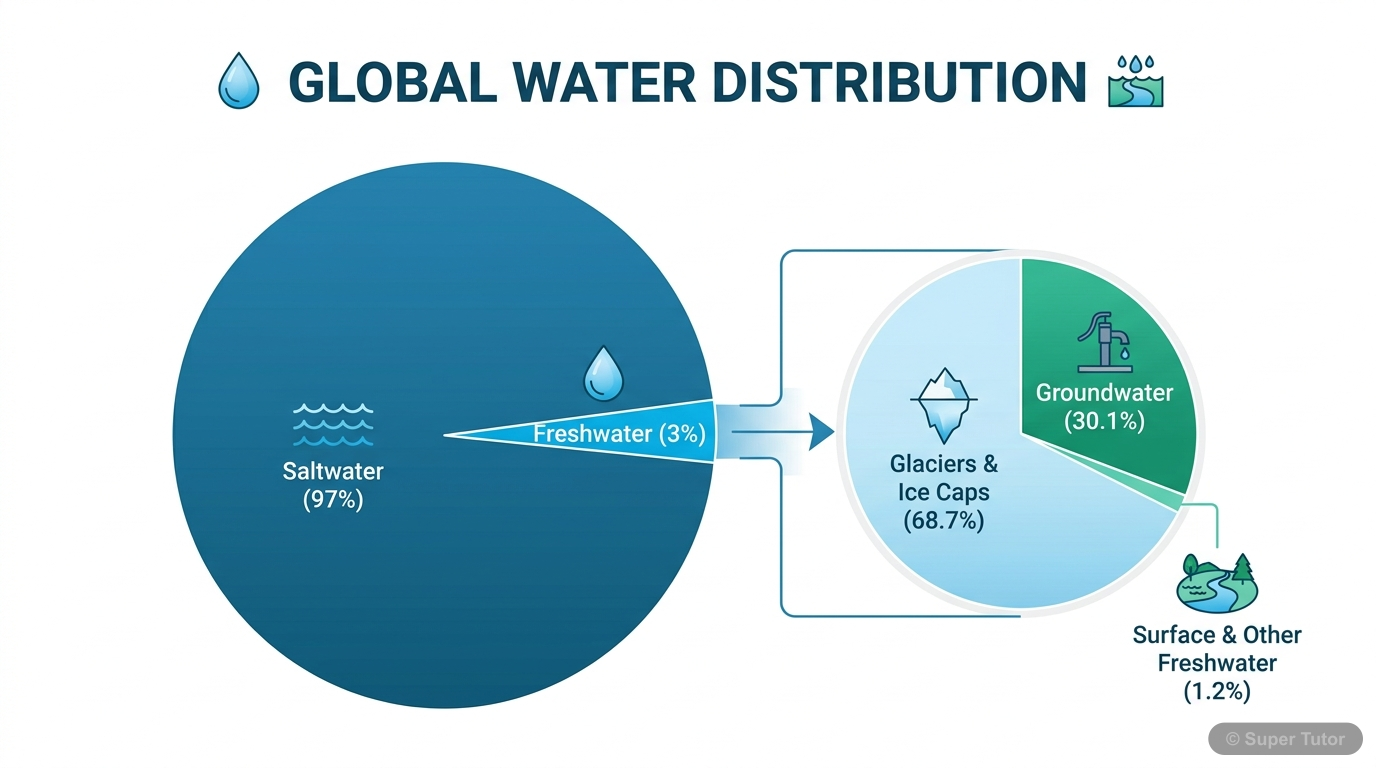
Super Tutor has 15+ illustrations like this for Water Resources alone — flashcards, concept maps, and step-by-step visuals.
See them allEXERCISES — Water Resources
1(i)Which one of the following types describes water as a resource?
(a) Abiotic resource
(b) Non-renewable Resources
(c) Biotic Resource
(d) Non-cyclic ResourceShow solution
Water is an abiotic resource because it is a non-living (inorganic) component of the environment. It is also a renewable/cyclic resource since it is continuously replenished through the hydrological cycle. Hence options (b) and (d) are incorrect, and (c) is incorrect because biotic resources are derived from living organisms.
1(ii)Which one of the following south Indian states has the highest groundwater utilisation (in per cent) of its total ground water potential?
(a) Tamil Nadu
(b) Karnataka
(c) Andhra Pradesh
(d) KeralaShow solution
Tamil Nadu has the highest groundwater utilisation as a percentage of its total groundwater potential among the given south Indian states. This is due to low and erratic rainfall, high dependence on groundwater for irrigation, and intensive agricultural activity, especially paddy and sugarcane cultivation.
1(iii)The highest proportion of the total water used in the country is in which one of the following sectors?
(a) Irrigation
(b) Industries
(c) Domestic use
(d) None of the aboveShow solution
Agriculture/Irrigation accounts for the largest share of total water consumption in India — approximately 89% of the total water used. India's economy is predominantly agrarian and irrigation is essential for food production, making it by far the largest consumer of water resources in the country.
2(i)It is said that the water resources in India have been depleting very fast. Discuss the factors responsible for depletion of water resources.Show solution
Given/Context: Water resources in India are depleting rapidly due to multiple human and natural factors.
Factors responsible for depletion of water resources:
1. Growing population: Rapid population growth has increased the demand for water for drinking, sanitation, and food production.
2. Over-exploitation of groundwater: Excessive withdrawal of groundwater for irrigation (especially through tube wells and bore wells) has led to a sharp decline in the water table in many states like Punjab, Haryana, and Rajasthan.
3. Expanding irrigated agriculture: The Green Revolution promoted water-intensive crops (paddy, wheat, sugarcane), leading to over-use of both surface and groundwater.
4. Rapid industrialisation and urbanisation: Industries consume large quantities of water, and urban areas generate enormous demand for domestic water supply.
5. Pollution of water bodies: Discharge of industrial effluents, agricultural chemicals (fertilisers, pesticides), and untreated sewage into rivers and lakes reduces the availability of usable freshwater.
6. Deforestation: Reduction in forest cover decreases the recharge of groundwater and increases surface run-off, reducing water retention in the soil.
These factors together are causing a serious water crisis in many parts of India.
2(ii)What factors are responsible for the highest groundwater development in the states of Punjab, Haryana, and Tamil Nadu?Show solution
Given/Context: Punjab, Haryana, and Tamil Nadu show the highest levels of groundwater development (utilisation exceeding 100% of their groundwater potential in some districts).
Factors responsible:
1. Intensive irrigated agriculture: These states practise highly intensive agriculture. Punjab and Haryana are the granary of India, growing water-intensive crops like paddy and wheat. Tamil Nadu grows paddy and sugarcane.
2. Green Revolution technology: The adoption of High Yielding Variety (HYV) seeds during the Green Revolution required assured and regular irrigation, leading to massive expansion of tube wells and bore wells.
3. Low and erratic rainfall: Tamil Nadu receives most of its rainfall during the retreating monsoon (October–December), which is unreliable. Punjab and Haryana have semi-arid conditions in summer, making groundwater the primary source.
4. Flat topography and alluvial plains: The Indo-Gangetic plains (Punjab, Haryana) have deep alluvial aquifers that are easy to tap, encouraging over-extraction.
5. Subsidised electricity: Cheap or free electricity for agricultural pumps has encouraged farmers to pump groundwater indiscriminately.
As a result, groundwater levels in these states have been declining alarmingly.
2(iii)Why is the share of agricultural sector in total water used in the country expected to decline?Show solution
The share of the agricultural sector in total water use is expected to decline due to the following reasons:
1. Rapid industrialisation: As India industrialises, the demand for water in the industrial sector is growing significantly, increasing its share in total water consumption.
2. Urbanisation and rising domestic demand: Growing urban population and rising living standards are increasing domestic water consumption for drinking, sanitation, and household use.
3. Adoption of efficient irrigation techniques: Micro-irrigation methods like drip irrigation and sprinkler irrigation are being promoted, which use significantly less water per unit of crop production.
4. Shift in cropping patterns: There is a gradual shift towards less water-intensive crops and horticulture, reducing per-hectare water consumption.
5. Policy interventions: Government policies promoting water conservation in agriculture are expected to reduce wasteful use of water in irrigation.
Thus, while agriculture will remain the largest consumer, its proportional share is likely to decrease over time.
2(iv)What can be possible impacts of consumption of contaminated/unclean water on the people?Show solution
Consumption of contaminated or unclean water has severe health and socio-economic impacts:
1. Waterborne diseases: Contaminated water causes diseases like cholera, typhoid, dysentery, hepatitis A, and gastroenteritis, leading to high morbidity and mortality, especially among children.
2. Fluorosis: Excess fluoride in groundwater (common in Rajasthan, Andhra Pradesh) causes dental and skeletal fluorosis, leading to permanent disability.
3. Arsenicosis: High arsenic content in groundwater (found in West Bengal, Bihar) causes skin lesions, cancer, and other serious health problems.
4. Nitrate poisoning: Excess nitrates from agricultural run-off in water cause 'blue baby syndrome' (methaemoglobinaemia) in infants.
5. Economic burden: Increased healthcare costs and loss of productive working days due to illness impose a heavy economic burden on families and the nation.
6. Impact on women and children: Women and girls spend considerable time fetching clean water from distant sources, reducing time for education and productive work.
Thus, access to clean water is directly linked to public health, human development, and economic productivity.
3(i)Discuss the availability of water resources in the country and factors that determine its spatial distribution.Show solution
Availability of Water Resources in India:
India receives an average annual precipitation of about 4,000 billion cubic metres (BCM). However, due to evaporation, transpiration, and uneven distribution, the utilisable water resource is estimated at about 1,122 BCM — comprising approximately 690 BCM of surface water and 432 BCM of groundwater.
Surface Water Resources:
India has four major drainage systems — the Himalayan rivers (Ganga, Brahmaputra, Indus), the Deccan rivers (Godavari, Krishna, Cauvery), the coastal rivers, and the rivers of the inland drainage basin. The Ganga-Brahmaputra basin has the highest surface water availability.
Groundwater Resources:
The total replenishable groundwater resource is about 432 BCM, of which only about 395 BCM is available for use. The Indo-Gangetic plains have the richest groundwater reserves.
Factors Determining Spatial Distribution:
1. Rainfall distribution: Areas with high rainfall (Northeast India, Western Ghats) have abundant water, while arid regions (Rajasthan, parts of Gujarat) face acute scarcity. The spatial variation in monsoon rainfall is the most critical factor.
2. River systems: States with large perennial rivers (Uttar Pradesh, Bihar, West Bengal) have greater surface water availability than states with seasonal rivers.
3. Topography: Mountainous regions receive more precipitation and act as water towers. Plains have better groundwater recharge due to alluvial deposits.
4. Geology and soil: Alluvial plains (Indo-Gangetic plains) have high groundwater potential due to porous aquifers, while hard rock areas (Deccan Plateau) have limited groundwater storage.
5. Vegetation and land use: Forested areas retain more water and recharge groundwater, while deforested areas have higher run-off and lower retention.
6. Seasonal variation: India's monsoon-dependent rainfall means most precipitation occurs in 3–4 months, creating seasonal imbalance in water availability.
Thus, water availability in India is highly uneven — both spatially and temporally — making water management a critical challenge.
3(ii)The depleting water resources may lead to social conflicts and disputes. Elaborate it with suitable examples.Show solution
Introduction:
Water is a finite and vital resource. As water resources deplete due to over-exploitation, pollution, and growing demand, competition for available water intensifies, leading to social conflicts at various levels — between communities, between states, and even between nations.
Inter-State Water Disputes in India:
1. Cauvery Water Dispute (Karnataka vs. Tamil Nadu): The Cauvery river is shared between Karnataka, Tamil Nadu, Kerala, and Puducherry. Disputes over the allocation of Cauvery waters have persisted for decades. Tamil Nadu demands more water for its delta farmers, while Karnataka wants to retain water for its own irrigation needs. This conflict has repeatedly led to violence, protests, and bandhs in both states.
2. Krishna Water Dispute (Andhra Pradesh, Telangana, Karnataka, Maharashtra): The Krishna river basin states have long disputed the sharing of Krishna waters. The Bachawat Tribunal and later the Brijesh Kumar Tribunal have attempted to resolve the dispute, but tensions persist, especially after the bifurcation of Andhra Pradesh.
3. Ravi-Beas Waters Dispute (Punjab vs. Haryana): The construction of the Sutlej-Yamuna Link (SYL) canal to share Ravi-Beas waters between Punjab and Haryana has been a long-standing dispute. Punjab passed a law terminating the water-sharing agreement, leading to a constitutional and political crisis.
Community-Level Conflicts:
At the local level, conflicts arise between farmers over access to canal water, between urban and rural areas over groundwater extraction, and between industries and local communities over pollution of water sources.
International Dimension:
India shares rivers with neighbouring countries. The Indus Waters Treaty with Pakistan and disputes over Teesta waters with Bangladesh show that water scarcity can create international tensions.
Conclusion:
As water becomes scarcer, such conflicts are likely to intensify. Equitable water sharing policies, inter-state water tribunals, and community-based water management are essential to prevent water conflicts from escalating into larger social and political crises.
3(iii)What is watershed management? Do you think it can play an important role in sustainable development?Show solution
What is Watershed Management?
A watershed (also called a catchment area or drainage basin) is a land area that drains into a common water body such as a river, lake, or reservoir. Watershed management refers to the efficient management and conservation of all resources — land, water, plants, and animals — within a watershed to ensure their sustainable use.
It involves a set of activities such as:
- Construction of check dams, percolation tanks, and contour bunds to harvest rainwater and recharge groundwater.
- Afforestation and revegetation of degraded lands to reduce soil erosion and improve water retention.
- Soil and water conservation measures to prevent run-off and land degradation.
- Integrated management of land use, agriculture, and water resources within the watershed.
Role of Watershed Management in Sustainable Development:
Yes, watershed management can play a very important role in sustainable development for the following reasons:
1. Water conservation: By harvesting rainwater and recharging groundwater, watershed management ensures year-round water availability for drinking and irrigation, reducing dependence on erratic monsoons.
2. Soil conservation: Check dams and vegetative cover reduce soil erosion, maintaining land productivity for future generations.
3. Agricultural development: Assured water supply through watershed development increases crop yields and reduces the risk of crop failure, improving food security and farmers' incomes.
4. Ecological balance: Afforestation and protection of vegetation within watersheds helps maintain biodiversity and ecological balance.
5. Reducing floods and droughts: Proper watershed management moderates extreme hydrological events by regulating water flow — reducing floods during heavy rains and maintaining base flows during dry seasons.
6. Community participation: Watershed development programmes (like the Haryali, IWDP, and DPAP schemes in India) involve local communities, building social capital and ensuring long-term sustainability.
Examples: The success of watershed management in Ralegan Siddhi (Maharashtra) under Anna Hazare and Hiware Bazar demonstrates how degraded, drought-prone villages can be transformed into water-secure, prosperous communities through participatory watershed management.
Conclusion:
Watershed management integrates ecological, economic, and social dimensions of development. It ensures that natural resources are used without compromising the ability of future generations to meet their needs — making it a cornerstone of sustainable development.
Stuck on a step?
Ask Super Tutor AI to explain any solution on this page in a simpler way — free, 24x7.
Ask a Doubt FreeFrequently Asked Questions
What are the important topics in Water Resources for Bihar Board Class 12 Geography?
How to score full marks in Water Resources — Bihar Board Class 12 Geography?
Where can I get free NCERT Solutions for Water Resources Class 12 Geography?
Sources & Official References
Content is aligned to the official syllabus. Refer to the board website for the latest curriculum.
More resources for Water Resources
Important Questions
Practice with board exam-style questions
Syllabus
What topics to cover
Revision Notes
Key points for last-minute revision
Study Plan
Step-by-step plan to ace this chapter
Flashcards
Quick-fire cards for active recall
Formula Sheet
All formulas in one place
Chapter Summary
Understand the chapter at a glance
Practice Quiz
Test yourself with a quick quiz
Concept Maps
See how topics connect visually
For serious students
Get the full Water Resources chapter — for free.
Quizzes, flashcards, AI doubt-solver and a step-by-step study plan for Bihar Board Class 12 Geography.