Psychological Disorders — NCERT Solutions
Bihar Board · Class 12 · Psychology
NCERT Solutions for Psychological Disorders, Bihar Board Class 12 Psychology: 11 textbook questions solved step by step. Covers Review Questions.
Interactive on Super Tutor
Studying Psychological Disorders? Get the full interactive chapter.
Quizzes, flashcards, AI doubt-solver and a step-by-step study plan — built for NCERT solutions and more.
Free trial, no card needed.
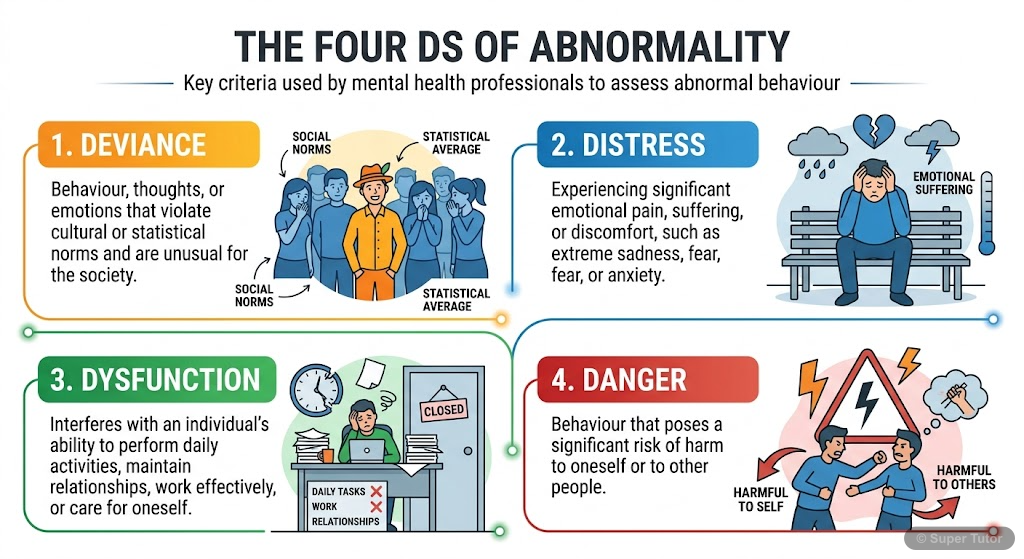
One of 11 illustrations for Psychological Disorders in Super Tutor — alongside flashcards, concept maps and practice questions.
The first 6 solutions are open to read. The other 5 are free with a Super Tutor account.
Review Questions
1Identify the symptoms associated with depression and mania.Show solution
Given/Concept: Depression and mania are the two poles of mood disorders. Depression involves a persistent low mood, while mania involves an abnormally elevated mood.
Symptoms of Depression:
- Persistent sad, anxious, or 'empty' mood
- Loss of interest or pleasure in activities once enjoyed (anhedonia)
- Feelings of hopelessness, worthlessness, or excessive guilt
- Fatigue and decreased energy
- Difficulty concentrating, remembering, or making decisions
- Insomnia or hypersomnia (sleeping too much)
- Changes in appetite — significant weight loss or gain
- Psychomotor agitation or retardation (restlessness or slowed movements)
- Recurrent thoughts of death or suicide
Symptoms of Mania:
- Abnormally elevated, expansive, or irritable mood
- Inflated self-esteem or grandiosity
- Decreased need for sleep (feels rested after only 3 hours)
- More talkative than usual; pressure to keep talking
- Flight of ideas — racing thoughts
- Distractibility
- Increase in goal-directed activity (social, occupational, or sexual)
- Excessive involvement in pleasurable activities with high potential for painful consequences (e.g., unrestrained spending, reckless driving)
Conclusion: Depression and mania represent opposite extremes of mood. When both occur in the same individual (alternating), the condition is called Bipolar Disorder.
2Describe the characteristics of children with hyperactivity.Show solution
Given/Concept: Hyperactivity is a key feature of Attention-Deficit/Hyperactivity Disorder (ADHD), a neurodevelopmental disorder. It is characterised by persistent patterns of inattention and/or hyperactivity-impulsivity that interfere with functioning.
Characteristics of Children with Hyperactivity:
- Motor Restlessness: The child is constantly 'on the go', fidgets with hands or feet, squirms in seat, and cannot remain seated when expected to do so.
- Impulsivity: Acts before thinking; blurts out answers before questions are completed; has difficulty waiting for their turn; interrupts or intrudes on others.
- Inattention: Fails to give close attention to details; makes careless mistakes in schoolwork; has difficulty sustaining attention in tasks or play activities; does not seem to listen when spoken to directly.
- Disorganisation: Loses things necessary for tasks (e.g., pencils, books); fails to finish schoolwork or chores; has difficulty organising tasks.
- Excessive Talking: Talks excessively; runs about or climbs in situations where it is inappropriate.
- Distractibility: Easily distracted by extraneous stimuli; forgetful in daily activities.
- Academic and Social Difficulties: These behaviours lead to poor academic performance and difficulties in maintaining peer relationships.
Conclusion: These characteristics must be present in more than one setting (e.g., home and school) and must be inconsistent with the child's developmental level to be diagnosed as ADHD.
3What are the consequences of alcohol substance addiction?Show solution
Given/Concept: Alcohol substance addiction (Alcohol Use Disorder) is classified under Substance-Related and Addictive Disorders. Prolonged and excessive use of alcohol leads to serious physical, psychological, and social consequences.
Consequences of Alcohol Addiction:
A. Physical/Biological Consequences:
- Liver damage — fatty liver, hepatitis, and cirrhosis
- Damage to the nervous system (peripheral neuropathy)
- Cardiovascular problems — increased risk of heart disease
- Nutritional deficiencies (especially Vitamin B1/thiamine), leading to Wernicke-Korsakoff syndrome
- Increased risk of cancers (mouth, throat, liver)
- Withdrawal symptoms — tremors, sweating, seizures, delirium tremens
B. Psychological Consequences:
- Development of tolerance (needing more alcohol to achieve the same effect)
- Dependence — both physical and psychological
- Depression, anxiety, and other mood disorders
- Impaired memory, concentration, and judgment
- Hallucinations and delusions in severe cases
C. Social Consequences:
- Breakdown of family relationships and domestic violence
- Loss of employment and financial difficulties
- Social isolation and stigma
- Legal problems (e.g., drunk driving)
- Neglect of responsibilities at home, work, or school
Conclusion: Alcohol addiction is a multidimensional problem that devastates the physical health, mental well-being, and social life of the individual and those around them.
4Can a distorted body image lead to eating disorders? Classify the various forms of it.Show solution
Given/Concept: Feeding and Eating Disorders involve persistent disturbances in eating behaviour that impair health or psychosocial functioning. A distorted body image — perceiving one's body as fat or unacceptable even when it is not — is a central feature of many eating disorders.
Yes, a distorted body image can lead to eating disorders. When individuals (especially adolescents and young women) perceive themselves as overweight despite being normal or underweight, they engage in extreme dietary restriction, purging, or binge eating. Cultural pressures that glorify thinness further reinforce this distorted perception.
Classification of Eating Disorders:
1. Anorexia Nervosa:
- Intense fear of gaining weight and refusal to maintain a minimally normal body weight.
- Severely restricted food intake leading to significantly low body weight.
- Distorted body image — the person sees themselves as fat even when dangerously thin.
- Can lead to malnutrition, amenorrhoea (absence of menstruation), and even death.
2. Bulimia Nervosa:
- Recurrent episodes of binge eating (consuming large amounts of food in a short time) followed by compensatory behaviours such as self-induced vomiting, misuse of laxatives, fasting, or excessive exercise.
- The individual feels a lack of control during binge episodes.
- Body weight may be normal or slightly above normal.
- Associated with feelings of shame, guilt, and depression.
3. Binge-Eating Disorder:
- Recurrent episodes of eating large quantities of food rapidly, even when not hungry, and to the point of discomfort.
- Unlike bulimia, there are no compensatory purging behaviours.
- Associated with marked distress, obesity, and related health problems.
Conclusion: Distorted body image, reinforced by societal and media standards of thinness, is a major psychological factor driving eating disorders. Early intervention and cognitive restructuring of body image are essential for treatment.
5"Physicians make diagnosis looking at a person's physical symptoms". How are psychological disorders diagnosed?Show solution
Given/Concept: Unlike physical illnesses where diagnosis relies on laboratory tests, X-rays, or physical examination, psychological disorders are diagnosed primarily through behavioural observation, clinical interviews, and standardised classification systems.
Diagnosis of Psychological Disorders:
1. Clinical Interview:
The mental health professional conducts a detailed interview with the patient to gather information about the nature, duration, and severity of symptoms, personal history, family history, and social functioning.
2. Behavioural Observation:
The clinician observes the patient's behaviour, appearance, speech, thought processes, mood, and affect during the interview and in other settings.
3. Psychological Testing:
- Intelligence Tests (e.g., Wechsler scales) to assess cognitive functioning.
- Personality Tests (e.g., MMPI — Minnesota Multiphasic Personality Inventory; projective tests like Rorschach Inkblot Test and TAT) to assess personality traits and psychopathology.
- Neuropsychological Tests to assess brain-behaviour relationships.
4. Use of Classification Systems:
- DSM-5 (Diagnostic and Statistical Manual of Mental Disorders, 5th edition) by the American Psychiatric Association.
- ICD-10 (International Classification of Diseases, 10th edition) by the World Health Organisation.
These manuals provide specific diagnostic criteria (symptoms, duration, impairment) for each disorder.
5. Case History:
A detailed case history including developmental history, medical history, family background, and social environment is compiled.
6. Medical Examination:
To rule out any underlying physical/neurological causes for the symptoms.
Conclusion: Psychological diagnosis is a comprehensive, multi-method process that combines clinical judgment, standardised tools, and classification criteria — unlike physical diagnosis which relies more on objective biological tests.
6Distinguish between obsessions and compulsions.Show solution
Given/Concept: Obsessions and compulsions are the two core features of Obsessive-Compulsive Disorder (OCD), classified under Obsessive-Compulsive and Related Disorders.
| Basis | Obsessions | Compulsions |
|---|---|---|
| Definition | Persistent, unwanted, intrusive thoughts, images, or urges that cause marked anxiety or distress. | Repetitive behaviours or mental acts that a person feels driven to perform in response to an obsession. |
| Nature | Cognitive/mental — they are thoughts or mental events. | Behavioural/mental acts — they are actions or rituals. |
| Control | The person cannot control or suppress these thoughts despite trying. | The person performs these acts to reduce the anxiety caused by obsessions. |
| Purpose | They serve no purposeful function; they are ego-dystonic (unwanted and inconsistent with one's self-concept). | They are aimed at preventing some dreaded event or reducing distress, but are not realistically connected to it. |
| Examples | Fear of contamination by germs; doubts about whether one has locked the door; disturbing violent or sexual thoughts. | Repeated hand-washing; checking locks repeatedly; counting; arranging objects in a specific order. |
| Outcome | Cause significant anxiety and distress. | Provide temporary relief from anxiety but reinforce the cycle of OCD. |
Conclusion: Obsessions and compulsions are interlinked — obsessions generate anxiety, and compulsions are performed to neutralise that anxiety. Together they create a vicious cycle that is the hallmark of OCD.
Free with a Super Tutor account
Free with a Super Tutor account
Free with a Super Tutor account
Free with a Super Tutor account
Free with a Super Tutor account
5 more solved questions in Psychological Disorders
They are free with a Super Tutor account, along with practice quizzes and flashcards for this chapter. Free to start, no card needed.
Frequently Asked Questions
What are the important topics in Psychological Disorders for Bihar Board Class 12 Psychology?
Are these NCERT Solutions for Psychological Disorders free?
How should I revise Psychological Disorders for the Bihar Board Class 12 board exam?
Sources & Official References
Content is aligned to the official syllabus. Refer to the board website for the latest curriculum.
More resources for Psychological Disorders
Practice Quiz
Test yourself with a quick quiz
Important Questions
Exam-style questions with answers
Revision Notes
Key points for last-minute revision
Chapter Summary
Understand the chapter at a glance
Concept Maps
See how topics connect
Study Plan
Step-by-step plan for this chapter
Flashcards
Quick-fire cards for active recall
Syllabus
What topics to cover
For serious students
Get the full Psychological Disorders chapter — start free.
Quizzes, flashcards, an AI doubt solver and a study plan for Bihar Board Class 12 Psychology. Free to start, no card needed.