Social Influence and Group Processes — NCERT Solutions
Bihar Board · Class 12 · Psychology
NCERT Solutions for Social Influence and Group Processes, Bihar Board Class 12 Psychology: 5 textbook questions solved step by step.
Interactive on Super Tutor
Studying Social Influence and Group Processes? Get the full interactive chapter.
Quizzes, flashcards, AI doubt-solver and a step-by-step study plan — built for NCERT solutions and more.
Free trial, no card needed.
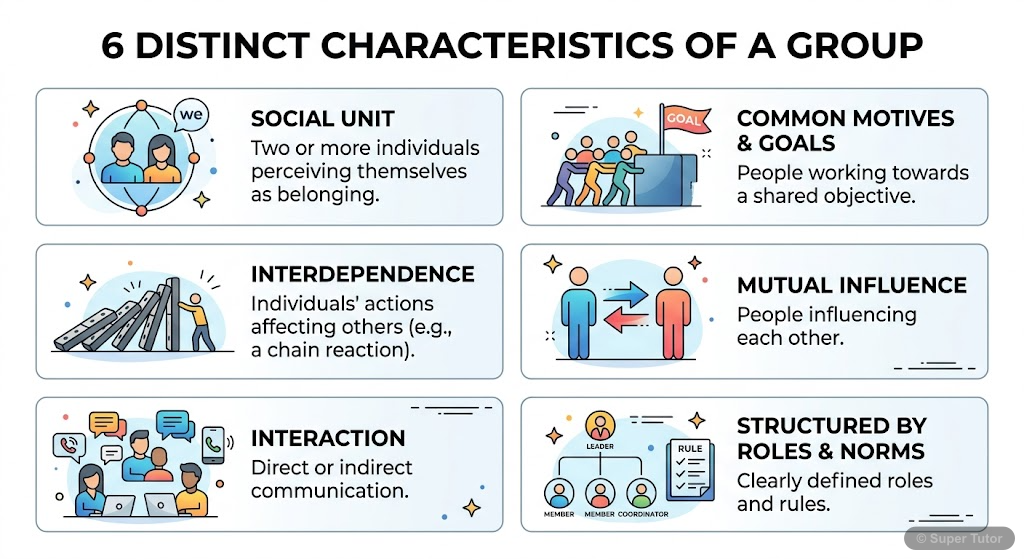
Learn better with visuals Super Tutor pairs illustrations like this with notes and quizzes for Social Influence and Group Processes.
The first 3 solutions are open to read. The other 2 are free with a Super Tutor account.
Review Questions — Chapter 7: Social Influence and Group Processes
1Compare and contrast formal and informal groups, and ingroups and outgroups.Show solution
Given/Concept: Groups can be classified on different bases. Two important classifications are: (i) Formal vs. Informal groups, and (ii) Ingroups vs. Outgroups.
Formal and Informal Groups:
| Basis | Formal Groups | Informal Groups |
|---|---|---|
| Definition | Groups deliberately created by an organisation to accomplish specific goals. | Groups that emerge naturally from social interaction and shared interests. |
| Structure | Clearly defined rules, roles, and hierarchy. | No fixed rules or hierarchy; flexible structure. |
| Purpose | Task-oriented; focused on achieving organisational objectives. | Socially oriented; focused on friendship, companionship, and shared interests. |
| Examples | A school committee, a work department, a sports team. | A group of friends, a neighbourhood group. |
| Duration | Usually continue as long as the organisation exists. | May dissolve when common interest fades. |
Ingroups and Outgroups:
| Basis | Ingroup | Outgroup |
|---|---|---|
| Definition | A group to which an individual belongs and with which they identify ('we' group). | A group to which an individual does not belong ('they' group). |
| Attitude | Members feel loyalty, solidarity, and a sense of belonging. | Members are often viewed with suspicion, rivalry, or prejudice. |
| Perception | One's own group is seen positively (ingroup favouritism). | The other group is often stereotyped or seen negatively (outgroup derogation). |
| Examples | 'My school', 'my family', 'my country'. | 'Their school', 'their team', 'another country'. |
Contrast Summary: Formal vs. Informal is about how the group is formed (deliberately vs. naturally), whereas Ingroup vs. Outgroup is about the psychological sense of belonging and identity (us vs. them).
Conclusion: Both classifications show that groups differ in their origin, structure, and the psychological impact they have on members' behaviour and attitudes.
2Are you a member of a certain group? Discuss what motivated you to join that group.Show solution
Note: This is a personal/reflective question. A model answer is provided below that students can adapt to their own experience.
Given: The student is asked to reflect on their own group membership and the motivations behind joining it.
Model Answer:
Yes, I am a member of my school's debate club (students may substitute any group — sports team, study group, cultural club, etc.).
The following factors motivated me to join this group:
- Security: Being part of a group of like-minded students made me feel supported and less anxious about public speaking.
- Self-esteem: Membership in the debate club gave me a sense of pride and boosted my confidence. Winning debates enhanced my self-worth.
- Satisfaction of social needs: The group fulfilled my need for belonging and friendship. I developed close bonds with fellow members.
- Goal achievement: I wanted to improve my communication and critical thinking skills. The group provided a structured environment to achieve these personal goals.
- Knowledge and information: Through debates on various topics, I gained new knowledge and diverse perspectives that I would not have acquired alone.
- Similarity: I was attracted to the group because its members shared my interest in current affairs and argumentation.
Conclusion: According to psychological research, people join groups primarily because groups satisfy their needs for security, affiliation, self-esteem, and goal achievement. My experience with the debate club confirms these motivations.
3How does Tuckman's stage model help you to understand the formation of groups?Show solution
Given: Tuckman proposed a stage model to explain how groups form and develop over time.
Concept: Tuckman's Stage Model (1965) describes group development through five stages: Forming, Storming, Norming, Performing, and Adjourning (the fifth stage was added later).
Explanation of Each Stage:
Stage 1 — Forming:
- Members come together for the first time.
- There is uncertainty about the group's purpose, structure, and leadership.
- Members are polite, cautious, and try to understand each other.
- Understanding: This stage helps us see that groups begin with exploration and orientation.
Stage 2 — Storming:
- Conflict and competition emerge among members.
- Members assert their opinions; disagreements about roles and goals arise.
- This is the most difficult stage.
- Understanding: This stage shows that conflict is a natural part of group development, not a sign of failure.
Stage 3 — Norming:
- The group begins to resolve conflicts and establish norms (shared rules of behaviour).
- Cohesion develops; members cooperate and feel a sense of group identity.
- Understanding: This stage explains how groups develop shared expectations that guide behaviour.
Stage 4 — Performing:
- The group is fully functional and focused on achieving its goals.
- Members work interdependently and efficiently.
- Understanding: This is the most productive stage; it shows that effective group work requires passing through earlier stages.
Stage 5 — Adjourning (Mourning):
- The group disbands after completing its task.
- Members may feel a sense of loss or satisfaction.
- Understanding: This stage reminds us that groups have a life cycle.
How the Model Helps:
- It provides a roadmap for understanding why groups behave differently at different points in time.
- It helps leaders and members anticipate challenges (like conflict in the storming stage) and manage them effectively.
- It explains why newly formed groups are less productive than established ones.
- It helps in designing interventions to move a group from one stage to the next.
Conclusion: Tuckman's model is a valuable tool for understanding that group formation is a dynamic, sequential process, and that each stage is necessary for the group to mature and perform effectively.
Free with a Super Tutor account
Free with a Super Tutor account
2 more solved questions in Social Influence and Group Processes
They are free with a Super Tutor account, along with practice quizzes and flashcards for this chapter. Free to start, no card needed.
Frequently Asked Questions
What are the important topics in Social Influence and Group Processes for Bihar Board Class 12 Psychology?
Are these NCERT Solutions for Social Influence and Group Processes free?
How should I revise Social Influence and Group Processes for the Bihar Board Class 12 board exam?
Sources & Official References
Content is aligned to the official syllabus. Refer to the board website for the latest curriculum.
More resources for Social Influence and Group Processes
Practice Quiz
Test yourself with a quick quiz
Important Questions
Exam-style questions with answers
Revision Notes
Key points for last-minute revision
Chapter Summary
Understand the chapter at a glance
Concept Maps
See how topics connect
Study Plan
Step-by-step plan for this chapter
Flashcards
Quick-fire cards for active recall
Syllabus
What topics to cover
For serious students
Get the full Social Influence and Group Processes chapter — start free.
Quizzes, flashcards, an AI doubt solver and a study plan for Bihar Board Class 12 Psychology. Free to start, no card needed.