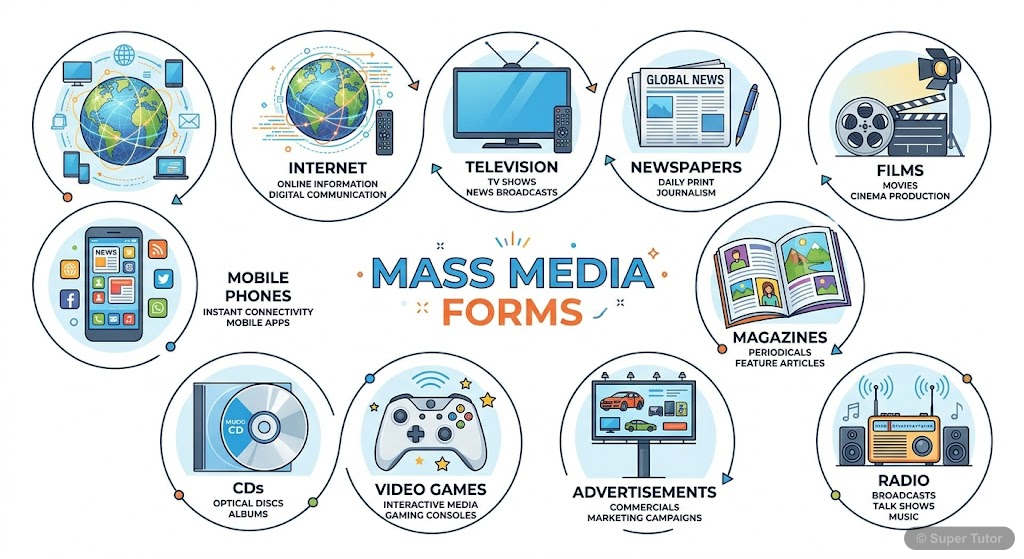
Mass Media and Communications
Bihar Board · Class 12 · Sociology
NCERT Solutions for Mass Media and Communications — Bihar Board Class 12 Sociology.
Interactive on Super Tutor
Studying Mass Media and Communications? Get the full interactive chapter.
Quizzes, flashcards, AI doubt-solver and a step-by-step study plan — built for ncert solutions and more.
1,000+ Class 12 students started this chapter today

This is just one of 19+ visuals inside Super Tutor's Mass Media and Communications chapter
Explore the full setExercise Questions — Mass Media and Communications (Class 12 Sociology)
1Trace out the changes that have been occurring in the newspaper industry. What is your opinion on these changes?Show solution
Key Changes in the Newspaper Industry:
Step 1 – Early Phase (Colonial Period):
- Newspapers in India began as tools of colonial administration and later became instruments of the nationalist movement.
- Papers like *Kesari* (Bal Gangadhar Tilak) and *Young India* (Mahatma Gandhi) played a crucial role in mobilising public opinion against British rule.
- Readership was limited to the educated, urban elite; most papers were in English.
Step 2 – Post-Independence Expansion:
- After 1947, the Indian-language (vernacular) press grew rapidly, reaching rural and semi-urban populations.
- Newspapers became vehicles of nation-building, spreading awareness about democracy, rights, and development.
- The Press Council of India was established to maintain journalistic standards.
Step 3 – Liberalisation and Commercialisation (Post-1990s):
- Economic liberalisation opened the newspaper industry to large corporate investment.
- Newspapers transformed from primarily political/public-interest organs into commercial enterprises driven by advertising revenue.
- The phenomenon of 'paid news' emerged, blurring the line between editorial content and advertisement.
- Cover prices fell drastically (sometimes to ₹1–2) because revenue shifted from readers to advertisers.
- Circulation wars led to aggressive marketing strategies such as free supplements, gifts, and price wars.
Step 4 – Regional Language Press Boom:
- Contrary to predictions, the regional language press grew enormously. Papers in Hindi, Malayalam, Tamil, Marathi, etc., recorded some of the highest circulations in the world.
- This democratised information access, bringing news to first-generation literates in small towns and villages.
Step 5 – Digital Revolution and the Internet Age:
- The rise of the internet, smartphones, and social media has posed a serious challenge to print newspapers.
- Many newspapers launched online editions; some moved to digital-only formats.
- Readership of print editions has declined in urban areas, though rural readership continues to grow.
- 'Citizen journalism' and online news portals have emerged as competitors.
Opinion on These Changes:
- The commercialisation of newspapers has made them financially viable and widely accessible, which is a positive development.
- However, dependence on corporate advertising has compromised editorial independence; news is increasingly shaped by market interests rather than public interest.
- The growth of the regional-language press is a genuinely democratic development, giving voice to marginalised communities.
- The digital shift is inevitable, but it raises concerns about the digital divide — those without internet access (largely rural and poor populations) may be left behind.
- Overall, the changes reflect the tension between media as a public good and media as a commercial product. A healthy democracy requires that the public-interest role of newspapers be protected even as the industry adapts to new economic realities.
Conclusion: The newspaper industry has undergone profound transformation — from a nationalist tool to a commercial enterprise to a digital platform. While these changes have expanded reach and diversity, they also demand greater vigilance about journalistic ethics, independence, and inclusivity.
2Is radio as a medium of mass communication dying out? Discuss the potential that FM stations have in post-liberalisation India.Show solution
Step 1 – Is Radio Dying Out?
At first glance, with the rise of television, the internet, and smartphones, radio might seem to be a dying medium. However, this conclusion is premature for the following reasons:
- Radio remains the most accessible medium in India. Battery-powered transistor radios work without electricity, making them indispensable in rural areas and regions with poor power supply (as illustrated by Bihar in the chapter).
- Radio has a low cost of access — a cheap transistor is far more affordable than a television or smartphone.
- Radio reaches remote and geographically difficult areas where other media cannot penetrate.
- During disasters and emergencies, radio is often the only reliable medium of communication.
- All India Radio (AIR) still broadcasts in hundreds of languages and dialects, serving communities that no other medium reaches.
Step 2 – The FM Revolution in Post-Liberalisation India:
FM (Frequency Modulation) radio emerged as a vibrant new form of radio broadcasting after liberalisation:
- Phase I (1990s): The government began allowing private FM stations in select cities. These stations focused on music and entertainment, attracting urban youth.
- Phase II (2000s onwards): The government expanded FM licensing to smaller cities and towns, dramatically increasing reach.
- Community Radio: Post-liberalisation policy also opened space for community radio stations — low-power FM stations run by NGOs, educational institutions, and local communities to serve hyper-local needs (agriculture, health, local culture).
Step 3 – Potential of FM Stations:
| Dimension | Potential |
|---|---|
| Entertainment | Local music, Bhojpuri, folk songs, devotional content — as seen in Raghav's station |
| Local language content | FM can broadcast in local dialects ignored by national media |
| Agricultural information | Weather forecasts, crop prices, farming tips for rural listeners |
| Health awareness | Public health campaigns, especially in areas with low literacy |
| Women's empowerment | As Raghav noted, women are major radio listeners; FM can carry content specifically for them |
| Democratic participation | Community FM gives marginalised groups a voice in public discourse |
| Low infrastructure cost | As Raghav's ₹50 kit shows, FM transmission can be set up cheaply |
Step 4 – Challenges:
- Licensing regulations restrict who can run FM stations; news broadcasting on private FM is still restricted by government policy.
- Commercial FM stations in cities tend to focus on entertainment rather than public-interest content.
- Community radio stations face financial sustainability challenges.
Conclusion: Radio is far from dying — it is reinventing itself through FM technology. In post-liberalisation India, FM stations have enormous potential to democratise information, celebrate local culture, and serve communities that television and the internet have not yet reached. The story of Raghav's FM station in Bihar powerfully illustrates how radio, even in its most basic form, can build community and fulfil genuine social needs. What is required is a supportive policy environment that enables community and local FM stations to flourish.
3Trace the changes that have been happening in the medium of television. Discuss.Show solution
Step 1 – Introduction of Television in India (1959–1980s):
- Television was introduced in India on 15 September 1959 in Delhi as an experimental service by All India Radio (AIR).
- Initially it was a state-controlled, public service medium with a clear educational and developmental mandate.
- Doordarshan (DD) was established as the national broadcaster in 1976.
- Programming focused on agricultural information (*Krishi Darshan*), adult education, and national integration.
- The 1982 Asian Games in Delhi marked a turning point — colour television was introduced and viewership expanded dramatically.
- The serial *Hum Log* (1984) was India's first soap opera, and *Ramayan* (1987–88) and *Mahabharat* (1988–89) drew unprecedented audiences, demonstrating television's power to create a shared national experience.
Step 2 – Satellite Revolution and Liberalisation (1991 onwards):
- The Gulf War (1991) and the arrival of CNN showed Indian audiences that television could deliver live, global news.
- STAR TV (Satellite Television Asian Region), owned by Rupert Murdoch's News Corporation, began broadcasting into India via satellite in 1991.
- This broke the government's monopoly on television broadcasting.
- Zee TV (1992) became the first private Hindi satellite channel, followed rapidly by dozens of others.
- Cable television networks spread across urban and semi-urban India, connecting households to dozens of channels.
Step 3 – Explosion of Channels and Content (1990s–2000s):
- The number of channels grew from a handful to hundreds — news channels, entertainment channels, regional language channels, sports channels, children's channels, religious channels, etc.
- 24-hour news channels (NDTV, Aaj Tak, Star News, etc.) transformed journalism — news became continuous, competitive, and increasingly sensationalised.
- Reality shows, talent hunts (*Indian Idol*, *Kaun Banega Crorepati*), and daily soap operas became dominant formats.
- Regional language television grew enormously, with dedicated channels in Tamil, Telugu, Malayalam, Kannada, Bengali, Marathi, etc.
Step 4 – Impact on Culture and Society:
- Television became the primary medium through which consumerism and advertising entered Indian homes, transforming aspirations and lifestyles.
- It created a pan-Indian popular culture while also strengthening regional identities through regional channels.
- Concerns arose about the homogenisation of culture, the marginalisation of minority languages and cultures, and the projection of urban, middle-class values as the norm.
- The portrayal of women in television serials has been widely debated — while some serials reinforce patriarchal values, others have addressed social issues.
- Television has been a powerful tool for political communication — election campaigns, political debates, and government messaging.
Step 5 – The Digital and OTT Era (2010s–Present):
- The arrival of Direct-to-Home (DTH) services improved picture quality and expanded channel choice.
- Over-the-Top (OTT) platforms like Netflix, Amazon Prime, Disney+ Hotstar, and SonyLIV have emerged as major competitors to traditional television.
- Viewers now consume content on demand, on smartphones and tablets, at times of their choosing — disrupting the traditional broadcast model.
- Original web series have introduced more diverse, experimental, and sometimes more realistic content than mainstream television.
- The digital divide means that OTT platforms primarily serve urban, educated, and economically better-off audiences, while traditional television remains dominant in rural areas.
Discussion / Critical Analysis:
- Television has been the single most powerful medium of mass communication in post-independence India, shaping culture, politics, and consumption patterns.
- The shift from a state-controlled public service model to a market-driven commercial model has had mixed consequences: greater diversity and choice on one hand, and commercialisation, sensationalism, and cultural homogenisation on the other.
- The relationship between television and democracy is complex — it can inform and mobilise citizens, but it can also be used for propaganda and the manufacture of consent.
- The challenge for the future is to ensure that television (and its digital successors) serves the public interest, represents diverse communities, and remains accessible to all sections of society.
Conclusion: Television in India has undergone a remarkable transformation — from a single government channel with a developmental mission to a vast, commercially driven, multi-channel landscape now being disrupted by digital streaming. Each phase of this transformation reflects broader changes in India's economy, politics, and society. Understanding these changes helps us become more critical and conscious consumers of the media we engage with every day.
Stuck on a step?
Ask Super Tutor AI to explain any solution on this page in a simpler way — free, 24x7.
Ask a Doubt FreeFrequently Asked Questions
What are the important topics in Mass Media and Communications for Bihar Board Class 12 Sociology?
How to score full marks in Mass Media and Communications — Bihar Board Class 12 Sociology?
Where can I get free NCERT Solutions for Mass Media and Communications Class 12 Sociology?
Sources & Official References
Content is aligned to the official syllabus. Refer to the board website for the latest curriculum.
More resources for Mass Media and Communications
Important Questions
Practice with board exam-style questions
Syllabus
What topics to cover
Revision Notes
Key points for last-minute revision
Study Plan
Step-by-step plan to ace this chapter
Flashcards
Quick-fire cards for active recall
Formula Sheet
All formulas in one place
Chapter Summary
Understand the chapter at a glance
Practice Quiz
Test yourself with a quick quiz
Concept Maps
See how topics connect visually
For serious students
Get the full Mass Media and Communications chapter — for free.
Quizzes, flashcards, AI doubt-solver and a step-by-step study plan for Bihar Board Class 12 Sociology.