Structural Change — NCERT Solutions
Bihar Board · Class 12 · Sociology
NCERT Solutions for Structural Change, Bihar Board Class 12 Sociology: 4 textbook questions solved step by step.
Interactive on Super Tutor
Studying Structural Change? Get the full interactive chapter.
Quizzes, flashcards, AI doubt-solver and a step-by-step study plan — built for NCERT solutions and more.
Free trial, no card needed.
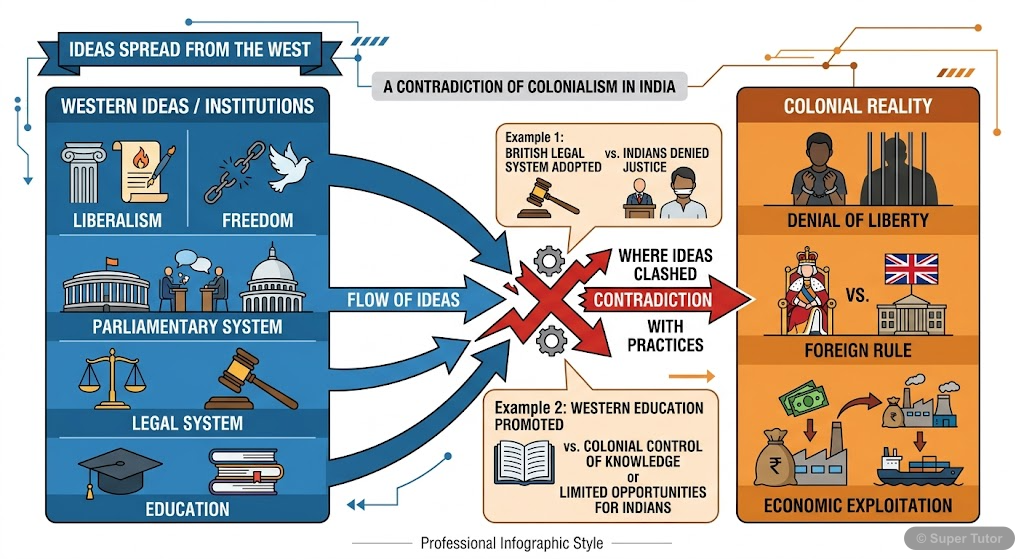
One of 9 illustrations for Structural Change in Super Tutor — alongside flashcards, concept maps and practice questions.
The first 2 solutions are open to read. The other 2 are free with a Super Tutor account.
Exercises — Structural Change (Chapter 2, Social Change and Development in India, Class 12 Sociology)
1How has colonialism impacted our lives? You can either focus on one aspect, like culture or politics, or treat them together.Show solution
Given / Context: Colonialism refers to the political, economic, and cultural domination of one country over another. India was under British colonial rule for nearly two centuries (1757–1947).
Concept Used: Colonialism brings structural changes not only in the economy and polity but also in culture, education, language, and social institutions. These changes do not disappear with the end of formal colonial rule but continue to shape society in complex ways.
Answer (treating multiple aspects together):
1. Economic Impact:
- The colonial economy was designed to serve British interests. India was turned into a supplier of raw materials and a market for British manufactured goods.
- Traditional industries (e.g., handloom weaving) were destroyed, leading to de-industrialisation.
- Land revenue systems (Zamindari, Ryotwari) disrupted agrarian structures and created new classes of landlords and landless peasants.
- Railways, though built for commercial and military purposes, inadvertently integrated the Indian market.
2. Political Impact:
- Colonial rule introduced modern bureaucracy, a centralised legal system, and codified laws — many of which India retained after Independence.
- The idea of a unified Indian nation-state itself emerged partly as a response to colonial rule.
- Democratic institutions, the Constitution, and parliamentary democracy bear the imprint of colonial administrative structures.
3. Cultural and Educational Impact:
- English became the language of administration, higher education, and the elite — a legacy that continues today.
- Western education created a new middle class (intelligentsia) that both absorbed and critiqued colonial values.
- Indian culture was often portrayed as inferior, leading to a complex mix of cultural pride and inferiority among Indians — a phenomenon scholars call the 'colonial mentality.'
- Social reform movements (against sati, child marriage, caste discrimination) were partly triggered by colonial encounter and Western Enlightenment ideas.
4. Social Impact:
- The census operations under colonialism hardened caste and religious identities by classifying people rigidly.
- Tribal communities were displaced from forests through colonial forest laws.
- Migration of indentured labour to colonies like Mauritius, Fiji, and the Caribbean created the Indian diaspora.
Conclusion: Colonialism is not merely a chapter in history. Its economic inequalities, cultural hierarchies, institutional frameworks, and social divisions continue to influence Indian society even today. As the chapter notes, 'colonialism is not just a topic in history but something which lives on in complex ways in our lives even today.'
2Industrialisation and urbanisation are linked processes. Discuss.Show solution
Given / Context: The chapter discusses how colonialism introduced industrialisation and urbanisation in India, and how these two processes are deeply interconnected.
Concept Used: Industrialisation refers to the shift from agrarian/handicraft economies to large-scale machine-based manufacturing. Urbanisation refers to the growth of towns and cities and the movement of population from rural to urban areas. Both are key dimensions of structural change.
Discussion:
1. How Industrialisation Leads to Urbanisation:
- Industries require a large concentration of labour. Workers migrate from villages to towns and cities where factories are located.
- This migration swells the urban population, turning small towns into large cities (e.g., Bombay/Mumbai, Calcutta/Kolkata, Madras/Chennai grew as industrial and port cities under colonialism).
- Industries also attract ancillary services — trade, banking, transport, housing — which further expand urban settlements.
2. How Urbanisation Supports Industrialisation:
- Cities provide the infrastructure (roads, railways, ports, electricity) that industries need.
- Urban areas offer a large pool of skilled and unskilled labour.
- Urban markets provide demand for industrial goods.
- Cities become centres of capital accumulation, innovation, and entrepreneurship.
3. Colonial Context:
- Under British rule, port cities like Bombay, Calcutta, and Madras were developed primarily to facilitate the export of raw materials and import of British goods — linking industrial capitalism in Britain to urbanisation in India.
- Railways connected the hinterland to these port cities, deepening both processes.
4. Changes in 'Way of Life' (Wirth, 1938):
- Industrialisation and urbanisation together transform not just the economy but also social life — family structures become nuclear, caste and community ties weaken, anonymity increases, and a new urban culture emerges.
- Louis Wirth described urbanism as 'a way of life' characterised by heterogeneity, impersonality, and secondary relationships.
5. Statistical Evidence from India:
- In 1951, only 17.29% of India's population lived in urban areas. By 2011, this rose to 31.16% (377.10 million people in 7,935 towns), reflecting decades of industrial and urban growth.
Conclusion: Industrialisation and urbanisation are mutually reinforcing processes. Industries drive people to cities, and cities provide the conditions for further industrial growth. Together, they bring about fundamental structural changes in economy, society, and culture.
Free with a Super Tutor account
(a) Describe the place where you live.
(b) What are the features which make you think it is a town and not a city, a village and not a town, or a city and not a village?
(c) Is there any factory where you live?
(d) Is agriculture the main job that people do?
(e) Is it the occupational nature that has a determining influence?
(f) Is it the buildings?
(g) Is it the availability of educational opportunities?
(h) Is it the way people live and behave?
(i) Is it the way people talk and dress?
Free with a Super Tutor account
2 more solved questions in Structural Change
They are free with a Super Tutor account, along with practice quizzes and flashcards for this chapter. Free to start, no card needed.
Frequently Asked Questions
What are the important topics in Structural Change for Bihar Board Class 12 Sociology?
Are these NCERT Solutions for Structural Change free?
How should I revise Structural Change for the Bihar Board Class 12 board exam?
Sources & Official References
Content is aligned to the official syllabus. Refer to the board website for the latest curriculum.
More resources for Structural Change
Practice Quiz
Test yourself with a quick quiz
Important Questions
Exam-style questions with answers
Revision Notes
Key points for last-minute revision
Chapter Summary
Understand the chapter at a glance
Concept Maps
See how topics connect
Study Plan
Step-by-step plan for this chapter
Flashcards
Quick-fire cards for active recall
Syllabus
What topics to cover
For serious students
Get the full Structural Change chapter — start free.
Quizzes, flashcards, an AI doubt solver and a study plan for Bihar Board Class 12 Sociology. Free to start, no card needed.