Is Matter around us Pure? — Practice Quiz
Bihar Board · Class 9 · Science
Try a 4-question quiz on Is Matter around us Pure? for Bihar Board Class 9 Science: tap an answer to check it and see why.
Interactive on Super Tutor
Studying Is Matter around us Pure?? Get the full interactive chapter.
Quizzes, flashcards, AI doubt-solver and a step-by-step study plan — built for practice quiz and more.
Free trial, no card needed.
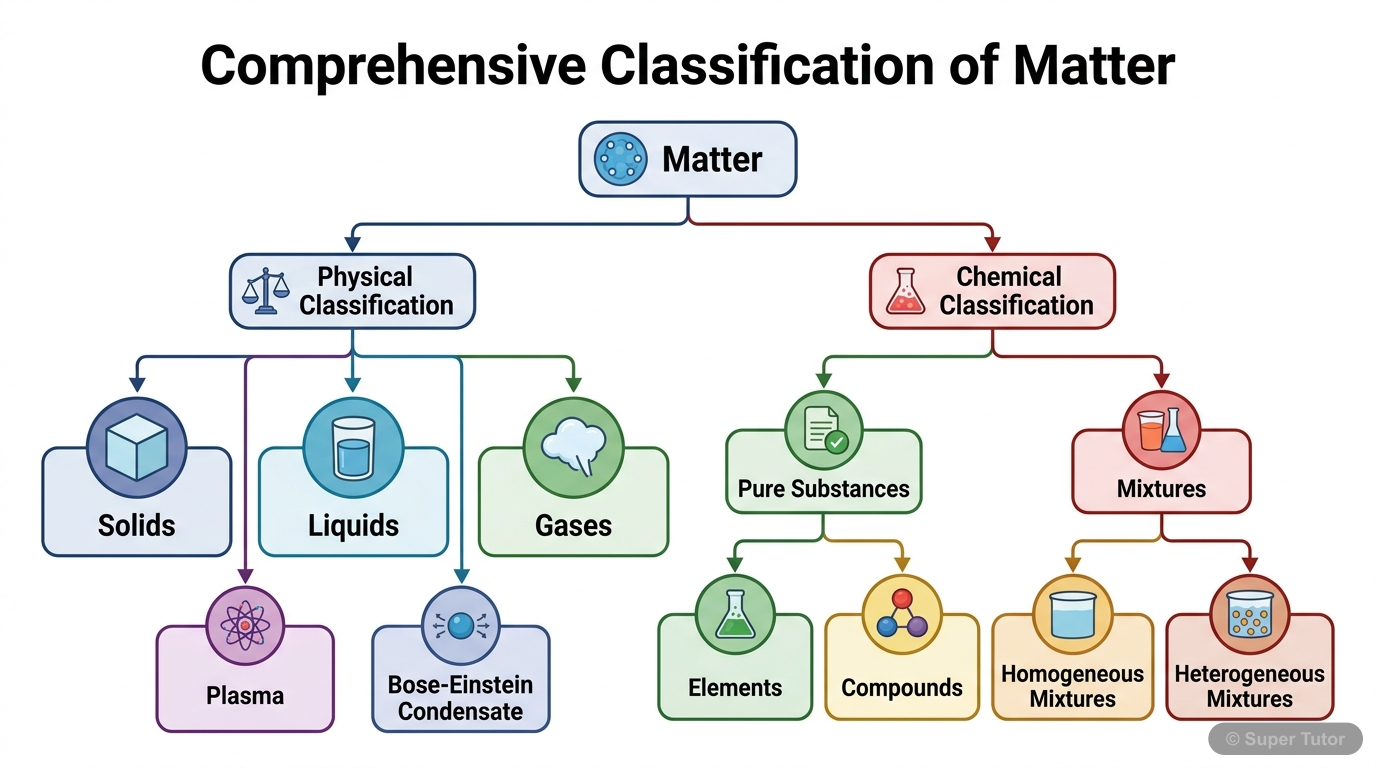
Learn better with visuals Super Tutor pairs illustrations like this with notes and quizzes for Is Matter around us Pure?.
Quick Quiz: Is Matter around us Pure?
0/4Tap an answer to check it instantly. No sign-up needed for these 4.
Which of the following is an example of a homogeneous mixture?
In a solution of salt in water, which component is the solvent?
What happens when we filter a suspension?
The Tyndall effect is observed in:
Sample Questions
Which of the following properties are shown by metals? (Select all correct answers)
Show answer
They have lustre (shine), They conduct heat and electricity, They are malleable, They are sonorous
Metals show lustre, conduct heat and electricity, are malleable (can be hammered into sheets), and are sonorous (make ringing sounds). Being poor conductors of electricity is a property of non-metals, not metals.
Which of the following are examples of colloids? (Select all correct answers)
Show answer
Milk, Fog, Jelly, Smoke
Milk, fog, jelly, and smoke are all colloids where particles are dispersed in a medium but are not visible to naked eyes. Sugar solution is a true solution, not a colloid.
Which of the following statements about compounds are correct? (Select all correct answers)
Show answer
They have a fixed composition, They show properties different from their constituent elements, They are formed by chemical combination of elements
Compounds have fixed composition, show different properties from constituent elements, and are formed by chemical combination. They cannot be separated by physical methods and do not have variable composition (that's a property of mixtures).
What is the formula for mass by mass percentage of a solution?
Show answer
(Mass of solute/Mass of solution) × 100
Mass by mass percentage is calculated by dividing the mass of solute by the total mass of solution and multiplying by 100. This gives the percentage of solute by mass in the solution.
+22 more questions on Is Matter around us Pure? (Bihar Board Class 9 Science)
Practise AllFrequently Asked Questions
What are the important topics in Is Matter around us Pure? for Bihar Board Class 9 Science?
How many practice questions are there for Is Matter around us Pure??
Sources & Official References
Content is aligned to the official syllabus. Refer to the board website for the latest curriculum.
More resources for Is Matter around us Pure?
For serious students
Get the full Is Matter around us Pure? chapter — start free.
Quizzes, flashcards, an AI doubt solver and a study plan for Bihar Board Class 9 Science. Free to start, no card needed.