Metals and Non-metals — Flashcards
CBSE · Class 10 · Science
80 flashcards for Metals and Non-metals (CBSE Class 10 Science) to test yourself on key terms and facts. Sample: "What is metallic lustre?"
Interactive on Super Tutor
Studying Metals and Non-metals? Get the full interactive chapter.
Quizzes, flashcards, AI doubt-solver and a step-by-step study plan — built for flashcards and more.
Free trial, no card needed.
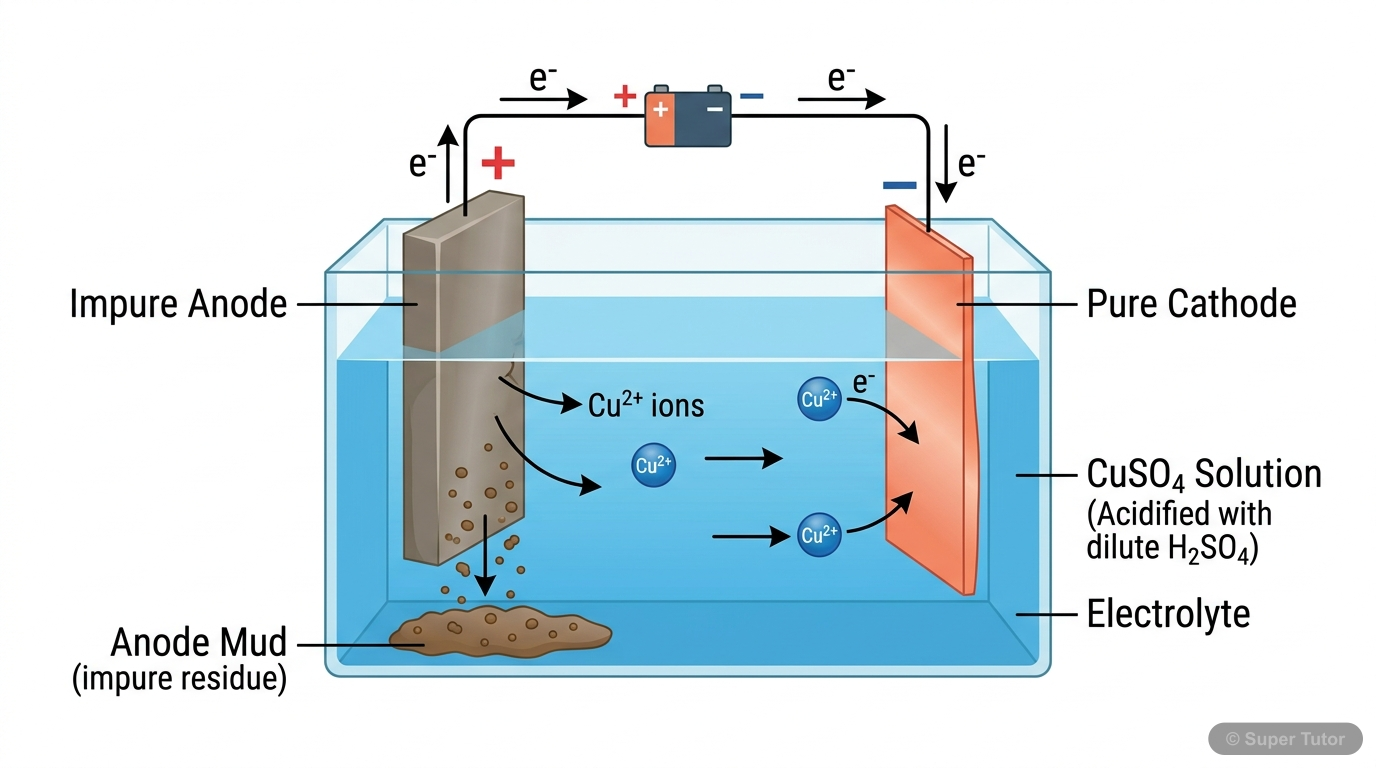
Learn better with visuals Super Tutor pairs illustrations like this with notes and quizzes for Metals and Non-metals.
What is metallic lustre?
Answer
Metals, in their pure state, have a shining surface. This property is called metallic lustre. Metals such as copper and aluminium show this shining appearance when their surface is clean.
धात्विक चमक क्या है?
Answer
धातुओं की शुद्ध अवस्था में एक चमकदार सतह होती है। इस गुण को धात्विक चमक कहते हैं। ताँबा, एल्युमिनियम आदि धातुएँ अपनी सतह साफ होने पर यह चमक दिखाती हैं।…
Why are metals generally hard?
Answer
Metals are generally hard, but hardness varies from metal to metal. Alkali metals like sodium and potassium are soft enough to be cut with a knife. This shows that hardness is a general property, not …
धातुएं आम तौर पर कठोर क्यों होती हैं?
Answer
धातुएं साधारणतया कठोर होती हैं, किन्तु कठोरता धातु-दर-धातु में भिन्न होती है। सोडियम, पोटैशियम आदि क्षार धातुएं इतनी नरम होती हैं कि चाकू से काटी जा सकती हैं। इससे पता चलता है कि कठोरता एक सामान्य गुण…
Why can gold be drawn into very thin wires?
Answer
Metals are ductile, which means they can be drawn into thin wires. Gold is the most ductile metal. A wire of about 2 km length can be drawn from one gram of gold.
सोने को बहुत पतले तारों में क्यों खींचा जा सकता है?
Answer
धातुएँ तन्य होती हैं, अर्थात इन्हें खींचकर पतले तार बनाए जा सकते हैं। सोना सबसे अधिक तन्य धातु है। सोने के एक ग्राम से 2 km लम्बाई का तार खींचा जा सकता है।…
What is malleability?
Answer
Malleability is the property of metals by which they can be beaten into thin sheets. Gold and silver are the most malleable metals.
मॅलेबिलिटी क्या है?
Answer
मृदुता या आघातनीयता धातुओं का वह गुण है जिसके द्वारा उन्हें पीटकर पतली चादरें बनाई जा सकती हैं। सोना और चांदी सबसे अधिक आघातनीय धातुएँ हैं।…
+72 more flashcards
Practise AllFrequently Asked Questions
What are the important topics in Metals and Non-metals for CBSE Class 10 Science?
How many flashcards are available for Metals and Non-metals?
How should I revise Metals and Non-metals for the CBSE Class 10 board exam?
Sources & Official References
- NCERT Official — ncert.nic.in
- CBSE Academic — cbseacademic.nic.in
- CBSE Official — cbse.gov.in
- National Education Policy 2020 — education.gov.in
Content is aligned to the official syllabus. Refer to the board website for the latest curriculum.
More resources for Metals and Non-metals
Practice Quiz
Test yourself with a quick quiz
Important Questions
Exam-style questions with answers
Revision Notes
Key points for last-minute revision
Formula Sheet
The chapter's formulas in one place
Chapter Summary
Understand the chapter at a glance
Concept Maps
See how topics connect
Study Plan
Step-by-step plan for this chapter
Syllabus
What topics to cover
NCERT Solutions
Every textbook question solved step by step
For serious students
Get the full Metals and Non-metals chapter — start free.
Quizzes, flashcards, an AI doubt solver and a study plan for CBSE Class 10 Science. Free to start, no card needed.