Financial Management
CBSE · Class 12 · Business Studies
Quick revision notes for Financial Management — CBSE Class 12 Business Studies. Key concepts, formulas, and definitions for last-minute revision.
Interactive on Super Tutor
Studying Financial Management? Get the full interactive chapter.
Quizzes, flashcards, AI doubt-solver and a step-by-step study plan — built for revision notes and more.
1,000+ Class 12 students started this chapter today
This is just one of 13+ visuals inside Super Tutor's Financial Management chapter
Explore the full setKey Topics to Revise
1. Meaning of Business Finance and Financial Management
- Money required for carrying out business activities is called business finance.
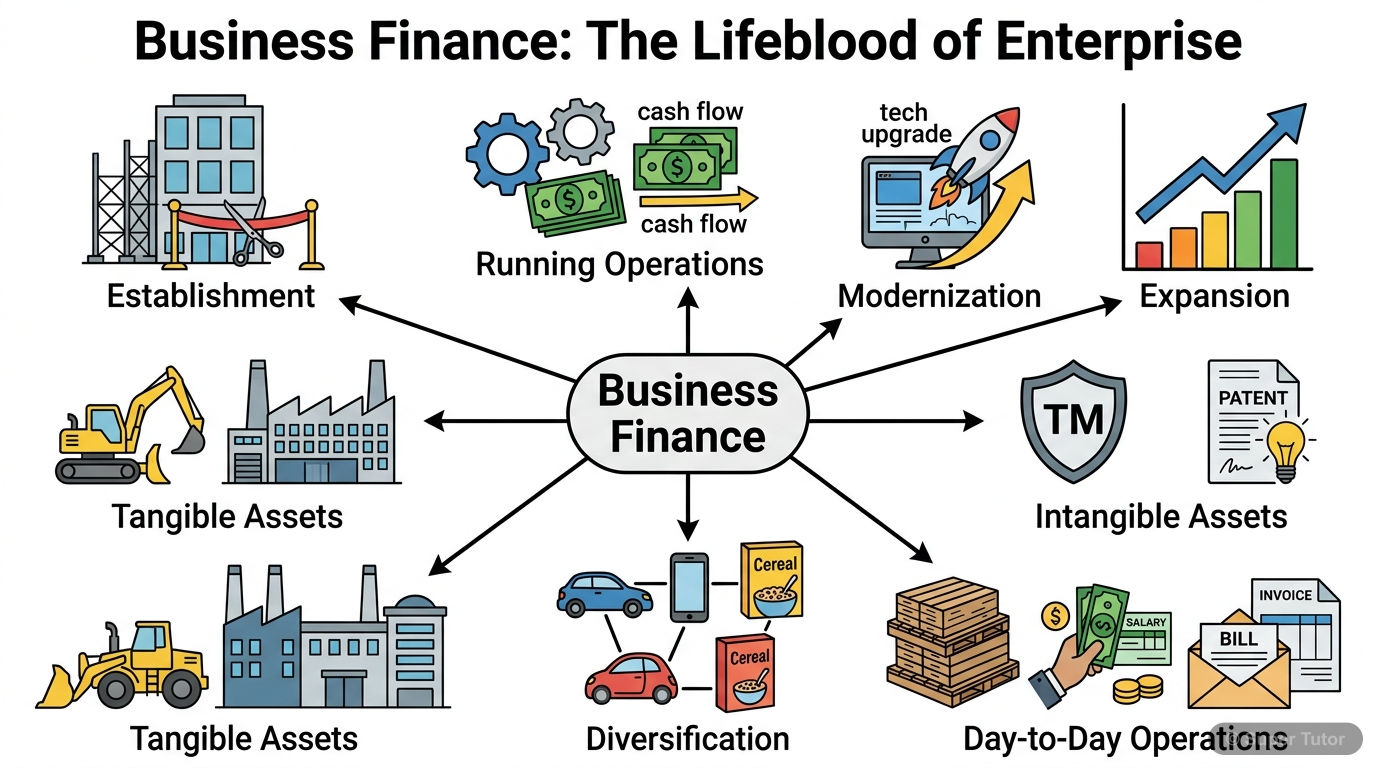
- Business finance is needed to start, run, modernise, expand, and diversify a business.
- Finance is required for tangible assets like machinery, factories, buildings, and offices, and for intangible assets like trademarks, patents, and technical expertise.
2. Objectives and Financial Decisions
- The primary aim of financial management is to maximise shareholders' wealth, which is called the wealth-maximisation concept.
- The market price of equity shares rises when financial decisions add value.
- Financial management involves three major decisions: investment decision, financing decision, and dividend decision.
3. Financial Planning
- Financial planning is the preparation of a financial blueprint of an organisation’s future operations.
- Its purpose is to ensure enough funds are available at the right time.
- Financial planning is not equivalent to, or a substitute for, financial management.
4. Capital Structure and Financial Leverage
- Capital structure refers to the mix between owners and borrowed funds.
- Owners' funds include equity share capital, preference share capital, reserves and surpluses.
- Borrowed funds include loans, debentures, and public deposits.
Get complete notes with diagrams and examples
Full NotesKey Concepts
Frequently Asked Questions
What are the important topics in Financial Management for CBSE Class 12 Business Studies?
How to score full marks in Financial Management — CBSE Class 12 Business Studies?
Sources & Official References
- NCERT Official — ncert.nic.in
- CBSE Academic — cbseacademic.nic.in
- CBSE Official — cbse.gov.in
- National Education Policy 2020 — education.gov.in
Content is aligned to the official syllabus. Refer to the board website for the latest curriculum.
More resources for Financial Management
Practice Quiz
Test yourself with a quick quiz
Important Questions
Practice with board exam-style questions
Formula Sheet
All formulas in one place
Chapter Summary
Understand the chapter at a glance
Concept Maps
See how topics connect visually
Study Plan
Step-by-step plan to ace this chapter
Flashcards
Quick-fire cards for active recall
Syllabus
What topics to cover
NCERT Solutions
Every textbook question solved step by step
For serious students
Get the full Financial Management chapter — for free.
Quizzes, flashcards, AI doubt-solver and a step-by-step study plan for CBSE Class 12 Business Studies.