Electrochemistry
CBSE · Class 12 · Chemistry
Complete topic list for Electrochemistry in CBSE Class 12 Chemistry. Key concepts, sub-topics, and what to focus on for board exams.
Interactive on Super Tutor
Studying Electrochemistry? Get the full interactive chapter.
Quizzes, flashcards, AI doubt-solver and a step-by-step study plan — built for syllabus and more.
1,000+ Class 12 students started this chapter today
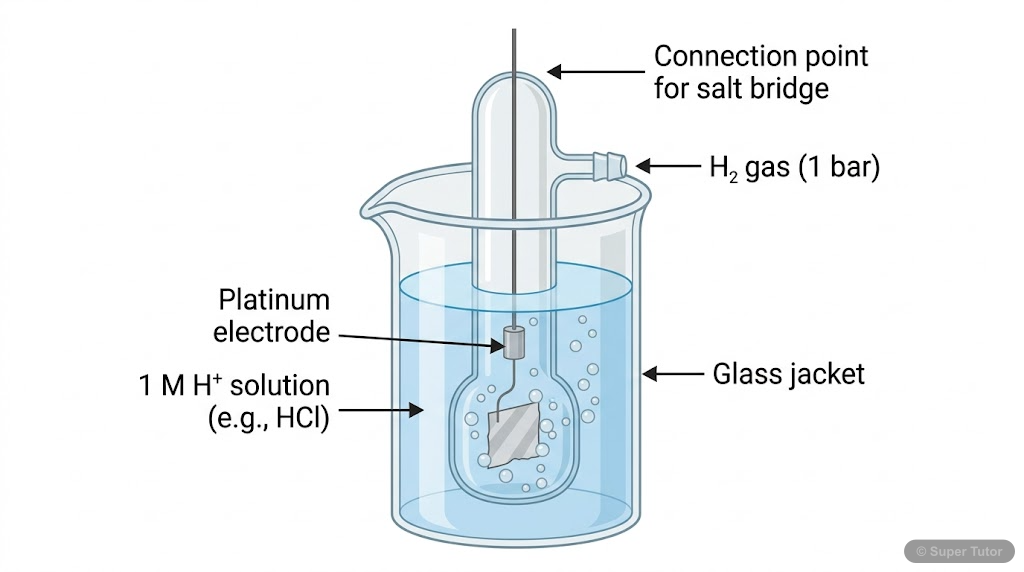
Learn better with visuals Super Tutor has hundreds of illustrations like this across every chapter — all free to try.
Get startedTopics in Electrochemistry
1. Electrochemical Cells and Electrode Potentials
- A Daniell cell converts the chemical energy of the redox reaction Zn(s) + Cu2+(aq) -> Zn2+(aq) + Cu(s) into electrical energy.
- A Daniell cell is a galvanic or voltaic cell.
- In a galvanic cell, oxidation takes place at the anode and reduction takes place at the cathode.
2. Nernst Equation, Equilibrium Constant, and Gibbs Energy
- The Nernst equation gives electrode potential or cell potential under non-standard conditions.
- For a Daniell cell, E_cell increases with increase in [Cu2+] and decreases with increase in [Zn2+].
- At equilibrium, cell potential becomes zero.
3. Conductance, Resistivity, Conductivity, and Molar Conductivity
- Resistance depends on the dimensions of a conductor or solution column.
- Resistivity is a material property and is the resistance of a substance of unit length and unit area of cross section.
- Conductance is the reciprocal of resistance.
4. Kohlrausch Law and Weak Electrolytes
- Kohlrausch law states that the limiting molar conductivity of an electrolyte is the sum of the individual ionic contributions.
- This law helps find limiting molar conductivity of weak electrolytes.
- For weak electrolytes, Λm cannot be obtained by extrapolation to zero concentration.
Key Concepts
Central concept: Electrochemistry
Frequently Asked Questions
What are the important topics in Electrochemistry for CBSE Class 12 Chemistry?
How to score full marks in Electrochemistry — CBSE Class 12 Chemistry?
Sources & Official References
- NCERT Official — ncert.nic.in
- CBSE Academic — cbseacademic.nic.in
- CBSE Official — cbse.gov.in
- National Education Policy 2020 — education.gov.in
Content is aligned to the official syllabus. Refer to the board website for the latest curriculum.
More resources for Electrochemistry
Practice Quiz
Test yourself with a quick quiz
Important Questions
Practice with board exam-style questions
Revision Notes
Key points for last-minute revision
Formula Sheet
All formulas in one place
Chapter Summary
Understand the chapter at a glance
Concept Maps
See how topics connect visually
Study Plan
Step-by-step plan to ace this chapter
Flashcards
Quick-fire cards for active recall
NCERT Solutions
Every textbook question solved step by step
For serious students
Get the full Electrochemistry chapter — for free.
Quizzes, flashcards, AI doubt-solver and a step-by-step study plan for CBSE Class 12 Chemistry.