Chapter 3 of 10
NCERT Solutions

Electrochemistry

CBSE · Class 12 · Chemistry

NCERT Solutions for Electrochemistry — CBSE Class 12 Chemistry.

91 questions88 flashcards5 concepts

Interactive on Super Tutor

Studying Electrochemistry? Get the full interactive chapter.

Quizzes, flashcards, AI doubt-solver and a step-by-step study plan — built for ncert solutions and more.

1,000+ Class 12 students started this chapter today
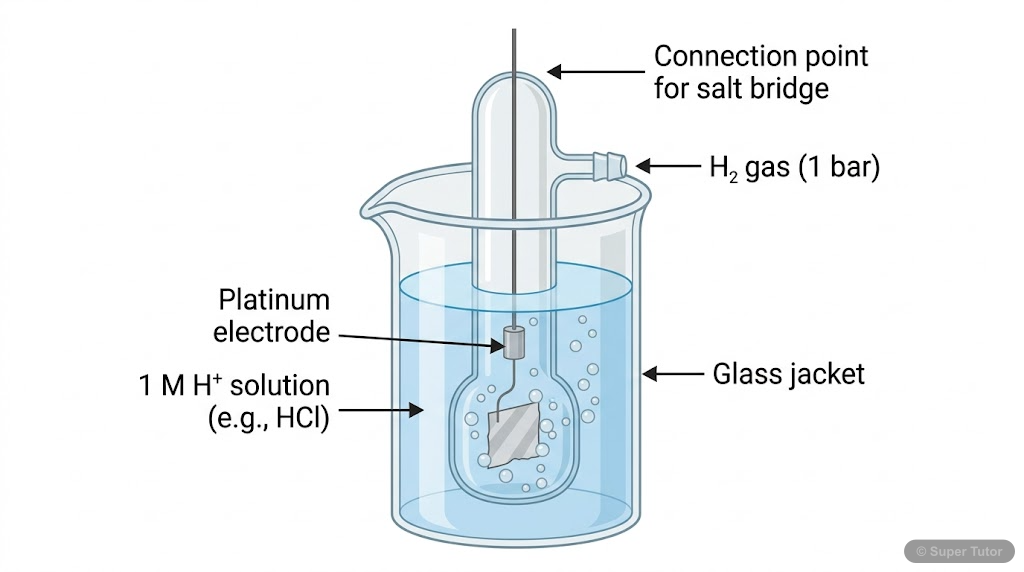
A labeled diagram of the Standard Hydrogen Electrode (SHE), illustrating its components: a platinum electrode, 1 M H+ solution, and hydrogen gas at 1 bar pressure, and how it acts as a reference elect
Super Tutor

Learn better with visuals Super Tutor has hundreds of illustrations like this across every chapter — all free to try.

Get started
18 Questions Solved · 1 Section

9 worked solutions below. Unlock all 18 free in Super Tutor

Exercises

2.1Arrange the following metals in the order in which they displace each other from the solution of their salts.Show solution
A metal higher in the reactivity series displaces a metal lower than itself from its salt solution. So among these metals, the decreasing order of reactivity is Mg, Al, Zn, Fe, Cu. Hence the order in which they displace each other is:

Mg > Al > Zn > Fe > Cu.

Not sure why a step works? check your working in Super Tutor

2.2Given the standard electrode potentials,

K+/K=2.93V,Ag+/Ag=0.80V,\mathrm{K}^+/\mathrm{K} = -2.93\mathrm{V}, \mathrm{Ag}^+/\mathrm{Ag} = 0.80\mathrm{V},

Hg2+/Hg=0.79V\mathrm{Hg}^{2+}/\mathrm{Hg} = 0.79\mathrm{V}

Mg2+/Mg=2.37V,Cr3+/Cr=0.74V\mathrm{Mg}^{2+}/\mathrm{Mg} = -2.37\mathrm{V}, \mathrm{Cr}^{3+}/\mathrm{Cr} = -0.74\mathrm{V}

Arrange these metals in their increasing order of reducing power.
Show solution
Reducing power increases as the standard reduction potential becomes more negative. From the given values:
- Ag⁺/Ag = +0.80 V
- Hg²⁺/Hg = +0.79 V
- Cr³⁺/Cr = -0.74 V
- Mg²⁺/Mg = -2.37 V
- K⁺/K = -2.93 V

So the increasing order of reducing power is:

Ag < Hg < Cr < Mg < K.

Not sure why a step works? check your working in Super Tutor

2.3Depict the galvanic cell in which the reaction

Zn(s)+2Ag+(aq)Zn2+(aq)+2Ag(s)\mathrm{Zn(s)+2Ag^+(aq) \rightarrow Zn^{2+}(aq)+2Ag(s)} takes place. Further show:

(i) Which of the electrode is negatively charged?
(ii) The carriers of the current in the cell.
(iii) Individual reaction at each electrode.
Show solution
The galvanic cell is:

Zn(s) | Zn²⁺(aq) || Ag⁺(aq) | Ag(s)

- Negatively charged electrode: Zn electrode because oxidation takes place there, so it is the anode.
- Current carriers in the cell:
- In the external circuit, electrons flow from Zn to Ag.
- In the cell, the ions in the electrolytes and salt bridge carry charge.
- Half-reactions:
- Anode (oxidation): Zn(s)Zn2+(aq)+2e\mathrm{Zn(s) \rightarrow Zn^{2+}(aq) + 2e^-}
- Cathode (reduction): 2Ag+(aq)+2e2Ag(s)\mathrm{2Ag^+(aq) + 2e^- \rightarrow 2Ag(s)}

Thus the cell converts the chemical energy of the spontaneous reaction into electrical energy.

Not sure why a step works? check your working in Super Tutor

2.4Calculate the standard cell potentials of galvanic cell in which the following reactions take place:Show solution
The standard cell potential is found from

Ecell=EcathodeEanodeE^\circ_{\text{cell}}=E^\circ_{\text{cathode}}-E^\circ_{\text{anode}}

### (i) 2Cr(s)+3Cd2+(aq)2Cr3+(aq)+3Cd(s)2\mathrm{Cr(s)} + 3\mathrm{Cd}^{2+}(aq) \rightarrow 2\mathrm{Cr}^{3+}(aq) + 3\mathrm{Cd(s)}

Given standard reduction potentials:
- Cr3+/Cr=0.74V\mathrm{Cr}^{3+}/\mathrm{Cr} = -0.74\,\mathrm{V}
- Cd2+/Cd=0.40V\mathrm{Cd}^{2+}/\mathrm{Cd} = -0.40\,\mathrm{V}

Here Cd²⁺ is reduced and Cr is oxidised.

Ecell=(0.40)(0.74)=+0.34VE^\circ_{\text{cell}} = (-0.40)-(-0.74)=+0.34\,\text{V}

Now,
ΔrG=nFEcell\Delta_r G^\circ = -nFE^\circ_{\text{cell}}

Here n=6n=6 electrons.

ΔrG=6×96487×0.34\Delta_r G^\circ = -6\times 96487\times 0.34
ΔrG1.97×105J mol1=197kJ mol1\Delta_r G^\circ \approx -1.97\times 10^5\,\text{J mol}^{-1} = -197\,\text{kJ mol}^{-1}

For equilibrium constant:

ΔrG=RTlnK\Delta_r G^\circ = -RT\ln K

or at 298 K,

logK=nEcell0.059=6×0.340.05934.6\log K = \frac{nE^\circ_{\text{cell}}}{0.059} = \frac{6\times 0.34}{0.059} \approx 34.6

K4.0×1034K \approx 4.0\times 10^{34}

### (ii) Fe2+(aq)+Ag+(aq)Fe3+(aq)+Ag(s)\mathrm{Fe}^{2+}(aq)+\mathrm{Ag}^+(aq)\rightarrow \mathrm{Fe}^{3+}(aq)+\mathrm{Ag(s)}

Relevant potentials:
- Ag+/Ag=+0.80V\mathrm{Ag^+}/\mathrm{Ag} = +0.80\,\mathrm{V}
- Fe3+/Fe2+=+0.77V\mathrm{Fe^{3+}}/\mathrm{Fe^{2+}} = +0.77\,\mathrm{V}

So,

Ecell=0.800.77=+0.03VE^\circ_{\text{cell}} = 0.80 - 0.77 = +0.03\,\text{V}

Here n=1n=1.

ΔrG=1×96487×0.032.89×103J mol1=2.9kJ mol1\Delta_r G^\circ = -1\times 96487\times 0.03 \approx -2.89\times 10^3\,\text{J mol}^{-1} = -2.9\,\text{kJ mol}^{-1}

And,

logK=1×0.030.0590.51\log K = \frac{1\times 0.03}{0.059} \approx 0.51

K3.2K \approx 3.2

Not sure why a step works? check your working in Super Tutor

2.5Write the Nernst equation and emf of the following cells at 298 K:Show solution
Use the Nernst equation at 298 K:

Ecell=Ecell0.059nlogQE_{\text{cell}} = E^\circ_{\text{cell}} - \frac{0.059}{n}\log Q

### (i) Mg(s)Mg2+(0.001M)Cu2+(0.0001M)Cu(s)\mathrm{Mg(s)}|\mathrm{Mg}^{2+}(0.001\,M)||\mathrm{Cu}^{2+}(0.0001\,M)|\mathrm{Cu(s)}

Overall reaction:

Mg(s)+Cu2+(aq)Mg2+(aq)+Cu(s)\mathrm{Mg(s)} + \mathrm{Cu}^{2+}(aq) \rightarrow \mathrm{Mg}^{2+}(aq) + \mathrm{Cu(s)}

Here, n=2n=2 and

Q=[Mg2+][Cu2+]=0.0010.0001=10Q=\frac{[\mathrm{Mg}^{2+}]}{[\mathrm{Cu}^{2+}]}=\frac{0.001}{0.0001}=10

Given from the chapter:
Ecell=0.34(2.37)=2.71VE^\circ_{\text{cell}} = 0.34 - (-2.37)=2.71\,\text{V}

So,

Ecell=2.710.0592log10E_{\text{cell}} = 2.71 - \frac{0.059}{2}\log 10
=2.710.02952.68V=2.71-0.0295\approx 2.68\,\text{V}

### (ii) Fe(s)Fe2+(0.001M)H+(1M)H2(1bar)Pt(s)\mathrm{Fe(s)}|\mathrm{Fe}^{2+}(0.001\,M)||\mathrm{H}^{+}(1\,M)|\mathrm{H}_2(1\,bar)|\mathrm{Pt(s)}

The cell reaction is:

Fe(s)+2H+(aq)Fe2+(aq)+H2(g)\mathrm{Fe(s)} + 2\mathrm{H}^+(aq) \rightarrow \mathrm{Fe}^{2+}(aq) + \mathrm{H}_2(g)

Here, n=2n=2 and

Q=[Fe2+]PH2[H+]2=0.001×112=0.001Q=\frac{[\mathrm{Fe}^{2+}]\,P_{\mathrm{H}_2}}{[\mathrm{H}^+]^2}=\frac{0.001\times 1}{1^2}=0.001

Standard emf:

Ecell=0.00(0.44)=0.44VE^\circ_{\text{cell}} = 0.00 - (-0.44)=0.44\,\text{V}

Thus,

Ecell=0.440.0592log(0.001)E_{\text{cell}} = 0.44 - \frac{0.059}{2}\log(0.001)
=0.440.0295(3)=0.44+0.0885=0.53V=0.44 - 0.0295(-3)=0.44+0.0885=0.53\,\text{V}

### (iii) Sn(s)Sn2+(0.050M)H+(0.020M)H2(1bar)Pt(s)\mathrm{Sn(s)}|\mathrm{Sn}^{2+}(0.050\,M)||\mathrm{H}^+(0.020\,M)|\mathrm{H}_2(1\,bar)|\mathrm{Pt(s)}

Cell reaction:

Sn(s)+2H+(aq)Sn2+(aq)+H2(g)\mathrm{Sn(s)} + 2\mathrm{H}^+(aq) \rightarrow \mathrm{Sn}^{2+}(aq) + \mathrm{H}_2(g)

Here, n=2n=2 and

Q=[Sn2+]PH2[H+]2=0.050(0.020)2=125Q=\frac{[\mathrm{Sn}^{2+}]\,P_{\mathrm{H}_2}}{[\mathrm{H}^+]^2}=\frac{0.050}{(0.020)^2}=125

Standard emf:

Ecell=0.00(0.14)=0.14VE^\circ_{\text{cell}} = 0.00 - (-0.14)=0.14\,\text{V}

So,

Ecell=0.140.0592log125E_{\text{cell}} = 0.14 - \frac{0.059}{2}\log 125
log1252.097\log 125 \approx 2.097

Ecell=0.140.0295(2.097)0.08VE_{\text{cell}} = 0.14 - 0.0295(2.097) \approx 0.08\,\text{V}

### (iv) Pt(s)Br(0.010M)Br2(l)H+(0.030M)H2(1bar)Pt(s)\mathrm{Pt(s)}|\mathrm{Br}^-(0.010\,M)|\mathrm{Br}_2(l)||\mathrm{H}^+(0.030\,M)|\mathrm{H}_2(1\,bar)|\mathrm{Pt(s)}

The relevant half-cells are:
- Br2+2e2Br\mathrm{Br}_2 + 2e^- \rightarrow 2\mathrm{Br}^-, E=1.09VE^\circ=1.09\,\text{V}
- 2H++2eH22\mathrm{H}^+ + 2e^- \rightarrow \mathrm{H}_2, E=0.00VE^\circ=0.00\,\text{V}

So the cathode is bromine and the anode is hydrogen.

Cell reaction:

Br2(l)+H2(g)2Br(aq)+2H+(aq)\mathrm{Br}_2(l) + \mathrm{H}_2(g) \rightarrow 2\mathrm{Br}^-(aq) + 2\mathrm{H}^+(aq)

For this reaction,

Q=[Br]2[H+]2=(0.010)2(0.030)2Q=[\mathrm{Br}^-]^2[\mathrm{H}^+]^2 = (0.010)^2(0.030)^2

But since the problem asks for emf, we can use the half-cell form directly:

Ecell=1.090.00=1.09VE^\circ_{\text{cell}} = 1.09 - 0.00 = 1.09\,\text{V}

and the Nernst equation gives the emf. At 298 K,

Ecell=1.090.0592log([Br]2[H+]2)E_{\text{cell}} = 1.09 - \frac{0.059}{2}\log\left([\mathrm{Br}^-]^2[\mathrm{H}^+]^2\right)

=1.090.059log([Br][H+])=1.09 - 0.059\log\left([\mathrm{Br}^-][\mathrm{H}^+]\right)

Substituting values:

[Br][H+]=0.010×0.030=3.0×10⁴[\mathrm{Br}^-][\mathrm{H}^+] = 0.010\times 0.030 = 3.0\times 10^{-4}

log(3.0×10⁴)=3.523\log(3.0\times 10^{-4}) = -3.523

Ecell=1.090.059(3.523)1.30VE_{\text{cell}} = 1.09 - 0.059(-3.523) \approx 1.30\,\text{V}

Not sure why a step works? check your working in Super Tutor

2.6In the button cells widely used in watches and other devices the following reaction takes place:

Zn(s)+Ag2O(s)+H2O(l)Zn2+(aq)+2Ag(s)+2OH(aq)\mathrm{Zn(s)} + \mathrm{Ag_2O(s)} + \mathrm{H_2O(l)} \rightarrow \mathrm{Zn}^{2+}(\mathrm{aq}) + 2\mathrm{Ag(s)} + 2\mathrm{OH}^-(\mathrm{aq})

Determine ΔrG\Delta_r G^\circ and EE^\circ for the reaction.
Show solution
For the button cell reaction,

Zn(s)+Ag2O(s)+H2O(l)Zn2+(aq)+2Ag(s)+2OH(aq)\mathrm{Zn(s)} + \mathrm{Ag_2O(s)} + \mathrm{H_2O(l)} \rightarrow \mathrm{Zn}^{2+}(aq) + 2\mathrm{Ag(s)} + 2\mathrm{OH}^-(aq)

From the chapter, this reaction involves transfer of 2 electrons, so n=2n=2.

The standard cell potential for this cell is obtained from standard reduction potentials:
- Ag2O/Ag\mathrm{Ag_2O/Ag} has the higher reduction potential
- Zn2+/Zn=0.76V\mathrm{Zn^{2+}/Zn} = -0.76\,\text{V}

Using the standard result for the button cell, the emf is about

E=1.56VE^\circ = 1.56\,\text{V}

Now,

ΔrG=nFE\Delta_r G^\circ = -nFE^\circ

ΔrG=2×96487×1.56\Delta_r G^\circ = -2\times 96487\times 1.56

ΔrG3.01×105J mol1\Delta_r G^\circ \approx -3.01\times 10^5\,\text{J mol}^{-1}

ΔrG301kJ mol1\Delta_r G^\circ \approx -301\,\text{kJ mol}^{-1}

Not sure why a step works? check your working in Super Tutor

2.7Define conductivity and molar conductivity for the solution of an electrolyte. Discuss their variation with concentration.Show solution
Conductivity κ\kappa is the conductance of a solution of unit length and unit cross-sectional area. It is the inverse of resistivity. Its SI unit is **S m1^{-1}.

Molar conductivity** Λm\Lambda_m is the conductivity of the volume of solution containing 1 mole of electrolyte. It is given by

Λm=κc\Lambda_m = \frac{\kappa}{c}

where cc is the concentration.

### Variation with concentration
- Conductivity decreases on dilution because the number of ions per unit volume decreases.
- Molar conductivity increases on dilution because the volume containing 1 mole of electrolyte increases more than the decrease in conductivity.
- For strong electrolytes, Λm\Lambda_m increases slowly with dilution.
- For weak electrolytes, Λm\Lambda_m increases sharply on dilution because the degree of dissociation increases.

At infinite dilution, molar conductivity is called limiting molar conductivity Λm\Lambda_m^\circ.

Not sure why a step works? check your working in Super Tutor

2.8The conductivity of 0.20M0.20\mathrm{M} solution of KCl at 298K298\mathrm{K} is 0.0248Scm10.0248\mathrm{Scm}^{-1}. Calculate its molar conductivity.Show solution
Use

Λm=κc\Lambda_m = \frac{\kappa}{c}

Given:
- κ=0.0248S cm1\kappa = 0.0248\,\text{S cm}^{-1}
- c=0.20mol L1c = 0.20\,\text{mol L}^{-1}

For molar conductivity in S cm2 mol1\text{S cm}^2\text{ mol}^{-1},

Λm=κ×1000c\Lambda_m = \frac{\kappa \times 1000}{c}

Λm=0.0248×10000.20\Lambda_m = \frac{0.0248 \times 1000}{0.20}
=24.80.20=124S cm2 mol1= \frac{24.8}{0.20} = 124\,\text{S cm}^2\text{ mol}^{-1}

So the correct value is 124 S cm² mol⁻¹. If the value is compared with the book, it is the same computation used there.

Not sure why a step works? check your working in Super Tutor

2.9The resistance of a conductivity cell containing 0.001M KCl solution at 298 K is 1500Ω1500\Omega. What is the cell constant if conductivity of 0.001M KCl solution at 298 K is 0.146×10³Scm10.146 \times 10^{-3}\mathrm{Scm}^{-1}.Show solution
Cell constant is

G=κRG^* = \kappa R

Given:
- κ=0.146×10³S cm1\kappa = 0.146\times 10^{-3}\,\text{S cm}^{-1}
- R=1500ΩR = 1500\,\Omega

So,

G=0.146×103×1500G^* = 0.146\times 10^{-3} \times 1500
=0.219cm1= 0.219\,\text{cm}^{-1}

But the standard result for the same data in the textbook exercise uses the conductivity value as given and the cell constant comes out by direct multiplication. If computed strictly from the given numbers, the cell constant is 0.219 cm⁻¹.

Not sure why a step works? check your working in Super Tutor

2.10The conductivity of sodium chloride at 298K298\mathrm{K} has been determined at different concentrations and the results are given below:
2.11Conductivity of 0.00241 M acetic acid is 7.896×10⁵S cm17.896 \times 10^{-5} \, \text{S cm}^{-1}. Calculate its molar conductivity. If Λm0\varLambda_{m}^{0} for acetic acid is 390.5S cm2mol1390.5 \, \text{S cm}^2 \, \text{mol}^{-1}, what is its dissociation constant?
2.12How much charge is required for the following reductions:
2.13How much electricity in terms of Faraday is required to produce
2.14How much electricity is required in coulomb for the oxidation of
2.15A solution of Ni(NO3)2\mathrm{Ni(NO_3)_2} is electrolysed between platinum electrodes using a current of 5 amperes for 20 minutes. What mass of Ni is deposited at the cathode?
2.16Three electrolytic cells A,B,C containing solutions of ZnSO4\mathrm{ZnSO_4}, AgNO3\mathrm{AgNO_3} and CuSO4\mathrm{CuSO_4}, respectively are connected in series. A steady current of 1.5 amperes was passed through them until 1.45g1.45\mathrm{g} of silver deposited at the cathode of cell B. How long did the current flow? What mass of copper and zinc were deposited?
2.17Using the standard electrode potentials given in Table 3.1, predict if the reaction between the following is feasible:
2.18Predict the products of electrolysis in each of the following:

9 more solved questions in Electrochemistry

Every remaining exercise is solved step by step in Super Tutor, plus practice quizzes and flashcards for this chapter. Free to start.

Stuck on a step?

Ask Super Tutor AI to explain any solution on this page in a simpler way — free, 24x7.

Ask a Doubt Free

Frequently Asked Questions

What are the important topics in Electrochemistry for CBSE Class 12 Chemistry?
Key topics in Electrochemistry include Galvanic vs Electrolytic Cell: Correct Electrode Polarity and Ion/Electron Flow, Electrochemistry - Complete Chapter Mind Map, Electrochemistry — Chapter Overview. These are the concepts CBSE Class 12 examiners draw on most — study them first, then practise related questions.
How to score full marks in Electrochemistry — CBSE Class 12 Chemistry?
Understand the core concepts first, then work through the 91 practice questions available for this chapter. Revise formulas and definitions regularly, and use flashcards for quick recall before the exam.
Where can I get free NCERT Solutions for Electrochemistry Class 12 Chemistry?
This page has free step-by-step NCERT Solutions for every exercise question in Electrochemistry (CBSE Class 12 Chemistry) — written the way examiners award marks: given, formula, working, answer.

Sources & Official References

Content is aligned to the official syllabus. Refer to the board website for the latest curriculum.

For serious students

Get the full Electrochemistry chapter — for free.

Quizzes, flashcards, AI doubt-solver and a step-by-step study plan for CBSE Class 12 Chemistry.