Moving Charges and Magnetism — Practice Quiz
CBSE · Class 12 · Physics
Try a 4-question quiz on Moving Charges and Magnetism for CBSE Class 12 Physics: tap an answer to check it and see why.
Interactive on Super Tutor
Studying Moving Charges and Magnetism? Get the full interactive chapter.
Quizzes, flashcards, AI doubt-solver and a step-by-step study plan — built for practice quiz and more.
Free trial, no card needed.
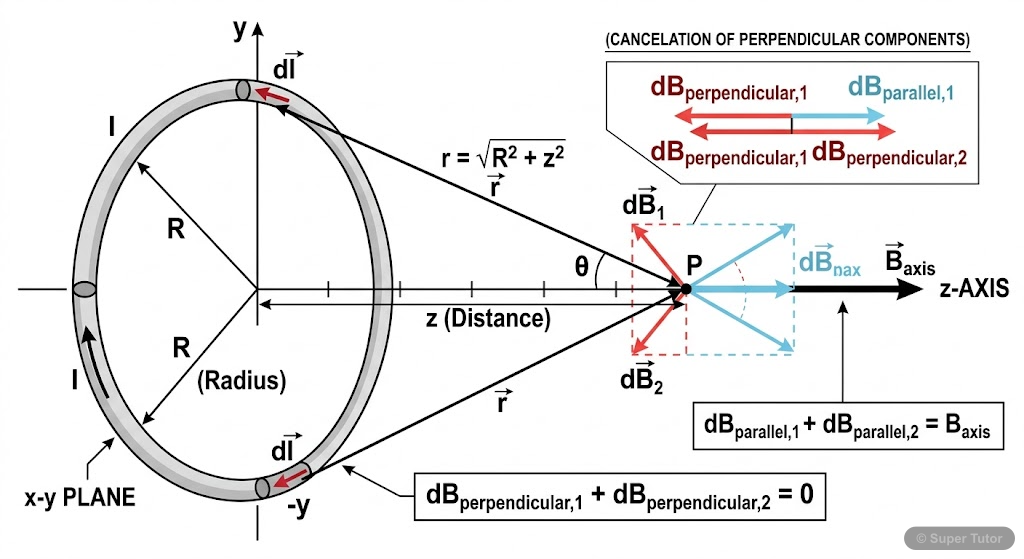
One of 16 illustrations for Moving Charges and Magnetism in Super Tutor — alongside flashcards, concept maps and practice questions.
Quick Quiz: Moving Charges and Magnetism
0/4Tap an answer to check it instantly. No sign-up needed for these 4.
What is the SI unit of magnetic field?
The magnetic force on a charged particle is zero when:
Who discovered the relationship between electricity and magnetism in 1820?
The direction of magnetic field around a current-carrying straight wire is given by:
Sample Questions
The Lorentz force on a charged particle includes contributions from:
Show answer
Electric field, Magnetic field
The Lorentz force F = q(E + v × B) includes contributions from both electric field E and magnetic field B. The electric force qE can do work on the particle, while the magnetic force q(v × B) is always perpendicular to velocity and does no work.
The magnetic field at the center of a circular current loop is:
Show answer
μ₀I/2R
At the center of a circular loop carrying current I with radius R, the magnetic field is B = μ₀I/2R. This formula comes from integrating the Biot-Savart law around the circular loop, where all current elements contribute in the same direction at the center.
In a uniform magnetic field, a charged particle moves in a circular path. Which quantities remain constant during this motion?
Show answer
Speed of the particle, Kinetic energy of the particle, Angular frequency, Radius of circular path
Since magnetic force does no work (being perpendicular to velocity), the speed and kinetic energy remain constant. The radius r = mv/qB and angular frequency ω = qB/m also remain constant for uniform B. Only the direction of velocity changes continuously.
The cyclotron frequency depends on:
Show answer
Charge and mass of particle, and magnetic field strength
The cyclotron frequency ν = qB/2πm depends only on the charge q, mass m of the particle, and magnetic field strength B. It is independent of the particle's speed and radius, which is the key principle used in cyclotron accelerators.
+114 more questions on Moving Charges and Magnetism (CBSE Class 12 Physics)
Practise AllFrequently Asked Questions
What are the important topics in Moving Charges and Magnetism for CBSE Class 12 Physics?
How many practice questions are there for Moving Charges and Magnetism?
Sources & Official References
- NCERT Official — ncert.nic.in
- CBSE Academic — cbseacademic.nic.in
- CBSE Official — cbse.gov.in
- National Education Policy 2020 — education.gov.in
Content is aligned to the official syllabus. Refer to the board website for the latest curriculum.
More resources for Moving Charges and Magnetism
Important Questions
Exam-style questions with answers
Revision Notes
Key points for last-minute revision
Formula Sheet
The chapter's formulas in one place
Chapter Summary
Understand the chapter at a glance
Concept Maps
See how topics connect
Study Plan
Step-by-step plan for this chapter
Flashcards
Quick-fire cards for active recall
Syllabus
What topics to cover
NCERT Solutions
Every textbook question solved step by step
For serious students
Get the full Moving Charges and Magnetism chapter — start free.
Quizzes, flashcards, an AI doubt solver and a study plan for CBSE Class 12 Physics. Free to start, no card needed.