Moving Charges and Magnetism
CBSE · Class 12 · Physics
Quick revision notes for Moving Charges and Magnetism — CBSE Class 12 Physics. Key concepts, formulas, and definitions for last-minute revision.
Interactive on Super Tutor
Studying Moving Charges and Magnetism? Get the full interactive chapter.
Quizzes, flashcards, AI doubt-solver and a step-by-step study plan — built for revision notes and more.
1,000+ Class 12 students started this chapter today
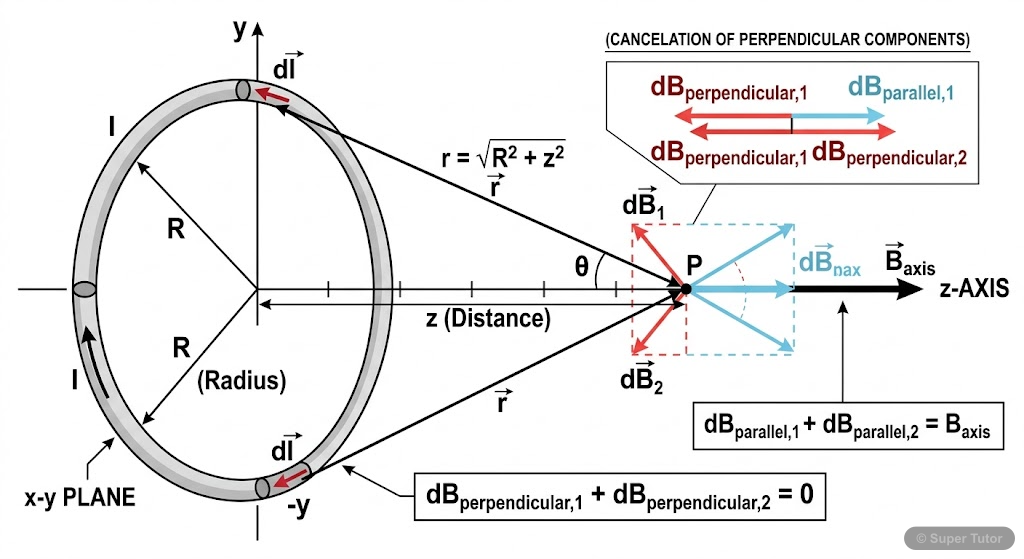
Super Tutor has 16+ illustrations like this for Moving Charges and Magnetism alone — flashcards, concept maps, and step-by-step visuals.
See them allKey Topics to Revise
1. Historical idea and basic magnetic field concepts
- Oersted discovered the connection between electricity and magnetism during a lecture demonstration in summer 1820.
- A current in a straight wire causes a compass needle near it to deflect.
- The alignment of the compass needle is tangential to an imaginary circle around the wire.
2. Lorentz force and force on a current-carrying conductor
- The force on a charge moving in electric and magnetic fields is called the Lorentz force.
- The magnetic force acts perpendicular to both velocity and magnetic field.
- Force on a negative charge is opposite to that on a positive charge.
3. Motion of a charged particle in a uniform magnetic field
- If velocity is perpendicular to magnetic field, the particle describes a circle.
- If velocity has a component parallel to the field, that component is unchanged and the path becomes helical.
- Magnetic force does no work, so speed remains constant in a pure magnetic field.
4. Biot-Savart law and field of a circular loop
- Biot-Savart law gives the magnetic field due to a current element.
- dB is proportional to current, element length, and inversely proportional to r squared.
- The direction of dB is perpendicular to the plane containing dl and r.
Get complete notes with diagrams and examples
Full NotesKey Concepts
Frequently Asked Questions
What are the important topics in Moving Charges and Magnetism for CBSE Class 12 Physics?
How to score full marks in Moving Charges and Magnetism — CBSE Class 12 Physics?
Sources & Official References
- NCERT Official — ncert.nic.in
- CBSE Academic — cbseacademic.nic.in
- CBSE Official — cbse.gov.in
- National Education Policy 2020 — education.gov.in
Content is aligned to the official syllabus. Refer to the board website for the latest curriculum.
More resources for Moving Charges and Magnetism
Practice Quiz
Test yourself with a quick quiz
Important Questions
Practice with board exam-style questions
Formula Sheet
All formulas in one place
Chapter Summary
Understand the chapter at a glance
Concept Maps
See how topics connect visually
Study Plan
Step-by-step plan to ace this chapter
Flashcards
Quick-fire cards for active recall
Syllabus
What topics to cover
NCERT Solutions
Every textbook question solved step by step
For serious students
Get the full Moving Charges and Magnetism chapter — for free.
Quizzes, flashcards, AI doubt-solver and a step-by-step study plan for CBSE Class 12 Physics.