Politics of planned development — NCERT Solutions
CBSE · Class 12 · Political Science
NCERT Solutions for Politics of planned development, CBSE Class 12 Political Science: 9 textbook questions solved step by step.
Interactive on Super Tutor
Studying Politics of planned development? Get the full interactive chapter.
Quizzes, flashcards, AI doubt-solver and a step-by-step study plan — built for NCERT solutions and more.
Free trial, no card needed.
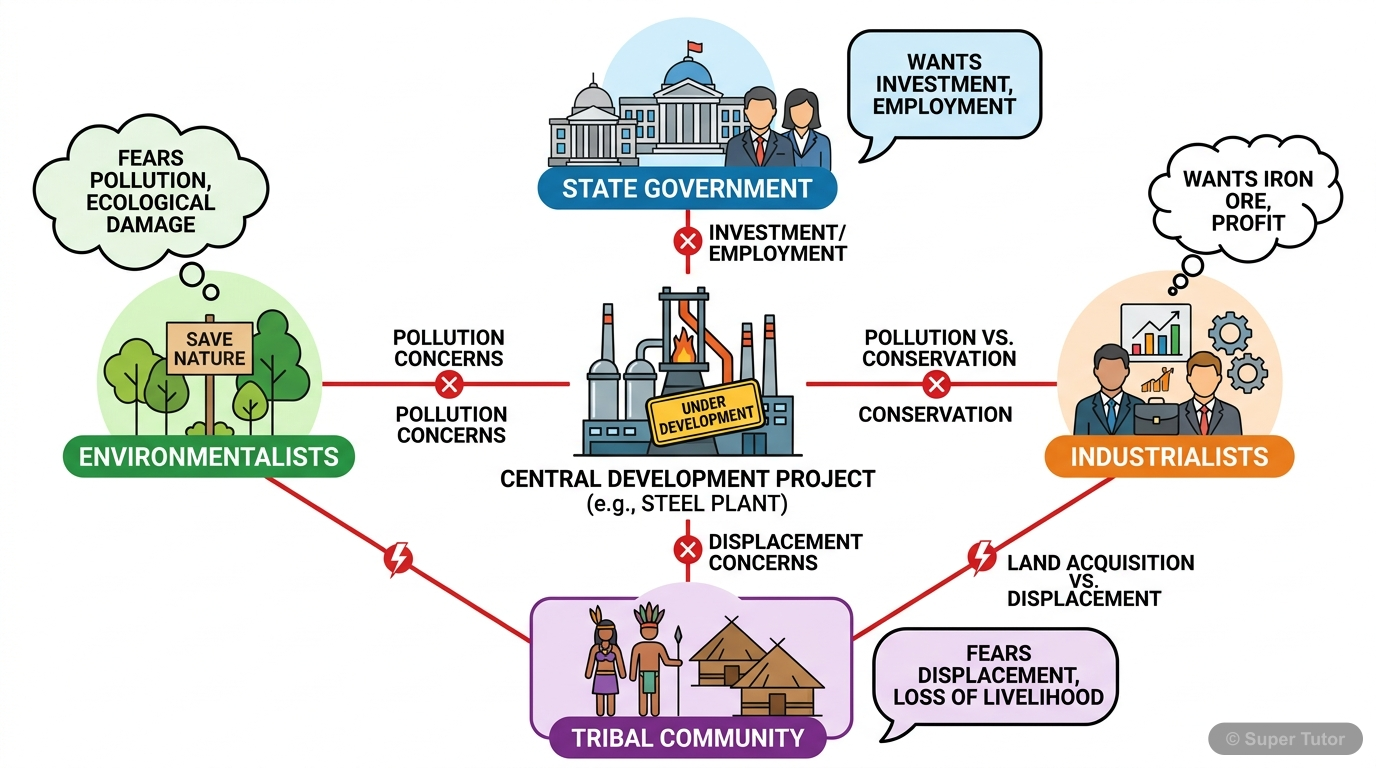
Learn better with visuals Super Tutor pairs illustrations like this with notes and quizzes for Politics of planned development.
The first 5 solutions are open to read. The other 4 are free with a Super Tutor account.
Exercise — Politics of Planned Development
1Which of these statements about the Bombay Plan is incorrect?
(a) It was a blueprint for India's economic future.
(b) It supported state-ownership of industry.
(c) It was made by some leading industrialists.
(d) It supported strongly the idea of planning.Show solution
Correct Answer: (b) It supported state-ownership of industry.
Justification: The Bombay Plan (1944) was prepared by leading Indian industrialists like J.R.D. Tata, G.D. Birla, and others. While it strongly supported the idea of planning and envisioned a blueprint for India's economic future, it did NOT support state-ownership of industry. The industrialists who drafted it were in favour of private enterprise and wanted the state to play a supportive (not ownership) role in the economy. Hence, statement (b) is incorrect.
2Which of the following ideas did not form part of the early phase of India's development policy?
(a) Planning
(b) Liberalisation
(c) Cooperative Farming
(d) Self sufficiencyShow solution
Correct Answer: (b) Liberalisation
Justification: In the early phase of India's development policy after Independence, the emphasis was on:
- Planning (Five Year Plans through the Planning Commission)
- Cooperative Farming (as advocated by some leaders and debated in the Congress)
- Self-sufficiency (reducing dependence on imports, especially in food and industry)
Liberalisation — meaning opening up the economy to free markets, reducing state controls, and inviting foreign investment — was NOT part of the early development policy. Liberalisation came much later, prominently in 1991 with the New Economic Policy. Hence, (b) is the correct answer.
3The idea of planning in India was drawn from
(a) the Bombay plan
(b) experiences of the Soviet bloc countries
(c) Gandhian vision of society
(d) Demand by peasant organisations
i. b and d only
ii. d and c only
iii. a and b only
iv. all the aboveShow solution
Correct Answer: (iii) a and b only
Justification:
- The Bombay Plan (a) was an early blueprint that endorsed the idea of state-led planning for India's economic development, showing that even industrialists supported planning.
- The Soviet Union's experience (b) of rapid industrialisation through centralised Five Year Plans was a major inspiration for Indian planners like Jawaharlal Nehru and P.C. Mahalanobis.
- The Gandhian vision (c) focused on village self-sufficiency and cottage industries — it was not the basis of the centralised, heavy-industry-oriented planning model India adopted.
- Peasant organisations (d) did not drive the idea of planning.
Therefore, the idea of planning was primarily drawn from (a) and (b), making option (iii) correct.
4Match the following.
(a) Charan Singh
(b) P C Mahalanobis
(c) Bihar Famine
(d) Verghese Kurien
i. Industrialisation
ii. Zoning
iii. Farmers
iv. Milk CooperativesShow solution
Correct Matching:
| Leader/Event | Associated With |
|---|---|
| (a) Charan Singh | (iii) Farmers |
| (b) P C Mahalanobis | (i) Industrialisation |
| (c) Bihar Famine | (ii) Zoning |
| (d) Verghese Kurien | (iv) Milk Cooperatives |
Explanation:
- Charan Singh was a prominent leader who championed the cause of farmers and peasants and opposed the urban/industrial bias in planning.
- P.C. Mahalanobis was the chief architect of the Second Five Year Plan, which gave priority to heavy industrialisation (the Mahalanobis model).
- Bihar Famine led to the policy of zoning (restricting movement of foodgrains across state borders) to prevent hoarding and ensure food availability within states.
- Verghese Kurien was the architect of Operation Flood and the Amul cooperative, making India the world's largest milk producer through milk cooperatives.
5What were the major differences in the approach towards development at the time of Independence? Has the debate been resolved?Show solution
Given/Context: At the time of Independence, India faced the fundamental question: What kind of development model should be adopted? There were several competing visions.
Major Differences in Approach:
1. Capitalist vs. Socialist Path:
- One group (including many industrialists and some Congress leaders) favoured a capitalist model with private enterprise, free markets, and limited state intervention.
- Another group (including Nehru and socialist leaders) favoured a socialist model with state ownership of key industries, central planning, and redistribution of wealth.
2. Industrialisation vs. Agriculture:
- Leaders like Nehru and Mahalanobis prioritised heavy industrialisation as the engine of growth.
- Leaders like Charan Singh and Gandhians argued that agriculture and rural development must be the priority, since India was predominantly an agrarian society.
3. Large-scale vs. Small-scale/Cottage Industries:
- The Nehruvian model emphasised large-scale, capital-intensive industries (steel plants, dams, etc.).
- The Gandhian model stressed small-scale, labour-intensive cottage and village industries to generate rural employment.
4. Centralised Planning vs. Decentralised Development:
- Some favoured centralised planning through a Planning Commission.
- Others (especially Gandhians) preferred decentralised, village-level self-governance and self-sufficiency.
5. Role of the State:
- Debate over how much the state should control the economy — complete state ownership (left), mixed economy (centre), or minimal state interference (right).
Has the Debate Been Resolved?
No, the debate has not been fully resolved even today:
- In 1991, India adopted Liberalisation, Privatisation, and Globalisation (LPG) policies, shifting away from the socialist model towards a market economy. This seemed to resolve the debate in favour of the capitalist/market approach.
- However, debates continue about the role of the state in welfare, the neglect of agriculture, growing inequality, and the need for inclusive development.
- Issues like farmers' distress, unemployment, and regional imbalances show that the fundamental questions about the right development model remain contested.
Conclusion: The debate has evolved but not been conclusively resolved. India follows a mixed economy approach, but the balance between state and market, agriculture and industry, and growth and equity continues to be debated.
Free with a Super Tutor account
Free with a Super Tutor account
Free with a Super Tutor account
Free with a Super Tutor account
4 more solved questions in Politics of planned development
They are free with a Super Tutor account, along with practice quizzes and flashcards for this chapter. Free to start, no card needed.
Frequently Asked Questions
What are the important topics in Politics of planned development for CBSE Class 12 Political Science?
Are these NCERT Solutions for Politics of planned development free?
How should I revise Politics of planned development for the CBSE Class 12 board exam?
Sources & Official References
- NCERT Official — ncert.nic.in
- CBSE Academic — cbseacademic.nic.in
- CBSE Official — cbse.gov.in
- National Education Policy 2020 — education.gov.in
Content is aligned to the official syllabus. Refer to the board website for the latest curriculum.
More resources for Politics of planned development
Practice Quiz
Test yourself with a quick quiz
Important Questions
Exam-style questions with answers
Revision Notes
Key points for last-minute revision
Chapter Summary
Understand the chapter at a glance
Concept Maps
See how topics connect
Study Plan
Step-by-step plan for this chapter
Flashcards
Quick-fire cards for active recall
Syllabus
What topics to cover
For serious students
Get the full Politics of planned development chapter — start free.
Quizzes, flashcards, an AI doubt solver and a study plan for CBSE Class 12 Political Science. Free to start, no card needed.