Chapter 9 of 15
NCERT Solutions

Security in the Contemporary World

CBSE · Class 12 · Political Science

NCERT Solutions for Security in the Contemporary World — CBSE Class 12 Political Science.

47 questions22 flashcards5 concepts

Interactive on Super Tutor

Studying Security in the Contemporary World? Get the full interactive chapter.

Quizzes, flashcards, AI doubt-solver and a step-by-step study plan — built for ncert solutions and more.

1,000+ Class 12 students started this chapter today

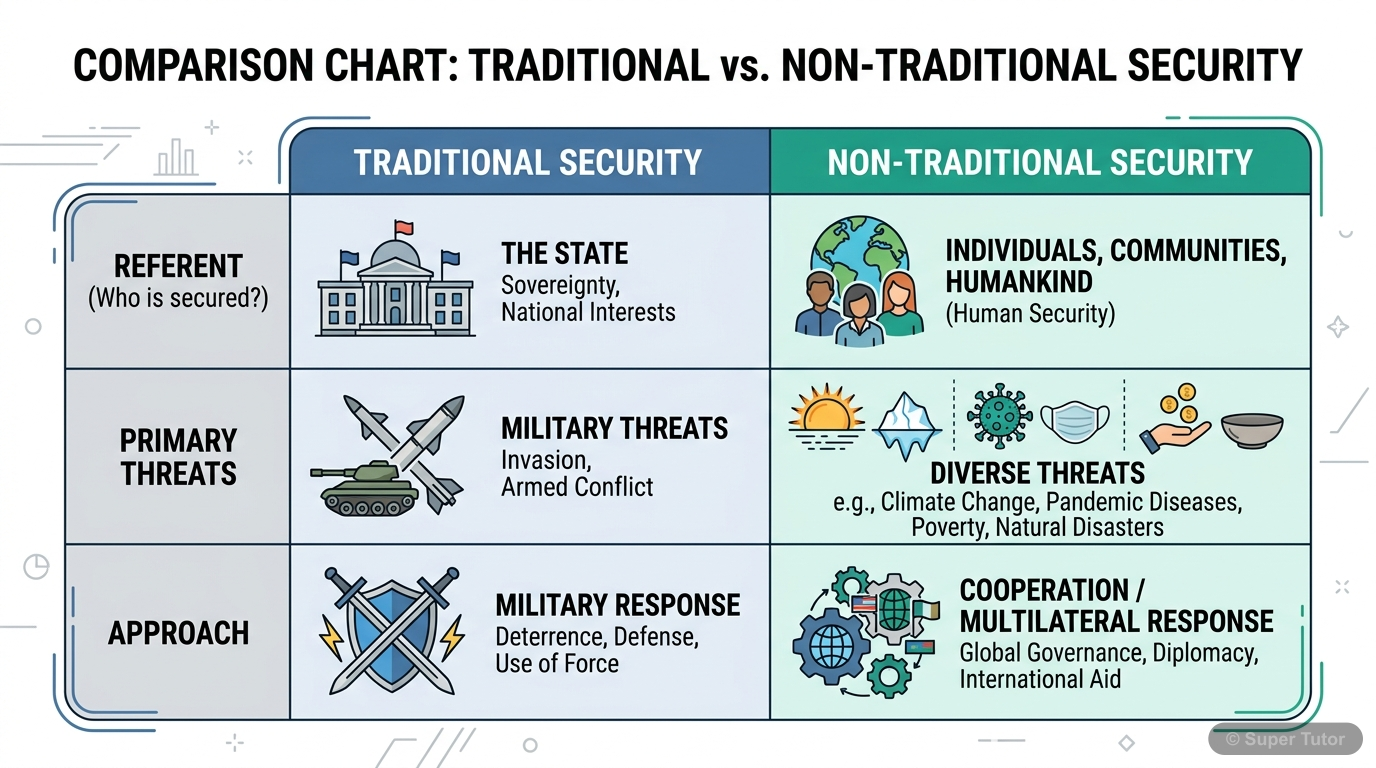
A comparison chart highlighting the key differences between traditional and non-traditional notions of security, including referent, types of threats, and approaches.
Super Tutor

This is just one of 7+ visuals inside Super Tutor's Security in the Contemporary World chapter

Explore the full set
12 Questions Solved · 1 Section

Security in the Contemporary World — CBSE Class 12 Political Science (Contemporary World Politics)

1Match the terms with their meaning:
i. Confidence Building Measures (CBMs)
ii. Arms Control
iii. Alliance
iv. Disarmament
a. Giving up certain types of weapons
b. A process of exchanging information on defence matters between nations on a regular basis
c. A coalition of nations meant to deter or defend against military attacks
d. Regulates the acquisition or development of weapons
Show solution
The correct matching is as follows:

i. Confidence Building Measures (CBMs)b\text{i. Confidence Building Measures (CBMs)} \longleftrightarrow \text{b}
ii. Arms Controld\text{ii. Arms Control} \longleftrightarrow \text{d}
iii. Alliancec\text{iii. Alliance} \longleftrightarrow \text{c}
iv. Disarmamenta\text{iv. Disarmament} \longleftrightarrow \text{a}

Explanation:
- CBMs (i → b): Confidence Building Measures involve a regular, institutionalised process of exchanging information on defence and military matters between nations so as to reduce suspicion and the risk of accidental war.
- Arms Control (ii → d): Arms Control does not eliminate weapons altogether but regulates (limits) the acquisition, development, or deployment of certain categories of weapons through treaties and agreements (e.g., SALT, START).
- Alliance (iii → c): An Alliance is a coalition or grouping of nations that come together to deter a common threat or to defend against military attacks collectively (e.g., NATO).
- Disarmament (iv → a): Disarmament requires all states to give up certain types of weapons entirely (e.g., the Chemical Weapons Convention requires states to destroy their chemical weapons stockpiles).
2Which among the following would you consider as a traditional security concern / non-traditional security concern / not a threat?
a. The spread of chikungunya / dengue fever
b. Inflow of workers from a neighbouring nation
c. Emergence of a group demanding nationhood for their region
d. Emergence of a group demanding autonomy for their region
e. A newspaper that is critical of the armed forces in the country
Show solution
Given: A list of situations to be classified as traditional security concern, non-traditional security concern, or not a threat.

Classification:

| Situation | Category | Reason |
|---|---|---|
| a. Spread of chikungunya/dengue fever | Non-Traditional Security Concern | Epidemic diseases threaten human security and the well-being of large populations; they are not military threats but endanger human lives on a large scale. |
| b. Inflow of workers from a neighbouring nation | Not a Threat (in most contexts) | Migration of workers is generally an economic phenomenon. It may create social tensions but is not inherently a security threat; it can even be beneficial economically. |
| c. Emergence of a group demanding nationhood for their region | Traditional Security Concern | A secessionist movement that demands a separate nation challenges the territorial integrity and sovereignty of the state — a core traditional security concern. |
| d. Emergence of a group demanding autonomy for their region | Not a Threat / possibly Non-Traditional | Demands for autonomy within a democratic framework are a political/governance issue. If pursued peacefully, it is not a security threat; it is a legitimate political demand. |
| e. A newspaper critical of the armed forces | Not a Threat | A free press criticising the military is a feature of democracy and freedom of expression. It does not constitute a security threat to the state. |

Conclusion: Traditional security concerns relate to military threats to the state's sovereignty and territorial integrity. Non-traditional concerns include threats to human security such as disease, poverty, and environmental degradation. Not every social or political phenomenon constitutes a security threat.
3What is the difference between traditional and non-traditional security? Which category would the creation and sustenance of alliances belong to?Show solution
Given: We need to distinguish between traditional and non-traditional security and classify alliances.

Traditional Security:
- Focuses on military threats to the state — its sovereignty, territorial integrity, and political independence.
- The referent object (what is being protected) is the state.
- Threats come from other states through war, conquest, or coercion.
- Responses include: building military capability, forming alliances, maintaining balance of power, and arms control/disarmament.
- Example: One country threatening to invade another.

Non-Traditional Security:
- Focuses on threats to human security and global security that go beyond military threats.
- The referent object is the individual/community/humanity as a whole.
- Threats include: terrorism, poverty, climate change, pandemics, human rights violations, refugee crises, drug trafficking, etc.
- Responses require international cooperation, multilateral institutions, and development policies.
- Example: Global warming, spread of HIV/AIDS, international terrorism.

Key Differences:

| Basis | Traditional Security | Non-Traditional Security |
|---|---|---|
| Nature of Threat | Military | Non-military (economic, environmental, social) |
| Referent Object | State | Individual / Humanity |
| Source of Threat | Other states | Non-state actors, nature, poverty |
| Response | Military power, alliances | Cooperation, diplomacy, development |

Classification of Alliances:
The creation and sustenance of alliances belongs to the traditional security perspective. Alliances are coalitions of states formed to increase collective military capability, deter aggression from rival states, and defend against military attacks. They are a classic instrument of statecraft in the traditional security framework (e.g., NATO was formed to counter the Soviet military threat during the Cold War).
4What are the differences in the threats that people in the Third World face and those living in the First World face?Show solution
Given: We need to compare security threats faced by people in the Third World (developing countries) versus the First World (developed/industrialised countries).

Threats faced by people in the Third World:
1. Internal security threats are more prominent — civil wars, ethnic conflicts, secessionist movements, and insurgencies are common.
2. Poverty and underdevelopment — lack of food, clean water, healthcare, and basic necessities pose a constant threat to human security.
3. State-sponsored violence — in many Third World states, the government itself is a source of threat to its own citizens through repression, human rights violations, and genocide.
4. Weak state institutions — inability to provide security, justice, or basic services makes populations vulnerable.
5. Colonial legacy — many borders were drawn arbitrarily by colonial powers, leading to ethnic and territorial conflicts.
6. Disease and epidemics — lack of healthcare infrastructure makes populations vulnerable to diseases like malaria, tuberculosis, etc.
7. Environmental threats — deforestation, desertification, and natural disasters hit harder due to lack of resources to cope.

Threats faced by people in the First World:
1. External military threats are the primary traditional concern, though these have reduced after the Cold War.
2. Terrorism — especially international terrorism (e.g., 9/11 in the USA) is a major concern.
3. Cyber security threats — attacks on critical infrastructure, financial systems, and data.
4. Immigration and refugee flows — seen as a social and security challenge.
5. Economic threats — financial crises, job losses due to globalisation.
6. Environmental threats — climate change, though they have greater resources to adapt.
7. Weapons of Mass Destruction (WMDs) — proliferation of nuclear, chemical, and biological weapons.

Key Difference: In the Third World, threats are often internal, human-security-based, and structural (poverty, weak governance), whereas in the First World, threats are more external, military, or technological in nature. People in the Third World face threats from both their own states and from non-state actors, while First World citizens are more threatened by external actors and non-traditional threats like terrorism and cyber attacks.
5Is terrorism a traditional or non-traditional threat to security?Show solution
Answer: Terrorism is a non-traditional threat to security.

Explanation:

Traditional security concerns itself with military threats from other states — wars, invasions, and interstate conflicts. The state is both the referent object (what is protected) and the primary actor.

Terrorism, however, has the following characteristics that place it firmly in the non-traditional category:

1. Non-state actors: Terrorism is mostly carried out by non-state actors — organised groups, networks, or individuals — not by sovereign states. (e.g., Al-Qaeda, ISIS)

2. Targets civilians: Terrorism deliberately targets civilians and non-combatants to spread fear and achieve political goals, unlike conventional warfare which targets military forces.

3. Transnational nature: Modern terrorism crosses national borders and cannot be addressed by a single state's military alone. It requires international cooperation, intelligence sharing, and multilateral responses.

4. Unconventional methods: Terrorists use suicide bombings, hijackings, cyber attacks, and biological/chemical agents — methods outside the scope of traditional military confrontation.

5. Threatens human security: Terrorism threatens the lives and security of ordinary individuals, not just the state's territorial integrity.

6. Cannot be countered by traditional means alone: Military power and nuclear deterrence are largely ineffective against terrorist networks. Responses require policing, intelligence, diplomacy, and addressing root causes like poverty and political grievances.

Conclusion: Because terrorism involves non-state actors, targets civilians, crosses borders, and requires non-military responses, it is classified as a non-traditional security threat. However, it is important to note that some scholars argue it has elements of both — when states sponsor terrorism, it acquires a traditional dimension as well.
6What are the choices available to a state when its security is threatened, according to the traditional security perspective?Show solution
Given: We need to identify the options available to a state facing a security threat under the traditional security framework.

Concept: The traditional security perspective focuses on military threats to the state's sovereignty and territorial integrity. When a state perceives such a threat, it has the following choices:

1. Surrender:
The state can give in to the demands of the threatening power. This is rarely chosen as it compromises sovereignty, but it may be considered when the power differential is overwhelming.

2. Deterrence (Prevention of War):
The state can try to prevent war by making the cost of attack too high for the aggressor. This is done by:
- Building up military strength and capability.
- Developing nuclear weapons as a deterrent (the logic: 'if you attack me, I will destroy you too').
- The goal is to convince the adversary that war is not worth fighting.

3. Defence (Limiting War):
If deterrence fails and war begins, the state can defend itself to:
- Protect its territory from conquest.
- Limit the damage caused by the war.
- Deny the attacker their objectives.

4. Alliance Building:
A state can join or form an alliance with other states to:
- Increase collective military power.
- Deter a common enemy.
- Share the burden of defence.
- Example: NATO was formed by Western nations to deter Soviet aggression.

5. Balance of Power:
A state can try to maintain or restore the balance of power by:
- Building up its own military.
- Forming alliances to counterbalance a rising or threatening power.
- The idea is that no single state should become so powerful that it can dominate others.

6. Arms Control and Disarmament:
States can negotiate treaties to:
- Limit the development or deployment of certain weapons (Arms Control).
- Completely eliminate certain categories of weapons (Disarmament).
- This reduces the risk of war by mutual agreement.

Conclusion: The traditional security perspective thus offers a state a spectrum of choices ranging from military build-up and alliances to diplomatic instruments like arms control, all aimed at protecting the state from military threats.
7What is 'Balance of Power'? How could a state achieve this?Show solution
What is Balance of Power?

Balance of Power is a situation in international relations where no single state is so powerful that it can dominate or dictate terms to all others. It is a condition of rough equilibrium of power among states or groups of states, so that no one nation can impose its will on the rest.

- It is a key concept in the traditional security perspective.
- The underlying logic is: if power is distributed roughly equally, no state will risk starting a war because it cannot be sure of winning.
- Historically, European states maintained the balance of power to prevent any one nation (like Napoleonic France or Nazi Germany) from dominating the continent.

How can a state achieve Balance of Power?

A state can use the following methods to achieve or maintain the balance of power:

1. Building Military Capability:
- A state can increase its own military strength — army, navy, air force, nuclear weapons — to match or deter a more powerful rival.
- Example: India's nuclear tests in 1998 were partly aimed at maintaining a balance with China and Pakistan.

2. Forming Alliances:
- A state can join or create alliances with other states to collectively balance against a powerful adversary.
- Example: During the Cold War, the USA formed NATO and the USSR formed the Warsaw Pact to balance each other.
- Smaller states often ally with a great power to balance a threatening neighbour.

3. Economic Strengthening:
- Economic power is the foundation of military power. A state can strengthen its economy to sustain military expenditure and technological development.

4. Diplomatic Maneuvering:
- States can use diplomacy to prevent rivals from forming powerful coalitions against them, or to bring neutral states to their side.

5. Internal Balancing:
- Increasing domestic production of weapons, investing in defence research and technology (e.g., missile programmes, space technology).

Conclusion: Balance of Power is both a description of the international system and a policy goal. States pursue it to ensure their own survival and to prevent any hegemon from dominating the international order.
8What are the objectives of military alliances? Give an example of a functioning military alliance with its specific objectives.Show solution
Objectives of Military Alliances:

A military alliance is a formal agreement between two or more states to cooperate for mutual defence and security. The main objectives are:

1. Deterrence: To discourage potential aggressors by presenting a united and powerful front. The combined military strength of allied nations makes an attack costly and risky.

2. Collective Defence: If one member is attacked, all members come to its defence. This is the principle of 'an attack on one is an attack on all.'

3. Balance of Power: Alliances help weaker states collectively balance against a stronger, threatening power.

4. Sharing Defence Burden: Military alliances allow member states to share the financial and logistical costs of maintaining security.

5. Coordination of Military Strategy: Alliances enable joint military planning, training, and operations among member states.

6. Political Solidarity: Alliances signal political unity and shared values, strengthening the diplomatic position of member states.

Example: NATO (North Atlantic Treaty Organisation)

- Founded: 1949
- Members: Originally 12 nations (USA, UK, France, etc.); currently 32 members (as of 2024).
- Headquarters: Brussels, Belgium.

Specific Objectives of NATO:
1. Original Objective (Cold War): To deter Soviet military aggression against Western Europe. Article 5 of the NATO Treaty states that an armed attack against one member is considered an attack against all.
2. Collective Defence: To provide mutual military assistance to any member state that is attacked.
3. Post-Cold War Objectives: Crisis management, cooperative security, and combating terrorism (NATO invoked Article 5 for the first time after the 9/11 attacks in 2001).
4. Promoting Democratic Values: NATO also aims to promote democracy, individual liberty, and the rule of law among its members.

Conclusion: Military alliances like NATO serve both military and political purposes, helping member states achieve security goals that they could not accomplish individually.
9Rapid environmental degradation is causing a serious threat to security. Do you agree with the statement? Substantiate your arguments.Show solution
Yes, I strongly agree that rapid environmental degradation poses a serious threat to security. This is a classic example of a non-traditional security threat that endangers both human security and state security.

Arguments in Favour:

1. Climate Change and Resource Scarcity:
- Global warming is causing rising sea levels, melting glaciers, and extreme weather events (floods, droughts, cyclones).
- This leads to scarcity of essential resources like fresh water, arable land, and food.
- Resource scarcity can trigger conflicts between communities and even between states (e.g., disputes over river water).

2. Threat to Human Security:
- Environmental degradation directly threatens the lives and livelihoods of millions of people, especially in developing countries.
- Desertification, soil erosion, and deforestation destroy agricultural land, pushing people into poverty and hunger.
- The UN recognises environmental threats as a core component of human security.

3. Environmental Refugees:
- As habitats become uninhabitable due to floods, droughts, or rising seas, millions of people are forced to migrate.
- This creates large-scale refugee crises that destabilise regions and create political tensions between nations.
- Example: Low-lying island nations like the Maldives and Tuvalu face the threat of being completely submerged.

4. Threat to State Sovereignty:
- Rising sea levels threaten the very existence of small island states, which is an extreme form of threat to sovereignty.
- Transboundary pollution (acid rain, river pollution) can create interstate disputes.

5. Health Threats:
- Environmental degradation leads to air and water pollution, causing widespread diseases.
- Destruction of ecosystems can lead to the emergence of new infectious diseases (zoonotic diseases).

6. Economic Security:
- Environmental disasters cause massive economic losses, destroying infrastructure, agriculture, and livelihoods.
- The economic cost of climate change is estimated to run into trillions of dollars globally.

7. Global Commons:
- The degradation of global commons — oceans, atmosphere, Antarctica — affects all nations and requires collective action.
- Overfishing, ocean acidification, and ozone depletion are threats that no single state can address alone.

Conclusion: Environmental degradation is not merely an ecological issue — it is a profound security challenge of the 21st century. It threatens human lives, state stability, and international peace. Addressing it requires multilateral cooperation, sustainable development policies, and a shift from the narrow traditional security framework to a broader human security approach.
10Nuclear weapons as deterrence or defence have limited usage against contemporary security threats to states. Explain the statement.Show solution
Given: We need to explain why nuclear weapons have limited utility against contemporary (modern) security threats.

Traditional Role of Nuclear Weapons:
During the Cold War, nuclear weapons served as the ultimate deterrent. The doctrine of Mutually Assured Destruction (MAD) meant that neither the USA nor the USSR would launch a nuclear first strike because it would guarantee their own destruction. Nuclear weapons were effective in preventing direct war between superpowers.

Why Nuclear Weapons Have Limited Usage Against Contemporary Threats:

1. Terrorism:
- Terrorist organisations like Al-Qaeda or ISIS do not have a fixed territory or a state structure that can be targeted with nuclear weapons.
- Nuclear weapons cannot be used against a small group of terrorists hiding in cities or mountains without causing massive civilian casualties.
- Deterrence requires a known, identifiable adversary — terrorists are often anonymous and stateless.

2. Civil Wars and Internal Conflicts:
- Many contemporary conflicts are internal — ethnic conflicts, insurgencies, secessionist movements.
- A state cannot use nuclear weapons against its own population or within its own territory.

3. Poverty and Underdevelopment:
- Nuclear weapons are completely useless against threats like poverty, hunger, and economic inequality, which are major sources of instability.

4. Pandemics and Health Threats:
- Diseases like COVID-19, Ebola, or HIV/AIDS cannot be deterred or defeated by nuclear weapons.
- These threats require medical research, healthcare infrastructure, and international cooperation.

5. Environmental Threats:
- Climate change, rising sea levels, and natural disasters cannot be addressed through military force or nuclear deterrence.

6. Cyber Attacks:
- Cyber warfare targets digital infrastructure. Nuclear weapons offer no defence against a cyber attack on power grids, financial systems, or military networks.

7. Refugee Crises and Human Trafficking:
- These are humanitarian challenges that require diplomatic, legal, and developmental responses, not military ones.

8. Non-State Actors:
- Many contemporary threats come from non-state actors (terrorist groups, criminal networks, multinational corporations). Nuclear deterrence is designed for state-to-state relations and is irrelevant here.

Conclusion: Nuclear weapons were designed for a specific type of threat — large-scale interstate military conflict between nuclear-armed states. The contemporary security environment is dominated by non-traditional threats — terrorism, pandemics, climate change, poverty, and cyber attacks — against which nuclear weapons are not only useless but also irrelevant. This demonstrates that security in the 21st century requires a much broader toolkit than military power alone.
11Looking at the Indian scenario, what type of security has been given priority in India, traditional or non-traditional? What examples could you cite to substantiate the argument?Show solution
Answer: India has given priority to both traditional and non-traditional security, but traditionally, traditional security concerns have dominated India's security policy, given its geopolitical situation. However, in recent decades, non-traditional security concerns have gained increasing importance.

Traditional Security Concerns in India:

1. Threats from Neighbouring States:
- India has fought wars with Pakistan (1947, 1965, 1971, 1999 Kargil) and China (1962).
- The threat of military conflict with Pakistan and China remains a primary security concern.

2. Nuclear Deterrence:
- India conducted nuclear tests in 1974 (Pokhran I) and 1998 (Pokhran II) and maintains a nuclear arsenal as a deterrent against Pakistan and China.
- India follows a 'No First Use' (NFU) policy but maintains credible minimum deterrence.

3. Military Alliances and Defence Partnerships:
- India has signed defence agreements with Russia, the USA, France, and others.
- India participates in joint military exercises (e.g., Malabar exercise with the USA and Japan).

4. Border Security:
- India maintains a large military presence on its borders with Pakistan (Line of Control) and China (Line of Actual Control).
- The Border Security Force (BSF) and other paramilitary forces guard India's borders.

5. Counter-Terrorism:
- India faces cross-border terrorism, particularly from Pakistan-based groups (e.g., Lashkar-e-Taiba, Jaish-e-Mohammed).
- The 26/11 Mumbai attacks (2008) highlighted the traditional-non-traditional overlap in terrorism.

Non-Traditional Security Concerns in India:

1. Poverty and Human Security:
- India has a large population living below the poverty line. The government's focus on schemes like MGNREGA, PM Jan Dhan Yojana, and food security programmes reflects concern for human security.

2. Environmental Security:
- India is highly vulnerable to climate change — rising sea levels threaten coastal areas, Himalayan glaciers are melting, and extreme weather events are increasing.
- India is a signatory to the Paris Agreement on climate change.

3. Health Security:
- India has faced major health challenges — polio eradication, HIV/AIDS, tuberculosis, and most recently COVID-19.
- The pandemic revealed the importance of health as a security issue.

4. Food and Water Security:
- India faces challenges of food security for its 1.4 billion population and water scarcity in many regions.

5. Internal Security:
- Naxalism/Left-Wing Extremism in central India is a major internal security challenge.
- Communal violence and ethnic conflicts in the Northeast are non-traditional security concerns.

Conclusion: India's security policy reflects a dual focus. Traditional security (military threats from Pakistan and China, nuclear deterrence, border security) has historically dominated. However, with growing recognition of human security, India is increasingly addressing non-traditional threats like poverty, climate change, terrorism, and health crises. The two dimensions are complementary and both are essential for India's comprehensive security.
12Read the cartoon below and write a short note in favour or against the connection between war and terrorism depicted in this cartoon. (Note: The cartoon by Ares, Cagle Cartoons Inc. is referenced but not visible in the OCR.)Show solution
Note: The cartoon by Ares (Cagle Cartoons Inc.) is not visible in the OCR text. However, based on the context of the chapter (Security in the Contemporary World) and the typical cartoons used in this NCERT chapter, the cartoon likely depicts the idea that war breeds terrorism — i.e., military interventions and wars create conditions that give rise to or intensify terrorist activities. A common depiction is of a soldier/war machine giving birth to or nurturing a terrorist/monster.

Short Note IN FAVOUR of the connection between war and terrorism:

The cartoon appears to suggest that war and terrorism are deeply interconnected — specifically, that war can be a cause of terrorism rather than its solution. This is a perspective that deserves serious consideration.

Arguments in Favour of this Connection:

1. War Creates Conditions for Terrorism:
When a country is devastated by war, its institutions collapse, law and order breaks down, and large numbers of people are displaced, traumatised, and radicalised. This creates a fertile ground for terrorist recruitment. The US invasion of Iraq in 2003 is a prime example — the destruction of the Iraqi state led directly to the rise of Al-Qaeda in Iraq and later ISIS.

2. Civilian Casualties Fuel Radicalisation:
War inevitably causes civilian casualties. When innocent people are killed by foreign military forces, it generates deep anger and a desire for revenge. This psychological and emotional response is one of the most powerful drivers of terrorist recruitment. The drone strikes in Pakistan and Afghanistan, which killed many civilians, are cited as having radicalised many individuals.

3. Power Vacuums:
War destroys existing power structures. When a government is toppled by military force (as in Libya or Afghanistan), the resulting power vacuum is often filled by extremist groups and terrorist organisations.

4. Historical Evidence:
The Soviet invasion of Afghanistan (1979) led to the rise of the Mujahideen, which later evolved into Al-Qaeda and the Taliban. The US-led War on Terror, paradoxically, saw the spread of terrorism to new regions of Africa, the Middle East, and Asia.

5. Terrorism as Asymmetric Response:
Weaker groups that cannot confront powerful states in conventional warfare often resort to terrorism as an asymmetric strategy. War, by demonstrating the overwhelming military superiority of states, may actually push groups towards terrorist tactics.

Conclusion:
The cartoon rightly highlights a dangerous cycle: war does not simply eliminate terrorism — it can generate and amplify it. A more effective approach to combating terrorism requires addressing its root causes — political grievances, poverty, lack of justice, and foreign occupation — rather than relying solely on military force. As the chapter emphasises, security in the contemporary world requires moving beyond traditional military responses to embrace diplomacy, development, and respect for human rights.

Stuck on a step?

Ask Super Tutor AI to explain any solution on this page in a simpler way — free, 24x7.

Ask a Doubt Free

Frequently Asked Questions

What are the important topics in Security in the Contemporary World for CBSE Class 12 Political Science?
Security in the Contemporary World covers several key topics that are frequently asked in CBSE Class 12 board exams. Focus on the core concepts listed on this page and practise related questions to build confidence.
How to score full marks in Security in the Contemporary World — CBSE Class 12 Political Science?
Understand the core concepts first, then work through the 47 practice questions available for this chapter. Revise formulas and definitions regularly, and use flashcards for quick recall before the exam.
Where can I get free NCERT Solutions for Security in the Contemporary World Class 12 Political Science?
This page has free step-by-step NCERT Solutions for every exercise question in Security in the Contemporary World (CBSE Class 12 Political Science) — written the way examiners award marks: given, formula, working, answer.

Sources & Official References

Content is aligned to the official syllabus. Refer to the board website for the latest curriculum.

For serious students

Get the full Security in the Contemporary World chapter — for free.

Quizzes, flashcards, AI doubt-solver and a step-by-step study plan for CBSE Class 12 Political Science.