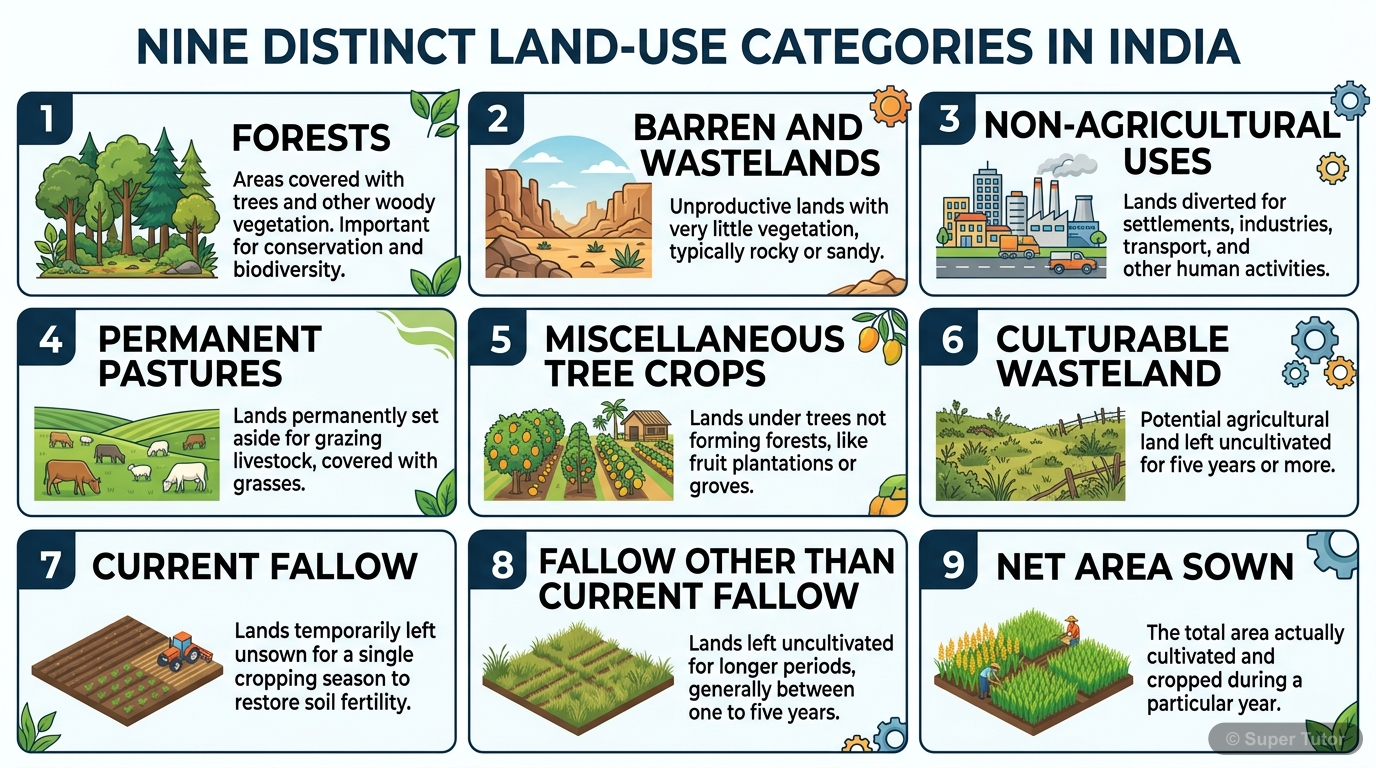
Land Resources and Agriculture
Chhattisgarh Board · Class 12 · Geography
NCERT Solutions for Land Resources and Agriculture — Chhattisgarh Board Class 12 Geography.
Interactive on Super Tutor
Studying Land Resources and Agriculture? Get the full interactive chapter.
Quizzes, flashcards, AI doubt-solver and a step-by-step study plan — built for ncert solutions and more.
1,000+ Class 12 students started this chapter today

This is just one of 8+ visuals inside Super Tutor's Land Resources and Agriculture chapter
Explore the full setEXERCISES — Land Resources and Agriculture
1(i)Which one of the following is NOT a land-use category?
(a) Fallow land
(b) Marginal land
(c) Net Area Sown
(d) Culturable WastelandShow solution
Justification: The standard land-use categories used in India include Fallow land, Net Area Sown, Culturable Wasteland, Forest land, Land put to non-agricultural uses, etc. 'Marginal land' is an economic/agricultural term used to describe land of poor productivity, but it is not an official land-use category in the Indian land-use classification system.
1(ii)What one of the following is the main reason due to which share of forest has shown an increase in the last forty years?
(a) Extensive and efficient efforts of afforestation
(b) Increase in community forest land
(c) Increase in notified area allocated for forest growth
(d) Better peoples' participation in managing forest area.Show solution
Justification: The recorded increase in forest area in India over the last four decades is largely due to the administrative/legal reclassification — i.e., more land has been officially notified and recorded under forest cover by the government. This does not necessarily mean actual tree cover has increased proportionally; it primarily reflects an increase in the notified/reserved area allocated for forests.
1(iii)Which one of the following is the main form of degradation in irrigated areas?
(a) Gully erosion
(b) Wind erosion
(c) Salinisation of soils
(d) Siltation of landShow solution
Justification: In irrigated areas, excessive and faulty irrigation leads to waterlogging, which causes salts to rise to the surface through capillary action. This results in salinisation and alkalisation of soils, making the land infertile. Gully and wind erosion are more characteristic of rainfed/arid areas, not irrigated zones.
1(iv)Which one of the following crops is not cultivated under dryland farming?
(a) Ragi
(b) Jowar
(c) Groundnut
(d) SugarcaneShow solution
Justification: Dryland farming is practised in areas with low rainfall (less than 75 cm annually) and without irrigation. Crops like Ragi, Jowar, and Groundnut are drought-resistant and well-suited to dryland conditions. Sugarcane requires a large and continuous supply of water throughout its long growing season and is therefore a wetland/irrigated crop, not a dryland crop.
1(v)In which of the following group of countries of the world, HYVs of wheat and rice were developed?
(a) Japan and Australia
(b) U.S.A. and Japan
(c) Mexico and Philippines
(d) Mexico and SingaporeShow solution
Justification: High Yielding Varieties (HYVs) of crops were developed as part of the Green Revolution. HYV wheat was developed at the International Maize and Wheat Improvement Centre (CIMMYT) in Mexico, while HYV rice was developed at the International Rice Research Institute (IRRI) in the Philippines. These varieties were later introduced in India in the mid-1960s.
2(i)Differentiate between barren and wasteland and culturable wasteland.Show solution
Difference:
| Basis | Barren and Wasteland | Culturable Wasteland |
|---|---|---|
| Definition | Land that cannot be brought under cultivation at all, even with high investment. | Land that is currently not under cultivation but can be brought under cultivation with effort and investment. |
| Examples | Deserts, rocky mountains, snow-covered peaks, ravines. | Degraded forests, waterlogged land, land affected by salinity — which can be reclaimed. |
| Possibility of cultivation | Not possible. | Possible with reclamation measures. |
In short: Barren wasteland is permanently uncultivable, whereas culturable wasteland is temporarily uncultivated but has the potential to be reclaimed for agriculture.
2(ii)How would you distinguish between net sown area and gross cropped area?Show solution
Net Sown Area (NSA):
- It refers to the total area of land on which crops are sown at least once in a year.
- Each piece of land is counted only once, regardless of how many crops are grown on it.
- It represents the actual physical area under cultivation.
Gross Cropped Area (GCA):
- It refers to the total area sown, counting the same piece of land as many times as crops are grown on it in a year.
- If a farmer grows two crops on the same field in a year, that field is counted twice.
-
Key Distinction: NSA counts physical area once; GCA counts the same area multiple times based on the number of crops grown. GCA is always equal to or greater than NSA.
2(iii)Why is the strategy of increasing cropping intensity important in a country like India?Show solution
Concept: Cropping Intensity =
Importance of increasing cropping intensity:
1. Limited land availability: India has a large population but the scope for expanding Net Sown Area is very limited, as most cultivable land is already under use.
2. Increasing food demand: With a growing population, food production must increase without necessarily bringing new land under cultivation.
3. Better utilisation of land: By growing two or three crops on the same piece of land in a year (multiple cropping), land productivity is maximised.
4. Economic benefit to farmers: Multiple cropping increases farm income without requiring additional land.
Thus, increasing cropping intensity is a sustainable strategy to meet food security goals in India.
2(iv)How do you measure total cultivable land?Show solution
Explanation of components:
- Net Sown Area: Land actually under crops at least once a year.
- Current Fallow: Land left without crops for a period up to one year to restore fertility.
- Fallow other than Current Fallow: Land left uncultivated for 1–5 years.
- Culturable Wasteland: Land not cultivated for more than 5 years but capable of being reclaimed.
Thus, total cultivable land represents the maximum area that can potentially be used for agriculture.
2(v)What is the difference between dryland and wetland farming?Show solution
| Basis | Dryland Farming | Wetland Farming |
|---|---|---|
| Rainfall | Practised in areas with annual rainfall less than 75 cm. | Practised in areas with high rainfall (more than 200 cm) or with assured irrigation. |
| Water source | Depends entirely on rainwater; no irrigation. | Depends on heavy rainfall or irrigation. |
| Crops grown | Drought-resistant crops like Ragi, Bajra, Jowar, Groundnut, Gram. | Water-intensive crops like Rice, Sugarcane, Jute. |
| Region | Rajasthan, parts of Deccan Plateau, semi-arid regions. | West Bengal, Assam, Kerala, coastal areas. |
| Risk | High risk due to dependence on monsoon. | Lower risk due to assured water supply. |
In short: Dryland farming is rain-dependent and practised in low-rainfall areas with drought-resistant crops, while wetland farming requires abundant water and supports water-intensive crops.
3(i)What are the different types of environmental problems of land resources in India?Show solution
Types of Environmental Problems of Land Resources in India:
1. Soil Erosion:
- Water erosion: In humid and semi-arid regions, heavy rainfall causes sheet erosion, rill erosion, and gully erosion, washing away the fertile topsoil. The Chambal ravines are a classic example.
- Wind erosion: In arid and semi-arid regions like Rajasthan, strong winds blow away the topsoil, leading to desertification.
2. Waterlogging:
- Excessive and faulty irrigation, especially in canal-irrigated areas, raises the water table. This deprives plant roots of oxygen and makes the land unfit for cultivation.
- It is a major problem in states like Punjab, Haryana, and Uttar Pradesh.
3. Salinisation and Alkalisation:
- Waterlogging causes salts to accumulate on the soil surface through capillary action, making the soil saline (usar/reh land).
- This severely reduces soil fertility and crop productivity.
- Large tracts of land in irrigated areas of Punjab, Haryana, and UP are affected.
4. Chemical Degradation:
- Excessive use of chemical fertilisers, pesticides, and insecticides has led to the accumulation of toxic substances in the soil profile.
- This destroys soil micro-organisms, reduces natural fertility, and contaminates groundwater.
5. Loss of Natural Fertility:
- Multiple cropping and reduction of fallow periods have reduced the time available for natural processes like nitrogen fixation.
- Displacement of leguminous crops from cropping patterns has further reduced natural soil enrichment.
6. Deforestation and Land Degradation:
- Clearing of forests for agriculture and development exposes soil to erosion and reduces its water-holding capacity.
Conclusion: These problems collectively threaten India's food security and call for sustainable land management practices, including proper irrigation management, organic farming, afforestation, and soil conservation measures.
3(ii)What are the important strategies for agricultural development followed in the post-independence period in India?Show solution
Important Strategies for Agricultural Development in Post-Independence India:
1. Institutional Reforms (1950s):
- Land reforms were introduced to abolish the zamindari system and redistribute land to the actual tillers.
- Consolidation of land holdings was undertaken to reduce fragmentation.
- Cooperative farming was promoted to help small farmers pool resources.
2. Community Development Programme (1952):
- Launched to improve rural infrastructure, irrigation, and agricultural practices through community participation.
3. Expansion of Cultivated Area:
- New land was brought under cultivation by reclaiming wastelands and extending irrigation facilities.
4. Green Revolution (Mid-1960s onwards):
- Introduction of High Yielding Variety (HYV) seeds of wheat (from Mexico) and rice (from Philippines).
- Increased use of chemical fertilisers, pesticides, and irrigation to support HYV crops.
- This dramatically increased food grain production, especially in Punjab, Haryana, and western Uttar Pradesh.
- India achieved self-sufficiency in food grains by the 1970s–80s.
5. Expansion of Irrigation:
- Large-scale development of irrigation infrastructure — major, medium, and minor irrigation projects — to reduce dependence on monsoon.
6. Diversification of Agriculture:
- Promotion of horticulture, floriculture, aquaculture, and animal husbandry to increase farmers' income and reduce over-dependence on food grains.
7. White Revolution (Operation Flood):
- Focused on increasing milk production and making India self-sufficient in dairy products.
8. Technology and Research:
- Establishment of agricultural research institutions (ICAR, agricultural universities) to develop better seeds, farming techniques, and pest management.
9. Liberalisation and Market Reforms (Post-1991):
- Opening of agricultural markets, promotion of contract farming, and encouragement of agro-based industries.
Conclusion: These strategies have transformed Indian agriculture from a subsistence level to a surplus-producing sector. However, challenges like regional disparities, environmental degradation, and farmer indebtedness still need to be addressed for sustainable agricultural development.
Stuck on a step?
Ask Super Tutor AI to explain any solution on this page in a simpler way — free, 24x7.
Ask a Doubt FreeFrequently Asked Questions
What are the important topics in Land Resources and Agriculture for Chhattisgarh Board Class 12 Geography?
How to score full marks in Land Resources and Agriculture — Chhattisgarh Board Class 12 Geography?
Where can I get free NCERT Solutions for Land Resources and Agriculture Class 12 Geography?
Sources & Official References
Content is aligned to the official syllabus. Refer to the board website for the latest curriculum.
More resources for Land Resources and Agriculture
Important Questions
Practice with board exam-style questions
Syllabus
What topics to cover
Revision Notes
Key points for last-minute revision
Study Plan
Step-by-step plan to ace this chapter
Flashcards
Quick-fire cards for active recall
Formula Sheet
All formulas in one place
Chapter Summary
Understand the chapter at a glance
Practice Quiz
Test yourself with a quick quiz
Concept Maps
See how topics connect visually
For serious students
Get the full Land Resources and Agriculture chapter — for free.
Quizzes, flashcards, AI doubt-solver and a step-by-step study plan for Chhattisgarh Board Class 12 Geography.