Getting to know Plants — Practice Quiz
Gujarat Board · Class 6 · Science
Try a 4-question quiz on Getting to know Plants for Gujarat Board Class 6 Science: tap an answer to check it and see why.
Interactive on Super Tutor
Studying Getting to know Plants? Get the full interactive chapter.
Quizzes, flashcards, AI doubt-solver and a step-by-step study plan — built for practice quiz and more.
Free trial, no card needed.
Learn better with visuals Super Tutor pairs illustrations like this with notes and quizzes for Getting to know Plants.
Quick Quiz: Getting to know Plants
0/4Tap an answer to check it instantly. No sign-up needed for these 4.
A student observes a plant with a hard but not very thick stem and notices that the branches grow near the base of the stem. Which category does this plant belong to?
In the coloured water experiment, a soft stem is placed in water mixed with red ink. After some time, the colour appears in the veins of the leaves. Which function of the stem does this experiment BEST demonstrate?
Priya observes that a plant has leaves with parallel venation. Without looking at the roots, what type of root system can she correctly predict this plant has?
During photosynthesis, which of the following is RELEASED by the leaf as a by-product?
Sample Questions
A flower is carefully dissected. The innermost part found after removing the sepals, petals, and stamens is the pistil. Which is the correct order of floral parts from outermost to innermost?
Show answer
Sepals → Petals → Stamens → Pistil
Step 1: A flower has four main whorls (circles of parts) arranged from outside to inside. Step 2: The outermost whorl is the sepals — small, leaf-like structures that protect the bud. Step 3: Inside the sepals are the petals — usually colourful, they attract pollinators. Step 4: Further inside are the stamens — the male reproductive parts of the flower. Step 5: The innermost part is the pistil — the female reproductive part, containing the ovary at its base.
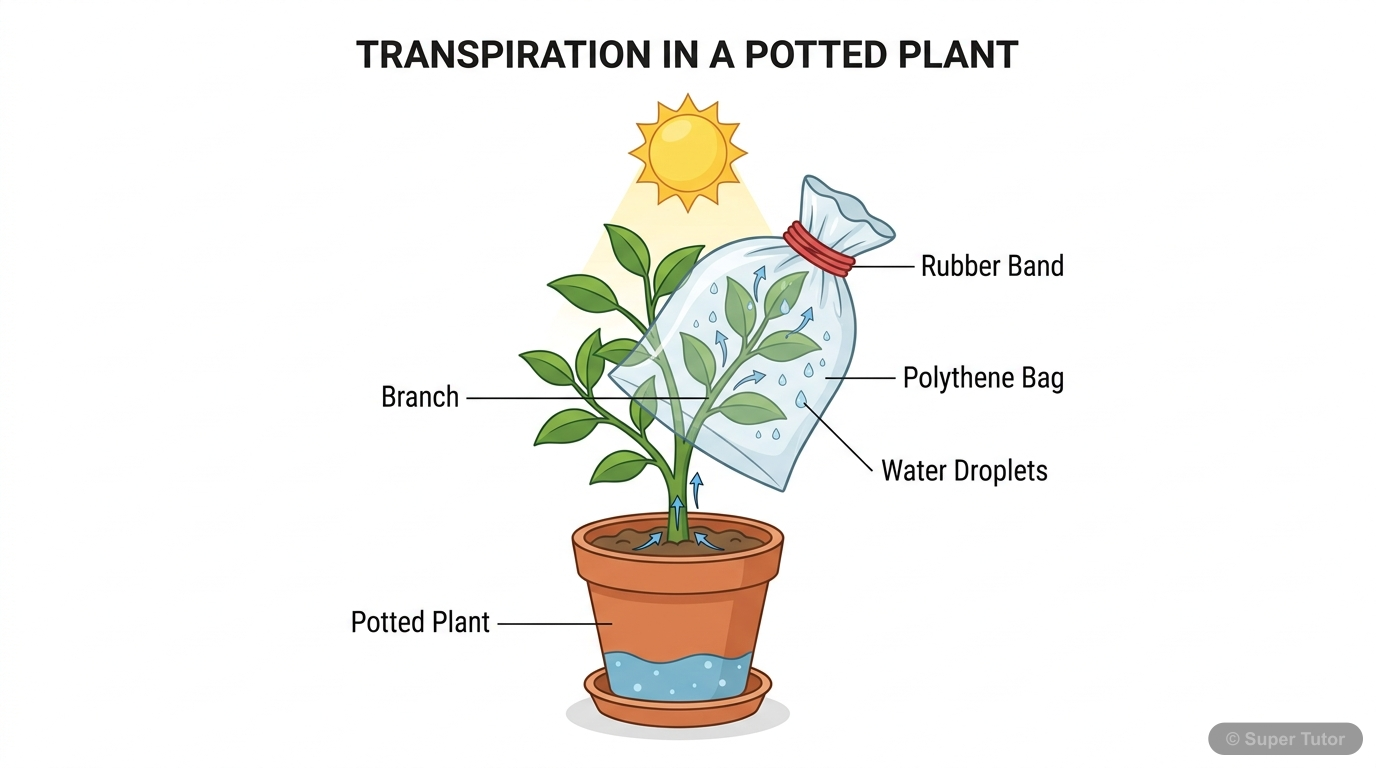
Rohan performs Activity 4 from the chapter — he covers a leafy branch with a polythene bag on a sunny day. After a few hours, he sees water droplets inside the bag. Which process is responsible for this observation?
Show answer
Transpiration
Step 1: The polythene bag is sealed around leaves to trap any gases or water vapour that the leaf releases. Step 2: Leaves release water in the form of vapour through tiny pores — this process is called transpiration. Step 3: The water vapour collects inside the sealed bag and cools, forming water droplets. Step 4: This is similar to water vapour condensing into drops on a cold glass. Step 5: Photosynthesis produces food and releases oxygen — it does not directly release water droplets into the bag.
The starch test is performed on a leaf using iodine solution. The leaf turns blue-black. This result proves that:
Show answer
The leaf has prepared starch through photosynthesis
Step 1: In Activity 5, the green colour (chlorophyll) is removed from the leaf using spirit. Step 2: Iodine solution is then applied — iodine turns blue-black only in the presence of starch. Step 3: The blue-black colour confirms starch is present in the leaf. Step 4: This starch was made BY the leaf through photosynthesis using sunlight, water, and carbon dioxide. Step 5: Plants cannot absorb starch from soil or water — they manufacture it themselves, which is why plants are called producers.
Two plants of the same kind are grown — Plant A has its roots intact, while Plant B has its roots cut off. Both are watered equally. After one week, Plant B wilts and dies. Which TWO functions of roots does this experiment demonstrate?
Show answer
Roots absorb water and minerals AND anchor the plant in the soil
Step 1: Plant B dies even though it is watered — this shows that without roots, the plant cannot absorb water and minerals from the soil. Step 2: The roots are the only organs that can absorb water; without them, the plant starves of water. Step 3: Roots also hold the plant firmly in the soil (anchoring) — without roots, the plant can easily fall over. Step 4: Roots do not produce food — that is the job of leaves through photosynthesis. Step 5: Roots do not absorb sunlight or produce chlorophyll — those functions belong to the leaves.
+40 more questions on Getting to know Plants (Gujarat Board Class 6 Science)
Practise AllFrequently Asked Questions
What are the important topics in Getting to know Plants for Gujarat Board Class 6 Science?
How many practice questions are there for Getting to know Plants?
Sources & Official References
Content is aligned to the official syllabus. Refer to the board website for the latest curriculum.
More resources for Getting to know Plants
For serious students
Get the full Getting to know Plants chapter — start free.
Quizzes, flashcards, an AI doubt solver and a study plan for Gujarat Board Class 6 Science. Free to start, no card needed.