Nutrition in Animals — Practice Quiz
Gujarat Board · Class 7 · Science
Try a 4-question quiz on Nutrition in Animals for Gujarat Board Class 7 Science: tap an answer to check it and see why.
Interactive on Super Tutor
Studying Nutrition in Animals? Get the full interactive chapter.
Quizzes, flashcards, AI doubt-solver and a step-by-step study plan — built for practice quiz and more.
Free trial, no card needed.
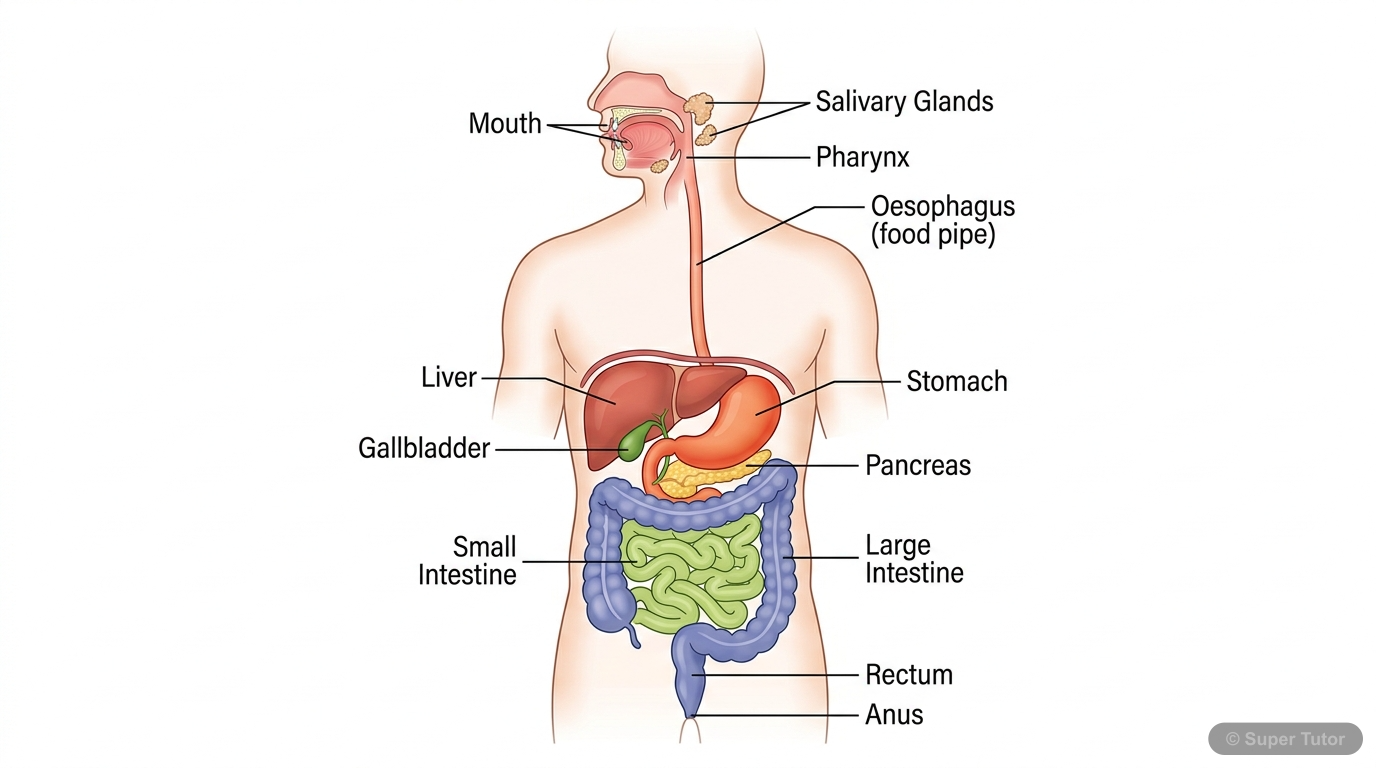
An illustration from Super Tutor's Nutrition in Animals chapter — alongside flashcards, concept maps and practice questions.
Quick Quiz: Nutrition in Animals
0/4Tap an answer to check it instantly. No sign-up needed for these 4.
Which of the following is the correct order of parts in the human alimentary canal?
In the human mouth, saliva acts on which component of food?
Which is the largest gland in the human body and what does it produce that helps in digestion?
What is the main function of villi present in the small intestine?
Sample Questions
In the stomach, hydrochloric acid (HCl) is produced. What is one important role of this acid?
Show answer
It kills harmful bacteria that enter with food and creates an acidic medium for digestive juices
Step 1: The inner lining of the stomach produces three things: mucous, hydrochloric acid (HCl), and digestive juices. Step 2: Mucous protects the stomach lining from the strong acid. Step 3: The hydrochloric acid serves two important purposes — it kills many harmful bacteria that enter the body along with food, keeping us safe from infections. Step 4: It also makes the environment inside the stomach acidic, which helps the digestive juices (enzymes) work properly to break down proteins. Step 5: Carbohydrate digestion starts in the mouth and is completed in the small intestine — NOT in the stom
What is the process called when digested food is taken into the cells of the body and used to make complex substances like proteins?
Show answer
Assimilation
Step 1: Nutrition in animals involves five steps: Ingestion → Digestion → Absorption → Assimilation → Egestion. Step 2: Digestion is the breaking down of complex food into simpler substances. Step 3: Absorption is when the digested food passes from the small intestine into the blood vessels. Step 4: Assimilation is the process where the absorbed nutrients (like amino acids) are taken up by body cells and used to build complex substances needed by the body, such as proteins for muscles and tissues. Step 5: Egestion is the removal of undigested waste from the body through the anus. So absorption
Cows and buffaloes can digest grass easily but humans cannot. Which carbohydrate is present in grass that humans cannot digest?
Show answer
Cellulose
Step 1: Grass and leafy plants are rich in cellulose, which is a type of carbohydrate that forms the cell walls of plants. Step 2: Humans do not have the special bacteria or enzymes needed to break down cellulose, so we cannot digest it. Step 3: Ruminants like cows, buffaloes, and deer have a special part of their stomach called the rumen, where bacteria live and help digest cellulose. Step 4: Animals like horses and rabbits have a large sac called the caecum where similar bacteria help digest cellulose. Step 5: Glucose and starch are easily digested by humans. Glycerol is a product of fat dig
What is rumination in ruminant animals?
Show answer
The process where swallowed food (cud) returns to the mouth and is chewed again
Step 1: Ruminants like cows, buffaloes, goats, and deer eat grass very quickly and swallow it. Step 2: This quickly swallowed, partially digested food is stored in a special part of the stomach called the rumen — this stored food is called cud. Step 3: Later, when the animal is resting, the cud comes back up from the rumen into the mouth in small lumps. Step 4: The animal then chews this cud properly and slowly — this is called rumination (you may have seen cows 'chewing' even when they are not eating anything new). Step 5: This process helps ruminants break down the tough grass and cellulose
+41 more questions on Nutrition in Animals (Gujarat Board Class 7 Science)
Practise AllFrequently Asked Questions
What are the important topics in Nutrition in Animals for Gujarat Board Class 7 Science?
How many practice questions are there for Nutrition in Animals?
Sources & Official References
Content is aligned to the official syllabus. Refer to the board website for the latest curriculum.
More resources for Nutrition in Animals
For serious students
Get the full Nutrition in Animals chapter — start free.
Quizzes, flashcards, an AI doubt solver and a study plan for Gujarat Board Class 7 Science. Free to start, no card needed.