The Delhi Sultanate
Gujarat Board · Class 7 · Social Science
Most important questions from The Delhi Sultanate for Gujarat Board Class 7 Social Science board exam 2026. MCQs, short answer, and long answer questions with marks.
Interactive on Super Tutor
Studying The Delhi Sultanate? Get the full interactive chapter.
Quizzes, flashcards, AI doubt-solver and a step-by-step study plan — built for important questions and more.
1,000+ Class 7 students started this chapter today
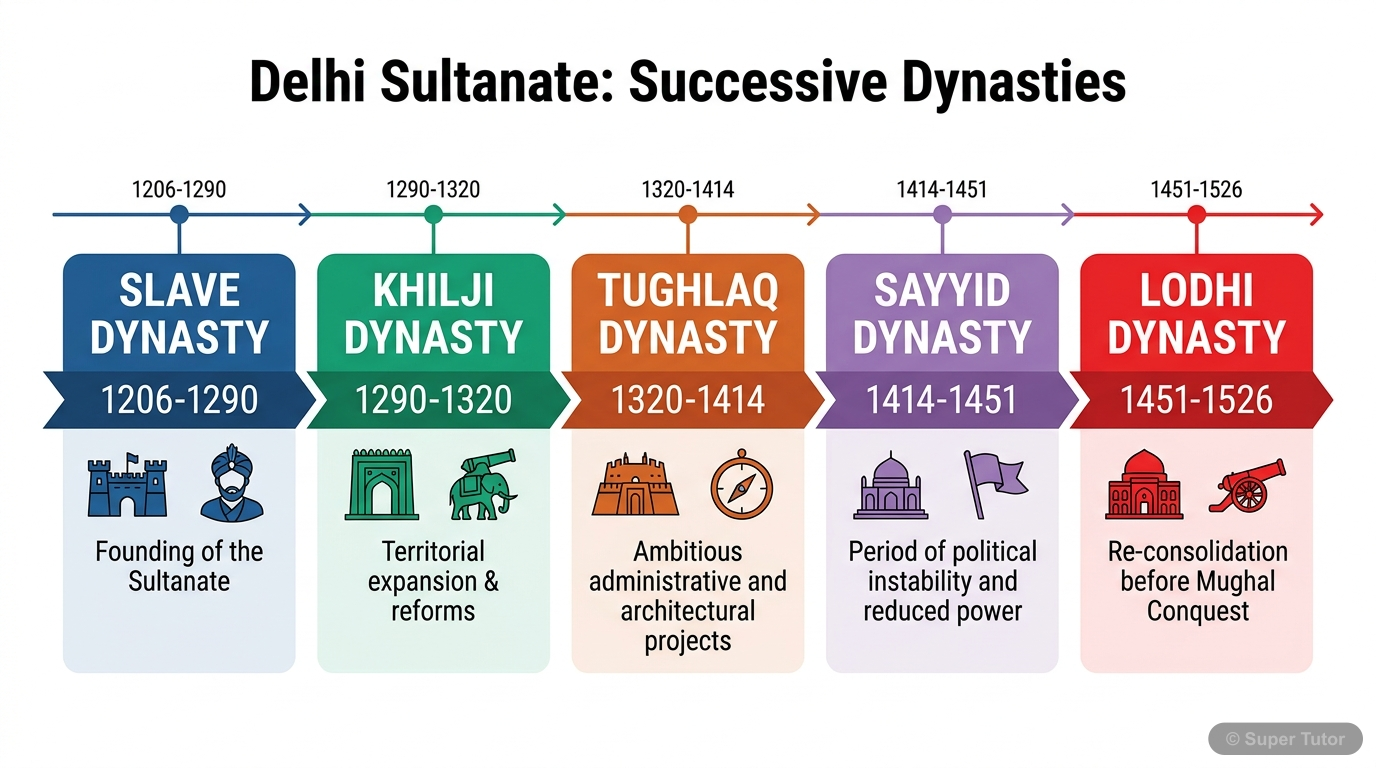
Super Tutor has 5+ illustrations like this for The Delhi Sultanate alone — flashcards, concept maps, and step-by-step visuals.
See them allSample Questions
Which of the following administrative reforms was introduced by Alauddin Khilji?
Show answer
Market control, price regulation, and the Daag-Chehra system for the army
Step 1: Alauddin Khilji was the most powerful ruler of the Khilji Dynasty (1290–1320 A.D.). Step 2: He introduced the 'Daag' (mark on horses) and 'Chehra' (face/description of soldiers) system to identify army horses and soldiers and prevent fraud. Step 3: He also introduced a market control system — fixing prices of goods to prevent hoarding and profiteering. Step 4: Shifting the capital to Daulatabad was done by Mohammad-Bin-Tughlaq of the Tughlaq Dynasty — not Alauddin. Step 5: The division into Iqtas was an earlier system, and the Chahalgani was created by Iltutmish.
Which traveller visited India during the reign of Mohammad-Bin-Tughlaq?
Show answer
Ibn Batuta
Step 1: Mohammad-Bin-Tughlaq was one of the most talented but controversial rulers of the Tughlaq Dynasty (1320–1414 A.D.). Step 2: Ibn Batuta was a famous African traveller who visited India during his reign and wrote detailed accounts of his experiences. Step 3: His writings give us valuable historical information about India during the Tughlaq period. Step 4: Marco Polo was a European traveller who visited India earlier during the time of the Mongol Empire. Step 5: Hiuen Tsang and Fa Hien were Chinese travellers who visited India during the ancient period (Gupta age) — not during the Delhi
Why are the schemes of Mohammad-Bin-Tughlaq called 'eccentric schemes' in history?
Show answer
They were good ideas but failed due to lack of practicality and poor implementation
Step 1: Mohammad-Bin-Tughlaq introduced bold schemes like shifting the capital from Delhi to Daulatabad and introducing token/symbolic currency. Step 2: These were not necessarily bad ideas in theory — shifting to Daulatabad could centralise power, and token currency is used in modern economies. Step 3: However, they failed because they were not practically planned — people suffered greatly during the forced mass migration to Daulatabad. Step 4: The token currency scheme also failed because fake coins flooded the market, causing economic chaos. Step 5: Because these schemes seemed intelligent
Who was the Sultan at the center of the Delhi Sultanate's administrative system and what was his chief minister called?
Show answer
The Sultan was supreme; his chief minister was called Vazir
Step 1: The administrative system of the Delhi Sultanate had the Sultan at the very center. Step 2: The Sultan held supreme power — he was the supreme commander of the army, the head of the executive, and the chief judge. Step 3: To help him run the administration, there was a cabinet, and the head of this cabinet (the chief minister) was called the 'Vazir.' Step 4: The Iqtadar (or Mukti) was the head of a province (Iqta), not the chief minister at the centre. Step 5: The Mukhi or Mukadam was the head of village administration at the local level — not the central minister.
+40 more questions available
Practice AllFrequently Asked Questions
What are the important topics in The Delhi Sultanate for Gujarat Board Class 7 Social Science?
How to score full marks in The Delhi Sultanate — Gujarat Board Class 7 Social Science?
How many important questions are there in The Delhi Sultanate?
Sources & Official References
Content is aligned to the official syllabus. Refer to the board website for the latest curriculum.
More resources for The Delhi Sultanate
Practice Quiz
Test yourself with a quick quiz
Revision Notes
Key points for last-minute revision
Formula Sheet
All formulas in one place
Chapter Summary
Understand the chapter at a glance
Concept Maps
See how topics connect visually
Study Plan
Step-by-step plan to ace this chapter
Flashcards
Quick-fire cards for active recall
Syllabus
What topics to cover
NCERT Solutions
Every textbook question solved step by step
For serious students
Get the full The Delhi Sultanate chapter — for free.
Quizzes, flashcards, AI doubt-solver and a step-by-step study plan for Gujarat Board Class 7 Social Science.