The Delhi Sultanate — Revision Notes
Gujarat Board · Class 7 · Social Science
The Delhi Sultanate revision notes for Gujarat Board Class 7 Social Science: 4 topics in quick points. Includes Establishment and Background of Delhi.
Interactive on Super Tutor
Studying The Delhi Sultanate? Get the full interactive chapter.
Quizzes, flashcards, AI doubt-solver and a step-by-step study plan — built for revision notes and more.
Free trial, no card needed.
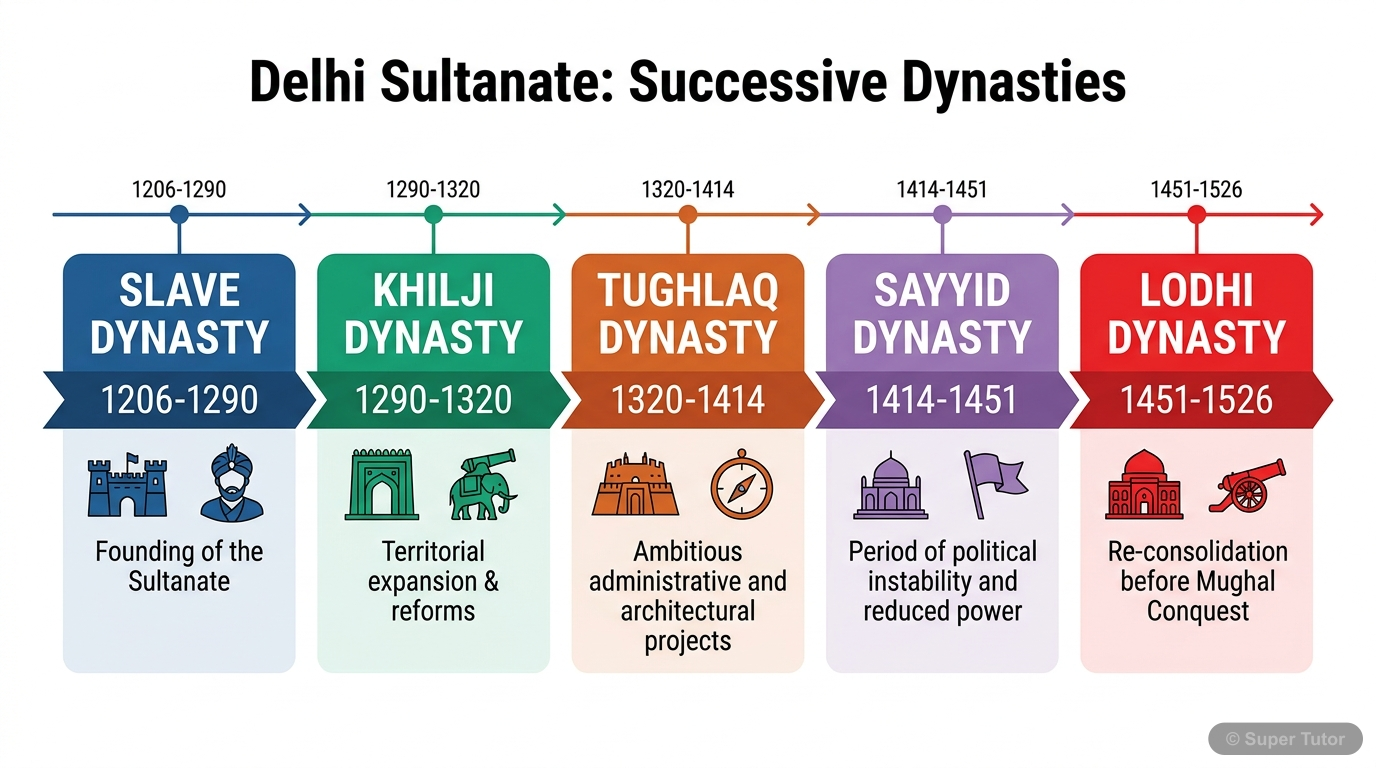
Learn better with visuals Super Tutor pairs illustrations like this with notes and quizzes for The Delhi Sultanate.
Key Topics to Revise
Establishment and Background of Delhi Sultanate
- Delhi was an important centre of trade and politics since ancient times under Tomar and Chauhan Rajputs.
- In the Second Battle of Tarai (1192 A.D.), Shihabuddin Ghori defeated Prithviraj Chauhan — this was the turning point that led to the Delhi Sultanate.
- The Delhi Sultanate was formally established in 1206 A.D. when Qutubuddin Aibak became the first Sultan.
The Five Dynasties and Their Important Rulers
- SLAVE DYNASTY (1206–1290 A.D.): Founded by Qutubuddin Aibak, who died in 1210 A.D. after falling from a horse while playing polo.
- Iltutmish (Aibak's slave and son-in-law) is considered the TRUE FOUNDER of the Slave Dynasty — he shifted the capital from Lahore to Delhi and established 'Chahalgani' (a group of 40 Turkish nobles).
- Razia Sultana was the FIRST WOMAN RULER of Delhi, appointed by her father Iltutmish. Historian Minhaj-e-Siraj praised her abilities.
State Administration of the Delhi Sultanate
- The Sultan was at the centre of all power — supreme commander, head of executive, and supreme judge.
- A cabinet (council of ministers) helped the Sultan; all ministers were appointed by the Sultan.
- Administration was divided into three levels: Central, Provincial, and Local.
Architecture and Constructions of the Delhi Sultanate
- The Delhi Sultanate began a new style of architecture called Indo-Islamic style — a blend of Indian and Islamic building traditions.
- Buildings constructed included: forts, mosques, tombs, houses, gardens, gates, and minarets.
- QUTUBUDDIN AIBAK'S CONSTRUCTIONS: Kuwat-ul-Islam mosque (Delhi), Qutub Minar (first floor only), Dhai-Din-ka-Jhopda mosque (Ajmer).
Get complete notes with diagrams and examples
Full NotesKey Concepts
Frequently Asked Questions
What are the important topics in The Delhi Sultanate for Gujarat Board Class 7 Social Science?
How should I revise The Delhi Sultanate for Class 7 exams?
Sources & Official References
Content is aligned to the official syllabus. Refer to the board website for the latest curriculum.
More resources for The Delhi Sultanate
For serious students
Get the full The Delhi Sultanate chapter — start free.
Quizzes, flashcards, an AI doubt solver and a study plan for Gujarat Board Class 7 Social Science. Free to start, no card needed.