Determination of Income and Employment — Chapter Summary
Haryana Board · Class 12 · Economics
Summary of Determination of Income and Employment for Haryana Board Class 12 Economics. Part of the Haryana Board Class 12 Economics syllabus.
Interactive on Super Tutor
Studying Determination of Income and Employment? Get the full interactive chapter.
Quizzes, flashcards, AI doubt-solver and a step-by-step study plan — built for chapter summary and more.
Free trial, no card needed.
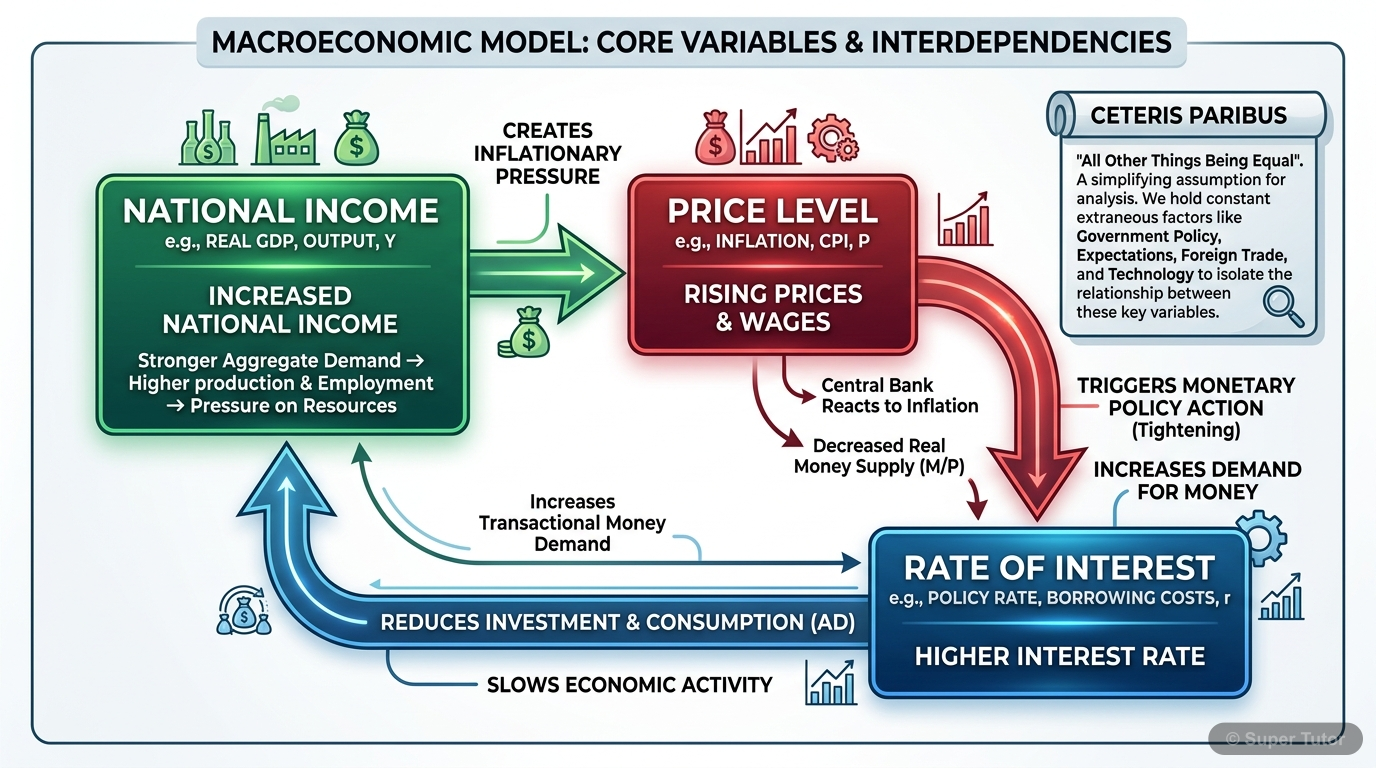
One of 12 illustrations for Determination of Income and Employment in Super Tutor — alongside flashcards, concept maps and practice questions.
Overview
National income, output, consumption, investment, and employment are determined by the interaction of aggregate demand and aggregate supply under fixed prices in the short run. The chapter uses Keynesian analysis to explain how planned spending, autonomous expenditure, the consumption function, and
Key Concepts
Ex ante values are planned measures
Ex ante values are planned measures of consumption, investment, or output. Ex post values are actual accounting measures of what has happened. Planned
Consumption is given by C =
Consumption is given by C = C̄ + cY. Autonomous consumption C̄ is independent of income, while induced consumption cY rises with income.
MPC = ΔC/ΔY = c
MPC = ΔC/ΔY = c. It lies between 0 and 1 inclusive, so additional income is either fully saved, fully consumed, or partly consumed and partly saved.
Savings equals income minus consumption
Savings equals income minus consumption: S = Y - C. Marginal Propensity to Save is MPS = ΔS/ΔY = s = 1-c, so s + c = 1.
Investment is assumed autonomous and constant
Investment is assumed autonomous and constant: I = Ī. It does not depend on income in the simple model.
Learning Objectives
- Understand the difference between ex ante and ex post measures
- Explain the consumption function and the roles of autonomous consumption and MPC
- Describe savings, MPS, and their relationship with consumption
- Understand autonomous investment and aggregate demand in the two-sector model
- Derive equilibrium income where ex ante aggregate demand equals ex ante aggregate supply
Frequently Asked Questions
What are the important topics in Determination of Income and Employment for Haryana Board Class 12 Economics?
How should I revise Determination of Income and Employment for the Haryana Board Class 12 board exam?
Sources & Official References
Content is aligned to the official syllabus. Refer to the board website for the latest curriculum.
More resources for Determination of Income and Employment
Practice Quiz
Test yourself with a quick quiz
Important Questions
Exam-style questions with answers
Revision Notes
Key points for last-minute revision
Formula Sheet
The chapter's formulas in one place
Concept Maps
See how topics connect
Study Plan
Step-by-step plan for this chapter
Flashcards
Quick-fire cards for active recall
Syllabus
What topics to cover
NCERT Solutions
Every textbook question solved step by step
For serious students
Get the full Determination of Income and Employment chapter — start free.
Quizzes, flashcards, an AI doubt solver and a study plan for Haryana Board Class 12 Economics. Free to start, no card needed.