Determination of Income and Employment — Important Questions
Haryana Board · Class 12 · Economics
34 important questions from Determination of Income and Employment for Haryana Board Class 12 Economics, with answers. Written for the board exams 2027.
Interactive on Super Tutor
Studying Determination of Income and Employment? Get the full interactive chapter.
Quizzes, flashcards, AI doubt-solver and a step-by-step study plan — built for important questions and more.
Free trial, no card needed.
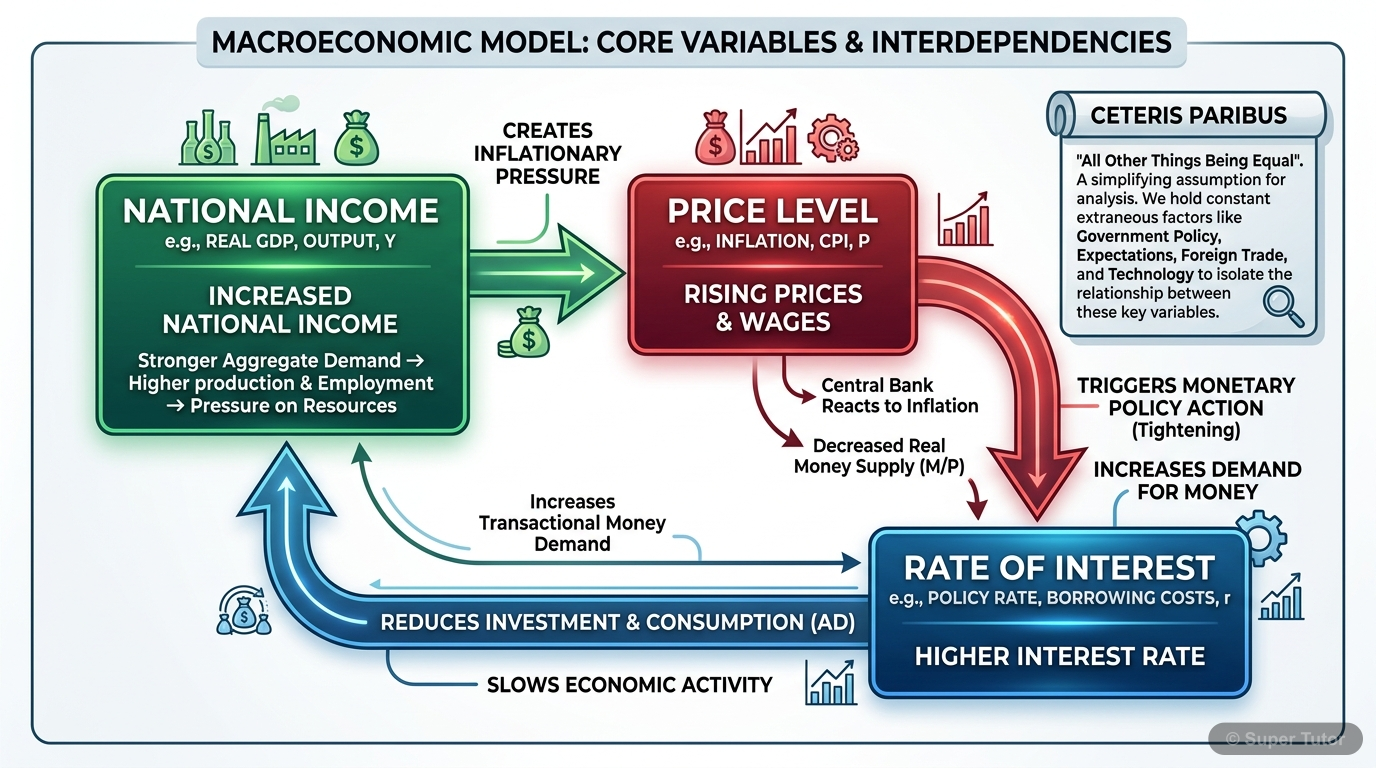
One of 12 illustrations for Determination of Income and Employment in Super Tutor — alongside flashcards, concept maps and practice questions.
Important Questions from Determination of Income and Employment
Which of the following are components of aggregate demand in a two-sector economy?
Show answer
Consumption, Investment
In a two-sector economy (without government and foreign trade), aggregate demand consists of only consumption (C) and investment (I). Government expenditure and net exports are included in three-sector and four-sector models respectively. Savings is not a component of aggregate demand.
In the Keynesian model, what assumption is made about investment?
Show answer
Investment is autonomous
In the simple Keynesian model, investment is assumed to be autonomous, meaning it is independent of the current income level. It is represented as Ī (I bar), a constant value determined by factors other than current income.
What does equilibrium in the goods market mean?
Show answer
Ex ante aggregate demand equals ex ante aggregate supply
Equilibrium in the goods market occurs when planned (ex ante) aggregate demand equals planned (ex ante) aggregate supply. At this point, there is no tendency for output or income to change.
Which of the following statements about the multiplier are correct?
Show answer
It measures the ratio of change in income to change in autonomous expenditure, Its value is 1/(1-c) where c is MPC, Higher MPC leads to higher multiplier
The multiplier shows how much total income changes due to a change in autonomous expenditure. Its formula is 1/(1-c) or 1/MPS. Higher MPC means lower MPS, leading to a higher multiplier. It is always positive and applies to any autonomous expenditure change.
+30 more questions on Determination of Income and Employment (Haryana Board Class 12 Economics)
Practise AllFrequently Asked Questions
What are the important topics in Determination of Income and Employment for Haryana Board Class 12 Economics?
How many important questions are there in Determination of Income and Employment?
Sources & Official References
Content is aligned to the official syllabus. Refer to the board website for the latest curriculum.
More resources for Determination of Income and Employment
Practice Quiz
Test yourself with a quick quiz
Revision Notes
Key points for last-minute revision
Formula Sheet
The chapter's formulas in one place
Chapter Summary
Understand the chapter at a glance
Concept Maps
See how topics connect
Study Plan
Step-by-step plan for this chapter
Flashcards
Quick-fire cards for active recall
Syllabus
What topics to cover
NCERT Solutions
Every textbook question solved step by step
For serious students
Get the full Determination of Income and Employment chapter — start free.
Quizzes, flashcards, an AI doubt solver and a study plan for Haryana Board Class 12 Economics. Free to start, no card needed.