Arithmetic Progressions — NCERT Solutions
Himachal Pradesh Board · Class 10 · Mathematics
NCERT Solutions for Arithmetic Progressions, Himachal Pradesh Board Class 10 Mathematics: 49 textbook questions solved step by step.
Interactive on Super Tutor
Studying Arithmetic Progressions? Get the full interactive chapter.
Quizzes, flashcards, AI doubt-solver and a step-by-step study plan — built for NCERT solutions and more.
Free trial, no card needed.
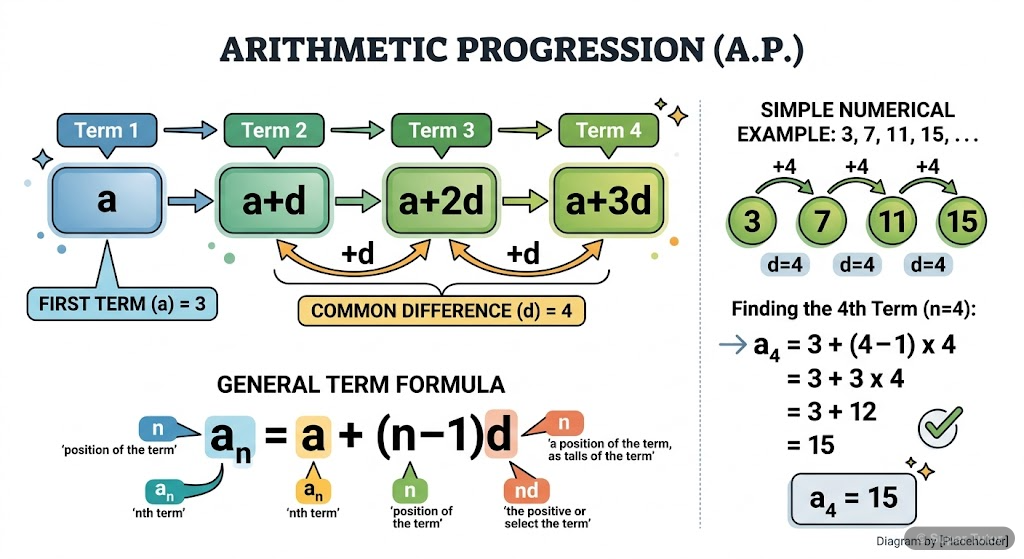
Learn better with visuals Super Tutor pairs illustrations like this with notes and quizzes for Arithmetic Progressions.
The first 25 solutions are open to read. The other 24 are free with a Super Tutor account.
Exercise 5.1
1In which of the following situations, does the list of numbers involved make an arithmetic progression, and why?
(i) The taxi fare after each km when the fare is ₹ 15 for the first km and ₹ 8 for each additional km.
(ii) The amount of air present in a cylinder when a vacuum pump removes 1/4 of the air remaining in the cylinder at a time.
(iii) The cost of digging a well after every metre of digging, when it costs ₹ 150 for the first metre and rises by ₹ 50 for each subsequent metre.
(iv) The amount of money in the account every year, when ₹ 10000 is deposited at compound interest at 8% per annum.Show solution
(i) Taxi fare situation:
Given: Fare for 1st km = ₹15, each additional km = ₹8.
Fare after 1st km = ₹15
Fare after 2nd km = ₹15 + ₹8 = ₹23
Fare after 3rd km = ₹23 + ₹8 = ₹31
Fare after 4th km = ₹31 + ₹8 = ₹39
The list is: 15, 23, 31, 39, …
Differences: , ,
Since each successive difference is the same (= 8), this list forms an AP with and .
(ii) Air in cylinder:
Let initial amount of air = .
After 1st pump:
After 2nd pump:
After 3rd pump:
The list is:
Difference:
Since , the differences are not equal.
This list does NOT form an AP.
(iii) Cost of digging a well:
Cost for 1st metre = ₹150
Cost for 2nd metre = ₹150 + ₹50 = ₹200
Cost for 3rd metre = ₹200 + ₹50 = ₹250
Cost for 4th metre = ₹250 + ₹50 = ₹300
The list is: 150, 200, 250, 300, …
Differences: , ,
Since each successive difference is the same (= 50), this list forms an AP with and .
(iv) Compound interest:
Amount after 1st year =
Amount after 2nd year =
Amount after 3rd year =
Differences: ;
Since the differences are not equal, this list does NOT form an AP.
2Write first four terms of the AP, when the first term and the common difference are given as follows:
(i) ,
(ii) ,
(iii) ,
(iv) ,
(v) , Show solution
The first four terms of an AP are: .
(i) ,
First four terms: 10, 20, 30, 40
(ii) ,
First four terms: 4, 1, −2, −5
(iii) ,
First four terms: −2, −2, −2, −2
(iv) ,
First four terms:
(v) ,
First four terms: −1.25, −1.50, −1.75, −2.00
3For the following APs, write the first term and the common difference:
(i)
(ii)
(iii)
(iv) Show solution
(i)
First term
Common difference
(ii)
First term
Common difference
(iii)
First term
Common difference
(iv)
First term
Common difference
4Which of the following are APs? If they form an AP, find the common difference and write three more terms.
(i)
(ii)
(iii)
(iv)
(v)
(vi)
(vii)
(viii)
(ix)
(x)
(xii)
(xiii)
(xiv) Show solution
(i)
Since , this is NOT an AP.
(ii)
This is an AP with .
Next three terms:
Three more terms:
(iii)
This is an AP with .
Next three terms:
Three more terms:
(iv)
This is an AP with .
Next three terms:
Three more terms:
(v)
This is an AP with .
Next three terms:
Three more terms:
(vi)
Since , this is NOT an AP.
(vii)
This is an AP with .
Next three terms:
Three more terms:
(viii)
, ,
This is an AP with .
Next three terms:
(ix)
Since , this is NOT an AP.
(x)
This is an AP with .
Next three terms:
Three more terms:
(xii)
Simplify:
This is an AP with .
Next three terms:
Three more terms:
(xiii)
Since and , these are not equal.
This is NOT an AP.
(xiv) i.e.,
This is an AP with .
Next three terms:
Three more terms:
Exercise 5.2
1Fill in the blanks in the following table, given that is the first term, the common difference and the th term of the AP:
(i) , , ,
(ii) , , ,
(iii) , , ,
(iv) , , ,
(v) , , , Show solution
Using the formula :
(i) , ,
(ii) , ,
(iii) , ,
(iv) , ,
(v) , ,
2Choose the correct choice in the following and justify:
(i) 30th term of the AP: 10, 7, 4, ..., is
(A) 97 (B) 77 (C) -77 (D) -87
(ii) 11th term of the AP: -3, -1/2, 2, ..., is
(A) 28 (B) 22 (C) -38 (D) -48½Show solution
(i) AP: 10, 7, 4, …
,
Correct option: (C) −77
(ii) AP:
,
Correct option: (B) 22
3In the following APs, find the missing terms in the boxes:
(i) 2, □, 26
(ii) □, 13, □, 3
(iii) 5, □, □, 9½
(iv) -4, □, □, □, □, 6
(v) □, 38, □, □, □, -22Show solution
(i) 2, □, 26
Here , .
Missing term: 14
(ii) □, 13, □, 3
,
Missing terms: 18, 8
(iii) 5, □, □,
,
Missing terms: ,
(iv) , □, □, □, □,
,
Missing terms: −2, 0, 2, 4
(v) □, 38, □, □, □,
,
Missing terms: 53, 23, 8, −7
4Which term of the AP: 3, 8, 13, 18, ..., is 78?Show solution
Given AP: 3, 8, 13, 18, …
,
Let .
Using :
78 is the 16th term of the AP.
5Find the number of terms in each of the following APs:
(i) 7, 13, 19, ..., 205
(ii) 18, 15½, 13, ..., -47Show solution
(i) 7, 13, 19, …, 205
, ,
There are 34 terms.
(ii)
, ,
There are 27 terms.
6Check whether -150 is a term of the AP: 11, 8, 5, 2, ...Show solution
Given AP: 11, 8, 5, 2, …
,
Assume .
Since is not a natural number, −150 is NOT a term of this AP.
7Find the 31st term of an AP whose 11th term is 38 and the 16th term is 73.Show solution
Given: and .
Using :
Subtracting (1) from (2):
From (1):
The 31st term is 178.
8An AP consists of 50 terms of which 3rd term is 12 and the last term is 106. Find the 29th term.Show solution
Given: , , .
Subtracting (1) from (2):
From (1):
The 29th term is 64.
9If the 3rd and the 9th terms of an AP are 4 and -8 respectively, which term of this AP is zero?Show solution
Given: and .
Subtracting (1) from (2):
From (1):
Let :
The 5th term of this AP is zero.
10The 17th term of an AP exceeds its 10th term by 7. Find the common difference.Show solution
Given:
The common difference is 1.
11Which term of the AP: 3, 15, 27, 39, ... will be 132 more than its 54th term?Show solution
Given AP: 3, 15, 27, 39, …
,
First, find the 54th term:
Let the required term be :
The 65th term is 132 more than the 54th term.
12Two APs have the same common difference. The difference between their 100th terms is 100, what is the difference between their 1000th terms?Show solution
Let the two APs have first terms and respectively, with the same common difference .
100th term of 1st AP:
100th term of 2nd AP:
Given:
1000th term of 1st AP:
1000th term of 2nd AP:
Difference
The difference between their 1000th terms is also 100.
13How many three-digit numbers are divisible by 7?Show solution
The smallest three-digit number divisible by 7:
remainder , so smallest =
The largest three-digit number divisible by 7:
remainder , so largest =
AP: 105, 112, 119, …, 994 with , ,
There are 128 three-digit numbers divisible by 7.
14How many multiples of 4 lie between 10 and 250?Show solution
The smallest multiple of 4 greater than 10 is 12.
The largest multiple of 4 less than 250 is 248.
AP: 12, 16, 20, …, 248 with , ,
There are 60 multiples of 4 between 10 and 250.
15For what value of , are the th terms of two APs: 63, 65, 67, ... and 3, 10, 17, ... equal?Show solution
AP 1: 63, 65, 67, … → ,
th term:
AP 2: 3, 10, 17, … → ,
th term:
Setting them equal:
The 13th terms of the two APs are equal.
16Determine the AP whose third term is 16 and the 7th term exceeds the 5th term by 12.Show solution
Given: and .
From :
From :
The AP is:
The AP is 4, 10, 16, 22, 28, …
17Find the 20th term from the last term of the AP: 3, 8, 13, ..., 253.Show solution
Given AP: 3, 8, 13, …, 253
, , last term
The 20th term from the last term is the same as the 20th term of the AP written in reverse, which has first term 253 and common difference .
The 20th term from the last is 158.
18The sum of the 4th and 8th terms of an AP is 24 and the sum of the 6th and 10th terms is 44. Find the first three terms of the AP.Show solution
Given: and .
Subtracting (1) from (2):
From (1):
First three terms:
The first three terms are −13, −8, −3.
19Subba Rao started work in 1995 at an annual salary of ₹ 5000 and received an increment of ₹ 200 each year. In which year did his income reach ₹ 7000?Show solution
Given: , , .
The 11th year from 1995 is .
Subba Rao's income reached ₹ 7000 in the year 2005.
20Ramkali saved ₹ 5 in the first week of a year and then increased her weekly savings by ₹ 1.75. If in the th week, her weekly savings become ₹ 20.75, find .Show solution
Given: , , .
In the 10th week, her savings become ₹ 20.75.
Exercise 5.3
1Find the sum of the following APs:
(i) 2, 7, 12, …, to 10 terms.
(ii) -37, -33, -29, …, to 12 terms.
(iii) 0.6, 1.7, 2.8, …, to 100 terms.
(iv) 1/15, 1/12, 1/10, …, to 11 terms.Show solution
Using :
(i) , ,
Sum = 245
(ii) , ,
Sum = −180
(iii) , ,
Sum = 5505
(iv) , ,
Sum =
(i)
(ii)
(iii)
Free with a Super Tutor account
(i) given , , , find and .
(ii) given , , find and .
(iii) given , , find and .
(iv) given , , find and .
(v) given , , find and .
(vi) given , , , find and .
(vii) given , , , find and .
(viii) given , , , find and .
(ix) given , , , find .
(x) given , , and there are total 9 terms. Find .
Free with a Super Tutor account
Free with a Super Tutor account
Free with a Super Tutor account
Free with a Super Tutor account
Free with a Super Tutor account
Free with a Super Tutor account
Free with a Super Tutor account
(i)
(ii)
Also find the sum of the first 15 terms in each case.
Free with a Super Tutor account
Free with a Super Tutor account
Free with a Super Tutor account
Free with a Super Tutor account
Free with a Super Tutor account
Free with a Super Tutor account
Free with a Super Tutor account
Free with a Super Tutor account
Free with a Super Tutor account
Free with a Super Tutor account
Free with a Super Tutor account
Exercise 5.4 (Optional)
Free with a Super Tutor account
Free with a Super Tutor account
Free with a Super Tutor account
Free with a Super Tutor account
Free with a Super Tutor account
24 more solved questions in Arithmetic Progressions
They are free with a Super Tutor account, along with practice quizzes and flashcards for this chapter. Free to start, no card needed.
Frequently Asked Questions
What are the important topics in Arithmetic Progressions for Himachal Pradesh Board Class 10 Mathematics?
Are these NCERT Solutions for Arithmetic Progressions free?
How should I revise Arithmetic Progressions for the Himachal Pradesh Board Class 10 board exam?
Sources & Official References
Content is aligned to the official syllabus. Refer to the board website for the latest curriculum.
More resources for Arithmetic Progressions
Practice Quiz
Test yourself with a quick quiz
Important Questions
Exam-style questions with answers
Revision Notes
Key points for last-minute revision
Formula Sheet
The chapter's formulas in one place
Chapter Summary
Understand the chapter at a glance
Concept Maps
See how topics connect
Study Plan
Step-by-step plan for this chapter
Flashcards
Quick-fire cards for active recall
Syllabus
What topics to cover
For serious students
Get the full Arithmetic Progressions chapter — start free.
Quizzes, flashcards, an AI doubt solver and a study plan for Himachal Pradesh Board Class 10 Mathematics. Free to start, no card needed.