Circles — NCERT Solutions
Himachal Pradesh Board · Class 10 · Mathematics
NCERT Solutions for Circles, Himachal Pradesh Board Class 10 Mathematics: 17 textbook questions solved step by step.
Interactive on Super Tutor
Studying Circles? Get the full interactive chapter.
Quizzes, flashcards, AI doubt-solver and a step-by-step study plan — built for NCERT solutions and more.
Free trial, no card needed.
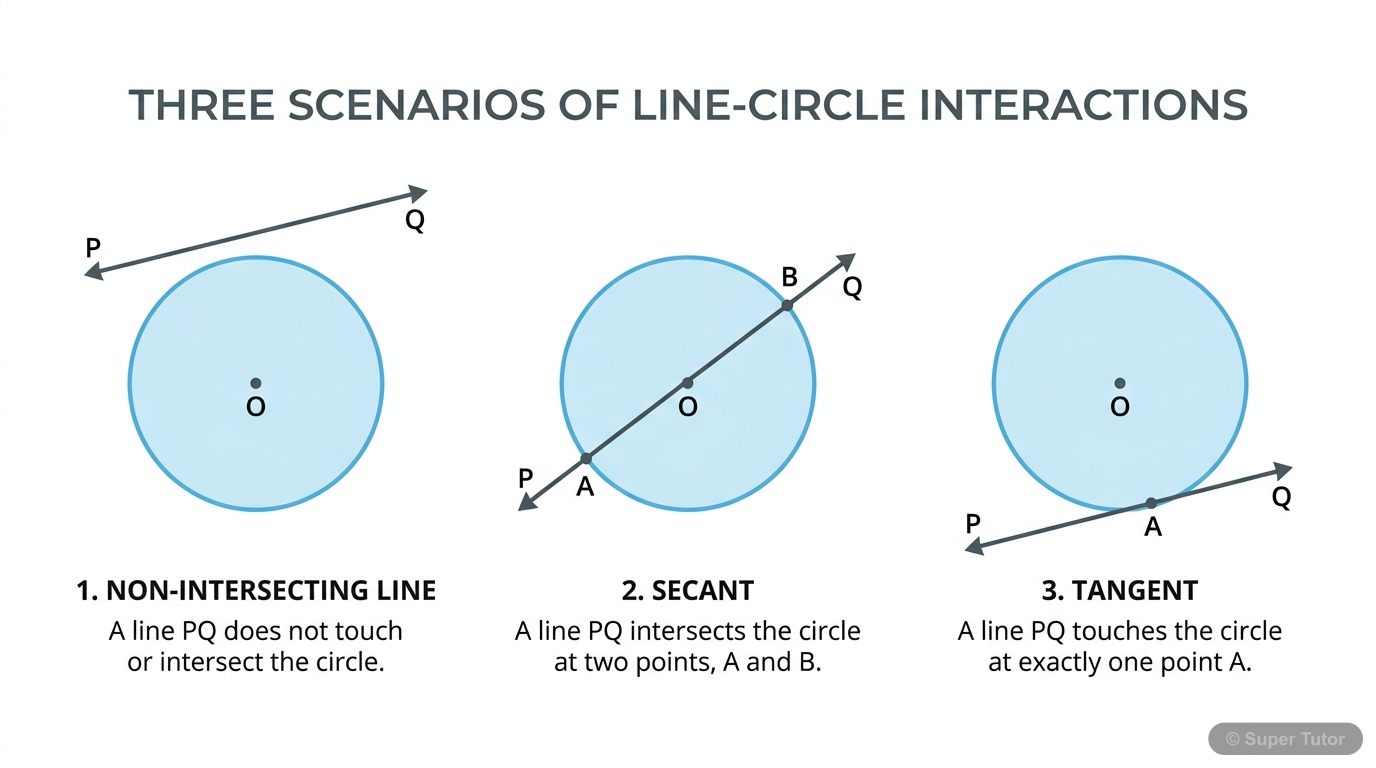
Learn better with visuals Super Tutor pairs illustrations like this with notes and quizzes for Circles.
The first 9 solutions are open to read. The other 8 are free with a Super Tutor account.
Exercise 10.1
1How many tangents can a circle have?Show solution
A circle can have infinitely many tangents.
Reason: At every point on the circumference of a circle, a unique tangent can be drawn. Since a circle has infinitely many points on it, infinitely many tangents can be drawn to a circle.
2Fill in the blanks:
(i) A tangent to a circle intersects it in __________ point(s).
(ii) A line intersecting a circle in two points is called a __________.
(iii) A circle can have __________ parallel tangents at the most.
(iv) The common point of a tangent to a circle and the circle is called __________.Show solution
(i) A tangent to a circle intersects it in one point.
Reason: By definition, a tangent touches the circle at exactly one point (the point of contact).
(ii) A line intersecting a circle in two points is called a secant.
Reason: A secant cuts the circle at two distinct points.
(iii) A circle can have two parallel tangents at the most.
Reason: Only two parallel tangents are possible — one at each end of a diameter (i.e., at diametrically opposite points).
(iv) The common point of a tangent to a circle and the circle is called the point of contact (or point of tangency).
Reason: The single point where the tangent meets the circle is defined as the point of contact.
3A tangent PQ at a point P of a circle of radius 5 cm meets a line through the centre O at a point Q so that OQ = 12 cm. Length PQ is:
(A) 12 cm (B) 13 cm (C) 8.5 cm (D) cm.Show solution
Correct Option: (D) cm
Given:
- Radius cm
- cm
- PQ is a tangent at P
Concept used: The tangent at any point of a circle is perpendicular to the radius through the point of contact.
Therefore, , which means .
Applying Pythagoras Theorem in right :
4Draw a circle and two lines parallel to a given line such that one is a tangent and the other, a secant to the circle.Show solution
Construction Steps:
- Draw a circle with centre O and any radius.
- Draw a given line (for reference direction).
- Draw a line parallel to such that it touches the circle at exactly one point — this is the tangent to the circle.
- Draw another line parallel to (and to ) such that it intersects the circle at two distinct points — this is the secant to the circle.
Observation:
- Line (tangent): touches the circle at one point only.
- Line (secant): intersects the circle at two points.
- Both and are parallel to the given line .
Exercise 10.2
1From a point Q, the length of the tangent to a circle is 24 cm and the distance of Q from the centre is 25 cm. The radius of the circle is
(A) 7 cm (B) 12 cm (C) 15 cm (D) 24.5 cmShow solution
Correct Option: (A) 7 cm
Given:
- Length of tangent cm
- Distance from centre cm
- Let radius
Concept: The tangent is perpendicular to the radius at the point of contact, so .
Applying Pythagoras Theorem in right :
2In Fig. 10.11, if TP and TQ are the two tangents to a circle with centre O so that , then is equal to
(A) 60° (B) 70° (C) 80° (D) 90°Show solution
Correct Option: (B) 70°
Given:
- TP and TQ are tangents from external point T
Concept: The tangent is perpendicular to the radius at the point of contact.
Therefore:
In quadrilateral OPTQ, the sum of all angles :
3If tangents PA and PB from a point P to a circle with centre O are inclined to each other at angle of 80°, then is equal to
(A) 50° (B) 60° (C) 70° (D) 80°Show solution
Correct Option: (A) 50°
Given:
- PA and PB are tangents from external point P
Concept: The tangent is perpendicular to the radius at the point of contact, so .
Also, by symmetry (tangents from an external point are equal), OP bisects :
In right :
4Prove that the tangents drawn at the ends of a diameter of a circle are parallel.Show solution
Given: A circle with centre O and diameter AB. Tangents and are drawn at points A and B respectively.
To Prove:
Proof:
Since is a tangent to the circle at point A, and OA is the radius:
Since is a tangent to the circle at point B, and OB is the radius:
From (1) and (2):
But and are alternate interior angles formed when the transversal AB cuts lines PQ and RS.
Since alternate interior angles are equal:
Hence proved.
5Prove that the perpendicular at the point of contact to the tangent to a circle passes through the centre.Show solution
Given: A circle with centre O. XY is a tangent to the circle at point P. A line is drawn perpendicular to XY at P.
To Prove: The line passes through the centre O.
Proof (by contradiction):
Assume that the perpendicular to XY at P does not pass through O.
Let the perpendicular at P meet some other point O′ (not the centre O).
Then .
But we know by the theorem that the tangent at any point of a circle is perpendicular to the radius through the point of contact.
Therefore, .
This means both and are perpendicular to at the same point P.
But through a given point, only one perpendicular can be drawn to a given line.
This is a contradiction.
Therefore, our assumption is wrong.
Hence, the perpendicular to the tangent XY at the point of contact P must pass through the centre O.
Hence proved.
Free with a Super Tutor account
Free with a Super Tutor account
Free with a Super Tutor account
Free with a Super Tutor account
Free with a Super Tutor account
Free with a Super Tutor account
Free with a Super Tutor account
Free with a Super Tutor account
8 more solved questions in Circles
They are free with a Super Tutor account, along with practice quizzes and flashcards for this chapter. Free to start, no card needed.
Frequently Asked Questions
What are the important topics in Circles for Himachal Pradesh Board Class 10 Mathematics?
Are these NCERT Solutions for Circles free?
How should I revise Circles for the Himachal Pradesh Board Class 10 board exam?
Sources & Official References
Content is aligned to the official syllabus. Refer to the board website for the latest curriculum.
More resources for Circles
Practice Quiz
Test yourself with a quick quiz
Important Questions
Exam-style questions with answers
Revision Notes
Key points for last-minute revision
Formula Sheet
The chapter's formulas in one place
Chapter Summary
Understand the chapter at a glance
Concept Maps
See how topics connect
Study Plan
Step-by-step plan for this chapter
Flashcards
Quick-fire cards for active recall
Syllabus
What topics to cover
For serious students
Get the full Circles chapter — start free.
Quizzes, flashcards, an AI doubt solver and a study plan for Himachal Pradesh Board Class 10 Mathematics. Free to start, no card needed.