Bhakti - Sufi Traditions: Changes in Religious Beliefs and Devotional Texts — Flashcards
Himachal Pradesh Board · Class 12 · History
92 flashcards for Bhakti - Sufi Traditions: Changes in Religious Beliefs and Devotional Texts (Himachal Pradesh Board Class 12 History) to test yourself.
Interactive on Super Tutor
Studying Bhakti - Sufi Traditions: Changes in Religious Beliefs and Devotional Texts? Get the full interactive chapter.
Quizzes, flashcards, AI doubt-solver and a step-by-step study plan — built for flashcards and more.
Free trial, no card needed.
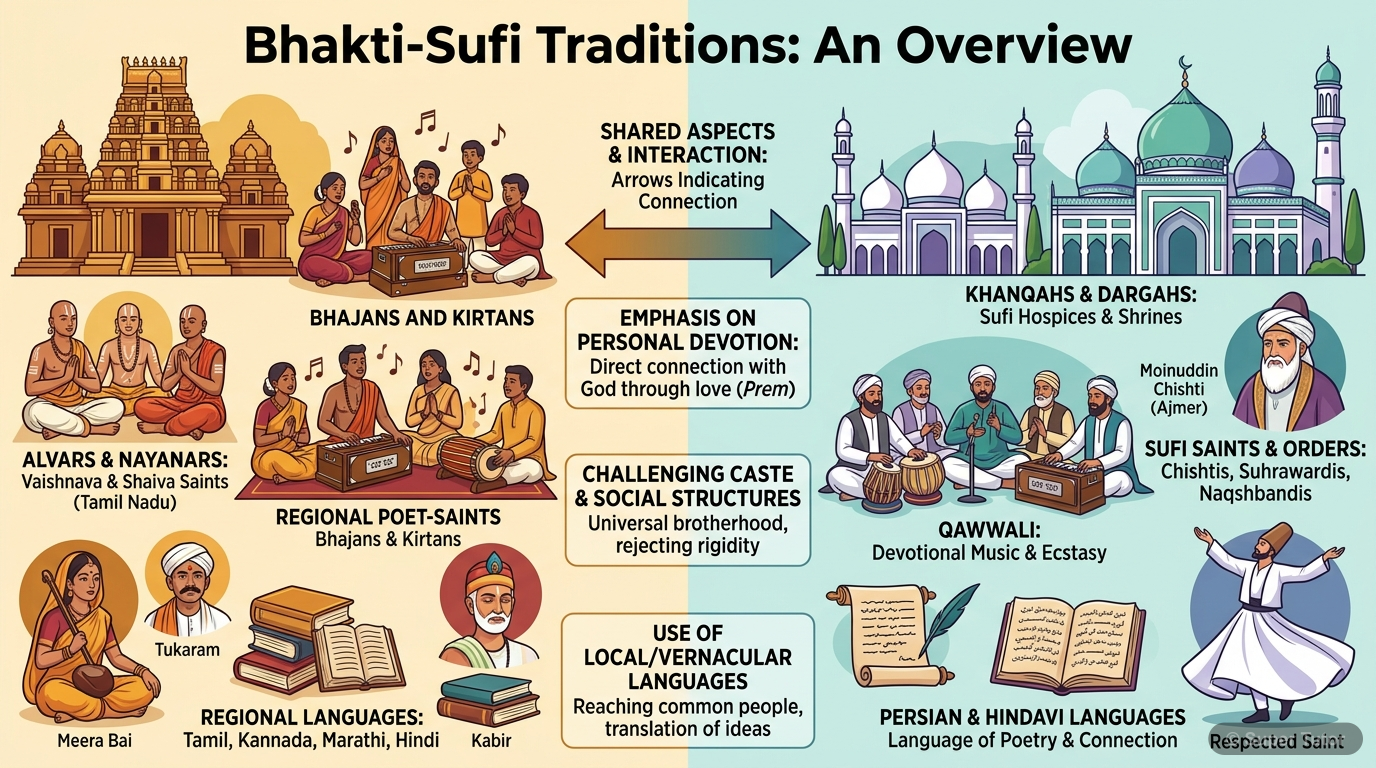
One of 15 illustrations for Bhakti - Sufi Traditions: Changes in Religious Beliefs and Devotional Texts in Super Tutor — alongside flashcards, concept maps and practice questions.
What is the main idea behind Bhakti traditions?
Answer
Bhakti traditions centre on loving devotion to a chosen deity. Some traditions worship a deity with attributes, called saguna bhakti, while others worship a formless divine power, called nirguna bhakt…
भक्ति परम्पराओं के पीछे मुख्य विचार क्या है?
Answer
भक्ति परम्पराओं का केन्द्र एक चुने हुए देवता के प्रति प्रेमपूर्ण भक्ति है। कुछ परम्पराओं में गुणयुक्त देवता की पूजा की जाती है जिसे सगुण भक्ति कहते हैं, जबकि अन्य परम्पराओं में निराकार दिव्य शक्ति की …
भक्ति में सगुण और निर्गुण का क्या अर्थ है?
Answer
सगुण भक्ति का अर्थ है भगवान के प्रति भक्ति जो गुण के साथ है, जैसे विष्णु, शिव या देवी के दृश्य रूप में। निर्गुण भक्ति का अर्थ है एक निराकार दिव्य वास्तविकता के प्रति भक्ति जो भौतिक आकार या मानवीय गुणो…
What do the terms saguna and nirguna mean in Bhakti?
Answer
Saguna bhakti means devotion to a god with attributes, such as Vishnu, Shiva, or the goddess in visible forms. Nirguna bhakti means devotion to a formless divine reality without physical shape or huma…
Why were the Puranas important in the development of religious change?
Answer
The Puranas received their present shape around the mid-first millennium CE and helped spread Brahmanical ideas in a form that was easier to understand. They were written in simple Sanskrit verse and …
धार्मिक परिवर्तन के विकास में पुराण क्यों महत्वपूर्ण थे?
Answer
The Puranas received their present shape around the mid-first millennium CE and helped spread Brahmanical ideas in a form that was easier to understand. They were written in simple Sanskrit verse and …
महान परंपरा और छोटी परंपरा शब्दों को किसने गढ़ा?
Answer
रॉबर्ट रेडफ़ील्ड ने बीसवीं शताब्दी में महान परंपरा और छोटी परंपरा शब्दों का निर्माण किया। ये शब्द प्रमुख संस्कृत परंपराओं और स्थानीय लोकप्रिय प्रथाओं के बीच की बातचीत का वर्णन करते हैं। वे यह समझाने म…
Who coined the terms great tradition and little tradition?
Answer
Robert Redfield coined the terms great tradition and little tradition in the twentieth century. These terms describe the interaction between dominant Sanskritic traditions and local popular practices.
+84 more flashcards
Practise AllFrequently Asked Questions
What are the important topics in Bhakti - Sufi Traditions: Changes in Religious Beliefs and Devotional Texts for Himachal Pradesh Board Class 12 History?
How many flashcards are available for Bhakti - Sufi Traditions: Changes in Religious Beliefs and Devotional Texts?
How should I revise Bhakti - Sufi Traditions: Changes in Religious Beliefs and Devotional Texts for the Himachal Pradesh Board Class 12 board exam?
Sources & Official References
Content is aligned to the official syllabus. Refer to the board website for the latest curriculum.
More resources for Bhakti - Sufi Traditions: Changes in Religious Beliefs and Devotional Texts
Practice Quiz
Test yourself with a quick quiz
Important Questions
Exam-style questions with answers
Revision Notes
Key points for last-minute revision
Chapter Summary
Understand the chapter at a glance
Concept Maps
See how topics connect
Study Plan
Step-by-step plan for this chapter
Syllabus
What topics to cover
NCERT Solutions
Every textbook question solved step by step
For serious students
Get the full Bhakti - Sufi Traditions: Changes in Religious Beliefs and Devotional Texts chapter — start free.
Quizzes, flashcards, an AI doubt solver and a study plan for Himachal Pradesh Board Class 12 History. Free to start, no card needed.