Peasants, Zamindars and the State: Agrarian Society and the Mughal Empire — Syllabus
Himachal Pradesh Board · Class 12 · History
What Peasants, Zamindars and the State: Agrarian Society and the Mughal Empire covers in Himachal Pradesh Board Class 12 History: 4 topics.
Interactive on Super Tutor
Studying Peasants, Zamindars and the State: Agrarian Society and the Mughal Empire? Get the full interactive chapter.
Quizzes, flashcards, AI doubt-solver and a step-by-step study plan — built for syllabus and more.
Free trial, no card needed.
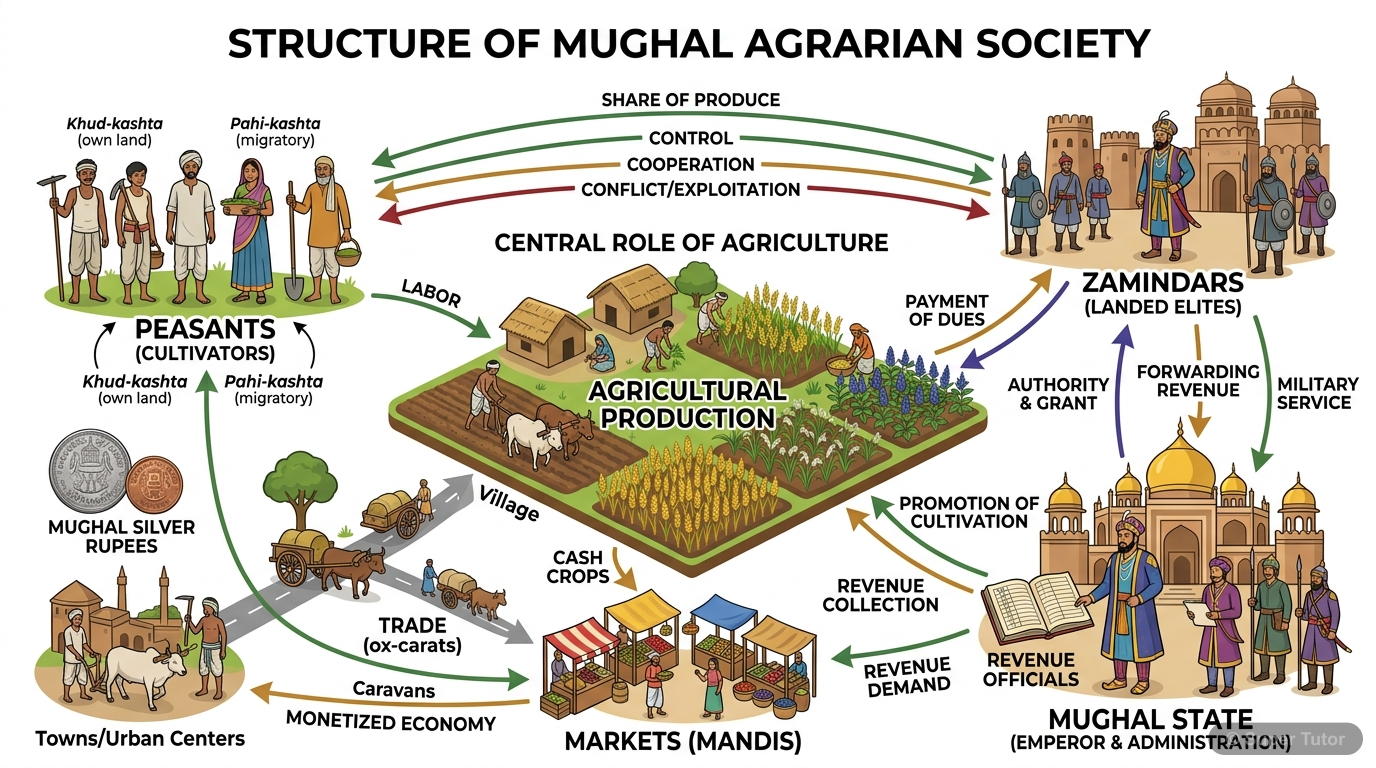
One of 11 illustrations for Peasants, Zamindars and the State: Agrarian Society and the Mughal Empire in Super Tutor — alongside flashcards, concept maps and practice questions.
Topics in Peasants, Zamindars and the State: Agrarian Society and the Mughal Empire
1. Peasants and Agricultural Production
- About 85% of India's population lived in villages during the 16th-17th centuries.
- The village was the basic unit of agricultural society.
- Peasants did seasonal work throughout the year: tilling, sowing, harvesting, and processing agro-based goods like sugar and oil.
2. Irrigation, Technology, and Crop Diversity
- Babur observed that the greater part of Hindustan was level land and that running water was scarce in many areas.
- Two irrigation devices described in northern India were the Persian wheel and the bucket system.
- The Persian wheel used ropes, pitchers, and a bullock-driven mechanism to lift water from wells.
3. Village Community, Panchayat, and Caste
- The village community had three main parts: cultivators, the panchayat, and the village headman.
- The panchayat was an assembly of elders and was usually a heterogeneous body in mixed-caste villages.
- It was an oligarchy with hereditary property rights.
4. Women in Agrarian Society
- Men and women worked side by side in agriculture.
- Men usually tilled and ploughed; women sowed, weeded, threshed, and winnowed.
- Women also did spinning, pottery-related tasks, and embroidery.
Key Concepts
Central concept: Agrarian society under the Mughal Empire and its linked systems of production, revenue, power, trade, forests, and social relations
Work through every topic in Peasants, Zamindars and the State: Agrarian Society and the Mughal Empire with notes and quizzes
Start This ChapterFrequently Asked Questions
What are the important topics in Peasants, Zamindars and the State: Agrarian Society and the Mughal Empire for Himachal Pradesh Board Class 12 History?
How should I revise Peasants, Zamindars and the State: Agrarian Society and the Mughal Empire for the Himachal Pradesh Board Class 12 board exam?
Sources & Official References
Content is aligned to the official syllabus. Refer to the board website for the latest curriculum.
More resources for Peasants, Zamindars and the State: Agrarian Society and the Mughal Empire
Practice Quiz
Test yourself with a quick quiz
Important Questions
Exam-style questions with answers
Revision Notes
Key points for last-minute revision
Formula Sheet
The chapter's formulas in one place
Chapter Summary
Understand the chapter at a glance
Concept Maps
See how topics connect
Study Plan
Step-by-step plan for this chapter
Flashcards
Quick-fire cards for active recall
NCERT Solutions
Every textbook question solved step by step
For serious students
Get the full Peasants, Zamindars and the State: Agrarian Society and the Mughal Empire chapter — start free.
Quizzes, flashcards, an AI doubt solver and a study plan for Himachal Pradesh Board Class 12 History. Free to start, no card needed.