Chapter 11 of 13
NCERT Solutions

Application of Derivatives

Himachal Pradesh Board · Class 12 · Mathematics

NCERT Solutions for Application of Derivatives — Himachal Pradesh Board Class 12 Mathematics.

45 questions22 flashcards5 concepts

Interactive on Super Tutor

Studying Application of Derivatives? Get the full interactive chapter.

Quizzes, flashcards, AI doubt-solver and a step-by-step study plan — built for ncert solutions and more.

1,000+ Class 12 students started this chapter today

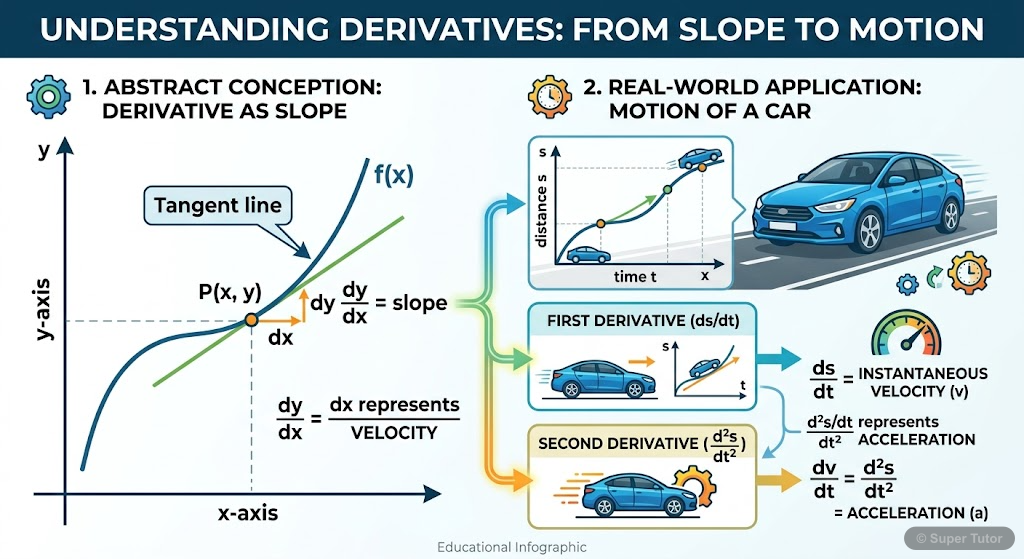
An infographic explaining the concept of a derivative as the instantaneous rate of change of one quantity with respect to another, using a simple example like distance vs. time.
Super Tutor

Super Tutor has 9+ illustrations like this for Application of Derivatives alone — flashcards, concept maps, and step-by-step visuals.

See them all
82 Questions Solved · 4 Sections

Exercise 6.1

1Find the rate of change of the area of a circle with respect to its radius rr when (a) r=3cmr = 3\,\text{cm} (b) r=4cmr = 4\,\text{cm}Show solution
Given: Area of a circle A=πr2A = \pi r^2.

Formula used: Rate of change of area with respect to radius =dAdr= \dfrac{dA}{dr}.

dAdr=2πr\frac{dA}{dr} = 2\pi r

(a) When r=3r = 3 cm:
dAdrr=3=2π(3)=6π cm2/cm\frac{dA}{dr}\bigg|_{r=3} = 2\pi(3) = 6\pi \text{ cm}^2/\text{cm}

(b) When r=4r = 4 cm:
dAdrr=4=2π(4)=8π cm2/cm\frac{dA}{dr}\bigg|_{r=4} = 2\pi(4) = 8\pi \text{ cm}^2/\text{cm}
2The volume of a cube is increasing at the rate of 8cm3/s8\,\text{cm}^3/\text{s}. How fast is the surface area increasing when the length of an edge is 12cm12\,\text{cm}?Show solution
Given: dVdt=8cm3/s\dfrac{dV}{dt} = 8\,\text{cm}^3/\text{s}, edge x=12cmx = 12\,\text{cm}.

Volume of cube: V=x3V = x^3
dVdt=3x2dxdt    8=3(12)2dxdt    dxdt=8432=154cm/s\frac{dV}{dt} = 3x^2\frac{dx}{dt} \implies 8 = 3(12)^2\frac{dx}{dt} \implies \frac{dx}{dt} = \frac{8}{432} = \frac{1}{54}\,\text{cm/s}

Surface area of cube: S=6x2S = 6x^2
dSdt=12xdxdt=12(12)154=14454=83cm2/s\frac{dS}{dt} = 12x\frac{dx}{dt} = 12(12)\cdot\frac{1}{54} = \frac{144}{54} = \frac{8}{3}\,\text{cm}^2/\text{s}

Hence, the surface area is increasing at the rate of 83cm2/s\dfrac{8}{3}\,\text{cm}^2/\text{s}.
3The radius of a circle is increasing uniformly at the rate of 3cm/s3\,\text{cm/s}. Find the rate at which the area of the circle is increasing when the radius is 10cm10\,\text{cm}.Show solution
Given: drdt=3cm/s\dfrac{dr}{dt} = 3\,\text{cm/s}, r=10cmr = 10\,\text{cm}.

Area: A=πr2A = \pi r^2
dAdt=2πrdrdt=2π(10)(3)=60πcm2/s\frac{dA}{dt} = 2\pi r\frac{dr}{dt} = 2\pi(10)(3) = 60\pi\,\text{cm}^2/\text{s}

Hence, the area is increasing at the rate of 60πcm2/s60\pi\,\text{cm}^2/\text{s}.
4An edge of a variable cube is increasing at the rate of 3cm/s3\,\text{cm/s}. How fast is the volume of the cube increasing when the edge is 10cm10\,\text{cm} long?Show solution
Given: dxdt=3cm/s\dfrac{dx}{dt} = 3\,\text{cm/s}, x=10cmx = 10\,\text{cm}.

Volume: V=x3V = x^3
dVdt=3x2dxdt=3(10)2(3)=900cm3/s\frac{dV}{dt} = 3x^2\frac{dx}{dt} = 3(10)^2(3) = 900\,\text{cm}^3/\text{s}

Hence, the volume is increasing at the rate of 900cm3/s900\,\text{cm}^3/\text{s}.
5A stone is dropped into a quiet lake and waves move in circles at the speed of 5cm/s5\,\text{cm/s}. At the instant when the radius of the circular wave is 8cm8\,\text{cm}, how fast is the enclosed area increasing?Show solution
Given: drdt=5cm/s\dfrac{dr}{dt} = 5\,\text{cm/s}, r=8cmr = 8\,\text{cm}.

Area: A=πr2A = \pi r^2
dAdt=2πrdrdt=2π(8)(5)=80πcm2/s\frac{dA}{dt} = 2\pi r\frac{dr}{dt} = 2\pi(8)(5) = 80\pi\,\text{cm}^2/\text{s}

Hence, the enclosed area is increasing at the rate of 80πcm2/s80\pi\,\text{cm}^2/\text{s}.
6The radius of a circle is increasing at the rate of 0.7cm/s0.7\,\text{cm/s}. What is the rate of increase of its circumference?Show solution
Given: drdt=0.7cm/s\dfrac{dr}{dt} = 0.7\,\text{cm/s}.

Circumference: C=2πrC = 2\pi r
dCdt=2πdrdt=2π(0.7)=1.4πcm/s\frac{dC}{dt} = 2\pi\frac{dr}{dt} = 2\pi(0.7) = 1.4\pi\,\text{cm/s}

Hence, the circumference is increasing at the rate of 1.4πcm/s1.4\pi\,\text{cm/s}.
7The length xx of a rectangle is decreasing at the rate of 5cm/minute5\,\text{cm/minute} and the width yy is increasing at the rate of 4cm/minute4\,\text{cm/minute}. When x=8cmx = 8\,\text{cm} and y=6cmy = 6\,\text{cm}, find the rates of change of (a) the perimeter, and (b) the area of the rectangle.Show solution
Given: dxdt=5cm/min\dfrac{dx}{dt} = -5\,\text{cm/min} (decreasing), dydt=4cm/min\dfrac{dy}{dt} = 4\,\text{cm/min} (increasing), x=8cmx = 8\,\text{cm}, y=6cmy = 6\,\text{cm}.

(a) Perimeter: P=2(x+y)P = 2(x + y)
dPdt=2(dxdt+dydt)=2(5+4)=2(1)=2cm/min\frac{dP}{dt} = 2\left(\frac{dx}{dt} + \frac{dy}{dt}\right) = 2(-5 + 4) = 2(-1) = -2\,\text{cm/min}
The perimeter is decreasing at the rate of 2cm/min2\,\text{cm/min}.

(b) Area: A=xyA = xy
dAdt=xdydt+ydxdt=8(4)+6(5)=3230=2cm2/min\frac{dA}{dt} = x\frac{dy}{dt} + y\frac{dx}{dt} = 8(4) + 6(-5) = 32 - 30 = 2\,\text{cm}^2/\text{min}
The area is increasing at the rate of 2cm2/min2\,\text{cm}^2/\text{min}.
8A balloon, which always remains spherical on inflation, is being inflated by pumping in 900 cubic centimetres of gas per second. Find the rate at which the radius of the balloon increases when the radius is 15cm15\,\text{cm}.Show solution
Given: dVdt=900cm3/s\dfrac{dV}{dt} = 900\,\text{cm}^3/\text{s}, r=15cmr = 15\,\text{cm}.

Volume of sphere: V=43πr3V = \dfrac{4}{3}\pi r^3
dVdt=4πr2drdt\frac{dV}{dt} = 4\pi r^2\frac{dr}{dt}
900=4π(15)2drdt=4π(225)drdt900 = 4\pi(15)^2\frac{dr}{dt} = 4\pi(225)\frac{dr}{dt}
drdt=900900π=1πcm/s\frac{dr}{dt} = \frac{900}{900\pi} = \frac{1}{\pi}\,\text{cm/s}

Hence, the radius is increasing at the rate of 1πcm/s\dfrac{1}{\pi}\,\text{cm/s}.
9A balloon, which always remains spherical has a variable radius. Find the rate at which its volume is increasing with the radius when the latter is 10cm10\,\text{cm}.Show solution
Given: Radius r=10cmr = 10\,\text{cm}.

Volume of sphere: V=43πr3V = \dfrac{4}{3}\pi r^3
dVdr=4πr2\frac{dV}{dr} = 4\pi r^2

At r=10cmr = 10\,\text{cm}:
dVdrr=10=4π(10)2=400πcm3/cm\frac{dV}{dr}\bigg|_{r=10} = 4\pi(10)^2 = 400\pi\,\text{cm}^3/\text{cm}

Hence, the volume is increasing at the rate of 400πcm3400\pi\,\text{cm}^3 per cm increase in radius.
10A ladder 5m5\,\text{m} long is leaning against a wall. The bottom of the ladder is pulled along the ground, away from the wall, at the rate of 2cm/s2\,\text{cm/s}. How fast is its height on the wall decreasing when the foot of the ladder is 4m4\,\text{m} away from the wall?Show solution
Given: Length of ladder =5m= 5\,\text{m}, dxdt=2cm/s=0.02m/s\dfrac{dx}{dt} = 2\,\text{cm/s} = 0.02\,\text{m/s}, x=4mx = 4\,\text{m}.

Let xx = distance of foot from wall, yy = height on wall.

By Pythagoras theorem:
x2+y2=25x^2 + y^2 = 25

Differentiating with respect to tt:
2xdxdt+2ydydt=0    dydt=xydxdt2x\frac{dx}{dt} + 2y\frac{dy}{dt} = 0 \implies \frac{dy}{dt} = -\frac{x}{y}\frac{dx}{dt}

When x=4mx = 4\,\text{m}: y=2516=3my = \sqrt{25 - 16} = 3\,\text{m}

dydt=43×0.02=0.083m/s=8300m/s\frac{dy}{dt} = -\frac{4}{3}\times 0.02 = -\frac{0.08}{3}\,\text{m/s} = -\frac{8}{300}\,\text{m/s}

Converting: dydt=83cm/s\dfrac{dy}{dt} = -\dfrac{8}{3}\,\text{cm/s}

Hence, the height on the wall is decreasing at the rate of 83cm/s\dfrac{8}{3}\,\text{cm/s}.
11A particle moves along the curve 6y=x3+26y = x^3 + 2. Find the points on the curve at which the yy-coordinate is changing 8 times as fast as the xx-coordinate.Show solution
Given: 6y=x3+26y = x^3 + 2 and dydt=8dxdt\dfrac{dy}{dt} = 8\dfrac{dx}{dt}.

Differentiating 6y=x3+26y = x^3 + 2 with respect to tt:
6dydt=3x2dxdt6\frac{dy}{dt} = 3x^2\frac{dx}{dt}

Substituting dydt=8dxdt\dfrac{dy}{dt} = 8\dfrac{dx}{dt}:
68dxdt=3x2dxdt6\cdot 8\frac{dx}{dt} = 3x^2\frac{dx}{dt}
48=3x2    x2=16    x=±448 = 3x^2 \implies x^2 = 16 \implies x = \pm 4

When x=4x = 4: 6y=64+2=66    y=116y = 64 + 2 = 66 \implies y = 11. Point: (4,11)(4, 11).

When x=4x = -4: 6y=64+2=62    y=3136y = -64 + 2 = -62 \implies y = -\dfrac{31}{3}. Point: (4,313)\left(-4, -\dfrac{31}{3}\right).

Hence, the required points are (4,11)(4, 11) and (4,313)\left(-4, -\dfrac{31}{3}\right).
12The radius of an air bubble is increasing at the rate of 12cm/s\dfrac{1}{2}\,\text{cm/s}. At what rate is the volume of the bubble increasing when the radius is 1cm1\,\text{cm}?Show solution
Given: drdt=12cm/s\dfrac{dr}{dt} = \dfrac{1}{2}\,\text{cm/s}, r=1cmr = 1\,\text{cm}.

Volume of sphere: V=43πr3V = \dfrac{4}{3}\pi r^3
dVdt=4πr2drdt=4π(1)212=2πcm3/s\frac{dV}{dt} = 4\pi r^2\frac{dr}{dt} = 4\pi(1)^2\cdot\frac{1}{2} = 2\pi\,\text{cm}^3/\text{s}

Hence, the volume of the bubble is increasing at the rate of 2πcm3/s2\pi\,\text{cm}^3/\text{s}.
13A balloon, which always remains spherical, has a variable diameter 32(2x+1)\dfrac{3}{2}(2x + 1). Find the rate of change of its volume with respect to xx.Show solution
Given: Diameter =32(2x+1)= \dfrac{3}{2}(2x+1), so radius r=34(2x+1)r = \dfrac{3}{4}(2x+1).

Volume: V=43πr3=43π[34(2x+1)]3V = \dfrac{4}{3}\pi r^3 = \dfrac{4}{3}\pi\left[\dfrac{3}{4}(2x+1)\right]^3

V=43π2764(2x+1)3=9π16(2x+1)3V = \frac{4}{3}\pi \cdot \frac{27}{64}(2x+1)^3 = \frac{9\pi}{16}(2x+1)^3

dVdx=9π163(2x+1)22=27π8(2x+1)2\frac{dV}{dx} = \frac{9\pi}{16}\cdot 3(2x+1)^2\cdot 2 = \frac{27\pi}{8}(2x+1)^2

Hence, dVdx=27π8(2x+1)2\dfrac{dV}{dx} = \dfrac{27\pi}{8}(2x+1)^2.
14Sand is pouring from a pipe at the rate of 12cm3/s12\,\text{cm}^3/\text{s}. The falling sand forms a cone on the ground in such a way that the height of the cone is always one-sixth of the radius of the base. How fast is the height of the sand cone increasing when the height is 4cm4\,\text{cm}?Show solution
Given: dVdt=12cm3/s\dfrac{dV}{dt} = 12\,\text{cm}^3/\text{s}, h=r6h = \dfrac{r}{6}, i.e., r=6hr = 6h.

Volume of cone: V=13πr2h=13π(6h)2h=13π36h3=12πh3V = \dfrac{1}{3}\pi r^2 h = \dfrac{1}{3}\pi(6h)^2 h = \dfrac{1}{3}\pi \cdot 36h^3 = 12\pi h^3

dVdt=36πh2dhdt\frac{dV}{dt} = 36\pi h^2\frac{dh}{dt}
12=36π(4)2dhdt=36π(16)dhdt12 = 36\pi(4)^2\frac{dh}{dt} = 36\pi(16)\frac{dh}{dt}
dhdt=12576π=148πcm/s\frac{dh}{dt} = \frac{12}{576\pi} = \frac{1}{48\pi}\,\text{cm/s}

Hence, the height of the sand cone is increasing at the rate of 148πcm/s\dfrac{1}{48\pi}\,\text{cm/s}.
15The total cost C(x)C(x) in Rupees associated with the production of xx units of an item is given by C(x)=0.007x30.003x2+15x+4000C(x) = 0.007x^3 - 0.003x^2 + 15x + 4000. Find the marginal cost when 17 units are produced.Show solution
Given: C(x)=0.007x30.003x2+15x+4000C(x) = 0.007x^3 - 0.003x^2 + 15x + 4000.

Marginal Cost (MC) =dCdx= \dfrac{dC}{dx}
dCdx=0.007(3x2)0.003(2x)+15=0.021x20.006x+15\frac{dC}{dx} = 0.007(3x^2) - 0.003(2x) + 15 = 0.021x^2 - 0.006x + 15

At x=17x = 17:
MC=0.021(17)20.006(17)+15\text{MC} = 0.021(17)^2 - 0.006(17) + 15
=0.021(289)0.102+15= 0.021(289) - 0.102 + 15
=6.0690.102+15=20.967= 6.069 - 0.102 + 15 = 20.967

Hence, the marginal cost when 17 units are produced is ₹ 20.967 (approximately ₹ 20.97).
16The total revenue in Rupees received from the sale of xx units of a product is given by R(x)=13x2+26x+15R(x) = 13x^2 + 26x + 15. Find the marginal revenue when x=7x = 7.Show solution
Given: R(x)=13x2+26x+15R(x) = 13x^2 + 26x + 15.

Marginal Revenue (MR) =dRdx= \dfrac{dR}{dx}
dRdx=26x+26\frac{dR}{dx} = 26x + 26

At x=7x = 7:
MR=26(7)+26=182+26=208\text{MR} = 26(7) + 26 = 182 + 26 = 208

Hence, the marginal revenue when x=7x = 7 is ₹ 208.
17The rate of change of the area of a circle with respect to its radius rr at r=6cmr = 6\,\text{cm} is\n(A) 10π10\pi (B) 12π12\pi (C) 8π8\pi (D) 11π11\piShow solution
Correct Answer: (B) 12π12\pi

Justification: Area A=πr2dAdr=2πrA = \pi r^2 \Rightarrow \dfrac{dA}{dr} = 2\pi r.

At r=6r = 6: dAdr=2π(6)=12π\dfrac{dA}{dr} = 2\pi(6) = 12\pi.
18The total revenue in Rupees received from the sale of xx units of a product is given by R(x)=3x2+36x+5R(x) = 3x^2 + 36x + 5. The marginal revenue, when x=15x = 15 is\n(A) 116 (B) 96 (C) 90 (D) 126Show solution
Correct Answer: (D) 126

Justification: MR=dRdx=6x+36\text{MR} = \dfrac{dR}{dx} = 6x + 36.

At x=15x = 15: MR=6(15)+36=90+36=126\text{MR} = 6(15) + 36 = 90 + 36 = 126.

Exercise 6.2

1Show that the function given by f(x)=3x+17f(x) = 3x + 17 is increasing on R\mathbf{R}.Show solution
Given: f(x)=3x+17f(x) = 3x + 17.

Differentiating: f'(x) = 3 > 0 for all xRx \in \mathbf{R}.

Since f'(x) > 0 for all xRx \in \mathbf{R}, the function ff is strictly increasing on R\mathbf{R}. \blacksquare
2Show that the function given by f(x)=e2xf(x) = e^{2x} is increasing on R\mathbf{R}.Show solution
Given: f(x)=e2xf(x) = e^{2x}.

Differentiating: f(x)=2e2xf'(x) = 2e^{2x}.

Since e^{2x} > 0 for all xRx \in \mathbf{R}, we have f'(x) = 2e^{2x} > 0 for all xRx \in \mathbf{R}.

Hence, ff is strictly increasing on R\mathbf{R}. \blacksquare
3Show that the function given by f(x)=sinxf(x) = \sin x is (a) increasing in (0,π2)\left(0, \dfrac{\pi}{2}\right) (b) decreasing in (π2,π)\left(\dfrac{\pi}{2}, \pi\right) (c) neither increasing nor decreasing in (0,π)(0, \pi)Show solution
Given: f(x)=sinxf(x) = \sin x, so f(x)=cosxf'(x) = \cos x.

(a) In (0,π2)\left(0, \dfrac{\pi}{2}\right): \cos x > 0, so f'(x) > 0. Hence ff is increasing in (0,π2)\left(0, \dfrac{\pi}{2}\right).

(b) In (π2,π)\left(\dfrac{\pi}{2}, \pi\right): \cos x < 0, so f'(x) < 0. Hence ff is decreasing in (π2,π)\left(\dfrac{\pi}{2}, \pi\right).

(c) In (0,π)(0, \pi): ff is increasing on (0,π2)\left(0, \dfrac{\pi}{2}\right) and decreasing on (π2,π)\left(\dfrac{\pi}{2}, \pi\right). Hence ff is neither increasing nor decreasing on the entire interval (0,π)(0, \pi). \blacksquare
4Find the intervals in which the function ff given by f(x)=2x23xf(x) = 2x^2 - 3x is (a) increasing (b) decreasingShow solution
Given: f(x)=2x23xf(x) = 2x^2 - 3x.

f(x)=4x3f'(x) = 4x - 3

Setting f(x)=0f'(x) = 0: 4x3=0x=344x - 3 = 0 \Rightarrow x = \dfrac{3}{4}.

(a) Increasing: f'(x) > 0 \Rightarrow 4x - 3 > 0 \Rightarrow x > \dfrac{3}{4}.

So ff is increasing on (34,)\left(\dfrac{3}{4}, \infty\right).

(b) Decreasing: f'(x) < 0 \Rightarrow x < \dfrac{3}{4}.

So ff is decreasing on (,34)\left(-\infty, \dfrac{3}{4}\right).
5Find the intervals in which the function ff given by f(x)=2x33x236x+7f(x) = 2x^3 - 3x^2 - 36x + 7 is (a) increasing (b) decreasingShow solution
Given: f(x)=2x33x236x+7f(x) = 2x^3 - 3x^2 - 36x + 7.

f(x)=6x26x36=6(x2x6)=6(x3)(x+2)f'(x) = 6x^2 - 6x - 36 = 6(x^2 - x - 6) = 6(x-3)(x+2)

Critical points: x=3x = 3 and x=2x = -2.

| Interval | Sign of (x3)(x-3) | Sign of (x+2)(x+2) | Sign of f(x)f'(x) |
|---|---|---|---|
| x < -2 | - | - | ++ |
| -2 < x < 3 | - | ++ | - |
| x > 3 | ++ | ++ | ++ |

(a) Increasing: f'(x) > 0 when x(,2)(3,)x \in (-\infty, -2) \cup (3, \infty).

(b) Decreasing: f'(x) < 0 when x(2,3)x \in (-2, 3).
6Find the intervals in which the following functions are strictly increasing or decreasing: (a) x2+2x5x^2 + 2x - 5 (b) 106x2x210 - 6x - 2x^2 (c) 2x39x212x+1-2x^3 - 9x^2 - 12x + 1 (d) 69xx26 - 9x - x^2 (e) (x+1)3(x3)3(x+1)^3(x-3)^3Show solution
(a) f(x)=x2+2x5f(x) = x^2 + 2x - 5

f(x)=2x+2=2(x+1)f'(x) = 2x + 2 = 2(x+1)

f(x)=0x=1f'(x) = 0 \Rightarrow x = -1

- Strictly increasing: f'(x) > 0 \Rightarrow x > -1, i.e., x(1,)x \in (-1, \infty).
- Strictly decreasing: f'(x) < 0 \Rightarrow x < -1, i.e., x(,1)x \in (-\infty, -1).

---

(b) f(x)=106x2x2f(x) = 10 - 6x - 2x^2

f(x)=64x=2(3+2x)f'(x) = -6 - 4x = -2(3 + 2x)

f(x)=0x=32f'(x) = 0 \Rightarrow x = -\dfrac{3}{2}

- Strictly increasing: f'(x) > 0 \Rightarrow -2(3+2x) > 0 \Rightarrow x < -\dfrac{3}{2}, i.e., x(,32)x \in \left(-\infty, -\dfrac{3}{2}\right).
- Strictly decreasing: x(32,)x \in \left(-\dfrac{3}{2}, \infty\right).

---

(c) f(x)=2x39x212x+1f(x) = -2x^3 - 9x^2 - 12x + 1

f(x)=6x218x12=6(x2+3x+2)=6(x+1)(x+2)f'(x) = -6x^2 - 18x - 12 = -6(x^2 + 3x + 2) = -6(x+1)(x+2)

f(x)=0x=1,2f'(x) = 0 \Rightarrow x = -1, -2

| Interval | Sign of f(x)f'(x) |
|---|---|
| x < -2 | -6(-)(-)= -6(+) < 0 |
| -2 < x < -1 | -6(+)(-) > 0 |
| x > -1 | -6(+)(+) < 0 |

- Strictly increasing: x(2,1)x \in (-2, -1).
- Strictly decreasing: x(,2)(1,)x \in (-\infty, -2) \cup (-1, \infty).

---

(d) f(x)=69xx2f(x) = 6 - 9x - x^2

f(x)=92xf'(x) = -9 - 2x

f(x)=0x=92f'(x) = 0 \Rightarrow x = -\dfrac{9}{2}

- Strictly increasing: f'(x) > 0 \Rightarrow -9 - 2x > 0 \Rightarrow x < -\dfrac{9}{2}, i.e., x(,92)x \in \left(-\infty, -\dfrac{9}{2}\right).
- Strictly decreasing: x(92,)x \in \left(-\dfrac{9}{2}, \infty\right).

---

(e) f(x)=(x+1)3(x3)3f(x) = (x+1)^3(x-3)^3

f(x)=3(x+1)2(x3)3+(x+1)33(x3)2f'(x) = 3(x+1)^2(x-3)^3 + (x+1)^3 \cdot 3(x-3)^2
=3(x+1)2(x3)2[(x3)+(x+1)]= 3(x+1)^2(x-3)^2[(x-3)+(x+1)]
=3(x+1)2(x3)2(2x2)= 3(x+1)^2(x-3)^2(2x-2)
=6(x+1)2(x3)2(x1)= 6(x+1)^2(x-3)^2(x-1)

f(x)=0x=1,1,3f'(x) = 0 \Rightarrow x = -1, 1, 3

Note: (x+1)20(x+1)^2 \geq 0 and (x3)20(x-3)^2 \geq 0 always.

- Strictly increasing: f'(x) > 0 \Rightarrow (x-1) > 0 \Rightarrow x > 1 (and x3x \neq 3), i.e., x(1,3)(3,)x \in (1, 3) \cup (3, \infty).
- Strictly decreasing: f'(x) < 0 \Rightarrow (x-1) < 0 \Rightarrow x < 1 (and x1x \neq -1), i.e., x(,1)(1,1)x \in (-\infty, -1) \cup (-1, 1).
7Show that y=log(1+x)2x2+xy = \log(1+x) - \dfrac{2x}{2+x}, x > -1, is an increasing function of xx throughout its domain.Show solution
Given: y=log(1+x)2x2+xy = \log(1+x) - \dfrac{2x}{2+x}, x > -1.

dydx=11+x(2+x)(2)2x(1)(2+x)2\frac{dy}{dx} = \frac{1}{1+x} - \frac{(2+x)(2) - 2x(1)}{(2+x)^2}
=11+x4+2x2x(2+x)2=11+x4(2+x)2= \frac{1}{1+x} - \frac{4+2x-2x}{(2+x)^2} = \frac{1}{1+x} - \frac{4}{(2+x)^2}
=(2+x)24(1+x)(1+x)(2+x)2= \frac{(2+x)^2 - 4(1+x)}{(1+x)(2+x)^2}
=4+4x+x244x(1+x)(2+x)2=x2(1+x)(2+x)2= \frac{4 + 4x + x^2 - 4 - 4x}{(1+x)(2+x)^2} = \frac{x^2}{(1+x)(2+x)^2}

For x > -1: (1+x) > 0, (2+x)^2 > 0, and x20x^2 \geq 0.

So dydx0\dfrac{dy}{dx} \geq 0 for all x > -1, and dydx=0\dfrac{dy}{dx} = 0 only at x=0x = 0.

Hence, yy is an increasing function throughout its domain. \blacksquare
8Find the values of xx for which y=[x(x2)]2y = [x(x-2)]^2 is an increasing function.Show solution
Given: y=[x(x2)]2=[x22x]2y = [x(x-2)]^2 = [x^2 - 2x]^2.

dydx=2(x22x)(2x2)=4x(x2)(x1)\frac{dy}{dx} = 2(x^2-2x)(2x-2) = 4x(x-2)(x-1)

Critical points: x=0,1,2x = 0, 1, 2.

| Interval | Sign of dydx\frac{dy}{dx} |
|---|---|
| x < 0 | 4(-)(-)(-) < 0 |
| 0 < x < 1 | 4(+)(-)(-) > 0 |
| 1 < x < 2 | 4(+)(-)(+) < 0 |
| x > 2 | 4(+)(+)(+) > 0 |

yy is increasing when dydx0\dfrac{dy}{dx} \geq 0, i.e., for x[0,1][2,)x \in [0, 1] \cup [2, \infty).
9Prove that y=4sinθ(2+cosθ)θy = \dfrac{4\sin\theta}{(2+\cos\theta)} - \theta is an increasing function of θ\theta in [0,π2]\left[0, \dfrac{\pi}{2}\right].Show solution
Given: y=4sinθ2+cosθθy = \dfrac{4\sin\theta}{2+\cos\theta} - \theta.

dydθ=4cosθ(2+cosθ)4sinθ(sinθ)(2+cosθ)21\frac{dy}{d\theta} = \frac{4\cos\theta(2+\cos\theta) - 4\sin\theta(-\sin\theta)}{(2+\cos\theta)^2} - 1
=8cosθ+4cos2θ+4sin2θ(2+cosθ)21= \frac{8\cos\theta + 4\cos^2\theta + 4\sin^2\theta}{(2+\cos\theta)^2} - 1
=8cosθ+4(2+cosθ)21= \frac{8\cos\theta + 4}{(2+\cos\theta)^2} - 1
=8cosθ+4(2+cosθ)2(2+cosθ)2= \frac{8\cos\theta + 4 - (2+\cos\theta)^2}{(2+\cos\theta)^2}
=8cosθ+444cosθcos2θ(2+cosθ)2= \frac{8\cos\theta + 4 - 4 - 4\cos\theta - \cos^2\theta}{(2+\cos\theta)^2}
=4cosθcos2θ(2+cosθ)2=cosθ(4cosθ)(2+cosθ)2= \frac{4\cos\theta - \cos^2\theta}{(2+\cos\theta)^2} = \frac{\cos\theta(4 - \cos\theta)}{(2+\cos\theta)^2}

For θ[0,π2]\theta \in \left[0, \dfrac{\pi}{2}\right]:
- cosθ0\cos\theta \geq 0
- 4 - \cos\theta \geq 4 - 1 = 3 > 0
- (2+\cos\theta)^2 > 0

Hence dydθ0\dfrac{dy}{d\theta} \geq 0 for all θ[0,π2]\theta \in \left[0, \dfrac{\pi}{2}\right].

Therefore, yy is an increasing function of θ\theta in [0,π2]\left[0, \dfrac{\pi}{2}\right]. \blacksquare
10Prove that the logarithmic function is increasing on (0,)(0, \infty).Show solution
Let f(x)=logxf(x) = \log x, defined for x > 0.

f(x)=1xf'(x) = \frac{1}{x}

For all x(0,)x \in (0, \infty): x > 0 \Rightarrow \dfrac{1}{x} > 0 \Rightarrow f'(x) > 0.

Hence, the logarithmic function is strictly increasing on (0,)(0, \infty). \blacksquare
11Prove that the function ff given by f(x)=x2x+1f(x) = x^2 - x + 1 is neither strictly increasing nor decreasing on (1,1)(-1, 1).Show solution
Given: f(x)=x2x+1f(x) = x^2 - x + 1.

f(x)=2x1f'(x) = 2x - 1

f(x)=0x=12(1,1)f'(x) = 0 \Rightarrow x = \dfrac{1}{2} \in (-1, 1).

- For x(1,12)x \in \left(-1, \dfrac{1}{2}\right): f'(x) = 2x - 1 < 0 (decreasing).
- For x(12,1)x \in \left(\dfrac{1}{2}, 1\right): f'(x) = 2x - 1 > 0 (increasing).

Since ff is decreasing on part of (1,1)(-1,1) and increasing on another part, ff is neither strictly increasing nor strictly decreasing on (1,1)(-1, 1). \blacksquare
12Which of the following functions are decreasing on (0,π2)\left(0, \dfrac{\pi}{2}\right)? (A) cosx\cos x (B) cos2x\cos 2x (C) cos3x\cos 3x (D) tanx\tan xShow solution
Correct Answer: (A) cosx\cos x

(A) f(x)=cosxf(x) = \cos x: f'(x) = -\sin x < 0 for x(0,π2)x \in \left(0, \dfrac{\pi}{2}\right). ✓ Decreasing.

(B) f(x)=cos2xf(x) = \cos 2x: f(x)=2sin2xf'(x) = -2\sin 2x. For x(0,π4)x \in \left(0, \dfrac{\pi}{4}\right), \sin 2x > 0 so f'(x) < 0; for x(π4,π2)x \in \left(\dfrac{\pi}{4}, \dfrac{\pi}{2}\right), \sin 2x < 0 so f'(x) > 0. Not entirely decreasing.

(C) f(x)=cos3xf(x) = \cos 3x: f(x)=3sin3xf'(x) = -3\sin 3x. At x=π3x = \dfrac{\pi}{3}, sin3x=0\sin 3x = 0 and changes sign. Not entirely decreasing.

(D) f(x)=tanxf(x) = \tan x: f'(x) = \sec^2 x > 0. Increasing.

Hence, only (A) cosx\cos x is decreasing on (0,π2)\left(0, \dfrac{\pi}{2}\right).
13On which of the following intervals is the function ff given by f(x)=x100+sinx1f(x) = x^{100} + \sin x - 1 decreasing? (A) (0,1)(0,1) (B) (π2,π)\left(\dfrac{\pi}{2}, \pi\right) (C) (0,π2)\left(0, \dfrac{\pi}{2}\right) (D) None of theseShow solution
Correct Answer: (D) None of these

f(x)=100x99+cosxf'(x) = 100x^{99} + \cos x

(A) (0,1)(0,1): 100x^{99} > 0 and \cos x > 0, so f'(x) > 0. Increasing.

(B) (π2,π)\left(\dfrac{\pi}{2}, \pi\right): 100x^{99} > 0 (since x > 0). Although \cos x < 0 here, 100x99100x^{99} dominates (e.g., at x=π/2x = \pi/2, 100(π/2)99100(\pi/2)^{99} is very large). So f'(x) > 0. Increasing.

(C) (0,π2)\left(0, \dfrac{\pi}{2}\right): Both 100x^{99} > 0 and \cos x > 0, so f'(x) > 0. Increasing.

Hence, ff is not decreasing on any of the given intervals. Answer: (D).
14For what values of aa the function ff given by f(x)=x2+ax+1f(x) = x^2 + ax + 1 is increasing on [1,2][1, 2]?Show solution
Given: f(x)=x2+ax+1f(x) = x^2 + ax + 1.

f(x)=2x+af'(x) = 2x + a

For ff to be increasing on [1,2][1, 2], we need f(x)0f'(x) \geq 0 for all x[1,2]x \in [1, 2].

The minimum value of f(x)=2x+af'(x) = 2x + a on [1,2][1,2] occurs at x=1x = 1:
f(1)=2+a0    a2f'(1) = 2 + a \geq 0 \implies a \geq -2

Hence, ff is increasing on [1,2][1, 2] for all a2a \geq -2.
15Let I be any interval disjoint from [1,1][-1, 1]. Prove that the function ff given by f(x)=x+1xf(x) = x + \dfrac{1}{x} is increasing on I.Show solution
Given: f(x)=x+1xf(x) = x + \dfrac{1}{x}.

f(x)=11x2=x21x2f'(x) = 1 - \frac{1}{x^2} = \frac{x^2 - 1}{x^2}

For any interval II disjoint from [1,1][-1, 1], we have |x| > 1, i.e., x^2 > 1.

So x^2 - 1 > 0 and x^2 > 0, giving f'(x) = \dfrac{x^2-1}{x^2} > 0.

Hence, ff is strictly increasing on II. \blacksquare
16Prove that the function ff given by f(x)=logsinxf(x) = \log \sin x is increasing on (0,π2)\left(0, \dfrac{\pi}{2}\right) and decreasing on (π2,π)\left(\dfrac{\pi}{2}, \pi\right).Show solution
Given: f(x)=logsinxf(x) = \log \sin x.

f(x)=1sinxcosx=cotxf'(x) = \frac{1}{\sin x}\cdot \cos x = \cot x

- For x(0,π2)x \in \left(0, \dfrac{\pi}{2}\right): \cot x > 0, so f'(x) > 0. Hence ff is increasing.
- For x(π2,π)x \in \left(\dfrac{\pi}{2}, \pi\right): \cot x < 0, so f'(x) < 0. Hence ff is decreasing. \blacksquare
17Prove that the function ff given by f(x)=logcosxf(x) = \log|\cos x| is decreasing on (0,π2)\left(0, \dfrac{\pi}{2}\right) and increasing on (3π2,2π)\left(\dfrac{3\pi}{2}, 2\pi\right).Show solution
Given: f(x)=logcosxf(x) = \log|\cos x|.

f(x)=1cosxddxcosxf'(x) = \frac{1}{|\cos x|}\cdot \frac{d}{dx}|\cos x|

For x(0,π2)x \in \left(0, \dfrac{\pi}{2}\right): \cos x > 0, so cosx=cosx|\cos x| = \cos x.
f(x)=sinxcosx=tanxf'(x) = \frac{-\sin x}{\cos x} = -\tan x
Since \tan x > 0 in (0,π2)\left(0, \dfrac{\pi}{2}\right), f'(x) < 0. Hence ff is decreasing on (0,π2)\left(0, \dfrac{\pi}{2}\right).

For x(3π2,2π)x \in \left(\dfrac{3\pi}{2}, 2\pi\right): \cos x > 0, so cosx=cosx|\cos x| = \cos x.
f(x)=tanxf'(x) = -\tan x
Since \tan x < 0 in (3π2,2π)\left(\dfrac{3\pi}{2}, 2\pi\right), f'(x) = -\tan x > 0. Hence ff is increasing on (3π2,2π)\left(\dfrac{3\pi}{2}, 2\pi\right). \blacksquare
18Prove that the function given by f(x)=x33x2+3x100f(x) = x^3 - 3x^2 + 3x - 100 is increasing in R\mathbf{R}.Show solution
Given: f(x)=x33x2+3x100f(x) = x^3 - 3x^2 + 3x - 100.

f(x)=3x26x+3=3(x22x+1)=3(x1)2f'(x) = 3x^2 - 6x + 3 = 3(x^2 - 2x + 1) = 3(x-1)^2

Since (x1)20(x-1)^2 \geq 0 for all xRx \in \mathbf{R}, we have f(x)=3(x1)20f'(x) = 3(x-1)^2 \geq 0 for all xRx \in \mathbf{R}.

f(x)=0f'(x) = 0 only at x=1x = 1 (a single point), so ff is strictly increasing on R\mathbf{R}. \blacksquare
19The interval in which y=x2exy = x^2 e^{-x} is increasing is (A) (,)(-\infty, \infty) (B) (2,0)(-2, 0) (C) (2,)(2, \infty) (D) (0,2)(0, 2)Show solution
Correct Answer: (D) (0,2)(0, 2)

dydx=2xex+x2(ex)=xex(2x)\dfrac{dy}{dx} = 2xe^{-x} + x^2(-e^{-x}) = xe^{-x}(2 - x)

Since e^{-x} > 0 always, \dfrac{dy}{dx} > 0 when x(2-x) > 0, i.e., 0 < x < 2.

Hence yy is increasing on (0,2)(0, 2).

Exercise 6.3

1Find the maximum and minimum values, if any, of the following functions given by (i) f(x)=(2x1)2+3f(x) = (2x-1)^2 + 3 (ii) f(x)=9x2+12x+2f(x) = 9x^2 + 12x + 2 (iii) f(x)=(x1)2+10f(x) = -(x-1)^2 + 10 (iv) g(x)=x3+1g(x) = x^3 + 1Show solution
(i) f(x)=(2x1)2+3f(x) = (2x-1)^2 + 3

Since (2x1)20(2x-1)^2 \geq 0 for all xx, we have f(x)3f(x) \geq 3.

f(x)=3f(x) = 3 when 2x1=0x=122x - 1 = 0 \Rightarrow x = \dfrac{1}{2}.

Minimum value = 3 at x=12x = \dfrac{1}{2}. No maximum value (as f(x)f(x) \to \infty).

---

(ii) f(x)=9x2+12x+2=(3x+2)22f(x) = 9x^2 + 12x + 2 = (3x+2)^2 - 2

Since (3x+2)20(3x+2)^2 \geq 0, f(x)2f(x) \geq -2.

f(x)=2f(x) = -2 when x=23x = -\dfrac{2}{3}.

Minimum value = 2-2 at x=23x = -\dfrac{2}{3}. No maximum value.

---

(iii) f(x)=(x1)2+10f(x) = -(x-1)^2 + 10

Since (x1)20-(x-1)^2 \leq 0, f(x)10f(x) \leq 10.

f(x)=10f(x) = 10 when x=1x = 1.

Maximum value = 10 at x=1x = 1. No minimum value.

---

(iv) g(x)=x3+1g(x) = x^3 + 1

g(x)=3x20g'(x) = 3x^2 \geq 0 for all xx, and g(x)=0g'(x) = 0 only at x=0x = 0.

Since g(x)g'(x) does not change sign, x=0x = 0 is neither a maximum nor a minimum.

Neither maximum nor minimum value exists.
2Find the maximum and minimum values, if any, of the following functions given by (i) f(x)=x+21f(x) = |x+2| - 1 (ii) g(x)=x+1+3g(x) = -|x+1| + 3 (iii) h(x)=sin(2x)+5h(x) = \sin(2x) + 5 (iv) f(x)=sin4x+3f(x) = |\sin 4x + 3| (v) h(x)=x+1,x(1,1)h(x) = x+1,\, x \in (-1,1)Show solution
(i) f(x)=x+21f(x) = |x+2| - 1

Since x+20|x+2| \geq 0, f(x)1f(x) \geq -1.

f(x)=1f(x) = -1 when x=2x = -2.

Minimum value = 1-1 at x=2x = -2. No maximum value.

---

(ii) g(x)=x+1+3g(x) = -|x+1| + 3

Since x+10-|x+1| \leq 0, g(x)3g(x) \leq 3.

g(x)=3g(x) = 3 when x=1x = -1.

Maximum value = 3 at x=1x = -1. No minimum value.

---

(iii) h(x)=sin(2x)+5h(x) = \sin(2x) + 5

Since 1sin(2x)1-1 \leq \sin(2x) \leq 1:

Maximum value = 1+5=61 + 5 = 6 (when sin2x=1\sin 2x = 1).

Minimum value = 1+5=4-1 + 5 = 4 (when sin2x=1\sin 2x = -1).

---

(iv) f(x)=sin4x+3f(x) = |\sin 4x + 3|

Since 1sin4x1-1 \leq \sin 4x \leq 1, we have 2sin4x+342 \leq \sin 4x + 3 \leq 4.

So \sin 4x + 3 > 0 always, hence sin4x+3=sin4x+3|\sin 4x + 3| = \sin 4x + 3.

Maximum value = 4, Minimum value = 2.

---

(v) h(x)=x+1h(x) = x + 1, x(1,1)x \in (-1, 1)

hh is strictly increasing on the open interval (1,1)(-1, 1).

As x1+x \to -1^+, h0h \to 0; as x1x \to 1^-, h2h \to 2. The endpoints are not attained.

Neither maximum nor minimum value exists (open interval).
3Find the local maxima and local minima, if any, of the following functions. Find also the local maximum and the local minimum values, as the case may be: (i) f(x)=x2f(x) = x^2 (ii) g(x)=x33xg(x) = x^3 - 3x (iii) h(x) = \sin x + \cos x,\, 0 < x < \dfrac{\pi}{2} (iv) f(x) = \sin x - \cos x,\, 0 < x < 2\pi (v) f(x)=x36x2+9x+15f(x) = x^3 - 6x^2 + 9x + 15 (vi) g(x) = \dfrac{x}{2} + \dfrac{2}{x},\, x > 0 (vii) g(x)=1x2+2g(x) = \dfrac{1}{x^2+2} (viii) f(x) = x\sqrt{1-x},\, 0 < x < 1Show solution
(i) f(x)=x2f(x) = x^2

f(x)=2x=0x=0f'(x) = 2x = 0 \Rightarrow x = 0.
f''(x) = 2 > 0, so x=0x = 0 is a point of local minimum.
Local minimum value = f(0)=0f(0) = 0.

---

(ii) g(x)=x33xg(x) = x^3 - 3x

g(x)=3x23=3(x21)=0x=±1g'(x) = 3x^2 - 3 = 3(x^2-1) = 0 \Rightarrow x = \pm 1.
g(x)=6xg''(x) = 6x.

- At x=1x = 1: g''(1) = 6 > 0local minimum. g(1)=13=2g(1) = 1 - 3 = -2.
- At x=1x = -1: g''(-1) = -6 < 0local maximum. g(1)=1+3=2g(-1) = -1 + 3 = 2.

Local maximum value = 2 at x=1x = -1; Local minimum value = 2-2 at x=1x = 1.

---

(iii) h(x)=sinx+cosxh(x) = \sin x + \cos x, 0 < x < \dfrac{\pi}{2}

h(x)=cosxsinx=0tanx=1x=π4h'(x) = \cos x - \sin x = 0 \Rightarrow \tan x = 1 \Rightarrow x = \dfrac{\pi}{4}.
h(x)=sinxcosxh''(x) = -\sin x - \cos x.

At x=π4x = \dfrac{\pi}{4}: h''\left(\dfrac{\pi}{4}\right) = -\dfrac{1}{\sqrt{2}} - \dfrac{1}{\sqrt{2}} = -\sqrt{2} < 0local maximum.

h(π4)=12+12=2h\left(\dfrac{\pi}{4}\right) = \dfrac{1}{\sqrt{2}} + \dfrac{1}{\sqrt{2}} = \sqrt{2}.

Local maximum value = 2\sqrt{2} at x=π4x = \dfrac{\pi}{4}.

---

(iv) f(x)=sinxcosxf(x) = \sin x - \cos x, 0 < x < 2\pi

f(x)=cosx+sinx=0tanx=1x=3π4f'(x) = \cos x + \sin x = 0 \Rightarrow \tan x = -1 \Rightarrow x = \dfrac{3\pi}{4} or x=7π4x = \dfrac{7\pi}{4}.
f(x)=sinx+cosxf''(x) = -\sin x + \cos x.

- At x=3π4x = \dfrac{3\pi}{4}: f''\left(\dfrac{3\pi}{4}\right) = -\dfrac{1}{\sqrt{2}} - \dfrac{1}{\sqrt{2}} = -\sqrt{2} < 0local maximum. f(3π4)=12+12=2f\left(\dfrac{3\pi}{4}\right) = \dfrac{1}{\sqrt{2}} + \dfrac{1}{\sqrt{2}} = \sqrt{2}.
- At x=7π4x = \dfrac{7\pi}{4}: f''\left(\dfrac{7\pi}{4}\right) = \dfrac{1}{\sqrt{2}} + \dfrac{1}{\sqrt{2}} = \sqrt{2} > 0local minimum. f(7π4)=1212=2f\left(\dfrac{7\pi}{4}\right) = -\dfrac{1}{\sqrt{2}} - \dfrac{1}{\sqrt{2}} = -\sqrt{2}.

Local maximum value = 2\sqrt{2} at x=3π4x = \dfrac{3\pi}{4}; Local minimum value = 2-\sqrt{2} at x=7π4x = \dfrac{7\pi}{4}.

---

(v) f(x)=x36x2+9x+15f(x) = x^3 - 6x^2 + 9x + 15

f(x)=3x212x+9=3(x24x+3)=3(x1)(x3)=0x=1,3f'(x) = 3x^2 - 12x + 9 = 3(x^2 - 4x + 3) = 3(x-1)(x-3) = 0 \Rightarrow x = 1, 3.
f(x)=6x12f''(x) = 6x - 12.

- At x=1x = 1: f''(1) = -6 < 0local maximum. f(1)=16+9+15=19f(1) = 1 - 6 + 9 + 15 = 19.
- At x=3x = 3: f''(3) = 6 > 0local minimum. f(3)=2754+27+15=15f(3) = 27 - 54 + 27 + 15 = 15.

Local maximum value = 19 at x=1x = 1; Local minimum value = 15 at x=3x = 3.

---

(vi) g(x)=x2+2xg(x) = \dfrac{x}{2} + \dfrac{2}{x}, x > 0

g(x)=122x2=0x2=4x=2g'(x) = \dfrac{1}{2} - \dfrac{2}{x^2} = 0 \Rightarrow x^2 = 4 \Rightarrow x = 2 (since x > 0).
g(x)=4x3g''(x) = \dfrac{4}{x^3}. At x=2x = 2: g''(2) = \dfrac{4}{8} = \dfrac{1}{2} > 0local minimum.

g(2)=1+1=2g(2) = 1 + 1 = 2.

Local minimum value = 2 at x=2x = 2.

---

(vii) g(x)=1x2+2g(x) = \dfrac{1}{x^2+2}

g(x)=2x(x2+2)2=0x=0g'(x) = \dfrac{-2x}{(x^2+2)^2} = 0 \Rightarrow x = 0.
g(x)g''(x): At x=0x = 0, use first derivative test: g'(x) > 0 for x < 0 and g'(x) < 0 for x > 0local maximum.

g(0)=12g(0) = \dfrac{1}{2}.

Local maximum value = 12\dfrac{1}{2} at x=0x = 0.

---

(viii) f(x)=x1xf(x) = x\sqrt{1-x}, 0 < x < 1

f(x)=1x+x121x=2(1x)x21x=23x21xf'(x) = \sqrt{1-x} + x\cdot\dfrac{-1}{2\sqrt{1-x}} = \dfrac{2(1-x) - x}{2\sqrt{1-x}} = \dfrac{2 - 3x}{2\sqrt{1-x}}

f(x)=023x=0x=23f'(x) = 0 \Rightarrow 2 - 3x = 0 \Rightarrow x = \dfrac{2}{3}.

For x < \dfrac{2}{3}: f'(x) > 0; for x > \dfrac{2}{3}: f'(x) < 0local maximum at x=23x = \dfrac{2}{3}.

f(23)=23123=2313=233=239f\left(\dfrac{2}{3}\right) = \dfrac{2}{3}\sqrt{1 - \dfrac{2}{3}} = \dfrac{2}{3}\cdot\dfrac{1}{\sqrt{3}} = \dfrac{2}{3\sqrt{3}} = \dfrac{2\sqrt{3}}{9}.

Local maximum value = 239\dfrac{2\sqrt{3}}{9} at x=23x = \dfrac{2}{3}.
4Prove that the following functions do not have maxima or minima: (i) f(x)=exf(x) = e^x (ii) g(x)=logxg(x) = \log x (iii) h(x)=x3+x2+x+1h(x) = x^3 + x^2 + x + 1Show solution
(i) f(x)=exf(x) = e^x

f'(x) = e^x > 0 for all xRx \in \mathbf{R}.

Since f(x)f'(x) never equals zero, there are no critical points. Hence ff has no maxima or minima. \blacksquare

---

(ii) g(x)=logxg(x) = \log x, x > 0

g'(x) = \dfrac{1}{x} > 0 for all x > 0.

No critical points exist. Hence gg has no maxima or minima. \blacksquare

---

(iii) h(x)=x3+x2+x+1h(x) = x^3 + x^2 + x + 1

h(x)=3x2+2x+1h'(x) = 3x^2 + 2x + 1.

Discriminant = 4 - 12 = -8 < 0, and leading coefficient > 0, so h'(x) > 0 for all xRx \in \mathbf{R}.

No critical points. Hence hh has no maxima or minima. \blacksquare
5Find the absolute maximum value and the absolute minimum value of the following functions in the given intervals: (i) f(x)=x3,x[2,2]f(x) = x^3,\, x \in [-2,2] (ii) f(x)=sinx+cosx,x[0,π]f(x) = \sin x + \cos x,\, x \in [0,\pi] (iii) f(x)=4x12x2,x[2,92]f(x) = 4x - \dfrac{1}{2}x^2,\, x \in \left[-2, \dfrac{9}{2}\right] (iv) f(x)=(x1)2+3,x[3,1]f(x) = (x-1)^2 + 3,\, x \in [-3,1]Show solution
(i) f(x)=x3f(x) = x^3, x[2,2]x \in [-2, 2]

f(x)=3x2=0x=0f'(x) = 3x^2 = 0 \Rightarrow x = 0.

Values: f(2)=8f(-2) = -8, f(0)=0f(0) = 0, f(2)=8f(2) = 8.

Absolute maximum = 8 at x=2x = 2; Absolute minimum = 8-8 at x=2x = -2.

---

(ii) f(x)=sinx+cosxf(x) = \sin x + \cos x, x[0,π]x \in [0, \pi]

f(x)=cosxsinx=0tanx=1x=π4f'(x) = \cos x - \sin x = 0 \Rightarrow \tan x = 1 \Rightarrow x = \dfrac{\pi}{4}.

Values: f(0)=1f(0) = 1, f(π4)=2f\left(\dfrac{\pi}{4}\right) = \sqrt{2}, f(π)=1f(\pi) = -1.

Absolute maximum = 2\sqrt{2} at x=π4x = \dfrac{\pi}{4}; Absolute minimum = 1-1 at x=πx = \pi.

---

(iii) f(x)=4x12x2f(x) = 4x - \dfrac{1}{2}x^2, x[2,92]x \in \left[-2, \dfrac{9}{2}\right]

f(x)=4x=0x=4f'(x) = 4 - x = 0 \Rightarrow x = 4.

Values: f(2)=82=10f(-2) = -8 - 2 = -10, f(4)=168=8f(4) = 16 - 8 = 8, f(92)=18818=144818=638f\left(\dfrac{9}{2}\right) = 18 - \dfrac{81}{8} = \dfrac{144-81}{8} = \dfrac{63}{8}.

Absolute maximum = 8 at x=4x = 4; Absolute minimum = 10-10 at x=2x = -2.

---

(iv) f(x)=(x1)2+3f(x) = (x-1)^2 + 3, x[3,1]x \in [-3, 1]

f(x)=2(x1)=0x=1f'(x) = 2(x-1) = 0 \Rightarrow x = 1.

Values: f(3)=16+3=19f(-3) = 16 + 3 = 19, f(1)=0+3=3f(1) = 0 + 3 = 3.

Absolute maximum = 19 at x=3x = -3; Absolute minimum = 3 at x=1x = 1.
6Find the maximum profit that a company can make, if the profit function is given by p(x)=4172x18x2p(x) = 41 - 72x - 18x^2.Show solution
Given: p(x)=4172x18x2p(x) = 41 - 72x - 18x^2.

p(x)=7236x=0x=2p'(x) = -72 - 36x = 0 \Rightarrow x = -2.

p''(x) = -36 < 0, so x=2x = -2 is a point of local (and absolute) maximum.

p(2)=4172(2)18(2)2=41+14472=113p(-2) = 41 - 72(-2) - 18(-2)^2 = 41 + 144 - 72 = 113

Hence, the maximum profit is 113 units.
7Find both the maximum value and the minimum value of 3x48x3+12x248x+253x^4 - 8x^3 + 12x^2 - 48x + 25 on the interval [0,3][0, 3].Show solution
Given: f(x)=3x48x3+12x248x+25f(x) = 3x^4 - 8x^3 + 12x^2 - 48x + 25, x[0,3]x \in [0, 3].

f(x)=12x324x2+24x48=12(x32x2+2x4)f'(x) = 12x^3 - 24x^2 + 24x - 48 = 12(x^3 - 2x^2 + 2x - 4)
=12[x2(x2)+2(x2)]=12(x2)(x2+2)= 12[x^2(x-2) + 2(x-2)] = 12(x-2)(x^2+2)

f(x)=0x=2f'(x) = 0 \Rightarrow x = 2 (since x^2 + 2 > 0 always).

Values:
- f(0)=25f(0) = 25
- f(2)=3(16)8(8)+12(4)48(2)+25=4864+4896+25=39f(2) = 3(16) - 8(8) + 12(4) - 48(2) + 25 = 48 - 64 + 48 - 96 + 25 = -39
- f(3)=3(81)8(27)+12(9)48(3)+25=243216+108144+25=16f(3) = 3(81) - 8(27) + 12(9) - 48(3) + 25 = 243 - 216 + 108 - 144 + 25 = 16

Maximum value = 25 at x=0x = 0; Minimum value = 39-39 at x=2x = 2.
8At what points in the interval [0,2π][0, 2\pi], does the function sin2x\sin 2x attain its maximum value?Show solution
Given: f(x)=sin2xf(x) = \sin 2x, x[0,2π]x \in [0, 2\pi].

f(x)=2cos2x=02x=π2,3π2,5π2,7π2f'(x) = 2\cos 2x = 0 \Rightarrow 2x = \dfrac{\pi}{2}, \dfrac{3\pi}{2}, \dfrac{5\pi}{2}, \dfrac{7\pi}{2}

x=π4,3π4,5π4,7π4\Rightarrow x = \dfrac{\pi}{4}, \dfrac{3\pi}{4}, \dfrac{5\pi}{4}, \dfrac{7\pi}{4}.

Values:
- f(π4)=sinπ2=1f\left(\dfrac{\pi}{4}\right) = \sin\dfrac{\pi}{2} = 1
- f(3π4)=sin3π2=1f\left(\dfrac{3\pi}{4}\right) = \sin\dfrac{3\pi}{2} = -1
- f(5π4)=sin5π2=1f\left(\dfrac{5\pi}{4}\right) = \sin\dfrac{5\pi}{2} = 1
- f(7π4)=sin7π2=1f\left(\dfrac{7\pi}{4}\right) = \sin\dfrac{7\pi}{2} = -1
- f(0)=0f(0) = 0, f(2π)=0f(2\pi) = 0.

Maximum value = 1 attained at x=π4x = \dfrac{\pi}{4} and x=5π4x = \dfrac{5\pi}{4}.
9What is the maximum value of the function sinx+cosx\sin x + \cos x?Show solution
Given: f(x)=sinx+cosxf(x) = \sin x + \cos x.

f(x)=2sin(x+π4)f(x) = \sqrt{2}\sin\left(x + \dfrac{\pi}{4}\right)

The maximum value of sin(x+π4)=1\sin\left(x + \dfrac{\pi}{4}\right) = 1.

Maximum value of f(x)=2f(x) = \sqrt{2}.

*(Alternatively: f(x)=cosxsinx=0x=π4f'(x) = \cos x - \sin x = 0 \Rightarrow x = \dfrac{\pi}{4}; f(π4)=12+12=2f\left(\dfrac{\pi}{4}\right) = \dfrac{1}{\sqrt{2}} + \dfrac{1}{\sqrt{2}} = \sqrt{2}, and f''\left(\dfrac{\pi}{4}\right) < 0, confirming maximum.)*
10Find the maximum value of 2x324x+1072x^3 - 24x + 107 in the interval [1,3][1, 3]. Find the maximum value of the same function in [3,1][-3, -1].Show solution
Given: f(x)=2x324x+107f(x) = 2x^3 - 24x + 107.

f(x)=6x224=6(x24)=0x=±2f'(x) = 6x^2 - 24 = 6(x^2 - 4) = 0 \Rightarrow x = \pm 2.

On [1,3][1, 3]: Critical point x=2x = 2.
- f(1)=224+107=85f(1) = 2 - 24 + 107 = 85
- f(2)=1648+107=75f(2) = 16 - 48 + 107 = 75
- f(3)=5472+107=89f(3) = 54 - 72 + 107 = 89

Maximum value on [1,3][1,3] = 89 at x=3x = 3.

On [3,1][-3, -1]: Critical point x=2x = -2.
- f(3)=54+72+107=125f(-3) = -54 + 72 + 107 = 125
- f(2)=16+48+107=139f(-2) = -16 + 48 + 107 = 139
- f(1)=2+24+107=129f(-1) = -2 + 24 + 107 = 129

Maximum value on [3,1][-3,-1] = 139 at x=2x = -2.
11It is given that at x=1x = 1, the function x462x2+ax+9x^4 - 62x^2 + ax + 9 attains its maximum value, on the interval [0,2][0, 2]. Find the value of aa.Show solution
Given: f(x)=x462x2+ax+9f(x) = x^4 - 62x^2 + ax + 9 attains maximum at x=1x = 1 on [0,2][0, 2].

For x=1x = 1 to be a critical point: f(1)=0f'(1) = 0.

f(x)=4x3124x+af'(x) = 4x^3 - 124x + a

f(1)=4124+a=0a=120f'(1) = 4 - 124 + a = 0 \Rightarrow a = 120

Hence, a=120a = 120.
12Find the maximum and minimum values of x+sin2xx + \sin 2x on [0,2π][0, 2\pi].Show solution
Given: f(x)=x+sin2xf(x) = x + \sin 2x, x[0,2π]x \in [0, 2\pi].

f(x)=1+2cos2x=0cos2x=12f'(x) = 1 + 2\cos 2x = 0 \Rightarrow \cos 2x = -\dfrac{1}{2}

2x=2π3,4π3,8π3,10π32x = \dfrac{2\pi}{3}, \dfrac{4\pi}{3}, \dfrac{8\pi}{3}, \dfrac{10\pi}{3}

x=π3,2π3,4π3,5π3x = \dfrac{\pi}{3}, \dfrac{2\pi}{3}, \dfrac{4\pi}{3}, \dfrac{5\pi}{3}

Values:
- f(0)=0f(0) = 0
- f(π3)=π3+sin2π3=π3+32f\left(\dfrac{\pi}{3}\right) = \dfrac{\pi}{3} + \sin\dfrac{2\pi}{3} = \dfrac{\pi}{3} + \dfrac{\sqrt{3}}{2}
- f(2π3)=2π3+sin4π3=2π332f\left(\dfrac{2\pi}{3}\right) = \dfrac{2\pi}{3} + \sin\dfrac{4\pi}{3} = \dfrac{2\pi}{3} - \dfrac{\sqrt{3}}{2}
- f(4π3)=4π3+sin8π3=4π3+32f\left(\dfrac{4\pi}{3}\right) = \dfrac{4\pi}{3} + \sin\dfrac{8\pi}{3} = \dfrac{4\pi}{3} + \dfrac{\sqrt{3}}{2}
- f(5π3)=5π3+sin10π3=5π332f\left(\dfrac{5\pi}{3}\right) = \dfrac{5\pi}{3} + \sin\dfrac{10\pi}{3} = \dfrac{5\pi}{3} - \dfrac{\sqrt{3}}{2}
- f(2π)=2πf(2\pi) = 2\pi

Comparing all values:

Absolute maximum = 2π2\pi at x=2πx = 2\pi.

Absolute minimum = 00 at x=0x = 0.
13Find two numbers whose sum is 24 and whose product is as large as possible.Show solution
Let the two numbers be xx and 24x24 - x.

Product: P=x(24x)=24xx2P = x(24-x) = 24x - x^2

P(x)=242x=0x=12P'(x) = 24 - 2x = 0 \Rightarrow x = 12

P''(x) = -2 < 0, so x=12x = 12 gives maximum.

The two numbers are 1212 and 2412=1224 - 12 = 12.

Maximum product = 12×12=14412 \times 12 = 144.
14Find two positive numbers xx and yy such that x+y=60x + y = 60 and xy3xy^3 is maximum.Show solution
Given: x+y=60x=60yx + y = 60 \Rightarrow x = 60 - y.

Let f(y)=xy3=(60y)y3=60y3y4f(y) = xy^3 = (60-y)y^3 = 60y^3 - y^4.

f(y)=180y24y3=4y2(45y)=0y=45f'(y) = 180y^2 - 4y^3 = 4y^2(45 - y) = 0 \Rightarrow y = 45 (since y > 0).

f(y)=360y12y2f''(y) = 360y - 12y^2. At y=45y = 45: f''(45) = 360(45) - 12(2025) = 16200 - 24300 = -8100 < 0.

So y=45y = 45 gives maximum. x=6045=15x = 60 - 45 = 15.

The two numbers are x=15x = 15 and y=45y = 45.
15Find two positive numbers xx and yy such that their sum is 35 and the product x2y5x^2y^5 is a maximum.Show solution
Given: x+y=35x=35yx + y = 35 \Rightarrow x = 35 - y.

Let f(y)=x2y5=(35y)2y5f(y) = x^2y^5 = (35-y)^2 y^5.

f(y)=2(35y)(1)y5+(35y)25y4f'(y) = 2(35-y)(-1)y^5 + (35-y)^2 \cdot 5y^4
=y4(35y)[2y+5(35y)]= y^4(35-y)[-2y + 5(35-y)]
=y4(35y)[1757y]= y^4(35-y)[175 - 7y]
=7y4(35y)(25y)= 7y^4(35-y)(25-y)

f(y)=0y=25f'(y) = 0 \Rightarrow y = 25 (since y > 0 and y < 35).

Sign check: For y < 25, f'(y) > 0; for y > 25, f'(y) < 0maximum at y=25y = 25.

x=3525=10x = 35 - 25 = 10.

The two numbers are x=10x = 10 and y=25y = 25.
16Find two positive numbers whose sum is 16 and the sum of whose cubes is minimum.Show solution
Let the two numbers be xx and 16x16 - x.

Sum of cubes: S=x3+(16x)3S = x^3 + (16-x)^3

S(x)=3x23(16x)2=3[x2(16x)2]=3(x16+x)(x+16x)=3(2x16)(16)=96(x8)S'(x) = 3x^2 - 3(16-x)^2 = 3[x^2 - (16-x)^2] = 3(x - 16 + x)(x + 16 - x) = 3(2x-16)(16) = 96(x-8)

S(x)=0x=8S'(x) = 0 \Rightarrow x = 8.

S''(x) = 96 > 0, so x=8x = 8 gives minimum.

The two numbers are 8 and 8.
17A square piece of tin of side 18cm18\,\text{cm} is to be made into a box without top, by cutting a square from each corner and folding up the flaps to form the box. What should be the side of the square to be cut off so that the volume of the box is the maximum possible?Show solution
Let the side of the square cut from each corner be xx cm.

Then: Length = Width = 182x18 - 2x, Height = xx.

Volume: V(x)=x(182x)2V(x) = x(18-2x)^2, where 0 < x < 9.

V(x)=x(32472x+4x2)=4x372x2+324xV(x) = x(324 - 72x + 4x^2) = 4x^3 - 72x^2 + 324x

V(x)=12x2144x+324=12(x212x+27)=12(x3)(x9)V'(x) = 12x^2 - 144x + 324 = 12(x^2 - 12x + 27) = 12(x-3)(x-9)

V(x)=0x=3V'(x) = 0 \Rightarrow x = 3 or x=9x = 9. Since 0 < x < 9, x=3x = 3.

V(x)=24x144V''(x) = 24x - 144. At x=3x = 3: V''(3) = 72 - 144 = -72 < 0maximum.

The side of the square to be cut off is 3cm3\,\text{cm}.

Maximum volume =3(186)2=3(144)=432cm3= 3(18-6)^2 = 3(144) = 432\,\text{cm}^3.
18A rectangular sheet of tin 45cm45\,\text{cm} by 24cm24\,\text{cm} is to be made into a box without top, by cutting off square from each corner and folding up the flaps. What should be the side of the square to be cut off so that the volume of the box is maximum?Show solution
Let the side of the square cut from each corner be xx cm.

Length =452x= 45 - 2x, Width =242x= 24 - 2x, Height =x= x, where 0 < x < 12.

Volume: V(x)=x(452x)(242x)V(x) = x(45-2x)(24-2x)

=x(108090x48x+4x2)=x(1080138x+4x2)= x(1080 - 90x - 48x + 4x^2) = x(1080 - 138x + 4x^2)
=4x3138x2+1080x= 4x^3 - 138x^2 + 1080x

V(x)=12x2276x+1080=12(x223x+90)=12(x5)(x18)V'(x) = 12x^2 - 276x + 1080 = 12(x^2 - 23x + 90) = 12(x-5)(x-18)

V(x)=0x=5V'(x) = 0 \Rightarrow x = 5 or x=18x = 18. Since 0 < x < 12, x=5x = 5.

V(x)=24x276V''(x) = 24x - 276. At x=5x = 5: V''(5) = 120 - 276 = -156 < 0maximum.

The side of the square to be cut off is 5cm5\,\text{cm}.
19Show that of all the rectangles inscribed in a given fixed circle, the square has the maximum area.Show solution
Let the circle have radius rr. Let the rectangle have sides 2a2a and 2b2b, so (2a)2+(2b)2=(2r)2(2a)^2 + (2b)^2 = (2r)^2, i.e., a2+b2=r2a^2 + b^2 = r^2.

Area: A=(2a)(2b)=4abA = (2a)(2b) = 4ab.

Using AM-GM inequality: aba2+b22=r22ab \leq \dfrac{a^2+b^2}{2} = \dfrac{r^2}{2}, with equality when a=ba = b.

So A=4ab4r22=2r2A = 4ab \leq 4 \cdot \dfrac{r^2}{2} = 2r^2, maximum when a=ba = b, i.e., the rectangle is a square.

Alternatively (calculus): Let b=r2a2b = \sqrt{r^2 - a^2}. A=4ar2a2A = 4a\sqrt{r^2-a^2}.

dAda=4[r2a2+aar2a2]=4(r22a2)r2a2=0a=r2\dfrac{dA}{da} = 4\left[\sqrt{r^2-a^2} + a\cdot\dfrac{-a}{\sqrt{r^2-a^2}}\right] = \dfrac{4(r^2-2a^2)}{\sqrt{r^2-a^2}} = 0 \Rightarrow a = \dfrac{r}{\sqrt{2}}.

Then b=r2=ab = \dfrac{r}{\sqrt{2}} = a, confirming the rectangle is a square. \blacksquare
20Show that the right circular cylinder of given surface and maximum volume is such that its height is equal to the diameter of the base.Show solution
Let radius =r= r, height =h= h, total surface area SS (constant).

S=2πr2+2πrhh=S2πr22πrS = 2\pi r^2 + 2\pi r h \Rightarrow h = \dfrac{S - 2\pi r^2}{2\pi r}

Volume: V=πr2h=πr2S2πr22πr=r(S2πr2)2=Sr2πr3V = \pi r^2 h = \pi r^2 \cdot \dfrac{S - 2\pi r^2}{2\pi r} = \dfrac{r(S - 2\pi r^2)}{2} = \dfrac{Sr}{2} - \pi r^3

dVdr=S23πr2=0r2=S6π\dfrac{dV}{dr} = \dfrac{S}{2} - 3\pi r^2 = 0 \Rightarrow r^2 = \dfrac{S}{6\pi}

\dfrac{d^2V}{dr^2} = -6\pi r < 0 → maximum.

Now h=S2πr22πr=6πr22πr22πr=4πr22πr=2rh = \dfrac{S - 2\pi r^2}{2\pi r} = \dfrac{6\pi r^2 - 2\pi r^2}{2\pi r} = \dfrac{4\pi r^2}{2\pi r} = 2r.

So h=2rh = 2r = diameter of the base. \blacksquare
21Of all the closed cylindrical cans (right circular), of a given volume of 100 cubic centimetres, find the dimensions of the can which has the minimum surface area?Show solution
Let radius =r= r, height =h= h.

Given: V=πr2h=100h=100πr2V = \pi r^2 h = 100 \Rightarrow h = \dfrac{100}{\pi r^2}.

Surface area: S=2πr2+2πrh=2πr2+2πr100πr2=2πr2+200rS = 2\pi r^2 + 2\pi r h = 2\pi r^2 + 2\pi r \cdot \dfrac{100}{\pi r^2} = 2\pi r^2 + \dfrac{200}{r}

dSdr=4πr200r2=04πr3=200r3=50πr=(50π)1/3\dfrac{dS}{dr} = 4\pi r - \dfrac{200}{r^2} = 0 \Rightarrow 4\pi r^3 = 200 \Rightarrow r^3 = \dfrac{50}{\pi} \Rightarrow r = \left(\dfrac{50}{\pi}\right)^{1/3}

\dfrac{d^2S}{dr^2} = 4\pi + \dfrac{400}{r^3} > 0 → minimum.

h=100πr2=100π(50π)2/3h = \dfrac{100}{\pi r^2} = \dfrac{100}{\pi \left(\frac{50}{\pi}\right)^{2/3}}

Note that h=2rh = 2r (can be verified), so height equals diameter.

Dimensions: r=(50π)1/3cmr = \left(\dfrac{50}{\pi}\right)^{1/3}\,\text{cm} and h=2(50π)1/3cmh = 2\left(\dfrac{50}{\pi}\right)^{1/3}\,\text{cm}.
22A wire of length 28m28\,\text{m} is to be cut into two pieces. One of the pieces is to be made into a square and the other into a circle. What should be the length of the two pieces so that the combined area of the square and the circle is minimum?Show solution
Let the length of wire for the square be xx m, so the circle gets (28x)(28-x) m.

Side of square =x4= \dfrac{x}{4}; radius of circle =28x2π= \dfrac{28-x}{2\pi}.

Combined area:
A=(x4)2+π(28x2π)2=x216+(28x)24πA = \left(\frac{x}{4}\right)^2 + \pi\left(\frac{28-x}{2\pi}\right)^2 = \frac{x^2}{16} + \frac{(28-x)^2}{4\pi}

dAdx=2x16+2(28x)(1)4π=x828x2π\frac{dA}{dx} = \frac{2x}{16} + \frac{2(28-x)(-1)}{4\pi} = \frac{x}{8} - \frac{28-x}{2\pi}

Setting dAdx=0\dfrac{dA}{dx} = 0:
x8=28x2π2πx=8(28x)2πx+8x=224x=2242π+8=112π+4\frac{x}{8} = \frac{28-x}{2\pi} \Rightarrow 2\pi x = 8(28-x) \Rightarrow 2\pi x + 8x = 224 \Rightarrow x = \frac{224}{2\pi+8} = \frac{112}{\pi+4}

\dfrac{d^2A}{dx^2} = \dfrac{1}{8} + \dfrac{1}{2\pi} > 0minimum.

Length for square =112π+4m= \dfrac{112}{\pi+4}\,\text{m}; Length for circle =28112π+4=28ππ+4m= 28 - \dfrac{112}{\pi+4} = \dfrac{28\pi}{\pi+4}\,\text{m}.
23Prove that the volume of the largest cone that can be inscribed in a sphere of radius RR is 827\dfrac{8}{27} of the volume of the sphere.Show solution
Let the cone have height hh and base radius rr, inscribed in a sphere of radius RR.

The centre of the sphere is at distance hRh - R from the base of the cone (taking the apex at top).

By geometry: r2=R2(hR)2=2Rhh2r^2 = R^2 - (h-R)^2 = 2Rh - h^2.

Volume of cone: V=13πr2h=πh3(2Rhh2)=π3(2Rh2h3)V = \dfrac{1}{3}\pi r^2 h = \dfrac{\pi h}{3}(2Rh - h^2) = \dfrac{\pi}{3}(2Rh^2 - h^3)

dVdh=π3(4Rh3h2)=πh3(4R3h)=0h=4R3\dfrac{dV}{dh} = \dfrac{\pi}{3}(4Rh - 3h^2) = \dfrac{\pi h}{3}(4R - 3h) = 0 \Rightarrow h = \dfrac{4R}{3}

d2Vdh2=π3(4R6h)\dfrac{d^2V}{dh^2} = \dfrac{\pi}{3}(4R - 6h). At h=4R3h = \dfrac{4R}{3}: = \dfrac{\pi}{3}(4R - 8R) = -\dfrac{4\pi R}{3} < 0maximum.

Vmax=π3(2R16R2964R327)=π3R327(3264)11V_{\max} = \frac{\pi}{3}\left(2R\cdot\frac{16R^2}{9} - \frac{64R^3}{27}\right) = \frac{\pi}{3}\cdot\frac{R^3}{27}(32 - 64) \cdot\frac{1}{1}

Let me recompute:
Vmax=π3(2R16R2964R327)=π3(32R3964R327)=π396R364R327=π332R327=32πR381V_{\max} = \frac{\pi}{3}\left(2R\cdot\frac{16R^2}{9} - \frac{64R^3}{27}\right) = \frac{\pi}{3}\left(\frac{32R^3}{9} - \frac{64R^3}{27}\right) = \frac{\pi}{3}\cdot\frac{96R^3 - 64R^3}{27} = \frac{\pi}{3}\cdot\frac{32R^3}{27} = \frac{32\pi R^3}{81}

Volume of sphere =43πR3= \dfrac{4}{3}\pi R^3.

VmaxVsphere=32πR3814πR33=32πR38134πR3=96324=827\frac{V_{\max}}{V_{\text{sphere}}} = \frac{\frac{32\pi R^3}{81}}{\frac{4\pi R^3}{3}} = \frac{32\pi R^3}{81}\cdot\frac{3}{4\pi R^3} = \frac{96}{324} = \frac{8}{27}

Hence, the volume of the largest inscribed cone is 827\dfrac{8}{27} of the volume of the sphere. \blacksquare
24Show that the right circular cone of least curved surface and given volume has an altitude equal to 2\sqrt{2} times the radius of the base.Show solution
Let radius =r= r, height =h= h, slant height l=r2+h2l = \sqrt{r^2+h^2}.

Given volume: V=13πr2hV = \dfrac{1}{3}\pi r^2 h (constant) h=3Vπr2\Rightarrow h = \dfrac{3V}{\pi r^2}.

Curved surface area: S=πrl=πrr2+h2S = \pi r l = \pi r\sqrt{r^2+h^2}

Minimise S2=π2r2(r2+h2)=π2r2(r2+9V2π2r4)=π2r4+9V2r2S^2 = \pi^2 r^2(r^2 + h^2) = \pi^2 r^2\left(r^2 + \dfrac{9V^2}{\pi^2 r^4}\right) = \pi^2 r^4 + \dfrac{9V^2}{r^2}

Let f(r)=π2r4+9V2r2f(r) = \pi^2 r^4 + 9V^2 r^{-2}.

f(r)=4π2r318V2r3=04π2r6=18V2r6=9V22π2f'(r) = 4\pi^2 r^3 - 18V^2 r^{-3} = 0 \Rightarrow 4\pi^2 r^6 = 18V^2 \Rightarrow r^6 = \dfrac{9V^2}{2\pi^2}

Now V=πr2h3V = \dfrac{\pi r^2 h}{3}, so V2=π2r4h29V^2 = \dfrac{\pi^2 r^4 h^2}{9}.

r6=92π2π2r4h29=r4h22r2=h22h=r2r^6 = \dfrac{9}{2\pi^2}\cdot\dfrac{\pi^2 r^4 h^2}{9} = \dfrac{r^4 h^2}{2} \Rightarrow r^2 = \dfrac{h^2}{2} \Rightarrow h = r\sqrt{2}.

Hence, altitude h=2rh = \sqrt{2}\,r. \blacksquare
25Show that the semi-vertical angle of the cone of the maximum volume and of given slant height is tan12\tan^{-1}\sqrt{2}.Show solution
Let slant height =l= l (constant), semi-vertical angle =θ= \theta.

Then r=lsinθr = l\sin\theta, h=lcosθh = l\cos\theta.

Volume: V=13πr2h=13πl2sin2θlcosθ=πl33sin2θcosθV = \dfrac{1}{3}\pi r^2 h = \dfrac{1}{3}\pi l^2\sin^2\theta \cdot l\cos\theta = \dfrac{\pi l^3}{3}\sin^2\theta\cos\theta

dVdθ=πl33[2sinθcos2θsin3θ]=πl33sinθ[2cos2θsin2θ]=0\dfrac{dV}{d\theta} = \dfrac{\pi l^3}{3}[2\sin\theta\cos^2\theta - \sin^3\theta] = \dfrac{\pi l^3}{3}\sin\theta[2\cos^2\theta - \sin^2\theta] = 0

Since sinθ0\sin\theta \neq 0: 2cos2θ=sin2θtan2θ=2tanθ=22\cos^2\theta = \sin^2\theta \Rightarrow \tan^2\theta = 2 \Rightarrow \tan\theta = \sqrt{2}.

\dfrac{d^2V}{d\theta^2} < 0 at this point (can be verified), confirming maximum.

Hence, semi-vertical angle =tan12= \tan^{-1}\sqrt{2}. \blacksquare
26Show that semi-vertical angle of right circular cone of given surface area and maximum volume is sin1(13)\sin^{-1}\left(\dfrac{1}{3}\right).Show solution
Let total surface area SS (constant), radius =r= r, slant height =l= l.

S=πrl+πr2l=Sπr2πr=SπrrS = \pi r l + \pi r^2 \Rightarrow l = \dfrac{S - \pi r^2}{\pi r} = \dfrac{S}{\pi r} - r

h2=l2r2=(Sπrr)2r2=S2π2r22Sπ+r2r2=S2π2r22Sπh^2 = l^2 - r^2 = \left(\dfrac{S}{\pi r} - r\right)^2 - r^2 = \dfrac{S^2}{\pi^2 r^2} - \dfrac{2S}{\pi} + r^2 - r^2 = \dfrac{S^2}{\pi^2 r^2} - \dfrac{2S}{\pi}

V2=π2r4h29=π2r49(S2π2r22Sπ)=r29(S22Sπr21ππ)V^2 = \dfrac{\pi^2 r^4 h^2}{9} = \dfrac{\pi^2 r^4}{9}\left(\dfrac{S^2}{\pi^2 r^2} - \dfrac{2S}{\pi}\right) = \dfrac{r^2}{9}\left(S^2 - \dfrac{2S\pi r^2}{1}\cdot\dfrac{\pi}{\pi}\right)

Let f(r)=V2=r29(S22πSr2)=S2r22πSr49f(r) = V^2 = \dfrac{r^2}{9}\left(S^2 - 2\pi S r^2\right) = \dfrac{S^2 r^2 - 2\pi S r^4}{9}

d(V2)dr=19(2S2r8πSr3)=2Sr9(S4πr2)=0\dfrac{d(V^2)}{dr} = \dfrac{1}{9}(2S^2 r - 8\pi S r^3) = \dfrac{2Sr}{9}(S - 4\pi r^2) = 0

S=4πr2\Rightarrow S = 4\pi r^2 (since r0r \neq 0).

Now sinθ=rl\sin\theta = \dfrac{r}{l} and l=Sπr2πr=4πr2πr2πr=3rl = \dfrac{S - \pi r^2}{\pi r} = \dfrac{4\pi r^2 - \pi r^2}{\pi r} = 3r.

sinθ=r3r=13θ=sin1(13)\sin\theta = \dfrac{r}{3r} = \dfrac{1}{3} \Rightarrow \theta = \sin^{-1}\left(\dfrac{1}{3}\right). \blacksquare
27The point on the curve x2=2yx^2 = 2y which is nearest to the point (0,5)(0, 5) is (A) (22,4)(2\sqrt{2}, 4) (B) (22,0)(2\sqrt{2}, 0) (C) (0,0)(0, 0) (D) (2,2)(2, 2)Show solution
Correct Answer: (A) (22,4)(2\sqrt{2}, 4)

A point on x2=2yx^2 = 2y is (x,x2/2)(x, x^2/2). Distance squared from (0,5)(0,5):
D=x2+(x225)2D = x^2 + \left(\frac{x^2}{2}-5\right)^2

Let t=x2t = x^2: D=t+(t25)2=t+t245t+25=t244t+25D = t + \left(\dfrac{t}{2}-5\right)^2 = t + \dfrac{t^2}{4} - 5t + 25 = \dfrac{t^2}{4} - 4t + 25.

dDdt=t24=0t=8x2=8x=±22\dfrac{dD}{dt} = \dfrac{t}{2} - 4 = 0 \Rightarrow t = 8 \Rightarrow x^2 = 8 \Rightarrow x = \pm 2\sqrt{2}, y=4y = 4.

Nearest point: (22,4)(2\sqrt{2}, 4).
28For all real values of xx, the minimum value of 1x+x21+x+x2\dfrac{1-x+x^2}{1+x+x^2} is (A) 0 (B) 1 (C) 3 (D) 13\dfrac{1}{3}Show solution
Correct Answer: (D) 13\dfrac{1}{3}

Let f(x)=1x+x21+x+x2f(x) = \dfrac{1-x+x^2}{1+x+x^2}.

f(x)=(1+2x)(1+x+x2)(1x+x2)(1+2x)(1+x+x2)2f'(x) = \dfrac{(-1+2x)(1+x+x^2) - (1-x+x^2)(1+2x)}{(1+x+x^2)^2}

Numerator =(1+2x)(1+x+x2)(1x+x2)(1+2x)= (-1+2x)(1+x+x^2) - (1-x+x^2)(1+2x)
=1xx2+2x+2x2+2x3(1+2xx2x2+x2+2x3)= -1-x-x^2+2x+2x^2+2x^3 - (1+2x-x-2x^2+x^2+2x^3)
=1+x+x2+2x31xx22x3+2x22x2= -1+x+x^2+2x^3 - 1 - x - x^2 - 2x^3 + 2x^2 - 2x^2

Simplifying: Numerator =2(x21)11= 2(x^2-1)\cdot\dfrac{1}{1} ... Let me use substitution.

At x=1x = -1: f(1)=1+1+111+1=3f(-1) = \dfrac{1+1+1}{1-1+1} = 3. At x=1x=1: f(1)=13f(1) = \dfrac{1}{3}.

f(x)=0f'(x) = 0 gives x=±1x = \pm 1. f(1)=13f(1) = \dfrac{1}{3} (minimum), f(1)=3f(-1) = 3 (maximum).

Minimum value = 13\dfrac{1}{3}.
29The maximum value of [x(x1)+1]1/3[x(x-1)+1]^{1/3}, 0x10 \leq x \leq 1 is (A) (13)1/3\left(\dfrac{1}{3}\right)^{1/3} (B) 12\dfrac{1}{2} (C) 1 (D) 0Show solution
Correct Answer: (C) 1

Let f(x)=[x(x1)+1]1/3=[x2x+1]1/3f(x) = [x(x-1)+1]^{1/3} = [x^2 - x + 1]^{1/3}.

Let g(x)=x2x+1g(x) = x^2 - x + 1. g(x)=2x1=0x=12g'(x) = 2x - 1 = 0 \Rightarrow x = \dfrac{1}{2}.

g(12)=1412+1=34g\left(\dfrac{1}{2}\right) = \dfrac{1}{4} - \dfrac{1}{2} + 1 = \dfrac{3}{4} (minimum of gg).

g(0)=1g(0) = 1, g(1)=1g(1) = 1.

So maximum of gg on [0,1][0,1] is 11, giving f=11/3=1f = 1^{1/3} = 1.

Maximum value = 1 at x=0x = 0 or x=1x = 1.

Miscellaneous Exercise on Chapter 6

1Show that the function given by f(x)=logxxf(x) = \dfrac{\log x}{x} has maximum at x=ex = e.Show solution
Given: f(x)=logxxf(x) = \dfrac{\log x}{x}, x > 0.

f(x)=1xxlogxx2=1logxx2f'(x) = \frac{\frac{1}{x}\cdot x - \log x}{x^2} = \frac{1 - \log x}{x^2}

f(x)=01logx=0logx=1x=ef'(x) = 0 \Rightarrow 1 - \log x = 0 \Rightarrow \log x = 1 \Rightarrow x = e.

f(x)=1xx2(1logx)2xx4=x2x(1logx)x4=12(1logx)x3f''(x) = \frac{-\frac{1}{x}\cdot x^2 - (1-\log x)\cdot 2x}{x^4} = \frac{-x - 2x(1-\log x)}{x^4} = \frac{-1-2(1-\log x)}{x^3}

At x=ex = e: f''(e) = \dfrac{-1 - 2(0)}{e^3} = \dfrac{-1}{e^3} < 0.

Hence, ff has a maximum at x=ex = e. \blacksquare
2The two equal sides of an isosceles triangle with fixed base bb are decreasing at the rate of 3cm3\,\text{cm} per second. How fast is the area decreasing when the two equal sides are equal to the base?Show solution
Let each equal side =a= a, base =b= b (fixed), dadt=3cm/s\dfrac{da}{dt} = -3\,\text{cm/s}.

Height of isosceles triangle: h=a2b24h = \sqrt{a^2 - \dfrac{b^2}{4}}.

Area: A=12bh=b2a2b24A = \dfrac{1}{2}\cdot b \cdot h = \dfrac{b}{2}\sqrt{a^2 - \dfrac{b^2}{4}}

dAdt=b22a2a2b2/4dadt=ab2a2b2/4dadt\frac{dA}{dt} = \frac{b}{2}\cdot\frac{2a}{2\sqrt{a^2-b^2/4}}\cdot\frac{da}{dt} = \frac{ab}{2\sqrt{a^2-b^2/4}}\cdot\frac{da}{dt}

When a=ba = b:
dAdt=bb2b2b2/4(3)=b22b32(3)=b2b3(3)=3b3=b3cm2/s\frac{dA}{dt} = \frac{b\cdot b}{2\sqrt{b^2-b^2/4}}\cdot(-3) = \frac{b^2}{2\cdot\frac{b\sqrt{3}}{2}}\cdot(-3) = \frac{b^2}{b\sqrt{3}}\cdot(-3) = \frac{-3b}{\sqrt{3}} = -b\sqrt{3}\,\text{cm}^2/\text{s}

The area is decreasing at the rate of b3cm2/sb\sqrt{3}\,\text{cm}^2/\text{s}.
3Find the intervals in which the function ff given by f(x)=4sinx2xxcosx2+cosxf(x) = \dfrac{4\sin x - 2x - x\cos x}{2+\cos x} is (i) increasing (ii) decreasing.Show solution
Given: f(x)=4sinx2xxcosx2+cosxf(x) = \dfrac{4\sin x - 2x - x\cos x}{2+\cos x}.

f(x)=(4cosx2cosx+xsinx)(2+cosx)(4sinx2xxcosx)(sinx)(2+cosx)2f'(x) = \frac{(4\cos x - 2 - \cos x + x\sin x)(2+\cos x) - (4\sin x - 2x - x\cos x)(-\sin x)}{(2+\cos x)^2}

Numerator:
=(3cosx2+xsinx)(2+cosx)+sinx(4sinx2xxcosx)= (3\cos x - 2 + x\sin x)(2+\cos x) + \sin x(4\sin x - 2x - x\cos x)
=6cosx4+2xsinx+3cos2x2cosx+xsinxcosx+4sin2x2xsinxxsinxcosx= 6\cos x - 4 + 2x\sin x + 3\cos^2 x - 2\cos x + x\sin x\cos x + 4\sin^2 x - 2x\sin x - x\sin x\cos x
=4cosx4+3cos2x+4sin2x= 4\cos x - 4 + 3\cos^2 x + 4\sin^2 x
=4cosx4+3cos2x+4(1cos2x)= 4\cos x - 4 + 3\cos^2 x + 4(1-\cos^2 x)
=4cosx4+3cos2x+44cos2x= 4\cos x - 4 + 3\cos^2 x + 4 - 4\cos^2 x
=4cosxcos2x= 4\cos x - \cos^2 x
=cosx(4cosx)= \cos x(4 - \cos x)

So f(x)=cosx(4cosx)(2+cosx)2f'(x) = \dfrac{\cos x(4-\cos x)}{(2+\cos x)^2}.

Since 4 - \cos x > 0 always and (2+\cos x)^2 > 0 always, the sign of f(x)f'(x) depends on cosx\cos x.

(i) Increasing: f'(x) > 0 \Rightarrow \cos x > 0 \Rightarrow x \in \left(0, \dfrac{\pi}{2}\right) \cup \left(\dfrac{3\pi}{2}, 2\pi\right) (in [0,2π][0, 2\pi]).

In general: x(2nππ2,2nπ+π2)x \in \left(2n\pi - \dfrac{\pi}{2},\, 2n\pi + \dfrac{\pi}{2}\right), nZn \in \mathbb{Z}.

(ii) Decreasing: f'(x) < 0 \Rightarrow \cos x < 0 \Rightarrow x \in \left(\dfrac{\pi}{2}, \dfrac{3\pi}{2}\right) (in [0,2π][0, 2\pi]).

In general: x(2nπ+π2,2nπ+3π2)x \in \left(2n\pi + \dfrac{\pi}{2},\, 2n\pi + \dfrac{3\pi}{2}\right), nZn \in \mathbb{Z}.
4Find the intervals in which the function ff given by f(x)=x3+1x3f(x) = x^3 + \dfrac{1}{x^3}, x0x \neq 0 is (i) increasing (ii) decreasing.Show solution
Given: f(x)=x3+x3f(x) = x^3 + x^{-3}.

f(x)=3x23x4=3(x61)x4=3(x21)(x4+x2+1)x4f'(x) = 3x^2 - \dfrac{3}{x^4} = \dfrac{3(x^6-1)}{x^4} = \dfrac{3(x^2-1)(x^4+x^2+1)}{x^4}

Since x^4 + x^2 + 1 > 0 always and x^4 > 0 for x0x \neq 0, sign depends on (x21)(x^2-1).

f(x)=0x=±1f'(x) = 0 \Rightarrow x = \pm 1.

(i) Increasing: f'(x) > 0 \Rightarrow x^2 > 1 \Rightarrow |x| > 1, i.e., x(,1)(1,)x \in (-\infty,-1) \cup (1,\infty).

(ii) Decreasing: f'(x) < 0 \Rightarrow x^2 < 1 \Rightarrow -1 < x < 1 (excluding x=0x = 0), i.e., x(1,0)(0,1)x \in (-1,0) \cup (0,1).
5Find the maximum area of an isosceles triangle inscribed in the ellipse x2a2+y2b2=1\dfrac{x^2}{a^2} + \dfrac{y^2}{b^2} = 1 with its vertex at one end of the major axis.Show solution
Let the vertex at one end of the major axis be A=(a,0)A = (a, 0).

A point on the ellipse: P=(acosθ,bsinθ)P = (a\cos\theta, b\sin\theta). By symmetry, the other vertex is Q=(acosθ,bsinθ)Q = (a\cos\theta, -b\sin\theta).

Base PQ=2bsinθPQ = 2b\sin\theta.

Height (horizontal distance from AA to line PQPQ) =aacosθ= a - a\cos\theta.

Area: A=122bsinθa(1cosθ)=absinθ(1cosθ)A = \dfrac{1}{2}\cdot 2b\sin\theta\cdot a(1-\cos\theta) = ab\sin\theta(1-\cos\theta)

dAdθ=ab[cosθ(1cosθ)+sinθsinθ]\dfrac{dA}{d\theta} = ab[\cos\theta(1-\cos\theta) + \sin\theta\cdot\sin\theta]
=ab[cosθcos2θ+sin2θ]= ab[\cos\theta - \cos^2\theta + \sin^2\theta]
=ab[cosθcos2θ+1cos2θ]= ab[\cos\theta - \cos^2\theta + 1 - \cos^2\theta]
=ab[cosθ2cos2θ+1]= ab[\cos\theta - 2\cos^2\theta + 1]
=ab(1+2cosθ)(1cosθ)11= ab(1+2\cos\theta)(1-\cos\theta) \cdot \dfrac{1}{1}

Actually: cosθ2cos2θ+1=02cos2θcosθ1=0(2cosθ+1)(cosθ1)=0\cos\theta - 2\cos^2\theta + 1 = 0 \Rightarrow 2\cos^2\theta - \cos\theta - 1 = 0 \Rightarrow (2\cos\theta+1)(\cos\theta-1) = 0

cosθ=12\Rightarrow \cos\theta = -\dfrac{1}{2} (since cosθ=1\cos\theta = 1 gives zero area) θ=2π3\Rightarrow \theta = \dfrac{2\pi}{3}.

\dfrac{d^2A}{d\theta^2} < 0 at θ=2π3\theta = \dfrac{2\pi}{3} (maximum).

Amax=absin2π3(1cos2π3)=ab3232=334abA_{\max} = ab\sin\dfrac{2\pi}{3}\left(1-\cos\dfrac{2\pi}{3}\right) = ab\cdot\dfrac{\sqrt{3}}{2}\cdot\dfrac{3}{2} = \dfrac{3\sqrt{3}}{4}ab

Maximum area of the inscribed isosceles triangle =334ab= \dfrac{3\sqrt{3}}{4}ab.
6A tank with rectangular base and rectangular sides, open at the top is to be constructed so that its depth is 2m2\,\text{m} and volume is 8m38\,\text{m}^3. If building of tank costs Rs 70 per sq metres for the base and Rs 45 per square metre for sides. What is the cost of least expensive tank?Show solution
Let the base dimensions be xmx\,\text{m} and ymy\,\text{m}, depth =2m= 2\,\text{m}.

Volume: V=2xy=8xy=4y=4xV = 2xy = 8 \Rightarrow xy = 4 \Rightarrow y = \dfrac{4}{x}.

Cost:
- Base area =xy=4m2= xy = 4\,\text{m}^2; Cost =70×4=280= 70 \times 4 = 280.
- Side areas: 2(2x)+2(2y)=4(x+y)2(2x) + 2(2y) = 4(x+y); Cost =45×4(x+y)=180(x+y)= 45 \times 4(x+y) = 180(x+y).

Total cost: C=280+180(x+4x)C = 280 + 180\left(x + \dfrac{4}{x}\right)

dCdx=180(14x2)=0x2=4x=2\dfrac{dC}{dx} = 180\left(1 - \dfrac{4}{x^2}\right) = 0 \Rightarrow x^2 = 4 \Rightarrow x = 2.

\dfrac{d^2C}{dx^2} = 180\cdot\dfrac{8}{x^3} > 0minimum.

At x=2x = 2: y=2y = 2.

C=280+180(2+2)=280+720=1000C = 280 + 180(2+2) = 280 + 720 = 1000.

The cost of the least expensive tank is Rs 1000.
7The sum of the perimeter of a circle and square is kk, where kk is some constant. Prove that the sum of their areas is least when the side of square is double the radius of the circle.Show solution
Let radius of circle =r= r, side of square =a= a.

Given: 2πr+4a=ka=k2πr42\pi r + 4a = k \Rightarrow a = \dfrac{k - 2\pi r}{4}.

Sum of areas: A=πr2+a2=πr2+(k2πr4)2A = \pi r^2 + a^2 = \pi r^2 + \left(\dfrac{k-2\pi r}{4}\right)^2

dAdr=2πr+2k2πr42π4=2πrπ(k2πr)4\dfrac{dA}{dr} = 2\pi r + 2\cdot\dfrac{k-2\pi r}{4}\cdot\dfrac{-2\pi}{4} = 2\pi r - \dfrac{\pi(k-2\pi r)}{4}

Setting dAdr=0\dfrac{dA}{dr} = 0:
2πr=π(k2πr)48r=k2πrr(8+2π)=kr=k2(π+4)2\pi r = \dfrac{\pi(k-2\pi r)}{4} \Rightarrow 8r = k - 2\pi r \Rightarrow r(8+2\pi) = k \Rightarrow r = \dfrac{k}{2(\pi+4)}

\dfrac{d^2A}{dr^2} = 2\pi + \dfrac{\pi^2}{2} > 0minimum.

At this rr: a=k2πr4=kπkπ+44=k4π+44=kπ+4=2ra = \dfrac{k - 2\pi r}{4} = \dfrac{k - \frac{\pi k}{\pi+4}}{4} = \dfrac{k\cdot\frac{4}{\pi+4}}{4} = \dfrac{k}{\pi+4} = 2r.

So a=2ra = 2r, i.e., side of square = double the radius of circle. \blacksquare
8A window is in the form of a rectangle surmounted by a semicircular opening. The total perimeter of the window is 10m10\,\text{m}. Find the dimensions of the window to admit maximum light through the whole opening.Show solution
Let width of rectangle =2r= 2r (diameter of semicircle), height of rectangle =h= h.

Perimeter: 2h+2r+πr=10h=102rπr2=5rπr22h + 2r + \pi r = 10 \Rightarrow h = \dfrac{10 - 2r - \pi r}{2} = 5 - r - \dfrac{\pi r}{2}.

Total area (light admitted):
A=2rh+πr22=2r(5rπr2)+πr22A = 2rh + \dfrac{\pi r^2}{2} = 2r\left(5 - r - \dfrac{\pi r}{2}\right) + \dfrac{\pi r^2}{2}
=10r2r2πr2+πr22=10r2r2πr22= 10r - 2r^2 - \pi r^2 + \dfrac{\pi r^2}{2} = 10r - 2r^2 - \dfrac{\pi r^2}{2}

dAdr=104rπr=0r=104+π\dfrac{dA}{dr} = 10 - 4r - \pi r = 0 \Rightarrow r = \dfrac{10}{4+\pi}

\dfrac{d^2A}{dr^2} = -(4+\pi) < 0maximum.

h=5rπr2=5104+π(1+π2)=510(2+π)2(4+π)=55(2+π)4+π=5(4+π)5(2+π)4+π=104+πh = 5 - r - \dfrac{\pi r}{2} = 5 - \dfrac{10}{4+\pi}\left(1+\dfrac{\pi}{2}\right) = 5 - \dfrac{10(2+\pi)}{2(4+\pi)} = 5 - \dfrac{5(2+\pi)}{4+\pi} = \dfrac{5(4+\pi) - 5(2+\pi)}{4+\pi} = \dfrac{10}{4+\pi}

So h=r=104+πh = r = \dfrac{10}{4+\pi}.

Dimensions: Width =2r=204+πm= 2r = \dfrac{20}{4+\pi}\,\text{m}, Height =h=104+πm= h = \dfrac{10}{4+\pi}\,\text{m}.
9A point on the hypotenuse of a triangle is at distance aa and bb from the sides of the triangle. Show that the minimum length of the hypotenuse is (a2/3+b2/3)3/2\left(a^{2/3} + b^{2/3}\right)^{3/2}.Show solution
Let the right angle be at CC, and let PP be a point on hypotenuse ABAB such that PL=aPL = a (perpendicular to BCBC) and PM=bPM = b (perpendicular to ACAC).

Let PAC=θ\angle PAC = \theta (angle that APAP makes with ACAC). Then:
- AP=bsinθAP = \dfrac{b}{\sin\theta} (since PM=bPM = b, PM=APsinθPM = AP\sin\theta)
- PB=acosθPB = \dfrac{a}{\cos\theta} (since PL=aPL = a, PL=PBcosθPL = PB\cos\theta... actually PL=PBsin(90°θ)=PBcosθPL = PB\sin(90°-\theta) = PB\cos\theta)

Wait, let ABP=ϕ\angle ABP = \phi. Then PL=PBsinϕ=aPL = PB\sin\phi = a and PM=APsinθ=bPM = AP\sin\theta = b where θ+ϕ=90°\theta + \phi = 90°.

Let CAB=θ\angle CAB = \theta. Then ABC=90°θ\angle ABC = 90° - \theta.

AP=bsinθAP = \dfrac{b}{\sin\theta}, PB=asin(90°θ)=acosθPB = \dfrac{a}{\sin(90°-\theta)} = \dfrac{a}{\cos\theta}.

Hypotenuse: L=AP+PB=bsinθ+acosθL = AP + PB = \dfrac{b}{\sin\theta} + \dfrac{a}{\cos\theta}

dLdθ=bcosθsin2θ+asinθcos2θ=0\dfrac{dL}{d\theta} = -\dfrac{b\cos\theta}{\sin^2\theta} + \dfrac{a\sin\theta}{\cos^2\theta} = 0

asin3θ=bcos3θtan3θ=batanθ=(ba)1/3\Rightarrow a\sin^3\theta = b\cos^3\theta \Rightarrow \tan^3\theta = \dfrac{b}{a} \Rightarrow \tan\theta = \left(\dfrac{b}{a}\right)^{1/3}

So sinθ=b1/3(a2/3+b2/3)1/2\sin\theta = \dfrac{b^{1/3}}{(a^{2/3}+b^{2/3})^{1/2}}, cosθ=a1/3(a2/3+b2/3)1/2\cos\theta = \dfrac{a^{1/3}}{(a^{2/3}+b^{2/3})^{1/2}}.

Lmin=bsinθ+acosθ=b(a2/3+b2/3)1/2b1/3+a(a2/3+b2/3)1/2a1/3L_{\min} = \frac{b}{\sin\theta} + \frac{a}{\cos\theta} = b\cdot\frac{(a^{2/3}+b^{2/3})^{1/2}}{b^{1/3}} + a\cdot\frac{(a^{2/3}+b^{2/3})^{1/2}}{a^{1/3}}
=(a2/3+b2/3)1/2(b2/3+a2/3)=(a2/3+b2/3)3/2= (a^{2/3}+b^{2/3})^{1/2}\left(b^{2/3} + a^{2/3}\right) = (a^{2/3}+b^{2/3})^{3/2}

Hence, minimum length of hypotenuse =(a2/3+b2/3)3/2= \left(a^{2/3}+b^{2/3}\right)^{3/2}. \blacksquare
10Find the points at which the function ff given by f(x)=(x2)4(x+1)3f(x) = (x-2)^4(x+1)^3 has (i) local maxima (ii) local minima (iii) point of inflexionShow solution
Given: f(x)=(x2)4(x+1)3f(x) = (x-2)^4(x+1)^3.

f(x)=4(x2)3(x+1)3+(x2)43(x+1)2f'(x) = 4(x-2)^3(x+1)^3 + (x-2)^4\cdot 3(x+1)^2
=(x2)3(x+1)2[4(x+1)+3(x2)]= (x-2)^3(x+1)^2[4(x+1) + 3(x-2)]
=(x2)3(x+1)2[4x+4+3x6]= (x-2)^3(x+1)^2[4x+4+3x-6]
=(x2)3(x+1)2(7x2)= (x-2)^3(x+1)^2(7x-2)

f(x)=0x=2,x=1,x=27f'(x) = 0 \Rightarrow x = 2,\, x = -1,\, x = \dfrac{2}{7}.

At x=1x = -1: (x+1)2(x+1)^2 factor → sign of ff' does not change. Point of inflexion.

At x=27x = \dfrac{2}{7}:
- For x < \dfrac{2}{7} (near): (x-2)^3 < 0, (x+1)^2 > 0, (7x-2) < 0f'(x) = (-)(+)(-) > 0.
- For x > \dfrac{2}{7} (near): (x-2)^3 < 0, (x+1)^2 > 0, (7x-2) > 0f'(x) = (-)(+)(+) < 0.

ff' changes from ++ to -local maximum at x=27x = \dfrac{2}{7}.

At x=2x = 2:
- For x < 2 (near): (x-2)^3 < 0, (x+1)^2 > 0, (7x-2) > 0f'(x) < 0.
- For x > 2 (near): (x-2)^3 > 0, (x+1)^2 > 0, (7x-2) > 0f'(x) > 0.

ff' changes from - to ++local minimum at x=2x = 2.

Summary:
- (i) Local maxima at x=27x = \dfrac{2}{7}.
- (ii) Local minima at x=2x = 2.
- (iii) Point of inflexion at x=1x = -1.
11Find the absolute maximum and minimum values of the function ff given by f(x)=cos2x+sinxf(x) = \cos^2 x + \sin x, x[0,π]x \in [0, \pi].Show solution
Given: f(x)=cos2x+sinx=1sin2x+sinxf(x) = \cos^2 x + \sin x = 1 - \sin^2 x + \sin x.

f(x)=2sinxcosx+cosx=cosx(12sinx)=0f'(x) = -2\sin x\cos x + \cos x = \cos x(1 - 2\sin x) = 0

cosx=0\Rightarrow \cos x = 0 or sinx=12\sin x = \dfrac{1}{2}.

In [0,π][0, \pi]: x=π2x = \dfrac{\pi}{2} or x=π6x = \dfrac{\pi}{6}.

Values:
- f(0)=1+0=1f(0) = 1 + 0 = 1
- f(π6)=cos2π6+sinπ6=34+12=54f\left(\dfrac{\pi}{6}\right) = \cos^2\dfrac{\pi}{6} + \sin\dfrac{\pi}{6} = \dfrac{3}{4} + \dfrac{1}{2} = \dfrac{5}{4}
- f(π2)=0+1=1f\left(\dfrac{\pi}{2}\right) = 0 + 1 = 1
- f(π)=1+0=1f(\pi) = 1 + 0 = 1

Absolute maximum value = 54\dfrac{5}{4} at x=π6x = \dfrac{\pi}{6}.

Absolute minimum value = 11 at x=0,π2,πx = 0, \dfrac{\pi}{2}, \pi.
12Show that the altitude of the right circular cone of maximum volume that can be inscribed in a sphere of radius rr is 4r3\dfrac{4r}{3}.Show solution
Let the cone have height hh and base radius RR, inscribed in a sphere of radius rr.

The centre of the sphere lies on the axis of the cone. If the apex is at the top of the sphere, the centre is at distance rr from apex, so the base is at distance hrh - r below the centre.

By Pythagoras: R2=r2(hr)2=2rhh2R^2 = r^2 - (h-r)^2 = 2rh - h^2.

Volume: V=13πR2h=πh3(2rhh2)=π3(2rh2h3)V = \dfrac{1}{3}\pi R^2 h = \dfrac{\pi h}{3}(2rh - h^2) = \dfrac{\pi}{3}(2rh^2 - h^3)

dVdh=π3(4rh3h2)=πh3(4r3h)=0h=4r3\dfrac{dV}{dh} = \dfrac{\pi}{3}(4rh - 3h^2) = \dfrac{\pi h}{3}(4r - 3h) = 0 \Rightarrow h = \dfrac{4r}{3}

d2Vdh2=π3(4r6h)\dfrac{d^2V}{dh^2} = \dfrac{\pi}{3}(4r - 6h). At h=4r3h = \dfrac{4r}{3}: = \dfrac{\pi}{3}\left(4r - 8r\right) = -\dfrac{4\pi r}{3} < 0maximum.

Hence, altitude of cone of maximum volume =4r3= \dfrac{4r}{3}. \blacksquare
13Let ff be a function defined on [a,b][a, b] such that f'(x) > 0, for all x(a,b)x \in (a, b). Then prove that ff is an increasing function on (a,b)(a, b).Show solution
To prove: ff is increasing on (a,b)(a, b), given f'(x) > 0 for all x(a,b)x \in (a, b).

Proof: Let x1,x2(a,b)x_1, x_2 \in (a, b) with x_1 < x_2.

By the Mean Value Theorem, there exists c(x1,x2)c \in (x_1, x_2) such that:
f(c)=f(x2)f(x1)x2x1f'(c) = \frac{f(x_2) - f(x_1)}{x_2 - x_1}

Since c(x1,x2)(a,b)c \in (x_1, x_2) \subset (a, b), we have f'(c) > 0.

Also x_2 - x_1 > 0.

Therefore: f(x_2) - f(x_1) = f'(c)(x_2 - x_1) > 0, i.e., f(x_1) < f(x_2).

Since x_1 < x_2 \Rightarrow f(x_1) < f(x_2) for all x1,x2(a,b)x_1, x_2 \in (a, b), ff is strictly increasing on (a,b)(a, b). \blacksquare
14Show that the height of the cylinder of maximum volume that can be inscribed in a sphere of radius RR is 2R3\dfrac{2R}{\sqrt{3}}. Also find the maximum volume.Show solution
Let the cylinder have radius rr and height hh, inscribed in a sphere of radius RR.

By geometry: r2+(h2)2=R2r2=R2h24r^2 + \left(\dfrac{h}{2}\right)^2 = R^2 \Rightarrow r^2 = R^2 - \dfrac{h^2}{4}.

Volume: V=πr2h=πh(R2h24)=π(R2hh34)V = \pi r^2 h = \pi h\left(R^2 - \dfrac{h^2}{4}\right) = \pi\left(R^2 h - \dfrac{h^3}{4}\right)

dVdh=π(R23h24)=0h2=4R23h=2R3\dfrac{dV}{dh} = \pi\left(R^2 - \dfrac{3h^2}{4}\right) = 0 \Rightarrow h^2 = \dfrac{4R^2}{3} \Rightarrow h = \dfrac{2R}{\sqrt{3}}

\dfrac{d^2V}{dh^2} = -\dfrac{3\pi h}{2} < 0maximum.

Maximum volume:
r2=R2144R23=R2R23=2R23r^2 = R^2 - \dfrac{1}{4}\cdot\dfrac{4R^2}{3} = R^2 - \dfrac{R^2}{3} = \dfrac{2R^2}{3}
Vmax=π2R232R3=4πR333=4πR333=4πR339V_{\max} = \pi\cdot\dfrac{2R^2}{3}\cdot\dfrac{2R}{\sqrt{3}} = \dfrac{4\pi R^3}{3\sqrt{3}} = \dfrac{4\pi R^3}{3\sqrt{3}} = \dfrac{4\pi R^3\sqrt{3}}{9}

Height =2R3= \dfrac{2R}{\sqrt{3}} and Maximum volume =4πR333= \dfrac{4\pi R^3}{3\sqrt{3}}. \blacksquare
15Show that height of the cylinder of greatest volume which can be inscribed in a right circular cone of height hh and semi vertical angle α\alpha is one-third that of the cone and the greatest volume of cylinder is 427πh3tan2α\dfrac{4}{27}\pi h^3\tan^2\alpha.Show solution
Let the cylinder have radius rr and height HH, inscribed in a cone of height hh and semi-vertical angle α\alpha.

From similar triangles: hHr=hhtanα=cotα\dfrac{h - H}{r} = \dfrac{h}{h\tan\alpha} = \cot\alpha, so r=(hH)tanαr = (h-H)\tan\alpha.

Volume of cylinder: V=πr2H=π(hH)2tan2αHV = \pi r^2 H = \pi(h-H)^2\tan^2\alpha\cdot H

Let f(H)=H(hH)2f(H) = H(h-H)^2.

f(H)=(hH)2+H2(hH)(1)=(hH)[(hH)2H]=(hH)(h3H)f'(H) = (h-H)^2 + H\cdot 2(h-H)(-1) = (h-H)[(h-H) - 2H] = (h-H)(h-3H)

f(H)=0H=hf'(H) = 0 \Rightarrow H = h (trivial) or H=h3H = \dfrac{h}{3}.

f(H)=1(h3H)+(hH)(3)f''(H) = -1\cdot(h-3H) + (h-H)(-3). At H=h3H = \dfrac{h}{3}: f''\left(\dfrac{h}{3}\right) = 0 + \left(h - \dfrac{h}{3}\right)(-3) = -2h < 0maximum.

So height of cylinder =h3= \dfrac{h}{3} = one-third of cone's height. \blacksquare

Greatest volume:
Vmax=πtan2αh3(hh3)2=πtan2αh34h29=4πh3tan2α27V_{\max} = \pi\tan^2\alpha\cdot\dfrac{h}{3}\left(h - \dfrac{h}{3}\right)^2 = \pi\tan^2\alpha\cdot\dfrac{h}{3}\cdot\dfrac{4h^2}{9} = \dfrac{4\pi h^3\tan^2\alpha}{27}

\blacksquare
16A cylindrical tank of radius 10m10\,\text{m} is being filled with wheat at the rate of 314 cubic metre per hour. Then the depth of the wheat is increasing at the rate of (A) 1m/h1\,\text{m/h} (B) 0.1m/h0.1\,\text{m/h} (C) 1.1m/h1.1\,\text{m/h} (D) 0.5m/h0.5\,\text{m/h}Show solution
Correct Answer: (A) 1m/h1\,\text{m/h}

Given: Radius r=10mr = 10\,\text{m}, dVdt=314m3/h\dfrac{dV}{dt} = 314\,\text{m}^3/\text{h}.

V=πr2h=π(10)2h=100πhV = \pi r^2 h = \pi(10)^2 h = 100\pi h

dVdt=100πdhdt\dfrac{dV}{dt} = 100\pi\dfrac{dh}{dt}

dhdt=314100π=314100×3.14=314314=1m/h\dfrac{dh}{dt} = \dfrac{314}{100\pi} = \dfrac{314}{100 \times 3.14} = \dfrac{314}{314} = 1\,\text{m/h}.

Stuck on a step?

Ask Super Tutor AI to explain any solution on this page in a simpler way — free, 24x7.

Ask a Doubt Free

Frequently Asked Questions

What are the important topics in Application of Derivatives for Himachal Pradesh Board Class 12 Mathematics?
Application of Derivatives covers several key topics that are frequently asked in Himachal Pradesh Board Class 12 board exams. Focus on the core concepts listed on this page and practise related questions to build confidence.
How to score full marks in Application of Derivatives — Himachal Pradesh Board Class 12 Mathematics?
Understand the core concepts first, then work through the 45 practice questions available for this chapter. Revise formulas and definitions regularly, and use flashcards for quick recall before the exam.
Where can I get free NCERT Solutions for Application of Derivatives Class 12 Mathematics?
This page has free step-by-step NCERT Solutions for every exercise question in Application of Derivatives (Himachal Pradesh Board Class 12 Mathematics) — written the way examiners award marks: given, formula, working, answer.

Sources & Official References

Content is aligned to the official syllabus. Refer to the board website for the latest curriculum.

For serious students

Get the full Application of Derivatives chapter — for free.

Quizzes, flashcards, AI doubt-solver and a step-by-step study plan for Himachal Pradesh Board Class 12 Mathematics.