Chapter 13 of 13
NCERT Solutions

Probability

Himachal Pradesh Board · Class 12 · Mathematics

NCERT Solutions for Probability — Himachal Pradesh Board Class 12 Mathematics.

48 questions25 flashcards5 concepts

Interactive on Super Tutor

Studying Probability? Get the full interactive chapter.

Quizzes, flashcards, AI doubt-solver and a step-by-step study plan — built for ncert solutions and more.

1,000+ Class 12 students started this chapter today

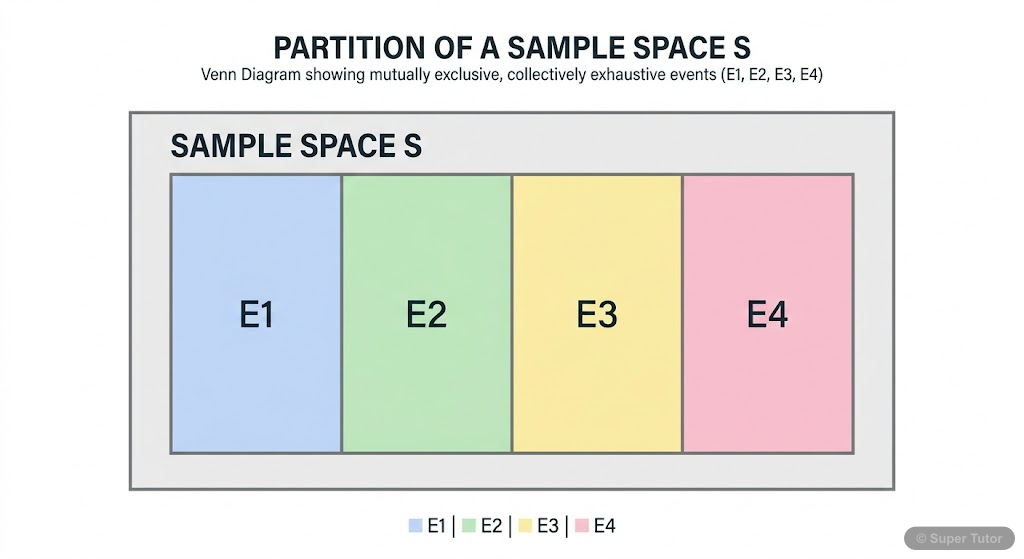
A Venn diagram illustrating a partition of a sample space S into several pairwise disjoint and exhaustive events E1, E2, ..., En.
Super Tutor

This is just one of 9+ visuals inside Super Tutor's Probability chapter

Explore the full set
62 Questions Solved · 4 Sections

Exercise 13.1

1Given that E and F are events such that P(E)=0.6\mathrm{P}(\mathrm{E}) = 0.6, P(F)=0.3\mathrm{P}(\mathrm{F}) = 0.3 and P(EF)=0.2\mathrm{P}(\mathrm{E} \cap \mathrm{F}) = 0.2, find P(EF)\mathrm{P}(\mathrm{E} \mid \mathrm{F}) and P(FE)\mathrm{P}(\mathrm{F} \mid \mathrm{E}).Show solution
Given: P(E)=0.6P(E) = 0.6, P(F)=0.3P(F) = 0.3, P(EF)=0.2P(E \cap F) = 0.2

Formula used: P(EF)=P(EF)P(F)P(E|F) = \dfrac{P(E \cap F)}{P(F)} and P(FE)=P(EF)P(E)P(F|E) = \dfrac{P(E \cap F)}{P(E)}

Finding P(EF)P(E|F):
P(EF)=P(EF)P(F)=0.20.3=23P(E|F) = \frac{P(E \cap F)}{P(F)} = \frac{0.2}{0.3} = \frac{2}{3}

Finding P(FE)P(F|E):
P(FE)=P(EF)P(E)=0.20.6=13P(F|E) = \frac{P(E \cap F)}{P(E)} = \frac{0.2}{0.6} = \frac{1}{3}

Answer: P(EF)=23P(E|F) = \dfrac{2}{3} and P(FE)=13P(F|E) = \dfrac{1}{3}.
2Compute P(AB)\mathrm{P}(\mathrm{A} \mid \mathrm{B}), if P(B)=0.5\mathrm{P}(\mathrm{B}) = 0.5 and P(AB)=0.32\mathrm{P}(\mathrm{A} \cap \mathrm{B}) = 0.32.Show solution
Given: P(B)=0.5P(B) = 0.5, P(AB)=0.32P(A \cap B) = 0.32

Formula used: P(AB)=P(AB)P(B)P(A|B) = \dfrac{P(A \cap B)}{P(B)}

P(AB)=0.320.5=3250=0.64P(A|B) = \frac{0.32}{0.5} = \frac{32}{50} = 0.64

Answer: P(AB)=0.64P(A|B) = 0.64.
3If P(A)=0.8\mathrm{P}(\mathrm{A}) = 0.8, P(B)=0.5\mathrm{P}(\mathrm{B}) = 0.5 and P(BA)=0.4\mathrm{P}(\mathrm{B} \mid \mathrm{A}) = 0.4, find (i) P(AB)\mathrm{P}(\mathrm{A} \cap \mathrm{B}), (ii) P(AB)\mathrm{P}(\mathrm{A} \mid \mathrm{B}), (iii) P(AB)\mathrm{P}(\mathrm{A} \cup \mathrm{B}).Show solution
Given: P(A)=0.8P(A) = 0.8, P(B)=0.5P(B) = 0.5, P(BA)=0.4P(B|A) = 0.4

(i) Finding P(AB)P(A \cap B):

Using P(BA)=P(AB)P(A)P(B|A) = \dfrac{P(A \cap B)}{P(A)}:
P(AB)=P(A)P(BA)=0.8×0.4=0.32P(A \cap B) = P(A) \cdot P(B|A) = 0.8 \times 0.4 = 0.32

(ii) Finding P(AB)P(A|B):
P(AB)=P(AB)P(B)=0.320.5=0.64P(A|B) = \frac{P(A \cap B)}{P(B)} = \frac{0.32}{0.5} = 0.64

(iii) Finding P(AB)P(A \cup B):

Using P(AB)=P(A)+P(B)P(AB)P(A \cup B) = P(A) + P(B) - P(A \cap B):
P(AB)=0.8+0.50.32=0.98P(A \cup B) = 0.8 + 0.5 - 0.32 = 0.98

Answers: (i) 0.320.32, (ii) 0.640.64, (iii) 0.980.98.
4Evaluate P(AB)\mathrm{P}(\mathrm{A} \cup \mathrm{B}), if 2P(A)=P(B)=5132\mathrm{P}(\mathrm{A}) = \mathrm{P}(\mathrm{B}) = \dfrac{5}{13} and P(AB)=25\mathrm{P}(\mathrm{A} \mid \mathrm{B}) = \dfrac{2}{5}.Show solution
Given: 2P(A)=P(B)=5132P(A) = P(B) = \dfrac{5}{13} and P(AB)=25P(A|B) = \dfrac{2}{5}

From the given condition:
P(B)=513,P(A)=526P(B) = \frac{5}{13}, \quad P(A) = \frac{5}{26}

Finding P(AB)P(A \cap B):
P(AB)=P(AB)P(B)    P(AB)=P(AB)P(B)=25×513=213P(A|B) = \frac{P(A \cap B)}{P(B)} \implies P(A \cap B) = P(A|B) \cdot P(B) = \frac{2}{5} \times \frac{5}{13} = \frac{2}{13}

Finding P(AB)P(A \cup B):
P(AB)=P(A)+P(B)P(AB)=526+513213P(A \cup B) = P(A) + P(B) - P(A \cap B) = \frac{5}{26} + \frac{5}{13} - \frac{2}{13}
=526+1026426=1126= \frac{5}{26} + \frac{10}{26} - \frac{4}{26} = \frac{11}{26}

Answer: P(AB)=1126P(A \cup B) = \dfrac{11}{26}.
5If P(A)=611\mathrm{P}(\mathrm{A}) = \dfrac{6}{11}, P(B)=511\mathrm{P}(\mathrm{B}) = \dfrac{5}{11} and P(AB)=711\mathrm{P}(\mathrm{A} \cup \mathrm{B}) = \dfrac{7}{11}, find (i) P(AB)\mathrm{P}(\mathrm{A} \cap \mathrm{B}), (ii) P(AB)\mathrm{P}(\mathrm{A} \mid \mathrm{B}), (iii) P(BA)\mathrm{P}(\mathrm{B} \mid \mathrm{A}).Show solution
Given: P(A)=611P(A) = \dfrac{6}{11}, P(B)=511P(B) = \dfrac{5}{11}, P(AB)=711P(A \cup B) = \dfrac{7}{11}

(i) Finding P(AB)P(A \cap B):
P(AB)=P(A)+P(B)P(AB)=611+511711=411P(A \cap B) = P(A) + P(B) - P(A \cup B) = \frac{6}{11} + \frac{5}{11} - \frac{7}{11} = \frac{4}{11}

(ii) Finding P(AB)P(A|B):
P(AB)=P(AB)P(B)=411511=45P(A|B) = \frac{P(A \cap B)}{P(B)} = \frac{\frac{4}{11}}{\frac{5}{11}} = \frac{4}{5}

(iii) Finding P(BA)P(B|A):
P(BA)=P(AB)P(A)=411611=46=23P(B|A) = \frac{P(A \cap B)}{P(A)} = \frac{\frac{4}{11}}{\frac{6}{11}} = \frac{4}{6} = \frac{2}{3}

Answers: (i) 411\dfrac{4}{11}, (ii) 45\dfrac{4}{5}, (iii) 23\dfrac{2}{3}.
6A coin is tossed three times. Determine P(EF)P(E|F) for: (i) E: head on third toss, F: heads on first two tosses; (ii) E: at least two heads, F: at most two heads; (iii) E: at most two tails, F: at least one tail.Show solution
Sample space when a coin is tossed three times has 23=82^3 = 8 equally likely outcomes:
S={HHH,HHT,HTH,HTT,THH,THT,TTH,TTT}S = \{HHH, HHT, HTH, HTT, THH, THT, TTH, TTT\}

(i) E: head on third toss, F: heads on first two tosses

E={HHH,HTH,THH,TTH}E = \{HHH, HTH, THH, TTH\}
F={HHH,HHT}F = \{HHH, HHT\}
EF={HHH}E \cap F = \{HHH\}

P(F)=28=14,P(EF)=18P(F) = \frac{2}{8} = \frac{1}{4}, \quad P(E \cap F) = \frac{1}{8}

P(EF)=P(EF)P(F)=1814=12P(E|F) = \frac{P(E \cap F)}{P(F)} = \frac{\frac{1}{8}}{\frac{1}{4}} = \frac{1}{2}

(ii) E: at least two heads, F: at most two heads

E={HHH,HHT,HTH,THH}E = \{HHH, HHT, HTH, THH\}
F={HHT,HTH,HTT,THH,THT,TTH,TTT}F = \{HHT, HTH, HTT, THH, THT, TTH, TTT\}
EF={HHT,HTH,THH}E \cap F = \{HHT, HTH, THH\}

P(F)=78,P(EF)=38P(F) = \frac{7}{8}, \quad P(E \cap F) = \frac{3}{8}

P(EF)=3878=37P(E|F) = \frac{\frac{3}{8}}{\frac{7}{8}} = \frac{3}{7}

(iii) E: at most two tails, F: at least one tail

E={HHH,HHT,HTH,HTT,THH,THT,TTH}E = \{HHH, HHT, HTH, HTT, THH, THT, TTH\} (all except TTT)
F={HHT,HTH,HTT,THH,THT,TTH,TTT}F = \{HHT, HTH, HTT, THH, THT, TTH, TTT\}
EF={HHT,HTH,HTT,THH,THT,TTH}E \cap F = \{HHT, HTH, HTT, THH, THT, TTH\}

P(F)=78,P(EF)=68=34P(F) = \frac{7}{8}, \quad P(E \cap F) = \frac{6}{8} = \frac{3}{4}

P(EF)=3478=34×87=67P(E|F) = \frac{\frac{3}{4}}{\frac{7}{8}} = \frac{3}{4} \times \frac{8}{7} = \frac{6}{7}

Answers: (i) 12\dfrac{1}{2}, (ii) 37\dfrac{3}{7}, (iii) 67\dfrac{6}{7}.
7Two coins are tossed once. Determine P(EF)P(E|F) for: (i) E: tail appears on one coin, F: one coin shows head; (ii) E: no tail appears, F: no head appears.Show solution
Sample space: S={HH,HT,TH,TT}S = \{HH, HT, TH, TT\}, each with probability 14\dfrac{1}{4}.

(i) E: tail appears on one coin, F: one coin shows head

E={HT,TH}E = \{HT, TH\} (exactly one tail)
F={HT,TH}F = \{HT, TH\} (exactly one head)
EF={HT,TH}E \cap F = \{HT, TH\}

P(F)=24=12,P(EF)=24=12P(F) = \frac{2}{4} = \frac{1}{2}, \quad P(E \cap F) = \frac{2}{4} = \frac{1}{2}

P(EF)=P(EF)P(F)=1212=1P(E|F) = \frac{P(E \cap F)}{P(F)} = \frac{\frac{1}{2}}{\frac{1}{2}} = 1

(ii) E: no tail appears, F: no head appears

E={HH}E = \{HH\} (no tail)
F={TT}F = \{TT\} (no head)
EF=ϕE \cap F = \phi

P(F)=14,P(EF)=0P(F) = \frac{1}{4}, \quad P(E \cap F) = 0

P(EF)=014=0P(E|F) = \frac{0}{\frac{1}{4}} = 0

Answers: (i) 11, (ii) 00.
8A die is thrown three times. E: 4 appears on the third toss, F: 6 and 5 appears respectively on first two tosses. Determine P(EF)P(E|F).Show solution
Given: A die is thrown three times. Total outcomes = 63=2166^3 = 216.

FF: 6 on first toss and 5 on second toss.
F={(6,5,1),(6,5,2),(6,5,3),(6,5,4),(6,5,5),(6,5,6)}F = \{(6,5,1),(6,5,2),(6,5,3),(6,5,4),(6,5,5),(6,5,6)\}, so F=6|F| = 6.

EFE \cap F: 6 on first, 5 on second, 4 on third = {(6,5,4)}\{(6,5,4)\}, so EF=1|E \cap F| = 1.

P(F)=6216=136,P(EF)=1216P(F) = \frac{6}{216} = \frac{1}{36}, \quad P(E \cap F) = \frac{1}{216}

P(EF)=P(EF)P(F)=1216136=1216×36=16P(E|F) = \frac{P(E \cap F)}{P(F)} = \frac{\frac{1}{216}}{\frac{1}{36}} = \frac{1}{216} \times 36 = \frac{1}{6}

Answer: P(EF)=16P(E|F) = \dfrac{1}{6}.
9Mother, father and son line up at random for a family picture. E: son on one end, F: father in middle. Determine P(EF)P(E|F).Show solution
Given: Three people — Mother (M), Father (F), Son (S) — line up at random.

Total arrangements = 3!=63! = 6:
{MFS,MSF,FMS,FSM,SMF,SFM}\{MFS, MSF, FMS, FSM, SMF, SFM\}

FF (father in middle): {MFS,SFM}\{MFS, SFM\}, so P(F)=26=13P(F) = \dfrac{2}{6} = \dfrac{1}{3}.

EE (son on one end): {SMF,SFM,MFS,FMS}\{SMF, SFM, MFS, FMS\}... Let me list carefully:
- Son on left end: {SMF,SFM}\{SMF, SFM\}
- Son on right end: {MFS,FMS}\{MFS, FMS\}
So E={SMF,SFM,MFS,FMS}E = \{SMF, SFM, MFS, FMS\}.

EFE \cap F (father in middle AND son on one end): {SFM,MFS}\{SFM, MFS\}, so P(EF)=26=13P(E \cap F) = \dfrac{2}{6} = \dfrac{1}{3}.

P(EF)=P(EF)P(F)=1313=1P(E|F) = \frac{P(E \cap F)}{P(F)} = \frac{\frac{1}{3}}{\frac{1}{3}} = 1

Answer: P(EF)=1P(E|F) = 1. (When father is in the middle, son must be on one end.)
10A black and a red dice are rolled. (a) Find the conditional probability of obtaining a sum greater than 9, given that the black die resulted in a 5. (b) Find the conditional probability of obtaining the sum 8, given that the red die resulted in a number less than 4.Show solution
Sample space: Each die has 6 faces, so total outcomes = 6×6=366 \times 6 = 36.

(a) Let A = sum > 9, B = black die shows 5.

B={(5,1),(5,2),(5,3),(5,4),(5,5),(5,6)}B = \{(5,1),(5,2),(5,3),(5,4),(5,5),(5,6)\}, P(B)=636=16P(B) = \dfrac{6}{36} = \dfrac{1}{6}.

For sum > 9 with black die = 5: red die must be > 4, i.e., 5 or 6.
AB={(5,5),(5,6)}A \cap B = \{(5,5),(5,6)\}, P(AB)=236=118P(A \cap B) = \dfrac{2}{36} = \dfrac{1}{18}.

P(AB)=P(AB)P(B)=11816=118×6=29P(A|B) = \frac{P(A \cap B)}{P(B)} = \frac{\frac{1}{18}}{\frac{1}{6}} = \frac{1}{18} \times 6 = \frac{2}{9}

(b) Let C = sum is 8, D = red die shows a number less than 4 (i.e., 1, 2, or 3).

D={(1,1),(1,2),(1,3),(2,1),(2,2),(2,3),(3,1),(3,2),(3,3),(4,1),(4,2),(4,3),(5,1),(5,2),(5,3),(6,1),(6,2),(6,3)}D = \{(1,1),(1,2),(1,3),(2,1),(2,2),(2,3),(3,1),(3,2),(3,3),(4,1),(4,2),(4,3),(5,1),(5,2),(5,3),(6,1),(6,2),(6,3)\}

Here (black, red) pairs where red < 4: P(D)=1836=12P(D) = \dfrac{18}{36} = \dfrac{1}{2}.

For sum = 8 with red die < 4: pairs (black, red) with black + red = 8 and red ∈ {1,2,3}:
- red = 1: black = 7 (impossible)
- red = 2: black = 6 → (6,2)(6,2)
- red = 3: black = 5 → (5,3)(5,3)

CD={(6,2),(5,3)}C \cap D = \{(6,2),(5,3)\}, P(CD)=236=118P(C \cap D) = \dfrac{2}{36} = \dfrac{1}{18}.

P(CD)=P(CD)P(D)=11812=19P(C|D) = \frac{P(C \cap D)}{P(D)} = \frac{\frac{1}{18}}{\frac{1}{2}} = \frac{1}{9}

Answers: (a) 29\dfrac{2}{9}, (b) 19\dfrac{1}{9}.
11A fair die is rolled. Consider events E={1,3,5}E = \{1,3,5\}, F={2,3}F = \{2,3\} and G={2,3,4,5}G = \{2,3,4,5\}. Find (i) P(EF)P(E|F) and P(FE)P(F|E); (ii) P(EG)P(E|G) and P(GE)P(G|E); (iii) P((EF)G)P((E \cup F)|G) and P((EF)G)P((E \cap F)|G).Show solution
Given: A fair die is rolled. S={1,2,3,4,5,6}S = \{1,2,3,4,5,6\}, each with probability 16\dfrac{1}{6}.

E={1,3,5}E = \{1,3,5\}, F={2,3}F = \{2,3\}, G={2,3,4,5}G = \{2,3,4,5\}

P(E)=36=12,P(F)=26=13,P(G)=46=23P(E) = \frac{3}{6} = \frac{1}{2}, \quad P(F) = \frac{2}{6} = \frac{1}{3}, \quad P(G) = \frac{4}{6} = \frac{2}{3}

EF={3}E \cap F = \{3\}, EG={3,5}E \cap G = \{3,5\}, EF={1,2,3,5}E \cup F = \{1,2,3,5\}, (EF)G={2,3,5}(E \cup F) \cap G = \{2,3,5\}, (EF)G={3}(E \cap F) \cap G = \{3\}

(i) P(EF)P(E|F) and P(FE)P(F|E):
P(EF)=P(EF)P(F)=1613=12P(E|F) = \frac{P(E \cap F)}{P(F)} = \frac{\frac{1}{6}}{\frac{1}{3}} = \frac{1}{2}
P(FE)=P(EF)P(E)=1612=13P(F|E) = \frac{P(E \cap F)}{P(E)} = \frac{\frac{1}{6}}{\frac{1}{2}} = \frac{1}{3}

(ii) P(EG)P(E|G) and P(GE)P(G|E):
P(EG)=P(EG)P(G)=2623=1323=12P(E|G) = \frac{P(E \cap G)}{P(G)} = \frac{\frac{2}{6}}{\frac{2}{3}} = \frac{\frac{1}{3}}{\frac{2}{3}} = \frac{1}{2}
P(GE)=P(EG)P(E)=2612=1312=23P(G|E) = \frac{P(E \cap G)}{P(E)} = \frac{\frac{2}{6}}{\frac{1}{2}} = \frac{\frac{1}{3}}{\frac{1}{2}} = \frac{2}{3}

(iii) P((EF)G)P((E \cup F)|G) and P((EF)G)P((E \cap F)|G):

(EF)G={2,3,5}(E \cup F) \cap G = \{2,3,5\}, so P((EF)G)=36=12P((E \cup F) \cap G) = \dfrac{3}{6} = \dfrac{1}{2}.
P((EF)G)=P((EF)G)P(G)=1223=34P((E \cup F)|G) = \frac{P((E \cup F) \cap G)}{P(G)} = \frac{\frac{1}{2}}{\frac{2}{3}} = \frac{3}{4}

(EF)G={3}(E \cap F) \cap G = \{3\}, so P((EF)G)=16P((E \cap F) \cap G) = \dfrac{1}{6}.
P((EF)G)=P((EF)G)P(G)=1623=14P((E \cap F)|G) = \frac{P((E \cap F) \cap G)}{P(G)} = \frac{\frac{1}{6}}{\frac{2}{3}} = \frac{1}{4}

Answers: (i) P(EF)=12P(E|F) = \dfrac{1}{2}, P(FE)=13P(F|E) = \dfrac{1}{3}; (ii) P(EG)=12P(E|G) = \dfrac{1}{2}, P(GE)=23P(G|E) = \dfrac{2}{3}; (iii) P((EF)G)=34P((E\cup F)|G) = \dfrac{3}{4}, P((EF)G)=14P((E\cap F)|G) = \dfrac{1}{4}.
12Assume that each born child is equally likely to be a boy or a girl. If a family has two children, what is the conditional probability that both are girls given that (i) the youngest is a girl, (ii) at least one is a girl?Show solution
Sample space: S={BB,BG,GB,GG}S = \{BB, BG, GB, GG\} (first child, second child), each equally likely with probability 14\dfrac{1}{4}.

Let A = both children are girls = {GG}\{GG\}.

(i) Given: youngest (second child) is a girl.

Let F1F_1 = youngest is a girl = {BG,GG}\{BG, GG\}, P(F1)=24=12P(F_1) = \dfrac{2}{4} = \dfrac{1}{2}.

AF1={GG}A \cap F_1 = \{GG\}, P(AF1)=14P(A \cap F_1) = \dfrac{1}{4}.

P(AF1)=P(AF1)P(F1)=1412=12P(A|F_1) = \frac{P(A \cap F_1)}{P(F_1)} = \frac{\frac{1}{4}}{\frac{1}{2}} = \frac{1}{2}

(ii) Given: at least one is a girl.

Let F2F_2 = at least one girl = {BG,GB,GG}\{BG, GB, GG\}, P(F2)=34P(F_2) = \dfrac{3}{4}.

AF2={GG}A \cap F_2 = \{GG\}, P(AF2)=14P(A \cap F_2) = \dfrac{1}{4}.

P(AF2)=P(AF2)P(F2)=1434=13P(A|F_2) = \frac{P(A \cap F_2)}{P(F_2)} = \frac{\frac{1}{4}}{\frac{3}{4}} = \frac{1}{3}

Answers: (i) 12\dfrac{1}{2}, (ii) 13\dfrac{1}{3}.
13An instructor has a question bank consisting of 300 easy True/False questions, 200 difficult True/False questions, 500 easy multiple choice questions and 400 difficult multiple choice questions. If a question is selected at random from the question bank, what is the probability that it will be an easy question given that it is a multiple choice question?Show solution
Given:
- Easy True/False: 300
- Difficult True/False: 200
- Easy Multiple Choice: 500
- Difficult Multiple Choice: 400
- Total questions: 300+200+500+400=1400300 + 200 + 500 + 400 = 1400

Let E = easy question, M = multiple choice question.

P(M)=500+4001400=9001400=914P(M) = \frac{500 + 400}{1400} = \frac{900}{1400} = \frac{9}{14}

P(EM)=5001400=514P(E \cap M) = \frac{500}{1400} = \frac{5}{14}

P(EM)=P(EM)P(M)=514914=59P(E|M) = \frac{P(E \cap M)}{P(M)} = \frac{\frac{5}{14}}{\frac{9}{14}} = \frac{5}{9}

Answer: The required probability is 59\dfrac{5}{9}.
14Given that the two numbers appearing on throwing two dice are different. Find the probability of the event 'the sum of numbers on the dice is 4'.Show solution
Sample space: Total outcomes when two dice are thrown = 36.

Let F = numbers on the two dice are different.
Number of outcomes where both dice show the same number = 6 (i.e., (1,1),(2,2),...,(6,6)).
So F=366=30|F| = 36 - 6 = 30, P(F)=3036=56P(F) = \dfrac{30}{36} = \dfrac{5}{6}.

Let E = sum of numbers is 4.
Outcomes with sum 4: {(1,3),(2,2),(3,1)}\{(1,3),(2,2),(3,1)\}.
But we need different numbers, so exclude (2,2)(2,2).
EF={(1,3),(3,1)}E \cap F = \{(1,3),(3,1)\}, P(EF)=236=118P(E \cap F) = \dfrac{2}{36} = \dfrac{1}{18}.

P(EF)=P(EF)P(F)=11856=118×65=115P(E|F) = \frac{P(E \cap F)}{P(F)} = \frac{\frac{1}{18}}{\frac{5}{6}} = \frac{1}{18} \times \frac{6}{5} = \frac{1}{15}

Answer: P(EF)=115P(E|F) = \dfrac{1}{15}.
15Consider the experiment of throwing a die, if a multiple of 3 comes up, throw the die again and if any other number comes, toss a coin. Find the conditional probability of the event 'the coin shows a tail', given that 'at least one die shows a 3'.Show solution
Sample space construction:
- If die shows 3 or 6 (multiples of 3): throw die again → outcomes: (3,1),(3,2),(3,3),(3,4),(3,5),(3,6),(6,1),(6,2),(6,3),(6,4),(6,5),(6,6)(3,1),(3,2),(3,3),(3,4),(3,5),(3,6),(6,1),(6,2),(6,3),(6,4),(6,5),(6,6) — 12 outcomes.
- If die shows 1, 2, 4, or 5: toss a coin → outcomes: (1,H),(1,T),(2,H),(2,T),(4,H),(4,T),(5,H),(5,T)(1,H),(1,T),(2,H),(2,T),(4,H),(4,T),(5,H),(5,T) — 8 outcomes.

Each face of the die has probability 16\dfrac{1}{6}. For multiples of 3, the second die has probability 16\dfrac{1}{6} each; for others, coin has probability 12\dfrac{1}{2} each.

Each outcome in the first group has probability 16×16=136\dfrac{1}{6} \times \dfrac{1}{6} = \dfrac{1}{36}.
Each outcome in the second group has probability 16×12=112\dfrac{1}{6} \times \dfrac{1}{2} = \dfrac{1}{12}.

Let A = coin shows tail = {(1,T),(2,T),(4,T),(5,T)}\{(1,T),(2,T),(4,T),(5,T)\}.
Let B = at least one die shows 3.

BB includes outcomes where first die = 3: (3,1),(3,2),(3,3),(3,4),(3,5),(3,6)(3,1),(3,2),(3,3),(3,4),(3,5),(3,6) and where second die = 3: (3,3),(6,3)(3,3),(6,3).
So B={(3,1),(3,2),(3,3),(3,4),(3,5),(3,6),(6,3)}B = \{(3,1),(3,2),(3,3),(3,4),(3,5),(3,6),(6,3)\}.

P(B)=6×136+1×136=636+136=736P(B) = 6 \times \frac{1}{36} + 1 \times \frac{1}{36} = \frac{6}{36} + \frac{1}{36} = \frac{7}{36}

AB=ϕA \cap B = \phi (A involves coin outcomes, B involves only die outcomes — they are disjoint events).

P(AB)=0P(A \cap B) = 0

P(AB)=P(AB)P(B)=0736=0P(A|B) = \frac{P(A \cap B)}{P(B)} = \frac{0}{\frac{7}{36}} = 0

Answer: P(AB)=0P(A|B) = 0.
16If P(A)=12P(A) = \dfrac{1}{2}, P(B)=0P(B) = 0, then P(AB)P(A|B) is (A) 0, (B) 12\dfrac{1}{2}, (C) not defined, (D) 1.Show solution
Correct Answer: (C) not defined.

P(AB)=P(AB)P(B)P(A|B) = \dfrac{P(A \cap B)}{P(B)}. Since P(B)=0P(B) = 0, the conditional probability P(AB)P(A|B) is not defined (division by zero is undefined).
17If A and B are events such that P(AB)=P(BA)P(A|B) = P(B|A), then (A) ABA \subset B but ABA \neq B, (B) A=BA = B, (C) AB=ϕA \cap B = \phi, (D) P(A)=P(B)P(A) = P(B).Show solution
Correct Answer: (D) P(A)=P(B)P(A) = P(B).

P(AB)=P(BA)P(A|B) = P(B|A) implies:
P(AB)P(B)=P(AB)P(A)\frac{P(A \cap B)}{P(B)} = \frac{P(A \cap B)}{P(A)}

Provided P(AB)0P(A \cap B) \neq 0, we can cancel P(AB)P(A \cap B) from both sides to get P(A)=P(B)P(A) = P(B).

Exercise 13.2

1If P(A)=35P(A) = \dfrac{3}{5} and P(B)=15P(B) = \dfrac{1}{5}, find P(AB)P(A \cap B) if A and B are independent events.Show solution
Given: P(A)=35P(A) = \dfrac{3}{5}, P(B)=15P(B) = \dfrac{1}{5}, A and B are independent.

For independent events: P(AB)=P(A)P(B)P(A \cap B) = P(A) \cdot P(B)

P(AB)=35×15=325P(A \cap B) = \frac{3}{5} \times \frac{1}{5} = \frac{3}{25}

Answer: P(AB)=325P(A \cap B) = \dfrac{3}{25}.
2Two cards are drawn at random and without replacement from a pack of 52 playing cards. Find the probability that both the cards are black.Show solution
Given: A pack of 52 cards has 26 black cards.

Let E1E_1 = first card drawn is black, E2E_2 = second card drawn is black.

P(E1)=2652=12P(E_1) = \frac{26}{52} = \frac{1}{2}

After drawing one black card, 25 black cards remain out of 51 total:
P(E2E1)=2551P(E_2|E_1) = \frac{25}{51}

By multiplication theorem:
P(E1E2)=P(E1)P(E2E1)=12×2551=25102P(E_1 \cap E_2) = P(E_1) \cdot P(E_2|E_1) = \frac{1}{2} \times \frac{25}{51} = \frac{25}{102}

Answer: The probability that both cards are black is 25102\dfrac{25}{102}.
3A box of oranges is inspected by examining three randomly selected oranges drawn without replacement. If all the three oranges are good, the box is approved for sale, otherwise, it is rejected. Find the probability that a box containing 15 oranges out of which 12 are good and 3 are bad ones will be approved for sale.Show solution
Given: 15 oranges total: 12 good, 3 bad. Three are drawn without replacement.

The box is approved if all three selected oranges are good.

Let E1,E2,E3E_1, E_2, E_3 be the events that the 1st, 2nd, 3rd orange drawn is good.

P(E1)=1215=45P(E_1) = \frac{12}{15} = \frac{4}{5}
P(E2E1)=1114P(E_2|E_1) = \frac{11}{14}
P(E3E1E2)=1013P(E_3|E_1 \cap E_2) = \frac{10}{13}

By multiplication theorem:
P(E1E2E3)=1215×1114×1013=13202730=4491P(E_1 \cap E_2 \cap E_3) = \frac{12}{15} \times \frac{11}{14} \times \frac{10}{13} = \frac{1320}{2730} = \frac{44}{91}

Answer: The probability that the box is approved for sale is 4491\dfrac{44}{91}.
4A fair coin and an unbiased die are tossed. Let A be the event 'head appears on the coin' and B be the event '3 on the die'. Check whether A and B are independent events or not.Show solution
Given: A fair coin and an unbiased die are tossed.

P(A)=12,P(B)=16P(A) = \frac{1}{2}, \quad P(B) = \frac{1}{6}

P(A)P(B)=12×16=112P(A) \cdot P(B) = \frac{1}{2} \times \frac{1}{6} = \frac{1}{12}

The event ABA \cap B = head on coin AND 3 on die = {(H,3)}\{(H,3)\}.

Total outcomes = 2×6=122 \times 6 = 12, so:
P(AB)=112P(A \cap B) = \frac{1}{12}

Since P(AB)=P(A)P(B)=112P(A \cap B) = P(A) \cdot P(B) = \dfrac{1}{12}, A and B are independent events.
5A die marked 1, 2, 3 in red and 4, 5, 6 in green is tossed. Let A be the event 'the number is even,' and B be the event 'the number is red'. Are A and B independent?Show solution
Given: Die faces: 1(red), 2(red), 3(red), 4(green), 5(green), 6(green).

AA = even number = {2,4,6}\{2, 4, 6\}, P(A)=36=12P(A) = \dfrac{3}{6} = \dfrac{1}{2}.

BB = red number = {1,2,3}\{1, 2, 3\}, P(B)=36=12P(B) = \dfrac{3}{6} = \dfrac{1}{2}.

ABA \cap B = even AND red = {2}\{2\}, P(AB)=16P(A \cap B) = \dfrac{1}{6}.

Now, P(A)P(B)=12×12=14P(A) \cdot P(B) = \dfrac{1}{2} \times \dfrac{1}{2} = \dfrac{1}{4}.

Since P(AB)=1614=P(A)P(B)P(A \cap B) = \dfrac{1}{6} \neq \dfrac{1}{4} = P(A) \cdot P(B), A and B are NOT independent.
6Let E and F be events with P(E)=35P(E) = \dfrac{3}{5}, P(F)=310P(F) = \dfrac{3}{10} and P(EF)=15P(E \cap F) = \dfrac{1}{5}. Are E and F independent?Show solution
Given: P(E)=35P(E) = \dfrac{3}{5}, P(F)=310P(F) = \dfrac{3}{10}, P(EF)=15P(E \cap F) = \dfrac{1}{5}.

Check: P(E)P(F)=35×310=950P(E) \cdot P(F) = \dfrac{3}{5} \times \dfrac{3}{10} = \dfrac{9}{50}.

But P(EF)=15=1050P(E \cap F) = \dfrac{1}{5} = \dfrac{10}{50}.

Since 1050950\dfrac{10}{50} \neq \dfrac{9}{50}, i.e., P(EF)P(E)P(F)P(E \cap F) \neq P(E) \cdot P(F), E and F are NOT independent.
7Given that the events A and B are such that P(A)=12P(A) = \dfrac{1}{2}, P(AB)=35P(A \cup B) = \dfrac{3}{5} and P(B)=pP(B) = p. Find pp if they are (i) mutually exclusive (ii) independent.Show solution
Given: P(A)=12P(A) = \dfrac{1}{2}, P(AB)=35P(A \cup B) = \dfrac{3}{5}, P(B)=pP(B) = p.

(i) Mutually exclusive: P(AB)=0P(A \cap B) = 0.
P(AB)=P(A)+P(B)    35=12+p    p=3512=110P(A \cup B) = P(A) + P(B) \implies \frac{3}{5} = \frac{1}{2} + p \implies p = \frac{3}{5} - \frac{1}{2} = \frac{1}{10}

(ii) Independent: P(AB)=P(A)P(B)=p2P(A \cap B) = P(A) \cdot P(B) = \dfrac{p}{2}.
P(AB)=P(A)+P(B)P(AB)P(A \cup B) = P(A) + P(B) - P(A \cap B)
35=12+pp2=12+p2\frac{3}{5} = \frac{1}{2} + p - \frac{p}{2} = \frac{1}{2} + \frac{p}{2}
p2=3512=110    p=15\frac{p}{2} = \frac{3}{5} - \frac{1}{2} = \frac{1}{10} \implies p = \frac{1}{5}

Answers: (i) p=110p = \dfrac{1}{10}, (ii) p=15p = \dfrac{1}{5}.
8Let A and B be independent events with P(A)=0.3P(A) = 0.3 and P(B)=0.4P(B) = 0.4. Find (i) P(AB)P(A \cap B), (ii) P(AB)P(A \cup B), (iii) P(AB)P(A|B), (iv) P(BA)P(B|A).Show solution
Given: A and B are independent, P(A)=0.3P(A) = 0.3, P(B)=0.4P(B) = 0.4.

(i) P(AB)=P(A)P(B)=0.3×0.4=0.12P(A \cap B) = P(A) \cdot P(B) = 0.3 \times 0.4 = 0.12

(ii) P(AB)=P(A)+P(B)P(AB)=0.3+0.40.12=0.58P(A \cup B) = P(A) + P(B) - P(A \cap B) = 0.3 + 0.4 - 0.12 = 0.58

(iii) Since A and B are independent:
P(AB)=P(A)=0.3P(A|B) = P(A) = 0.3

(iv) Since A and B are independent:
P(BA)=P(B)=0.4P(B|A) = P(B) = 0.4

Answers: (i) 0.120.12, (ii) 0.580.58, (iii) 0.30.3, (iv) 0.40.4.
9If A and B are two events such that P(A)=14P(A) = \dfrac{1}{4}, P(B)=12P(B) = \dfrac{1}{2} and P(AB)=18P(A \cap B) = \dfrac{1}{8}, find P(not A and not B).Show solution
Given: P(A)=14P(A) = \dfrac{1}{4}, P(B)=12P(B) = \dfrac{1}{2}, P(AB)=18P(A \cap B) = \dfrac{1}{8}.

P(not A and not B) = P(AB)=P((AB))=1P(AB)P(A' \cap B') = P((A \cup B)')= 1 - P(A \cup B).

P(AB)=P(A)+P(B)P(AB)=14+1218=28+4818=58P(A \cup B) = P(A) + P(B) - P(A \cap B) = \frac{1}{4} + \frac{1}{2} - \frac{1}{8} = \frac{2}{8} + \frac{4}{8} - \frac{1}{8} = \frac{5}{8}

P(AB)=158=38P(A' \cap B') = 1 - \frac{5}{8} = \frac{3}{8}

Answer: P(not A and not B)=38P(\text{not A and not B}) = \dfrac{3}{8}.
10Events A and B are such that P(A)=12P(A) = \dfrac{1}{2}, P(B)=712P(B) = \dfrac{7}{12} and P(not A or not B)=14P(\text{not A or not B}) = \dfrac{1}{4}. State whether A and B are independent.Show solution
Given: P(A)=12P(A) = \dfrac{1}{2}, P(B)=712P(B) = \dfrac{7}{12}, P(AB)=14P(A' \cup B') = \dfrac{1}{4}.

Using De Morgan's law: P(AB)=1P(AB)P(A' \cup B') = 1 - P(A \cap B).

14=1P(AB)    P(AB)=34\frac{1}{4} = 1 - P(A \cap B) \implies P(A \cap B) = \frac{3}{4}

Now check: P(A)P(B)=12×712=724P(A) \cdot P(B) = \dfrac{1}{2} \times \dfrac{7}{12} = \dfrac{7}{24}.

Since P(AB)=34=1824724=P(A)P(B)P(A \cap B) = \dfrac{3}{4} = \dfrac{18}{24} \neq \dfrac{7}{24} = P(A) \cdot P(B), A and B are NOT independent.
11Given two independent events A and B such that P(A)=0.3P(A) = 0.3, P(B)=0.6P(B) = 0.6. Find (i) P(A and B), (ii) P(A and not B), (iii) P(A or B), (iv) P(neither A nor B).Show solution
Given: A and B independent, P(A)=0.3P(A) = 0.3, P(B)=0.6P(B) = 0.6.

(i) P(A and B):
P(AB)=P(A)P(B)=0.3×0.6=0.18P(A \cap B) = P(A) \cdot P(B) = 0.3 \times 0.6 = 0.18

(ii) P(A and not B):
P(AB)=P(A)P(B)=P(A)[1P(B)]=0.3×0.4=0.12P(A \cap B') = P(A) \cdot P(B') = P(A) \cdot [1 - P(B)] = 0.3 \times 0.4 = 0.12

(iii) P(A or B):
P(AB)=P(A)+P(B)P(AB)=0.3+0.60.18=0.72P(A \cup B) = P(A) + P(B) - P(A \cap B) = 0.3 + 0.6 - 0.18 = 0.72

(iv) P(neither A nor B):
P(AB)=1P(AB)=10.72=0.28P(A' \cap B') = 1 - P(A \cup B) = 1 - 0.72 = 0.28

Answers: (i) 0.180.18, (ii) 0.120.12, (iii) 0.720.72, (iv) 0.280.28.
12A die is tossed thrice. Find the probability of getting an odd number at least once.Show solution
Given: A die is tossed three times.

P(odd number on one toss) = 36=12\dfrac{3}{6} = \dfrac{1}{2}.

P(no odd number in three tosses) = P(even on all three tosses) =(12)3=18= \left(\dfrac{1}{2}\right)^3 = \dfrac{1}{8}.

P(at least one odd number) =118=78= 1 - \dfrac{1}{8} = \dfrac{7}{8}.

Answer: 78\dfrac{7}{8}.
13Two balls are drawn at random with replacement from a box containing 10 black and 8 red balls. Find the probability that (i) both balls are red, (ii) first ball is black and second is red, (iii) one of them is black and other is red.Show solution
Given: Box has 10 black and 8 red balls. Total = 18. Draws are with replacement.

P(black)=1018=59P(\text{black}) = \dfrac{10}{18} = \dfrac{5}{9}, P(red)=818=49P(\text{red}) = \dfrac{8}{18} = \dfrac{4}{9}.

(i) Both balls are red:
P=49×49=1681P = \frac{4}{9} \times \frac{4}{9} = \frac{16}{81}

(ii) First ball is black and second is red:
P=59×49=2081P = \frac{5}{9} \times \frac{4}{9} = \frac{20}{81}

(iii) One black and one red (in any order):
P=P(black then red)+P(red then black)=59×49+49×59=2081+2081=4081P = P(\text{black then red}) + P(\text{red then black}) = \frac{5}{9} \times \frac{4}{9} + \frac{4}{9} \times \frac{5}{9} = \frac{20}{81} + \frac{20}{81} = \frac{40}{81}

Answers: (i) 1681\dfrac{16}{81}, (ii) 2081\dfrac{20}{81}, (iii) 4081\dfrac{40}{81}.
14Probability of solving specific problem independently by A and B are 12\dfrac{1}{2} and 13\dfrac{1}{3} respectively. If both try to solve the problem independently, find the probability that (i) the problem is solved, (ii) exactly one of them solves the problem.Show solution
Given: P(A)=12P(A) = \dfrac{1}{2}, P(B)=13P(B) = \dfrac{1}{3}. A and B work independently.

P(A)=12P(A') = \dfrac{1}{2}, P(B)=23P(B') = \dfrac{2}{3}.

(i) Problem is solved (at least one solves it):
P(AB)=1P(A)P(B)=112×23=113=23P(A \cup B) = 1 - P(A') \cdot P(B') = 1 - \frac{1}{2} \times \frac{2}{3} = 1 - \frac{1}{3} = \frac{2}{3}

(ii) Exactly one of them solves:
P=P(AB)+P(AB)=P(A)P(B)+P(A)P(B)P = P(A \cap B') + P(A' \cap B) = P(A)P(B') + P(A')P(B)
=12×23+12×13=26+16=36=12= \frac{1}{2} \times \frac{2}{3} + \frac{1}{2} \times \frac{1}{3} = \frac{2}{6} + \frac{1}{6} = \frac{3}{6} = \frac{1}{2}

Answers: (i) 23\dfrac{2}{3}, (ii) 12\dfrac{1}{2}.
15One card is drawn at random from a well shuffled deck of 52 cards. In which of the following cases are the events E and F independent? (i) E: 'the card drawn is a spade', F: 'the card drawn is an ace'; (ii) E: 'the card drawn is black', F: 'the card drawn is a king'; (iii) E: 'the card drawn is a king or queen', F: 'the card drawn is a queen or jack'.Show solution
(i) E: spade, F: ace

P(E)=1352=14P(E) = \dfrac{13}{52} = \dfrac{1}{4}, P(F)=452=113P(F) = \dfrac{4}{52} = \dfrac{1}{13}.

EFE \cap F = ace of spades: P(EF)=152P(E \cap F) = \dfrac{1}{52}.

P(E)P(F)=14×113=152=P(EF)P(E) \cdot P(F) = \dfrac{1}{4} \times \dfrac{1}{13} = \dfrac{1}{52} = P(E \cap F).

E and F are independent.

(ii) E: black card, F: king

P(E)=2652=12P(E) = \dfrac{26}{52} = \dfrac{1}{2}, P(F)=452=113P(F) = \dfrac{4}{52} = \dfrac{1}{13}.

EFE \cap F = black king (2 cards): P(EF)=252=126P(E \cap F) = \dfrac{2}{52} = \dfrac{1}{26}.

P(E)P(F)=12×113=126=P(EF)P(E) \cdot P(F) = \dfrac{1}{2} \times \dfrac{1}{13} = \dfrac{1}{26} = P(E \cap F).

E and F are independent.

(iii) E: king or queen, F: queen or jack

P(E)=852=213P(E) = \dfrac{8}{52} = \dfrac{2}{13}, P(F)=852=213P(F) = \dfrac{8}{52} = \dfrac{2}{13}.

EFE \cap F = queen (4 cards): P(EF)=452=113P(E \cap F) = \dfrac{4}{52} = \dfrac{1}{13}.

P(E)P(F)=213×213=4169113=13169P(E) \cdot P(F) = \dfrac{2}{13} \times \dfrac{2}{13} = \dfrac{4}{169} \neq \dfrac{1}{13} = \dfrac{13}{169}.

E and F are NOT independent.
16In a hostel, 60% of the students read Hindi newspaper, 40% read English newspaper and 20% read both Hindi and English newspapers. A student is selected at random. (a) Find the probability that she reads neither Hindi nor English newspapers. (b) If she reads Hindi newspaper, find the probability that she reads English newspaper. (c) If she reads English newspaper, find the probability that she reads Hindi newspaper.Show solution
Given: Let H = reads Hindi, E = reads English.
P(H)=0.6P(H) = 0.6, P(E)=0.4P(E) = 0.4, P(HE)=0.2P(H \cap E) = 0.2.

(a) P(neither Hindi nor English):
P(HE)=1P(HE)=1[P(H)+P(E)P(HE)]P(H' \cap E') = 1 - P(H \cup E) = 1 - [P(H) + P(E) - P(H \cap E)]
=1[0.6+0.40.2]=10.8=0.2= 1 - [0.6 + 0.4 - 0.2] = 1 - 0.8 = 0.2

(b) P(reads English | reads Hindi):
P(EH)=P(HE)P(H)=0.20.6=13P(E|H) = \frac{P(H \cap E)}{P(H)} = \frac{0.2}{0.6} = \frac{1}{3}

(c) P(reads Hindi | reads English):
P(HE)=P(HE)P(E)=0.20.4=12P(H|E) = \frac{P(H \cap E)}{P(E)} = \frac{0.2}{0.4} = \frac{1}{2}

Answers: (a) 0.20.2, (b) 13\dfrac{1}{3}, (c) 12\dfrac{1}{2}.
17The probability of obtaining an even prime number on each die, when a pair of dice is rolled is (A) 0, (B) 13\dfrac{1}{3}, (C) 112\dfrac{1}{12}, (D) 136\dfrac{1}{36}.Show solution
Correct Answer: (D) 136\dfrac{1}{36}.

The only even prime number is 2. So we need both dice to show 2.
P(both show 2)=16×16=136P(\text{both show 2}) = \frac{1}{6} \times \frac{1}{6} = \frac{1}{36}
18Two events A and B will be independent, if (A) A and B are mutually exclusive, (B) P(AB)=[1P(A)][1P(B)]P(A'B') = [1-P(A)][1-P(B)], (C) P(A)=P(B)P(A) = P(B), (D) P(A)+P(B)=1P(A) + P(B) = 1.Show solution
Correct Answer: (B) P(AB)=[1P(A)][1P(B)]P(A'B') = [1-P(A)][1-P(B)].

P(AB)=P(A)P(B)=[1P(A)][1P(B)]P(A' \cap B') = P(A') \cdot P(B') = [1-P(A)][1-P(B)] is exactly the condition that AA' and BB' are independent, which is equivalent to A and B being independent. This is the correct characterisation of independence.

Exercise 13.3

1An urn contains 5 red and 5 black balls. A ball is drawn at random, its colour is noted and is returned to the urn. Moreover, 2 additional balls of the colour drawn are put in the urn and then a ball is drawn at random. What is the probability that the second ball is red?Show solution
Given: Urn has 5 red and 5 black balls (total 10).

After drawing and returning a ball, 2 more of the same colour are added, making total 12 balls.

Case 1: First ball drawn is red (probability = 510=12\dfrac{5}{10} = \dfrac{1}{2}).
Urn now has 7 red + 5 black = 12 balls.
P(second ball is red | first is red) = 712\dfrac{7}{12}.

Case 2: First ball drawn is black (probability = 510=12\dfrac{5}{10} = \dfrac{1}{2}).
Urn now has 5 red + 7 black = 12 balls.
P(second ball is red | first is black) = 512\dfrac{5}{12}.

By total probability theorem:
P(second ball is red)=12×712+12×512=724+524=1224=12P(\text{second ball is red}) = \frac{1}{2} \times \frac{7}{12} + \frac{1}{2} \times \frac{5}{12} = \frac{7}{24} + \frac{5}{24} = \frac{12}{24} = \frac{1}{2}

Answer: 12\dfrac{1}{2}.
2A bag contains 4 red and 4 black balls, another bag contains 2 red and 6 black balls. One of the two bags is selected at random and a ball is drawn from the bag which is found to be red. Find the probability that the ball is drawn from the first bag.Show solution
Given:
- Bag I: 4 red, 4 black (total 8)
- Bag II: 2 red, 6 black (total 8)

Let E1E_1 = Bag I selected, E2E_2 = Bag II selected, A = red ball drawn.

P(E1)=P(E2)=12P(E_1) = P(E_2) = \frac{1}{2}
P(AE1)=48=12,P(AE2)=28=14P(A|E_1) = \frac{4}{8} = \frac{1}{2}, \quad P(A|E_2) = \frac{2}{8} = \frac{1}{4}

By Bayes' theorem:
P(E1A)=P(E1)P(AE1)P(E1)P(AE1)+P(E2)P(AE2)P(E_1|A) = \frac{P(E_1) \cdot P(A|E_1)}{P(E_1) \cdot P(A|E_1) + P(E_2) \cdot P(A|E_2)}
=12×1212×12+12×14=1414+18=1438=14×83=23= \frac{\frac{1}{2} \times \frac{1}{2}}{\frac{1}{2} \times \frac{1}{2} + \frac{1}{2} \times \frac{1}{4}} = \frac{\frac{1}{4}}{\frac{1}{4} + \frac{1}{8}} = \frac{\frac{1}{4}}{\frac{3}{8}} = \frac{1}{4} \times \frac{8}{3} = \frac{2}{3}

Answer: The probability that the ball was drawn from the first bag is 23\dfrac{2}{3}.
3Of the students in a college, it is known that 60% reside in hostel and 40% are day scholars. Previous year results report that 30% of all students who reside in hostel attain A grade and 20% of day scholars attain A grade in their annual examination. At the end of the year, one student is chosen at random from the college and he has an A grade, what is the probability that the student is a hostlier?Show solution
Given:
- P(H)P(H) = P(hostler) = 0.6
- P(D)P(D) = P(day scholar) = 0.4
- P(AH)P(A|H) = 0.30, P(AD)P(A|D) = 0.20

By Bayes' theorem:
P(HA)=P(H)P(AH)P(H)P(AH)+P(D)P(AD)P(H|A) = \frac{P(H) \cdot P(A|H)}{P(H) \cdot P(A|H) + P(D) \cdot P(A|D)}
=0.6×0.30.6×0.3+0.4×0.2=0.180.18+0.08=0.180.26=913= \frac{0.6 \times 0.3}{0.6 \times 0.3 + 0.4 \times 0.2} = \frac{0.18}{0.18 + 0.08} = \frac{0.18}{0.26} = \frac{9}{13}

Answer: The probability that the student is a hostler is 913\dfrac{9}{13}.
4In answering a question on a multiple choice test, a student either knows the answer or guesses. Let 34\dfrac{3}{4} be the probability that he knows the answer and 14\dfrac{1}{4} be the probability that he guesses. Assuming that a student who guesses at the answer will be correct with probability 14\dfrac{1}{4}. What is the probability that the student knows the answer given that he answered it correctly?Show solution
Given:
- P(K)P(K) = P(knows) = 34\dfrac{3}{4}
- P(G)P(G) = P(guesses) = 14\dfrac{1}{4}
- P(CK)P(C|K) = 1 (if he knows, he answers correctly)
- P(CG)P(C|G) = 14\dfrac{1}{4} (if he guesses, probability of correct = 14\dfrac{1}{4})

By Bayes' theorem:
P(KC)=P(K)P(CK)P(K)P(CK)+P(G)P(CG)P(K|C) = \frac{P(K) \cdot P(C|K)}{P(K) \cdot P(C|K) + P(G) \cdot P(C|G)}
=34×134×1+14×14=3434+116=3412+116=341316=34×1613=1213= \frac{\frac{3}{4} \times 1}{\frac{3}{4} \times 1 + \frac{1}{4} \times \frac{1}{4}} = \frac{\frac{3}{4}}{\frac{3}{4} + \frac{1}{16}} = \frac{\frac{3}{4}}{\frac{12+1}{16}} = \frac{\frac{3}{4}}{\frac{13}{16}} = \frac{3}{4} \times \frac{16}{13} = \frac{12}{13}

Answer: The probability that the student knows the answer is 1213\dfrac{12}{13}.
5A laboratory blood test is 99% effective in detecting a certain disease when it is in fact, present. However, the test also yields a false positive result for 0.5% of the healthy person tested. If 0.1 percent of the population actually has the disease, what is the probability that a person has the disease given that his test result is positive?Show solution
Given:
- P(D)P(D) = P(has disease) = 0.001
- P(D)P(D') = P(healthy) = 0.999
- P(+D)P(+|D) = 0.99 (test positive given disease)
- P(+D)P(+|D') = 0.005 (false positive)

By Bayes' theorem:
P(D+)=P(D)P(+D)P(D)P(+D)+P(D)P(+D)P(D|+) = \frac{P(D) \cdot P(+|D)}{P(D) \cdot P(+|D) + P(D') \cdot P(+|D')}
=0.001×0.990.001×0.99+0.999×0.005= \frac{0.001 \times 0.99}{0.001 \times 0.99 + 0.999 \times 0.005}
=0.000990.00099+0.004995=0.000990.005985= \frac{0.00099}{0.00099 + 0.004995} = \frac{0.00099}{0.005985}
=9905985=110665=22133= \frac{990}{5985} = \frac{110}{665} = \frac{22}{133}

Answer: P(D+)=221330.1653P(D|+) = \dfrac{22}{133} \approx 0.1653.
6There are three coins. One is a two headed coin (having head on both faces), another is a biased coin that comes up heads 75% of the time and third is an unbiased coin. One of the three coins is chosen at random and tossed, it shows heads, what is the probability that it was the two headed coin?Show solution
Given:
- Coin 1: two-headed, P(HC1)=1P(H|C_1) = 1
- Coin 2: biased, P(HC2)=0.75=34P(H|C_2) = 0.75 = \dfrac{3}{4}
- Coin 3: unbiased, P(HC3)=0.5=12P(H|C_3) = 0.5 = \dfrac{1}{2}
- P(C1)=P(C2)=P(C3)=13P(C_1) = P(C_2) = P(C_3) = \dfrac{1}{3}

By Bayes' theorem:
P(C1H)=P(C1)P(HC1)P(C1)P(HC1)+P(C2)P(HC2)+P(C3)P(HC3)P(C_1|H) = \frac{P(C_1) \cdot P(H|C_1)}{P(C_1)P(H|C_1) + P(C_2)P(H|C_2) + P(C_3)P(H|C_3)}
=13×113×1+13×34+13×12= \frac{\frac{1}{3} \times 1}{\frac{1}{3} \times 1 + \frac{1}{3} \times \frac{3}{4} + \frac{1}{3} \times \frac{1}{2}}
=1313(1+34+12)=11+34+12=194=49= \frac{\frac{1}{3}}{\frac{1}{3}\left(1 + \frac{3}{4} + \frac{1}{2}\right)} = \frac{1}{1 + \frac{3}{4} + \frac{1}{2}} = \frac{1}{\frac{9}{4}} = \frac{4}{9}

Answer: The probability that it was the two-headed coin is 49\dfrac{4}{9}.
7An insurance company insured 2000 scooter drivers, 4000 car drivers and 6000 truck drivers. The probability of an accidents are 0.01, 0.03 and 0.15 respectively. One of the insured persons meets with an accident. What is the probability that he is a scooter driver?Show solution
Given: Total insured = 12000.
- P(S)P(S) = P(scooter driver) = 200012000=16\dfrac{2000}{12000} = \dfrac{1}{6}
- P(C)P(C) = P(car driver) = 400012000=13\dfrac{4000}{12000} = \dfrac{1}{3}
- P(T)P(T) = P(truck driver) = 600012000=12\dfrac{6000}{12000} = \dfrac{1}{2}
- P(AS)=0.01P(A|S) = 0.01, P(AC)=0.03P(A|C) = 0.03, P(AT)=0.15P(A|T) = 0.15

By Bayes' theorem:
P(SA)=P(S)P(AS)P(S)P(AS)+P(C)P(AC)+P(T)P(AT)P(S|A) = \frac{P(S) \cdot P(A|S)}{P(S)P(A|S) + P(C)P(A|C) + P(T)P(A|T)}
=16×0.0116×0.01+13×0.03+12×0.15= \frac{\frac{1}{6} \times 0.01}{\frac{1}{6} \times 0.01 + \frac{1}{3} \times 0.03 + \frac{1}{2} \times 0.15}
=0.0160.016+0.033+0.152= \frac{\frac{0.01}{6}}{\frac{0.01}{6} + \frac{0.03}{3} + \frac{0.15}{2}}

Multiply numerator and denominator by 600:
=11+6+45=152= \frac{1}{1 + 6 + 45} = \frac{1}{52}

Answer: The probability that the person is a scooter driver is 152\dfrac{1}{52}.
8A factory has two machines A and B. Past record shows that machine A produced 60% of the items of output and machine B produced 40% of the items. Further, 2% of the items produced by machine A and 1% produced by machine B were defective. All the items are put into one stockpile and then one item is chosen at random from this and is found to be defective. What is the probability that it was produced by machine B?Show solution
Given:
- P(MA)=0.6P(M_A) = 0.6, P(MB)=0.4P(M_B) = 0.4
- P(DMA)=0.02P(D|M_A) = 0.02, P(DMB)=0.01P(D|M_B) = 0.01

By Bayes' theorem:
P(MBD)=P(MB)P(DMB)P(MA)P(DMA)+P(MB)P(DMB)P(M_B|D) = \frac{P(M_B) \cdot P(D|M_B)}{P(M_A) \cdot P(D|M_A) + P(M_B) \cdot P(D|M_B)}
=0.4×0.010.6×0.02+0.4×0.01=0.0040.012+0.004=0.0040.016=14= \frac{0.4 \times 0.01}{0.6 \times 0.02 + 0.4 \times 0.01} = \frac{0.004}{0.012 + 0.004} = \frac{0.004}{0.016} = \frac{1}{4}

Answer: The probability that the defective item was produced by machine B is 14\dfrac{1}{4}.
9Two groups are competing for the position on the Board of directors of a corporation. The probabilities that the first and the second groups will win are 0.6 and 0.4 respectively. Further, if the first group wins, the probability of introducing a new product is 0.7 and the corresponding probability is 0.3 if the second group wins. Find the probability that the new product introduced was by the second group.Show solution
Given:
- P(G1)=0.6P(G_1) = 0.6, P(G2)=0.4P(G_2) = 0.4
- P(NG1)=0.7P(N|G_1) = 0.7, P(NG2)=0.3P(N|G_2) = 0.3

By Bayes' theorem:
P(G2N)=P(G2)P(NG2)P(G1)P(NG1)+P(G2)P(NG2)P(G_2|N) = \frac{P(G_2) \cdot P(N|G_2)}{P(G_1) \cdot P(N|G_1) + P(G_2) \cdot P(N|G_2)}
=0.4×0.30.6×0.7+0.4×0.3=0.120.42+0.12=0.120.54=29= \frac{0.4 \times 0.3}{0.6 \times 0.7 + 0.4 \times 0.3} = \frac{0.12}{0.42 + 0.12} = \frac{0.12}{0.54} = \frac{2}{9}

Answer: The probability that the new product was introduced by the second group is 29\dfrac{2}{9}.
10Suppose a girl throws a die. If she gets a 5 or 6, she tosses a coin three times and notes the number of heads. If she gets 1, 2, 3 or 4, she tosses a coin once and notes whether a head or tail is obtained. If she obtained exactly one head, what is the probability that she threw 1, 2, 3 or 4 with the die?Show solution
Given:
- E1E_1: die shows 5 or 6, P(E1)=26=13P(E_1) = \dfrac{2}{6} = \dfrac{1}{3}
- E2E_2: die shows 1, 2, 3 or 4, P(E2)=46=23P(E_2) = \dfrac{4}{6} = \dfrac{2}{3}
- A: exactly one head

If E1E_1: coin tossed 3 times. P(exactly 1 head) = (31)(12)3=38\binom{3}{1}\left(\dfrac{1}{2}\right)^3 = \dfrac{3}{8}.

If E2E_2: coin tossed once. P(exactly 1 head) = P(head) = 12\dfrac{1}{2}.

By Bayes' theorem:
P(E2A)=P(E2)P(AE2)P(E1)P(AE1)+P(E2)P(AE2)P(E_2|A) = \frac{P(E_2) \cdot P(A|E_2)}{P(E_1) \cdot P(A|E_1) + P(E_2) \cdot P(A|E_2)}
=23×1213×38+23×12=1318+13=133+824=131124=13×2411=811= \frac{\frac{2}{3} \times \frac{1}{2}}{\frac{1}{3} \times \frac{3}{8} + \frac{2}{3} \times \frac{1}{2}} = \frac{\frac{1}{3}}{\frac{1}{8} + \frac{1}{3}} = \frac{\frac{1}{3}}{\frac{3+8}{24}} = \frac{\frac{1}{3}}{\frac{11}{24}} = \frac{1}{3} \times \frac{24}{11} = \frac{8}{11}

Answer: The probability is 811\dfrac{8}{11}.
11A manufacturer has three machine operators A, B and C. The first operator A produces 1% defective items, whereas the other two operators B and C produce 5% and 7% defective items respectively. A is on the job for 50% of the time, B is on the job for 30% of the time and C is on the job for 20% of the time. A defective item is produced, what is the probability that it was produced by A?Show solution
Given:
- P(A)=0.5P(A) = 0.5, P(B)=0.3P(B) = 0.3, P(C)=0.2P(C) = 0.2
- P(DA)=0.01P(D|A) = 0.01, P(DB)=0.05P(D|B) = 0.05, P(DC)=0.07P(D|C) = 0.07

By Bayes' theorem:
P(AD)=P(A)P(DA)P(A)P(DA)+P(B)P(DB)+P(C)P(DC)P(A|D) = \frac{P(A) \cdot P(D|A)}{P(A)P(D|A) + P(B)P(D|B) + P(C)P(D|C)}
=0.5×0.010.5×0.01+0.3×0.05+0.2×0.07= \frac{0.5 \times 0.01}{0.5 \times 0.01 + 0.3 \times 0.05 + 0.2 \times 0.07}
=0.0050.005+0.015+0.014=0.0050.034=534= \frac{0.005}{0.005 + 0.015 + 0.014} = \frac{0.005}{0.034} = \frac{5}{34}

Answer: The probability that the defective item was produced by operator A is 534\dfrac{5}{34}.
12A card from a pack of 52 cards is lost. From the remaining cards of the pack, two cards are drawn and are found to be both diamonds. Find the probability of the lost card being a diamond.Show solution
Given: One card is lost. Two cards drawn from remaining 51 are both diamonds.

Let E1E_1 = lost card is a diamond, E2E_2 = lost card is not a diamond.

P(E1)=1352=14,P(E2)=3952=34P(E_1) = \frac{13}{52} = \frac{1}{4}, \quad P(E_2) = \frac{39}{52} = \frac{3}{4}

Let A = both drawn cards are diamonds.

If E1E_1 (lost card is diamond): 12 diamonds remain in 51 cards.
P(AE1)=(122)(512)=661275=22425P(A|E_1) = \frac{\binom{12}{2}}{\binom{51}{2}} = \frac{66}{1275} = \frac{22}{425}

If E2E_2 (lost card is not diamond): 13 diamonds remain in 51 cards.
P(AE2)=(132)(512)=781275=26425P(A|E_2) = \frac{\binom{13}{2}}{\binom{51}{2}} = \frac{78}{1275} = \frac{26}{425}

By Bayes' theorem:
P(E1A)=P(E1)P(AE1)P(E1)P(AE1)+P(E2)P(AE2)P(E_1|A) = \frac{P(E_1) \cdot P(A|E_1)}{P(E_1) \cdot P(A|E_1) + P(E_2) \cdot P(A|E_2)}
=14×2242514×22425+34×26425= \frac{\frac{1}{4} \times \frac{22}{425}}{\frac{1}{4} \times \frac{22}{425} + \frac{3}{4} \times \frac{26}{425}}
=221700221700+781700=2222+78=22100=1150= \frac{\frac{22}{1700}}{\frac{22}{1700} + \frac{78}{1700}} = \frac{22}{22 + 78} = \frac{22}{100} = \frac{11}{50}

Answer: The probability that the lost card is a diamond is 1150\dfrac{11}{50}.
13Probability that A speaks truth is 45\dfrac{4}{5}. A coin is tossed. A reports that a head appears. The probability that actually there was head is (A) 45\dfrac{4}{5}, (B) 12\dfrac{1}{2}, (C) 15\dfrac{1}{5}, (D) 25\dfrac{2}{5}.Show solution
Correct Answer: (A) 45\dfrac{4}{5}.

Let HH = head actually appeared, HH' = tail actually appeared.
P(H)=P(H)=12P(H) = P(H') = \dfrac{1}{2}.

Let RR = A reports head.
- P(RH)=45P(R|H) = \dfrac{4}{5} (A speaks truth)
- P(RH)=15P(R|H') = \dfrac{1}{5} (A lies, reports head when tail appeared)

By Bayes' theorem:
P(HR)=P(H)P(RH)P(H)P(RH)+P(H)P(RH)=12×4512×45+12×15=410410+110=45P(H|R) = \frac{P(H) \cdot P(R|H)}{P(H) \cdot P(R|H) + P(H') \cdot P(R|H')} = \frac{\frac{1}{2} \times \frac{4}{5}}{\frac{1}{2} \times \frac{4}{5} + \frac{1}{2} \times \frac{1}{5}} = \frac{\frac{4}{10}}{\frac{4}{10} + \frac{1}{10}} = \frac{4}{5}
14If A and B are two events such that ABA \subset B and P(B)0P(B) \neq 0, then which of the following is correct? (A) P(AB)=P(B)P(A)P(A|B) = \dfrac{P(B)}{P(A)}, (B) P(A|B) &lt; P(A), (C) P(AB)P(A)P(A|B) \geq P(A), (D) None of these.Show solution
Correct Answer: (C) P(AB)P(A)P(A|B) \geq P(A).

Since ABA \subset B, we have AB=AA \cap B = A, so:
P(AB)=P(AB)P(B)=P(A)P(B)P(A|B) = \frac{P(A \cap B)}{P(B)} = \frac{P(A)}{P(B)}

Since ABA \subset B, P(A)P(B)P(A) \leq P(B), which means P(B)1P(B) \leq 1 and P(A)P(B)P(A)\dfrac{P(A)}{P(B)} \geq P(A).

Therefore P(AB)=P(A)P(B)P(A)P(A|B) = \dfrac{P(A)}{P(B)} \geq P(A).

Miscellaneous Exercise on Chapter 13

1A and B are two events such that P(A)0P(A) \neq 0. Find P(BA)P(B|A), if (i) A is a subset of B, (ii) AB=A \cap B = \emptyset.Show solution
Formula: P(BA)=P(AB)P(A)P(B|A) = \dfrac{P(A \cap B)}{P(A)}

(i) A is a subset of B (ABA \subset B):

If ABA \subset B, then AB=AA \cap B = A, so P(AB)=P(A)P(A \cap B) = P(A).
P(BA)=P(A)P(A)=1P(B|A) = \frac{P(A)}{P(A)} = 1

(ii) AB=A \cap B = \emptyset:

P(AB)=0P(A \cap B) = 0.
P(BA)=0P(A)=0P(B|A) = \frac{0}{P(A)} = 0

Answers: (i) 11, (ii) 00.
2A couple has two children. (i) Find the probability that both children are males, if it is known that at least one of the children is male. (ii) Find the probability that both children are females, if it is known that the elder child is a female.Show solution
Sample space: S={BB,BG,GB,GG}S = \{BB, BG, GB, GG\}, each equally likely.

(i) Both males, given at least one is male:

Let A = both are males = {BB}\{BB\}, F = at least one male = {BB,BG,GB}\{BB, BG, GB\}.
P(AF)=P(AF)P(F)=1434=13P(A|F) = \frac{P(A \cap F)}{P(F)} = \frac{\frac{1}{4}}{\frac{3}{4}} = \frac{1}{3}

(ii) Both females, given elder child is female:

Let B = both females = {GG}\{GG\}, E = elder child is female = {GB,GG}\{GB, GG\}.
P(BE)=P(BE)P(E)=1424=12P(B|E) = \frac{P(B \cap E)}{P(E)} = \frac{\frac{1}{4}}{\frac{2}{4}} = \frac{1}{2}

Answers: (i) 13\dfrac{1}{3}, (ii) 12\dfrac{1}{2}.
3Suppose that 5% of men and 0.25% of women have grey hair. A grey-haired person is selected at random. What is the probability of this person being male? Assume that there are equal number of males and females.Show solution
Given: Equal number of males and females, so P(M)=P(W)=12P(M) = P(W) = \dfrac{1}{2}.

P(GM)=0.05P(G|M) = 0.05, P(GW)=0.0025P(G|W) = 0.0025.

By Bayes' theorem:
P(MG)=P(M)P(GM)P(M)P(GM)+P(W)P(GW)P(M|G) = \frac{P(M) \cdot P(G|M)}{P(M) \cdot P(G|M) + P(W) \cdot P(G|W)}
=12×0.0512×0.05+12×0.0025=0.050.05+0.0025=0.050.0525=5052.5=2021= \frac{\frac{1}{2} \times 0.05}{\frac{1}{2} \times 0.05 + \frac{1}{2} \times 0.0025} = \frac{0.05}{0.05 + 0.0025} = \frac{0.05}{0.0525} = \frac{50}{52.5} = \frac{20}{21}

Answer: The probability that the grey-haired person is male is 2021\dfrac{20}{21}.
4Suppose that 90% of people are right-handed. What is the probability that at most 6 of a random sample of 10 people are right-handed?Show solution
Given: pp = P(right-handed) = 0.9, q=0.1q = 0.1, n=10n = 10.

This is a Binomial distribution: XB(10,0.9)X \sim B(10, 0.9).

P(at most 6 right-handed) = P(X6)=1P(X7)P(X \leq 6) = 1 - P(X \geq 7)

P(X7)=P(X=7)+P(X=8)+P(X=9)+P(X=10)P(X \geq 7) = P(X=7) + P(X=8) + P(X=9) + P(X=10)

P(X=k)=(10k)(0.9)k(0.1)10kP(X = k) = \binom{10}{k}(0.9)^k(0.1)^{10-k}

P(X=7)=(107)(0.9)7(0.1)3=120×(0.9)7×(0.1)3P(X=7) = \binom{10}{7}(0.9)^7(0.1)^3 = 120 \times (0.9)^7 \times (0.1)^3
P(X=8)=(108)(0.9)8(0.1)2=45×(0.9)8×(0.1)2P(X=8) = \binom{10}{8}(0.9)^8(0.1)^2 = 45 \times (0.9)^8 \times (0.1)^2
P(X=9)=(109)(0.9)9(0.1)1=10×(0.9)9×(0.1)P(X=9) = \binom{10}{9}(0.9)^9(0.1)^1 = 10 \times (0.9)^9 \times (0.1)
P(X=10)=(1010)(0.9)10=(0.9)10P(X=10) = \binom{10}{10}(0.9)^{10} = (0.9)^{10}

P(X6)=1[(107)(0.9)7(0.1)3+(108)(0.9)8(0.1)2+(109)(0.9)9(0.1)+(0.9)10]P(X \leq 6) = 1 - \left[\binom{10}{7}(0.9)^7(0.1)^3 + \binom{10}{8}(0.9)^8(0.1)^2 + \binom{10}{9}(0.9)^9(0.1) + (0.9)^{10}\right]

Answer: P(X6)=1k=710(10k)(0.9)k(0.1)10kP(X \leq 6) = 1 - \displaystyle\sum_{k=7}^{10}\binom{10}{k}(0.9)^k(0.1)^{10-k}.
5If a leap year is selected at random, what is the chance that it will contain 53 Tuesdays?Show solution
A leap year has 366 days = 52 complete weeks + 2 extra days.

The 52 complete weeks already contain 52 Tuesdays. For 53 Tuesdays, the 2 extra days must include a Tuesday.

The 2 extra days can be any consecutive pair:
{(Sun,Mon),(Mon,Tue),(Tue,Wed),(Wed,Thu),(Thu,Fri),(Fri,Sat),(Sat,Sun)}\{(Sun, Mon), (Mon, Tue), (Tue, Wed), (Wed, Thu), (Thu, Fri), (Fri, Sat), (Sat, Sun)\}

Total = 7 equally likely pairs.

Favourable outcomes (containing Tuesday): {(Mon,Tue),(Tue,Wed)}\{(Mon, Tue), (Tue, Wed)\} = 2 outcomes.

P(53 Tuesdays)=27P(53 \text{ Tuesdays}) = \frac{2}{7}

Answer: 27\dfrac{2}{7}.
6Suppose we have four boxes A, B, C and D containing coloured marbles as given below: Box A: 1 Red, 6 White, 3 Black; Box B: 6 Red, 2 White, 2 Black; Box C: 8 Red, 1 White, 1 Black; Box D: 0 Red, 6 White, 4 Black. One of the boxes has been selected at random and a single marble is drawn from it. If the marble is red, what is the probability that it was drawn from box A?, box B?, box C?Show solution
Given: Each box is selected with probability 14\dfrac{1}{4}.

Total marbles: A=10, B=10, C=10, D=10.

P(RA)=110P(R|A) = \dfrac{1}{10}, P(RB)=610P(R|B) = \dfrac{6}{10}, P(RC)=810P(R|C) = \dfrac{8}{10}, P(RD)=010=0P(R|D) = \dfrac{0}{10} = 0.

Total probability of red:
P(R)=14(110+610+810+0)=14×1510=1540=38P(R) = \frac{1}{4}\left(\frac{1}{10} + \frac{6}{10} + \frac{8}{10} + 0\right) = \frac{1}{4} \times \frac{15}{10} = \frac{15}{40} = \frac{3}{8}

By Bayes' theorem:
P(AR)=14×11038=14038=140×83=115P(A|R) = \frac{\frac{1}{4} \times \frac{1}{10}}{\frac{3}{8}} = \frac{\frac{1}{40}}{\frac{3}{8}} = \frac{1}{40} \times \frac{8}{3} = \frac{1}{15}

P(BR)=14×61038=64038=640×83=25P(B|R) = \frac{\frac{1}{4} \times \frac{6}{10}}{\frac{3}{8}} = \frac{\frac{6}{40}}{\frac{3}{8}} = \frac{6}{40} \times \frac{8}{3} = \frac{2}{5}

P(CR)=14×81038=84038=840×83=815P(C|R) = \frac{\frac{1}{4} \times \frac{8}{10}}{\frac{3}{8}} = \frac{\frac{8}{40}}{\frac{3}{8}} = \frac{8}{40} \times \frac{8}{3} = \frac{8}{15}

Answers: P(AR)=115P(A|R) = \dfrac{1}{15}, P(BR)=25P(B|R) = \dfrac{2}{5}, P(CR)=815P(C|R) = \dfrac{8}{15}.
7Assume that the chances of a patient having a heart attack is 40%. It is also assumed that a meditation and yoga course reduce the risk of heart attack by 30% and prescription of certain drug reduces its chances by 25%. At a time a patient can choose any one of the two options with equal probabilities. It is given that after going through one of the two options the patient selected at random suffers a heart attack. Find the probability that the patient followed a course of meditation and yoga.Show solution
Given:
- P(M)=P(D)=12P(M) = P(D) = \dfrac{1}{2} (equal probability of choosing meditation/yoga or drug)
- Base risk of heart attack = 0.40
- Meditation/yoga reduces risk by 30%: P(HM)=0.40×(10.30)=0.40×0.70=0.28P(H|M) = 0.40 \times (1 - 0.30) = 0.40 \times 0.70 = 0.28
- Drug reduces risk by 25%: P(HD)=0.40×(10.25)=0.40×0.75=0.30P(H|D) = 0.40 \times (1 - 0.25) = 0.40 \times 0.75 = 0.30

By Bayes' theorem:
P(MH)=P(M)P(HM)P(M)P(HM)+P(D)P(HD)P(M|H) = \frac{P(M) \cdot P(H|M)}{P(M) \cdot P(H|M) + P(D) \cdot P(H|D)}
=12×0.2812×0.28+12×0.30=0.280.28+0.30=0.280.58=1429= \frac{\frac{1}{2} \times 0.28}{\frac{1}{2} \times 0.28 + \frac{1}{2} \times 0.30} = \frac{0.28}{0.28 + 0.30} = \frac{0.28}{0.58} = \frac{14}{29}

Answer: The probability that the patient followed meditation and yoga is 1429\dfrac{14}{29}.
8If each element of a second order determinant is either zero or one, what is the probability that the value of the determinant is positive? (Assume that the individual entries of the determinant are chosen independently, each value being assumed with probability 12\dfrac{1}{2}).Show solution
A second order determinant: aamp;bcamp;d=adbc\begin{vmatrix} a &amp; b \\ c &amp; d \end{vmatrix} = ad - bc.

Each of a,b,c,d{0,1}a, b, c, d \in \{0, 1\} with probability 12\dfrac{1}{2} each. Total outcomes = 24=162^4 = 16.

We need ad - bc &gt; 0, i.e., ad &gt; bc, i.e., ad=1ad = 1 and bc=0bc = 0.

ad=1ad = 1 requires a=1a = 1 and d=1d = 1: probability =14= \dfrac{1}{4}.
bc=0bc = 0 requires NOT (b=1b=1 and c=1c=1): probability =114=34= 1 - \dfrac{1}{4} = \dfrac{3}{4}.

Since entries are independent:
P(ad - bc &gt; 0) = P(ad=1) \cdot P(bc=0) = \frac{1}{4} \times \frac{3}{4} = \frac{3}{16}

Answer: The probability that the determinant is positive is 316\dfrac{3}{16}.
9An electronic assembly consists of two subsystems, say, A and B. From previous testing procedures, the following probabilities are assumed to be known: P(A fails)=0.2P(A \text{ fails}) = 0.2, P(B fails alone)=0.15P(B \text{ fails alone}) = 0.15, P(A and B fail)=0.15P(A \text{ and } B \text{ fail}) = 0.15. Evaluate: (i) P(A fails | B has failed), (ii) P(A fails alone).Show solution
Given:
- P(A fails)=0.2P(A \text{ fails}) = 0.2
- P(A and B fail)=P(AB)=0.15P(A \text{ and } B \text{ fail}) = P(A \cap B) = 0.15
- P(B fails alone)=P(B)P(AB)=0.15P(B \text{ fails alone}) = P(B) - P(A \cap B) = 0.15

So P(B)=0.15+0.15=0.30P(B) = 0.15 + 0.15 = 0.30.

(i) P(A fails | B has failed):
P(AB)=P(AB)P(B)=0.150.30=0.5P(A|B) = \frac{P(A \cap B)}{P(B)} = \frac{0.15}{0.30} = 0.5

(ii) P(A fails alone):
P(A alone)=P(A)P(AB)=0.20.15=0.05P(A \text{ alone}) = P(A) - P(A \cap B) = 0.2 - 0.15 = 0.05

Answers: (i) 0.50.5, (ii) 0.050.05.
10Bag I contains 3 red and 4 black balls and Bag II contains 4 red and 5 black balls. One ball is transferred from Bag I to Bag II and then a ball is drawn from Bag II. The ball so drawn is found to be red in colour. Find the probability that the transferred ball is black.Show solution
Given:
- Bag I: 3 red, 4 black
- Bag II: 4 red, 5 black

Let E1E_1 = transferred ball is red, E2E_2 = transferred ball is black.

P(E1)=37,P(E2)=47P(E_1) = \frac{3}{7}, \quad P(E_2) = \frac{4}{7}

Let R = red ball drawn from Bag II.

If E1E_1 (red transferred): Bag II has 5 red, 5 black (10 total).
P(RE1)=510=12P(R|E_1) = \frac{5}{10} = \frac{1}{2}

If E2E_2 (black transferred): Bag II has 4 red, 6 black (10 total).
P(RE2)=410=25P(R|E_2) = \frac{4}{10} = \frac{2}{5}

By Bayes' theorem:
P(E2R)=P(E2)P(RE2)P(E1)P(RE1)+P(E2)P(RE2)P(E_2|R) = \frac{P(E_2) \cdot P(R|E_2)}{P(E_1) \cdot P(R|E_1) + P(E_2) \cdot P(R|E_2)}
=47×2537×12+47×25=835314+835= \frac{\frac{4}{7} \times \frac{2}{5}}{\frac{3}{7} \times \frac{1}{2} + \frac{4}{7} \times \frac{2}{5}} = \frac{\frac{8}{35}}{\frac{3}{14} + \frac{8}{35}}

Finding common denominator (70):
=16701570+1670=1631= \frac{\frac{16}{70}}{\frac{15}{70} + \frac{16}{70}} = \frac{16}{31}

Answer: The probability that the transferred ball was black is 1631\dfrac{16}{31}.
11If A and B are two events such that P(A)0P(A) \neq 0 and P(BA)=1P(B|A) = 1, then (A) ABA \subset B, (B) BAB \subset A, (C) B=ϕB = \phi, (D) A=ϕA = \phi.Show solution
Correct Answer: (A) ABA \subset B.

P(BA)=1    P(AB)P(A)=1    P(AB)=P(A)P(B|A) = 1 \implies \dfrac{P(A \cap B)}{P(A)} = 1 \implies P(A \cap B) = P(A).

This means every outcome in A is also in B, i.e., ABA \subset B.
12If P(A|B) &gt; P(A), then which of the following is correct: (A) P(B|A) &lt; P(B), (B) P(A \cap B) &lt; P(A) \cdot P(B), (C) P(B|A) &gt; P(B), (D) P(BA)=P(B)P(B|A) = P(B).Show solution
Correct Answer: (C) P(B|A) &gt; P(B).

P(A|B) &gt; P(A) \implies \dfrac{P(A \cap B)}{P(B)} &gt; P(A) \implies P(A \cap B) &gt; P(A) \cdot P(B).

Now, P(B|A) = \dfrac{P(A \cap B)}{P(A)} &gt; \dfrac{P(A) \cdot P(B)}{P(A)} = P(B).

Therefore P(B|A) &gt; P(B).
13If A and B are any two events such that P(A)+P(B)P(A and B)=P(A)P(A) + P(B) - P(A \text{ and } B) = P(A), then (A) P(BA)=1P(B|A) = 1, (B) P(AB)=1P(A|B) = 1, (C) P(BA)=0P(B|A) = 0, (D) P(AB)=0P(A|B) = 0.Show solution
Correct Answer: (B) P(AB)=1P(A|B) = 1.

Given: P(A)+P(B)P(AB)=P(A)P(A) + P(B) - P(A \cap B) = P(A)
    P(B)=P(AB)\implies P(B) = P(A \cap B)
    P(AB)=P(AB)P(B)=P(B)P(B)=1\implies P(A|B) = \frac{P(A \cap B)}{P(B)} = \frac{P(B)}{P(B)} = 1

This means BAB \subset A.

Stuck on a step?

Ask Super Tutor AI to explain any solution on this page in a simpler way — free, 24x7.

Ask a Doubt Free

Frequently Asked Questions

What are the important topics in Probability for Himachal Pradesh Board Class 12 Mathematics?
Probability covers several key topics that are frequently asked in Himachal Pradesh Board Class 12 board exams. Focus on the core concepts listed on this page and practise related questions to build confidence.
How to score full marks in Probability — Himachal Pradesh Board Class 12 Mathematics?
Understand the core concepts first, then work through the 48 practice questions available for this chapter. Revise formulas and definitions regularly, and use flashcards for quick recall before the exam.
Where can I get free NCERT Solutions for Probability Class 12 Mathematics?
This page has free step-by-step NCERT Solutions for every exercise question in Probability (Himachal Pradesh Board Class 12 Mathematics) — written the way examiners award marks: given, formula, working, answer.

Sources & Official References

Content is aligned to the official syllabus. Refer to the board website for the latest curriculum.

For serious students

Get the full Probability chapter — for free.

Quizzes, flashcards, AI doubt-solver and a step-by-step study plan for Himachal Pradesh Board Class 12 Mathematics.