Contemporary Centers of Power — Important Questions
Himachal Pradesh Board · Class 12 · Political Science
50 important questions from Contemporary Centers of Power for Himachal Pradesh Board Class 12 Political Science, with answers.
Interactive on Super Tutor
Studying Contemporary Centers of Power? Get the full interactive chapter.
Quizzes, flashcards, AI doubt-solver and a step-by-step study plan — built for important questions and more.
Free trial, no card needed.
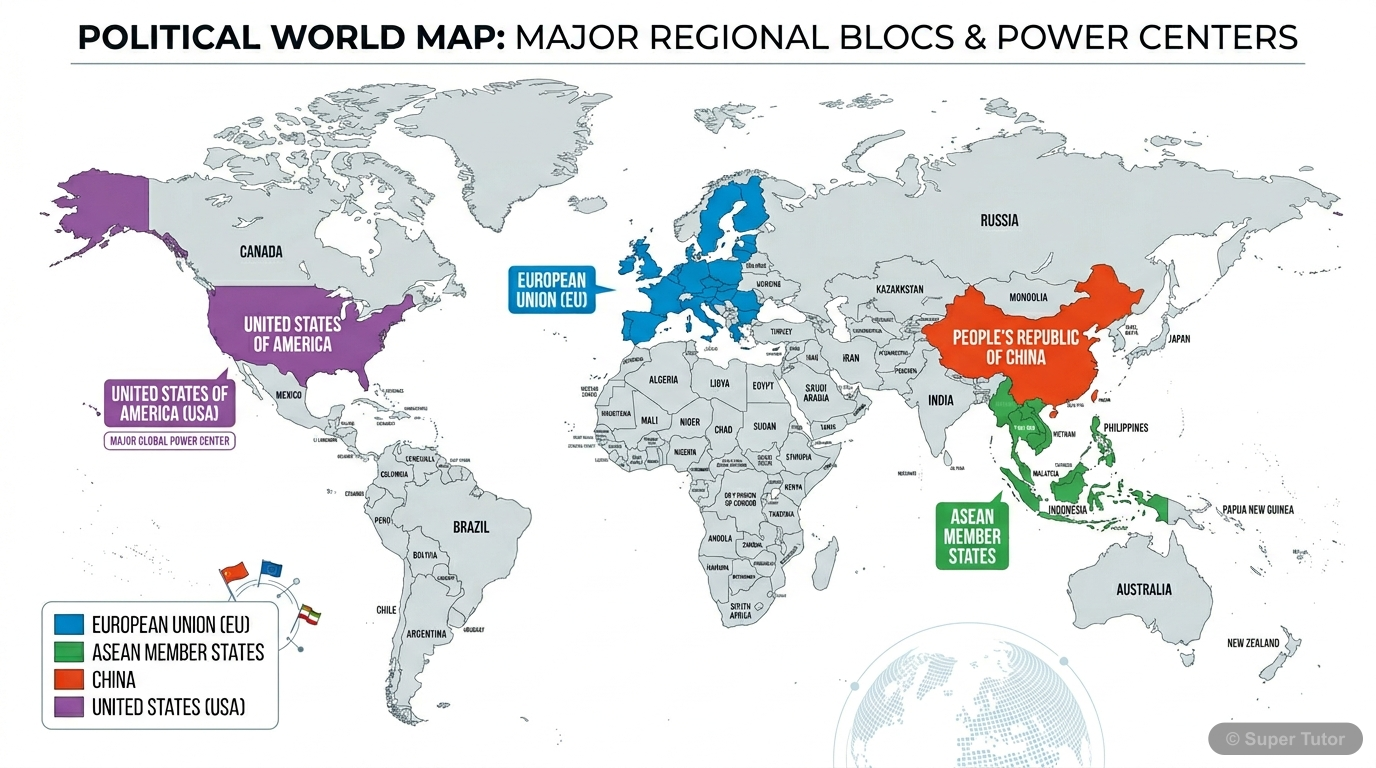
One of 11 illustrations for Contemporary Centers of Power in Super Tutor — alongside flashcards, concept maps and practice questions.
Important Questions from Contemporary Centers of Power
Which of the following are founding members of the European Coal and Steel Community (ECSC) in 1951?
Show answer
France, West Germany, Italy, Belgium, Netherlands
The six founding members of ECSC were France, West Germany, Italy, Belgium, Netherlands, and Luxembourg. The United Kingdom joined the European community much later in 1973.
When did China join the World Trade Organization (WTO)?
Show answer
2001
China's accession to the WTO in 2001 was a significant step in its opening to the outside world and integration into the global economy. This move helped China become a major player in international trade.
Which of the following are pillars of the ASEAN Community established in 2003?
Show answer
ASEAN Security Community, ASEAN Economic Community, ASEAN Socio-Cultural Community
In 2003, ASEAN agreed to establish an ASEAN Community comprising three pillars: the ASEAN Security Community, the ASEAN Economic Community, and the ASEAN Socio-Cultural Community. There are no separate military or political communities.
What was the primary objective behind the Marshall Plan for Europe?
Show answer
Economic revival of Europe
The Marshall Plan was America's massive financial help program for reviving Europe's economy after World War II. It was crucial in helping European states recover from wartime destruction and laid the foundation for European economic cooperation.
+46 more questions on Contemporary Centers of Power (Himachal Pradesh Board Class 12 Political Science)
Practise AllFrequently Asked Questions
What are the important topics in Contemporary Centers of Power for Himachal Pradesh Board Class 12 Political Science?
How many important questions are there in Contemporary Centers of Power?
Sources & Official References
Content is aligned to the official syllabus. Refer to the board website for the latest curriculum.
More resources for Contemporary Centers of Power
Practice Quiz
Test yourself with a quick quiz
Revision Notes
Key points for last-minute revision
Chapter Summary
Understand the chapter at a glance
Concept Maps
See how topics connect
Study Plan
Step-by-step plan for this chapter
Flashcards
Quick-fire cards for active recall
Syllabus
What topics to cover
NCERT Solutions
Every textbook question solved step by step
For serious students
Get the full Contemporary Centers of Power chapter — start free.
Quizzes, flashcards, an AI doubt solver and a study plan for Himachal Pradesh Board Class 12 Political Science. Free to start, no card needed.