Chapter 15 of 15
NCERT Solutions

Social Movements

Himachal Pradesh Board · Class 12 · Sociology

NCERT Solutions for Social Movements — Himachal Pradesh Board Class 12 Sociology.

45 questions22 flashcards5 concepts

Interactive on Super Tutor

Studying Social Movements? Get the full interactive chapter.

Quizzes, flashcards, AI doubt-solver and a step-by-step study plan — built for ncert solutions and more.

1,000+ Class 12 students started this chapter today

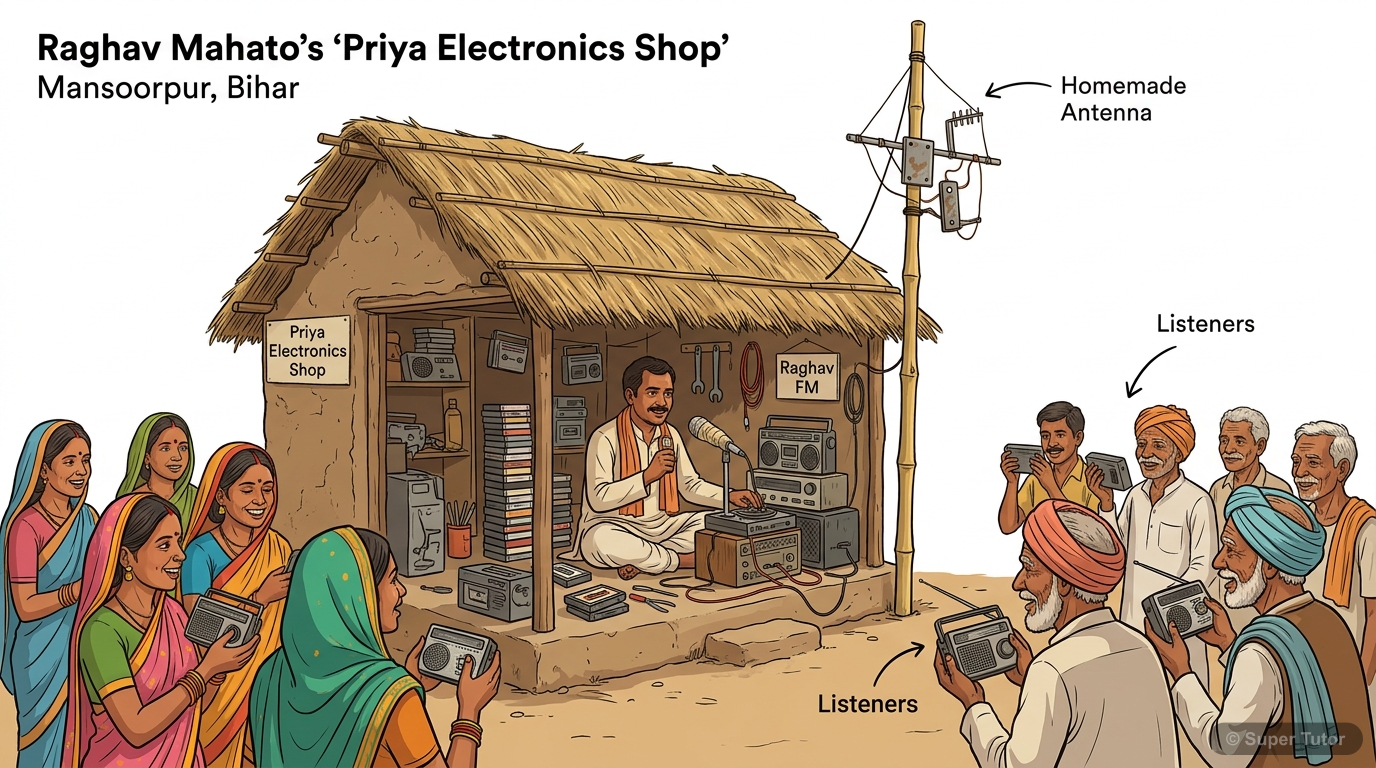
An infographic illustrating the defining characteristics of a social movement, including sustained collective action, organization, shared objectives/ideologies, and a focus on public issues.
Super Tutor

Learn better with visuals Super Tutor has hundreds of illustrations like this across every chapter — all free to try.

Get started
6 Questions Solved · 1 Section

Social Movements — End-of-Chapter Exercises

1Imagine a society where there has been no social movement. Discuss. You can also describe how you imagine such a society to be.Show solution
Given / Context: The question asks us to think critically about the role of social movements by imagining their complete absence.

Concept Used: Social movements are collective, organised efforts by groups of people to bring about — or resist — social, political, economic or cultural change. They are agents of social transformation.

Discussion:

1. A Static and Unchanging Society:
A society without any social movement would be largely static. Existing inequalities, injustices, and power structures would remain unchallenged. There would be no mechanism through which ordinary people could collectively demand change.

2. Perpetuation of Inequality:
Caste discrimination, gender oppression, racial segregation, and class exploitation would continue unchecked. For example, without the anti-caste movements led by figures like B.R. Ambedkar and Jyotiba Phule, the practice of untouchability might never have been legally abolished in India.

3. No Democratic Deepening:
Democracy deepens when citizens actively participate in public life. Without movements like the freedom struggle, women's suffrage movement, or civil rights movement, democratic rights would remain confined to a privileged few.

4. Absence of Environmental Consciousness:
Without movements like Chipko or the Narmada Bachao Andolan, environmental destruction would proceed without any organised resistance, threatening ecological balance and the livelihoods of forest-dwelling communities.

5. Suppression of Identity and Culture:
Minority groups — tribal communities, linguistic minorities, religious groups — would have no collective voice to assert their identity, culture, or rights.

6. Individual vs. Society:
As discussed in Class XI, there is a dialectical relationship between the individual and society. Social movements are the clearest expression of this relationship — individuals come together to reshape the society that shapes them. Without movements, individuals would remain passive objects of social forces rather than active subjects who can change those forces.

Imagining Such a Society:
Such a society would resemble a highly authoritarian or feudal order — where the powerful dictate terms and the powerless silently accept their fate. It would be a society frozen in time, unable to correct its own injustices or adapt to new aspirations.

Conclusion: Social movements are therefore not merely episodes of unrest; they are the very engine of social progress. A society without them would be one without the possibility of justice, equality, or meaningful change.
2aWrite a short note on: Women's MovementShow solution
Given / Context: The Women's Movement refers to organised collective efforts by women (and their allies) to challenge patriarchy and demand equal rights, dignity, and opportunities.

Concept Used: Social movements arise when groups seek to change their conditions. The Women's Movement is both an 'old' social movement (linked to reform and rights) and a 'new' social movement (linked to identity and personal autonomy).

Short Note:

1. Historical Roots — Reform Era (19th Century):
The Women's Movement in India has its roots in the 19th-century social reform movements. Reformers like Ram Mohan Roy campaigned against sati, and Jyotiba Phule and Savitribai Phule worked for women's education. These early efforts were largely led by men on behalf of women.

2. Nationalist Phase:
During the freedom struggle, women participated actively in the national movement. The demand for women's rights became intertwined with the demand for national independence. Women like Sarojini Naidu and Kasturba Gandhi became prominent public figures.

3. Post-Independence Phase:
After 1947, the Indian Constitution granted women equal rights. However, formal legal equality did not translate into social equality. Issues like dowry deaths, domestic violence, rape, and unequal wages persisted.

4. Contemporary Women's Movement (1970s onwards):
The 1970s saw a resurgence of feminist activism. Key issues included:
- Anti-dowry campaigns following a rise in dowry-related deaths.
- Anti-rape campaigns, especially after the Mathura rape case (1972), which led to amendments in rape laws.
- Campaigns against domestic violence, leading to the Protection of Women from Domestic Violence Act, 2005.
- Reservation for women in Panchayati Raj institutions (73rd Constitutional Amendment, 1992).

5. Dalit Feminist Perspective:
Scholars like Sharmila Rege have pointed out that the mainstream women's movement often ignored the specific experiences of Dalit women, who face the double burden of caste and gender discrimination. This led to the emergence of a distinct Dalit feminist standpoint.

6. Diversity within the Movement:
The Women's Movement in India is not monolithic. It includes liberal feminists, socialist feminists, eco-feminists, and Dalit feminists, each emphasising different aspects of women's oppression.

Conclusion: The Women's Movement has been instrumental in changing laws, raising consciousness, and challenging deep-rooted patriarchal norms in Indian society. It continues to evolve, addressing new forms of discrimination in the contemporary era.
2bWrite a short note on: Tribal MovementsShow solution
Given / Context: Tribal (Adivasi) movements refer to organised collective actions by tribal communities to protect their land, forest rights, cultural identity, and autonomy against exploitation and displacement.

Concept Used: Tribal movements combine elements of both old social movements (economic grievances — land, livelihood) and new social movements (identity, cultural rights, autonomy).

Short Note:

1. Historical Background:
Tribal communities in India have a long history of resistance. Colonial rule disrupted their traditional relationship with forests and land through forest laws and revenue settlements. This led to major uprisings such as:
- Santhal Rebellion (1855–56)
- Munda Ulgulan led by Birsa Munda (1899–1900)
These were early expressions of tribal resistance against colonial exploitation and the intrusion of moneylenders and landlords.

2. Post-Independence Issues:
After independence, development projects — dams, mines, industries — led to large-scale displacement of tribal communities. Tribals were often displaced without adequate rehabilitation. The benefits of development rarely reached them, while they bore its costs.

3. Land and Forest Rights:
A central demand of tribal movements has been the restoration of rights over land and forests. The Forest Rights Act, 2006 was a significant outcome of sustained tribal mobilisation, recognising the rights of forest-dwelling communities over forest land.

4. Naxalite Movement:
In some regions, tribal discontent merged with Naxalite (Maoist) movements, which sought radical redistribution of land. The Naxalbari uprising (1967) in West Bengal had a significant tribal component.

5. Identity and Autonomy Movements:
Many tribal movements in North-East India (e.g., Naga movement, Bodo movement) have demanded political autonomy or separate statehood to protect their distinct cultural identity and way of life. Scholar Tiplut Nongbri has written extensively on development, ethnicity, and gender among tribal communities.

6. Environmental Dimension:
Tribal movements often overlap with environmental movements, since tribal livelihoods are directly dependent on forests and rivers. The Narmada Bachao Andolan involved significant tribal participation.

Conclusion: Tribal movements in India reflect the multiple dimensions of tribal marginalisation — economic, political, cultural, and ecological. They challenge both the colonial legacy and the post-colonial development model that has often treated tribal communities as obstacles to 'progress' rather than as rights-bearing citizens.
3In India it is difficult to make a clear distinction between the old and new social movements. Discuss.Show solution
Given / Context: Sociologists distinguish between 'old' social movements (focused on economic issues — class, labour, land) and 'new' social movements (focused on identity, culture, environment, gender). The question asks us to examine whether this distinction holds in the Indian context.

Concept Used:
- Old Social Movements: Rooted in Marxist tradition; concerned with economic exploitation, class struggle, redistribution of resources (e.g., labour movements, peasant movements).
- New Social Movements: Emerged in the West from the 1960s–70s; concerned with identity, recognition, quality of life, environment, gender, ethnicity (e.g., feminist movements, environmental movements, civil rights movements).

Discussion:

1. The Western Framework:
The distinction between old and new social movements was developed primarily in the context of Western industrial societies. In the West, the 'old' labour movement was largely about class and economic redistribution, while 'new' movements shifted focus to post-material values like identity and lifestyle.

2. Why the Distinction is Blurred in India:

(a) Economic and Identity Issues Overlap:
In India, economic exploitation is almost always intertwined with caste, tribal, or gender identity. A Dalit agricultural labourer is exploited both because of class (economic) and caste (identity). It is impossible to separate the two. The anti-caste movement is simultaneously a movement for economic rights and for dignity and identity.

(b) Tribal Movements:
Tribal movements demand land rights (economic) and also assert their distinct cultural identity and right to self-governance (identity). The same movement carries both dimensions simultaneously.

(c) Women's Movement:
The Women's Movement demands equal wages and property rights (economic) as well as freedom from patriarchal norms, recognition of women's identity, and bodily autonomy (identity/cultural). These cannot be neatly separated.

(d) Environmental Movements:
As discussed in Question 4, environmental movements like Chipko or Narmada Bachao Andolan involve ecological concerns (new), but also the economic survival of forest-dependent communities (old) and the assertion of tribal/local identity (new).

(e) Peasant and Farmer Movements:
Peasant movements historically demanded land redistribution (old/economic). New Farmer movements demand remunerative prices and state support (economic), but also assert the identity and dignity of the farming community.

3. India's Specific Historical Context:
India's social structure is shaped by the unique intersection of caste, class, gender, tribe, and religion. Unlike Western societies where class was the primary axis of inequality, in India multiple axes of inequality operate simultaneously. Therefore, any social movement in India tends to address several of these dimensions at once.

4. Scholars' Views:
Sociologists like T.K. Oommen have argued that in India, civil society and social movements are deeply embedded in questions of nationhood, ethnicity, and caste — making the Western categories of 'old' and 'new' only partially applicable.

Conclusion: While the distinction between old and new social movements is analytically useful, it does not map neatly onto the Indian reality. Indian social movements are characterised by the simultaneous presence of economic, identity, cultural, and political demands. This reflects the complex, multi-layered nature of inequality and oppression in Indian society.
4Environmental movements often also contain economic and identity issues. Discuss.Show solution
Given / Context: Environmental movements are typically classified as 'new' social movements concerned with ecology and the natural environment. The question asks us to examine how they also incorporate economic and identity dimensions.

Concept Used: Social movements are rarely one-dimensional. Environmental movements in India, given the country's social structure, inevitably intersect with questions of livelihood (economic) and community identity (cultural/identity).

Discussion:

1. The Chipko Movement (1970s):
- Environmental Dimension: Villagers in the Garhwal Himalayas hugged trees to prevent them from being felled by commercial contractors. The movement sought to protect forests from deforestation.
- Economic Dimension: The forests were the primary source of livelihood for local communities — providing fodder, fuel, timber for agricultural tools, and non-timber forest produce. Deforestation directly threatened their economic survival.
- Identity Dimension: The movement asserted the rights of local hill communities (particularly women) over their natural resources against outside commercial interests. It was also an assertion of a distinct hill community identity and their traditional relationship with the forest.
- Ramchandra Guha has described Chipko as a 'social history of an environmental movement,' emphasising these multiple dimensions.

2. Narmada Bachao Andolan (NBA):
- Environmental Dimension: The movement opposed the construction of large dams on the Narmada river, arguing that they would cause massive ecological damage — submergence of forests, disruption of river ecosystems.
- Economic Dimension: Hundreds of thousands of people — mostly tribal communities, Dalits, and small farmers — faced displacement without adequate rehabilitation. Their agricultural land, homes, and livelihoods were to be submerged.
- Identity Dimension: For tribal communities, the forests and rivers are not merely economic resources but are central to their cultural identity, spiritual life, and sense of belonging. Displacement meant not just economic loss but the destruction of their entire way of life and community identity.

3. Anti-Mining Movements:
Movements against mining in tribal areas (e.g., in Odisha, Jharkhand, Chhattisgarh) similarly combine:
- Environmental concerns (destruction of forests, pollution of water)
- Economic concerns (loss of land and livelihood)
- Identity concerns (assertion of tribal rights over ancestral land; resistance to cultural displacement)

4. Why This Overlap Occurs in India:
In India, the communities most directly dependent on natural resources — forests, rivers, land — are also the most marginalised: tribal communities, Dalits, small and marginal farmers. For them, the environment is not an abstract concern but the very basis of their economic survival and cultural identity. Therefore, when the environment is threatened, their economy and identity are simultaneously threatened.

5. Broader Significance:
This overlap challenges the Western notion of environmentalism as a 'post-material' concern of the affluent middle class. In India, environmentalism is often a movement of the poor and marginalised fighting for their survival — what scholars call the 'environmentalism of the poor.'

Conclusion: Environmental movements in India cannot be understood purely in ecological terms. They are simultaneously struggles for economic survival and for the recognition of community identity and rights. This multi-dimensional character makes them powerful but also complex social movements.
5Distinguish between peasant and New Farmer's movements.Show solution
Given / Context: Both peasant movements and New Farmer's movements involve people engaged in agriculture, but they differ significantly in their social base, demands, ideology, and methods.

Concept Used: Social movements reflect the specific social and economic conditions of the groups involved. Changes in agrarian structure — particularly after the Green Revolution — gave rise to a new type of farmer movement distinct from the older peasant movements.

Distinction between Peasant Movements and New Farmer's Movements:

| Basis of Distinction | Peasant Movements | New Farmer's Movements |
|---|---|---|
| Period | Mainly pre-independence and early post-independence era | Emerged from the 1970s–80s onwards |
| Social Base | Poor peasants, landless labourers, sharecroppers, tenants | Middle and rich farmers, owner-cultivators who benefited from the Green Revolution |
| Primary Demands | Land redistribution, abolition of zamindari, reduction of rent, cancellation of debt | Remunerative prices for agricultural produce, lower input costs (fertilisers, electricity, water), loan waivers, opposition to globalisation |
| Ideology | Influenced by socialist/communist ideology; class struggle against landlords and moneylenders | Not based on class ideology; more of an interest-group politics asserting farmers' rights against the state and urban interests |
| Target of Struggle | Landlords, moneylenders, colonial state | The state (government) — demanding better prices and subsidies; later, multinational corporations and globalisation |
| Nature of Demands | Redistributive — seeking to change the ownership of land | Remunerative — seeking better returns from the market and state support |
| Examples | Tebhaga Movement (Bengal, 1946), Telangana Movement (1946–51), Naxalbari uprising (1967) | Shetkari Sanghatana (Maharashtra, led by Sharad Joshi), Bharatiya Kisan Union (UP, led by Mahendra Singh Tikait) |
| Relationship with State | Often confrontational; sought radical transformation of agrarian structure | Primarily pressure-group politics; sought policy changes through agitation and negotiation |
| Class Character | Represented the interests of the rural poor against the rural rich | Represented the interests of the rural rich/middle against urban interests and the state |

Additional Points:

1. Peasant Movements:
These were rooted in the extreme inequality of the pre-Green Revolution agrarian structure, where a small class of landlords (zamindars, jagirdars) controlled most of the land while the majority of the rural population were poor tenants, sharecroppers, or landless labourers. The demand was fundamentally for land — 'land to the tiller.'

2. New Farmer's Movements:
The Green Revolution (1960s–70s) transformed Indian agriculture. A new class of prosperous, market-oriented farmers emerged, particularly in Punjab, Haryana, Maharashtra, and Karnataka. These farmers were integrated into the market and were affected by input prices and output prices. Their movements were not about land redistribution but about getting a better deal from the market and the state.

Conclusion: Peasant movements were essentially class struggles of the rural poor against landlords and colonial/semi-feudal structures. New Farmer's movements, by contrast, are interest-group movements of commercially-oriented farmers seeking better economic terms from the state and the market. The shift from one to the other reflects the transformation of Indian agrarian structure over the 20th century.

Stuck on a step?

Ask Super Tutor AI to explain any solution on this page in a simpler way — free, 24x7.

Ask a Doubt Free

Frequently Asked Questions

What are the important topics in Social Movements for Himachal Pradesh Board Class 12 Sociology?
Social Movements covers several key topics that are frequently asked in Himachal Pradesh Board Class 12 board exams. Focus on the core concepts listed on this page and practise related questions to build confidence.
How to score full marks in Social Movements — Himachal Pradesh Board Class 12 Sociology?
Understand the core concepts first, then work through the 45 practice questions available for this chapter. Revise formulas and definitions regularly, and use flashcards for quick recall before the exam.
Where can I get free NCERT Solutions for Social Movements Class 12 Sociology?
This page has free step-by-step NCERT Solutions for every exercise question in Social Movements (Himachal Pradesh Board Class 12 Sociology) — written the way examiners award marks: given, formula, working, answer.

Sources & Official References

Content is aligned to the official syllabus. Refer to the board website for the latest curriculum.

For serious students

Get the full Social Movements chapter — for free.

Quizzes, flashcards, AI doubt-solver and a step-by-step study plan for Himachal Pradesh Board Class 12 Sociology.