Circles — NCERT Solutions
Himachal Pradesh Board · Class 9 · Mathematics
NCERT Solutions for Circles, Himachal Pradesh Board Class 9 Mathematics: 20 textbook questions solved step by step.
Interactive on Super Tutor
Studying Circles? Get the full interactive chapter.
Quizzes, flashcards, AI doubt-solver and a step-by-step study plan — built for NCERT solutions and more.
Free trial, no card needed.
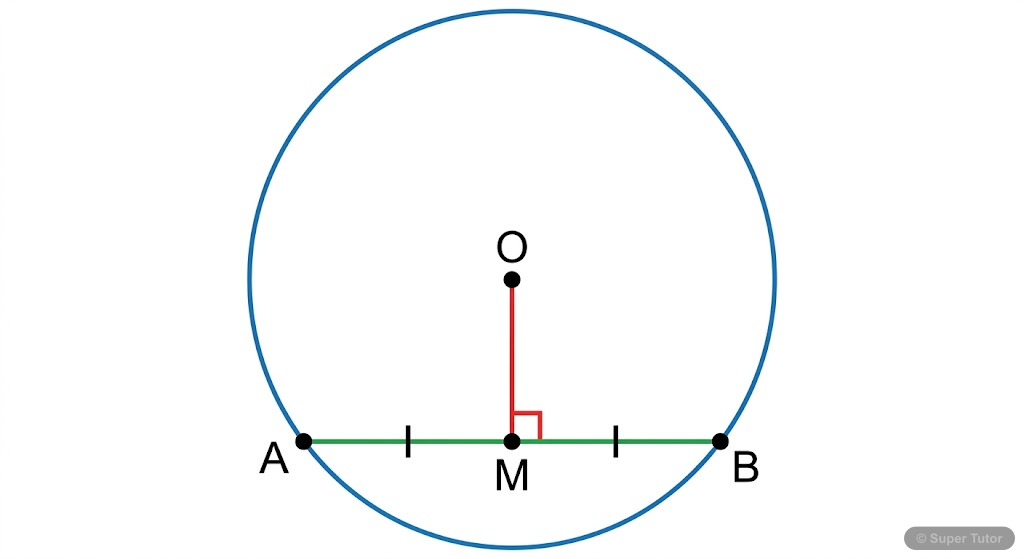
Learn better with visuals Super Tutor pairs illustrations like this with notes and quizzes for Circles.
The first 10 solutions are open to read. The other 10 are free with a Super Tutor account.
Exercise 9.1
1Recall that two circles are congruent if they have the same radii. Prove that equal chords of congruent circles subtend equal angles at their centres.Show solution
Given: Two congruent circles with centres O and O′ and equal radii r. AB and CD are equal chords of the two circles respectively, i.e., AB = CD.
To Prove: ∠AOB = ∠CO′D
Proof:
In △AOB and △CO′D:
By SSS congruence criterion:
Therefore, by CPCT:
Hence proved. Equal chords of congruent circles subtend equal angles at their centres.
2Prove that if chords of congruent circles subtend equal angles at their centres, then the chords are equal.Show solution
Given: Two congruent circles with centres O and O′ and equal radii r. Chords AB and CD subtend equal angles at their respective centres, i.e., ∠AOB = ∠CO′D.
To Prove: AB = CD
Proof:
In △AOB and △CO′D:
By SAS congruence criterion:
Therefore, by CPCT:
Hence proved. If chords of congruent circles subtend equal angles at their centres, then the chords are equal.
Exercise 9.2
1Two circles of radii 5 cm and 3 cm intersect at two points and the distance between their centres is 4 cm. Find the length of the common chord.Show solution
Given: Two circles with centres O and O′, radii 5 cm and 3 cm respectively. They intersect at points A and B. Distance OO′ = 4 cm.
To Find: Length of common chord AB.
Solution:
Let the common chord AB intersect OO′ at point M.
Let OM = x, so O′M = 4 − x.
In △OMA (right-angled at M, since the line joining centres is perpendicular to the common chord):
In △O′MA (right-angled at M):
Subtracting (2) from (1):
Substituting in (1):
Since M is the midpoint of AB (perpendicular from centre bisects the chord):
Note: Since x = 4 cm = OO′, point M coincides with O′. This means O′ lies on AB, confirming AB passes through O′.
2If two equal chords of a circle intersect within the circle, prove that the segments of one chord are equal to corresponding segments of the other chord.Show solution
Given: A circle with centre O. Two equal chords AB and CD intersect at point E inside the circle, i.e., AB = CD.
To Prove: AE = CE and BE = DE (corresponding segments are equal).
Construction: Draw OM ⊥ AB and ON ⊥ CD.
Proof:
Since AB = CD and equal chords are equidistant from the centre:
Also, since perpendicular from centre bisects the chord:
Since AB = CD:
In △OME and △ONE:
By RHS congruence:
By CPCT:
Now:
Also:
Hence proved. AE = CE and BE = DE.
3If two equal chords of a circle intersect within the circle, prove that the line joining the point of intersection to the centre makes equal angles with the chords.Show solution
Given: A circle with centre O. Two equal chords AB and CD intersect at point E inside the circle. OE is joined.
To Prove: ∠OEM = ∠OEN, i.e., OE makes equal angles with the two chords (where M and N are feet of perpendiculars from O to AB and CD respectively).
Construction: Draw OM ⊥ AB and ON ⊥ CD.
Proof:
Since AB = CD (equal chords of the same circle), they are equidistant from the centre:
In △OME and △ONE:
By RHS congruence:
By CPCT:
Hence proved. The line joining the point of intersection to the centre makes equal angles with the chords.
4If a line intersects two concentric circles (circles with the same centre) with centre O at A, B, C and D, prove that AB = CD (see Fig. 9.12).Show solution
Given: Two concentric circles with common centre O. A line intersects the inner circle at B and C, and the outer circle at A and D.
To Prove: AB = CD
Construction: Draw OM perpendicular to the line AD from centre O.
Proof:
For the outer circle, OM ⊥ AD:
Since perpendicular from centre bisects the chord:
For the inner circle, OM ⊥ BC:
Since perpendicular from centre bisects the chord:
Subtracting (2) from (1):
Hence proved.
5Three girls Reshma, Salma and Mandip are playing a game by standing on a circle of radius 5m drawn in a park. Reshma throws a ball to Salma, Salma to Mandip, Mandip to Reshma. If the distance between Reshma and Salma and between Salma and Mandip is 6m each, what is the distance between Reshma and Mandip?Show solution
Given: A circle of radius 5 m. Let Reshma, Salma and Mandip be at points R, S and M on the circle. RS = SM = 6 m.
To Find: RM
Solution:
Let O be the centre of the circle. Draw OA ⊥ RS and OB ⊥ SM.
Since OA ⊥ RS and perpendicular from centre bisects the chord:
In △OAS:
Similarly, OB = 4 m (since SM = 6 m and radius = 5 m).
Let O be the origin. Place S at the top. Since RS = SM = 6 m and both chords are equal, by symmetry, R and M are symmetric about the line OS.
Let the perpendicular from O to RS meet RS at A, and from O to SM meet SM at B.
Using coordinate geometry: Let O = (0, 0).
Since OA ⊥ RS and OA = 4 m, place A along the y-axis direction.
Let S = (0, 5) (topmost point).
For chord RS: midpoint A is at distance 4 from O along OS direction.
R and S are symmetric about A:
Wait — let me redo with S as a general point.
Let S = (0, 5). Chord RS has length 6, midpoint A satisfies OA ⊥ RS.
Since RS is horizontal (by symmetry, if S is at top and R, M are symmetric):
Verify: ✓, ✓
Check SM:
Let me use a proper coordinate approach.
Let O = (0,0). Let S = (s_x, s_y) on the circle, so .
Let the perpendicular from O to RS have foot A. Since OA = 4 and AS = 3:
Place the coordinate system so that S = (0, 5).
For chord RS (length 6): The perpendicular from O to RS has length .
Let RS be along a line. The foot of perpendicular from O to RS is at distance 4 from O.
Let A = foot on RS. Then and , .
So where is unit vector along RS.
Also , meaning .
Let . Then .
Similarly for chord SM: where is direction of SM.
This is getting complex. Let me use a direct approach.
Let O = (0,0), S = (0, 5).
For chord RS of length 6: perpendicular from O to RS = 4.
Let R = on circle, , .
Midpoint of RS = , and this is perpendicular to RS from O.
Distance from O to midpoint = 4:
Then , so .
By symmetry, and .
Verify SM: ✓
Now:
6A circular park of radius 20m is situated in a colony. Three boys Ankur, Syed and David are sitting at equal distance on its boundary each having a toy telephone in his hands to talk each other. Find the length of the string of each phone.Show solution
Given: A circular park of radius 20 m. Three boys Ankur (A), Syed (S) and David (D) sit at equal distances on the boundary, forming an equilateral triangle inscribed in the circle of radius 20 m.
To Find: Side length of the equilateral triangle (length of string).
Solution:
Since the three boys are at equal distances, they form an equilateral triangle inscribed in the circle.
For an equilateral triangle inscribed in a circle of radius R, the relationship between side and circumradius R is:
Derivation using perpendicular from centre:
Let O be the centre. Draw OM ⊥ AS where M is the midpoint of AS.
Let side of equilateral triangle = , so .
In △OAS, O is the circumcentre. The centroid divides the median in ratio 2:1.
Median of equilateral triangle
Circumradius
So:
Exercise 9.3
1In Fig. 9.23, A, B and C are three points on a circle with centre O such that ∠BOC = 30° and ∠AOB = 60°. If D is a point on the circle other than the arc ABC, find ∠ADC.Show solution
Given: ∠BOC = 30°, ∠AOB = 60°. D is a point on the circle on the arc other than arc ABC.
To Find: ∠ADC
Solution:
By the theorem — the angle subtended by an arc at the centre is double the angle subtended at any point on the remaining part of the circle:
2A chord of a circle is equal to the radius of the circle. Find the angle subtended by the chord at a point on the minor arc and also at a point on the major arc.Show solution
Given: Chord AB = radius of the circle (= r).
To Find: Angle subtended at a point on the minor arc and at a point on the major arc.
Solution:
Let O be the centre. Since OA = OB = AB = r, triangle OAB is equilateral.
Angle at a point on the major arc:
Let P be a point on the major arc. By the inscribed angle theorem:
Angle at a point on the minor arc:
Let Q be a point on the minor arc. AQBP is a cyclic quadrilateral (all on the circle). The sum of opposite angles:
Free with a Super Tutor account
Free with a Super Tutor account
Free with a Super Tutor account
Free with a Super Tutor account
Free with a Super Tutor account
Free with a Super Tutor account
Free with a Super Tutor account
Free with a Super Tutor account
Free with a Super Tutor account
Free with a Super Tutor account
10 more solved questions in Circles
They are free with a Super Tutor account, along with practice quizzes and flashcards for this chapter. Free to start, no card needed.
Frequently Asked Questions
What are the important topics in Circles for Himachal Pradesh Board Class 9 Mathematics?
Are these NCERT Solutions for Circles free?
How should I revise Circles for Class 9 exams?
Sources & Official References
Content is aligned to the official syllabus. Refer to the board website for the latest curriculum.
More resources for Circles
For serious students
Get the full Circles chapter — start free.
Quizzes, flashcards, an AI doubt solver and a study plan for Himachal Pradesh Board Class 9 Mathematics. Free to start, no card needed.