Triangles — NCERT Solutions
Himachal Pradesh Board · Class 9 · Mathematics
NCERT Solutions for Triangles, Himachal Pradesh Board Class 9 Mathematics: 21 textbook questions solved step by step.
Interactive on Super Tutor
Studying Triangles? Get the full interactive chapter.
Quizzes, flashcards, AI doubt-solver and a step-by-step study plan — built for NCERT solutions and more.
Free trial, no card needed.
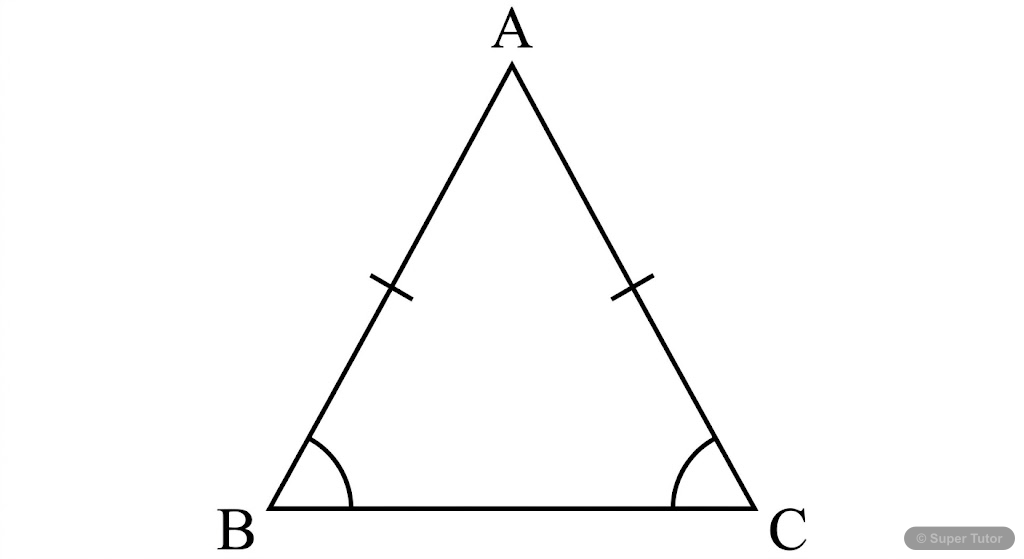
Learn better with visuals Super Tutor pairs illustrations like this with notes and quizzes for Triangles.
The first 11 solutions are open to read. The other 10 are free with a Super Tutor account.
Exercise 7.1
1In quadrilateral ACBD, AC = AD and AB bisects ∠A (see Fig. 7.16). Show that △ABC ≅ △ABD. What can you say about BC and BD?Show solution
Given: In quadrilateral ACBD, AC = AD and AB bisects ∠A, i.e., ∠CAB = ∠DAB.
To prove: △ABC ≅ △ABD
Proof:
Consider △ABC and △ABD.
Therefore, by SAS congruence rule:
About BC and BD:
Since △ABC ≅ △ABD, by CPCT:
So BC and BD are equal, i.e., B is equidistant from C and D.
2ABCD is a quadrilateral in which AD = BC and ∠DAB = ∠CBA (see Fig. 7.17). Prove that (i) △ABD ≅ △BAC (ii) BD = AC (iii) ∠ABD = ∠BACShow solution
Given: In quadrilateral ABCD, AD = BC and ∠DAB = ∠CBA.
(i) To prove: △ABD ≅ △BAC
Consider △ABD and △BAC.
Therefore, by SAS congruence rule:
(ii) To prove: BD = AC
Since △ABD ≅ △BAC (proved above), by CPCT:
(iii) To prove: ∠ABD = ∠BAC
Since △ABD ≅ △BAC, by CPCT:
3AD and BC are equal perpendiculars to a line segment AB (see Fig. 7.18). Show that CD bisects AB.Show solution
Given: AD ⊥ AB, BC ⊥ AB, and AD = BC.
To prove: CD bisects AB, i.e., the point of intersection O of CD and AB is the mid-point of AB (OA = OB).
Proof:
Consider △AOD and △BOC.
Therefore, by AAS congruence rule:
By CPCT:
Hence, O is the mid-point of AB, i.e., CD bisects AB.
4 and are two parallel lines intersected by another pair of parallel lines and (see Fig. 7.19). Show that △ABC ≅ △CDA.Show solution
Given: and . ABCD is a parallelogram formed by these lines, with AC as the diagonal.
To prove: △ABC ≅ △CDA
Proof:
Consider △ABC and △CDA.
Since and AC is a transversal:
Since and AC is a transversal:
Therefore, by ASA congruence rule:
5Line is the bisector of an angle ∠A and B is any point on . BP and BQ are perpendiculars from B to the arms of ∠A (see Fig. 7.20). Show that: (i) △APB ≅ △AQB (ii) BP = BQ or B is equidistant from the arms of ∠AShow solution
Given: Line bisects ∠A, so ∠PAB = ∠QAB. BP ⊥ AP and BQ ⊥ AQ, so ∠APB = ∠AQB = 90°.
(i) To prove: △APB ≅ △AQB
Consider △APB and △AQB.
Therefore, by AAS congruence rule:
(ii) To prove: BP = BQ
Since △APB ≅ △AQB, by CPCT:
Hence, B is equidistant from the arms of ∠A.
6In Fig. 7.21, AC = AE, AB = AD and ∠BAD = ∠EAC. Show that BC = DE.Show solution
Given: AC = AE, AB = AD, and ∠BAD = ∠EAC.
To prove: BC = DE
Proof:
We have:
Adding ∠DAC to both sides:
Now consider △ABC and △ADE.
Therefore, by SAS congruence rule:
By CPCT:
7AB is a line segment and P is its mid-point. D and E are points on the same side of AB such that ∠BAD = ∠ABE and ∠EPA = ∠DPB (see Fig. 7.22). Show that (i) △DAP ≅ △EBP (ii) AD = BEShow solution
Given: P is the mid-point of AB, so AP = BP. ∠BAD = ∠ABE and ∠EPA = ∠DPB.
(i) To prove: △DAP ≅ △EBP
We have:
Adding ∠EPD to both sides:
Now consider △DAP and △EBP.
Therefore, by ASA congruence rule:
(ii) To prove: AD = BE
Since △DAP ≅ △EBP, by CPCT:
8In right triangle ABC, right angled at C, M is the mid-point of hypotenuse AB. C is joined to M and produced to a point D such that DM = CM. Point D is joined to point B (see Fig. 7.23). Show that: (i) △AMC ≅ △BMD (ii) ∠DBC is a right angle. (iii) △DBC ≅ △ACB (iv) CM = ½ ABShow solution
Given: △ABC is right-angled at C. M is the mid-point of AB, so AM = BM. CM is produced to D such that DM = CM.
(i) To prove: △AMC ≅ △BMD
Consider △AMC and △BMD.
Therefore, by SAS congruence rule:
(ii) To prove: ∠DBC is a right angle
From (i), by CPCT:
These are alternate interior angles for lines AC and DB with transversal BC.
Therefore, , which means:
Since ∠ACB = 90° (given):
Hence, ∠DBC is a right angle.
(iii) To prove: △DBC ≅ △ACB
Consider △DBC and △ACB.
Therefore, by SAS congruence rule:
(iv) To prove: CM = ½ AB
From (iii), by CPCT:
But (since DM = CM).
Therefore:
Exercise 7.2
1In an isosceles triangle ABC, with AB = AC, the bisectors of ∠B and ∠C intersect each other at O. Join A to O. Show that: (i) OB = OC (ii) AO bisects ∠AShow solution
Given: △ABC is isosceles with AB = AC. Bisectors of ∠B and ∠C meet at O.
Since AB = AC, the angles opposite to equal sides are equal:
Therefore:
(i) To prove: OB = OC
In △OBC:
Sides opposite to equal angles are equal:
(ii) To prove: AO bisects ∠A
Consider △ABO and △ACO.
Therefore, by SSS congruence rule:
By CPCT:
Hence, AO bisects ∠A.
2In △ABC, AD is the perpendicular bisector of BC (see Fig. 7.30). Show that △ABC is an isosceles triangle in which AB = AC.Show solution
Given: AD is the perpendicular bisector of BC, so BD = DC and ∠ADB = ∠ADC = 90°.
To prove: AB = AC
Proof:
Consider △ADB and △ADC.
Therefore, by SAS congruence rule:
By CPCT:
Hence, △ABC is an isosceles triangle.
3ABC is an isosceles triangle in which altitudes BE and CF are drawn to equal sides AC and AB respectively (see Fig. 7.31). Show that these altitudes are equal.Show solution
Given: △ABC is isosceles with AB = AC. BE ⊥ AC and CF ⊥ AB.
To prove: BE = CF
Proof:
Consider △ABE and △ACF.
Therefore, by AAS congruence rule:
By CPCT:
Hence, the altitudes are equal.
Free with a Super Tutor account
Free with a Super Tutor account
Free with a Super Tutor account
Free with a Super Tutor account
Free with a Super Tutor account
Exercise 7.3
Free with a Super Tutor account
Free with a Super Tutor account
Free with a Super Tutor account
Free with a Super Tutor account
Free with a Super Tutor account
10 more solved questions in Triangles
They are free with a Super Tutor account, along with practice quizzes and flashcards for this chapter. Free to start, no card needed.
Frequently Asked Questions
What are the important topics in Triangles for Himachal Pradesh Board Class 9 Mathematics?
Are these NCERT Solutions for Triangles free?
How should I revise Triangles for Class 9 exams?
Sources & Official References
Content is aligned to the official syllabus. Refer to the board website for the latest curriculum.
More resources for Triangles
For serious students
Get the full Triangles chapter — start free.
Quizzes, flashcards, an AI doubt solver and a study plan for Himachal Pradesh Board Class 9 Mathematics. Free to start, no card needed.