Short Story
ICSE · Class 10 · English Language - Archer
Step-by-step guide to study Short Story in ICSE Class 10 English Language - Archer. Topics to cover, practice strategy, and time allocation.
Interactive on Super Tutor
Studying Short Story? Get the full interactive chapter.
Quizzes, flashcards, AI doubt-solver and a step-by-step study plan — built for study plan and more.
1,000+ Class 10 students started this chapter today
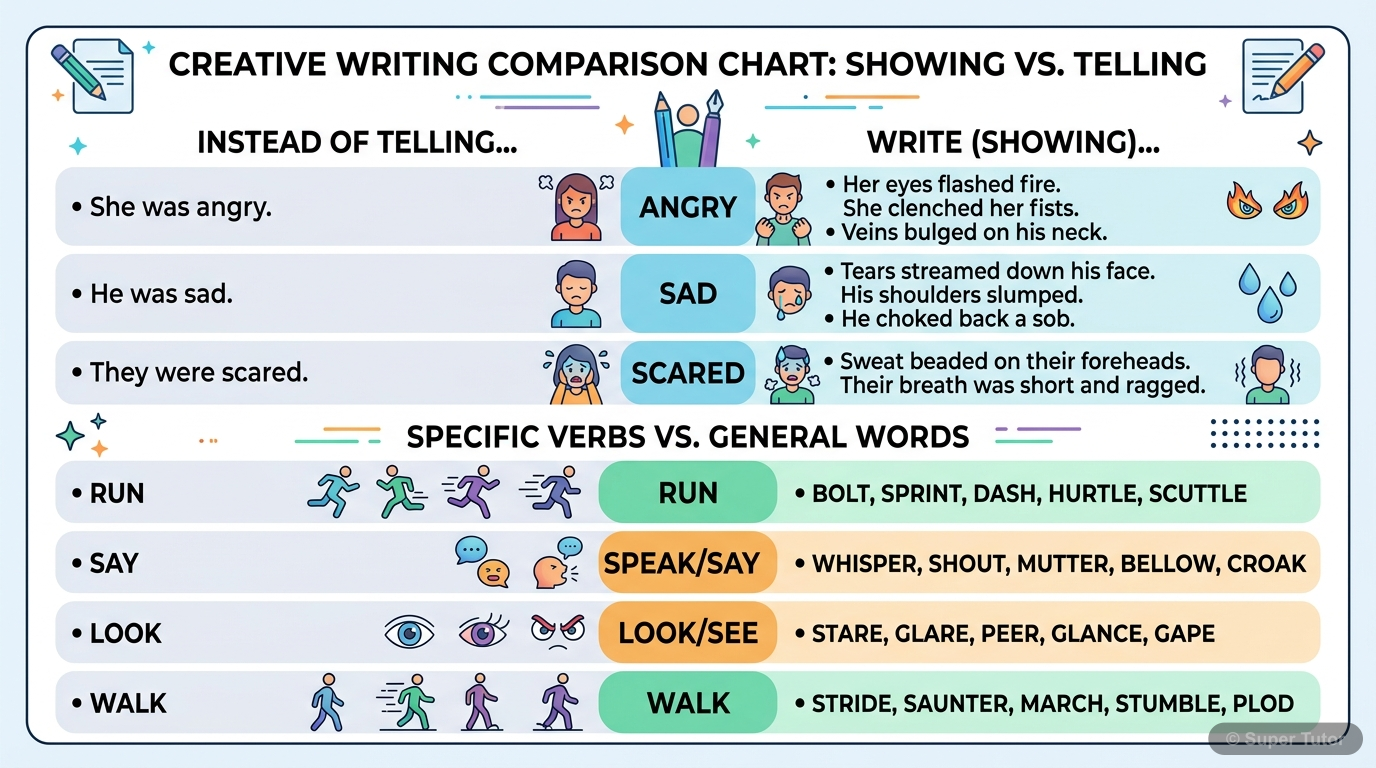
Learn better with visuals Super Tutor has hundreds of illustrations like this across every chapter — all free to try.
Get startedStudy Plan
Learn the Theory
Read the textbook chapter carefully. Note down definitions, formulas, and key concepts.
Practice Problems
Solve textbook exercises and additional practice questions. There are 43 questions available for this chapter.
Revise & Test
Revise key formulas and concepts without looking at notes. Take a practice quiz to test your understanding. Mark weak areas for re-revision.
Spaced Revision
Revisit Short Story after a week. Use flashcards for quick recall. Solve previous year questions from this chapter.
What to Focus On
- A story question usually contains one of four things: characters, first line, title, or plot.
- The outline should be developed from the given clue.
- The story should have a clear beginning, problem, climax, and resolution.
- Showing makes writing more dramatic and vivid.
- Actions, expressions, and dialogue can reveal feelings.
- Showing helps the reader feel closer to the character.
- Dialogue makes a story realistic and engaging.
- A short conversation is about 50 to 60 words.
- A conversation does not always need a clear beginning and end.
Common Mistakes to Avoid
A short story should be written in first person because it sounds more personal.
Showing emotion and telling emotion are equally good, so simple statements like "She was angry" are enough.
Any rich-sounding language improves a story, even if the sentences become long and heavy.
Memory Tips
Show, do not tell
Use fewer adverbs
Replace general words with specific words
Keep verb tense consistent
Want a personalised study plan?
Super Tutor creates a day-by-day plan for ICSE Class 10 English Language - Archer that adapts to your exam date and pace.
Create My Study Plan — FreeFrequently Asked Questions
What are the important topics in Short Story for ICSE Class 10 English Language - Archer?
How to score full marks in Short Story — ICSE Class 10 English Language - Archer?
Sources & Official References
Content is aligned to the official syllabus. Refer to the board website for the latest curriculum.
More resources for Short Story
Practice Quiz
Test yourself with a quick quiz
Important Questions
Practice with board exam-style questions
Revision Notes
Key points for last-minute revision
Formula Sheet
All formulas in one place
Chapter Summary
Understand the chapter at a glance
Concept Maps
See how topics connect visually
Flashcards
Quick-fire cards for active recall
Syllabus
What topics to cover
NCERT Solutions
Every textbook question solved step by step
For serious students
Get the full Short Story chapter — for free.
Quizzes, flashcards, AI doubt-solver and a step-by-step study plan for ICSE Class 10 English Language - Archer.