Short Story
ICSE · Class 10 · English Language - Archer
Summary of Short Story for ICSE Class 10 English Language - Archer. Key concepts, important points, and chapter overview.
Interactive on Super Tutor
Studying Short Story? Get the full interactive chapter.
Quizzes, flashcards, AI doubt-solver and a step-by-step study plan — built for chapter summary and more.
1,000+ Class 10 students started this chapter today
Learn better with visuals Super Tutor has hundreds of illustrations like this across every chapter — all free to try.
Get startedOverview
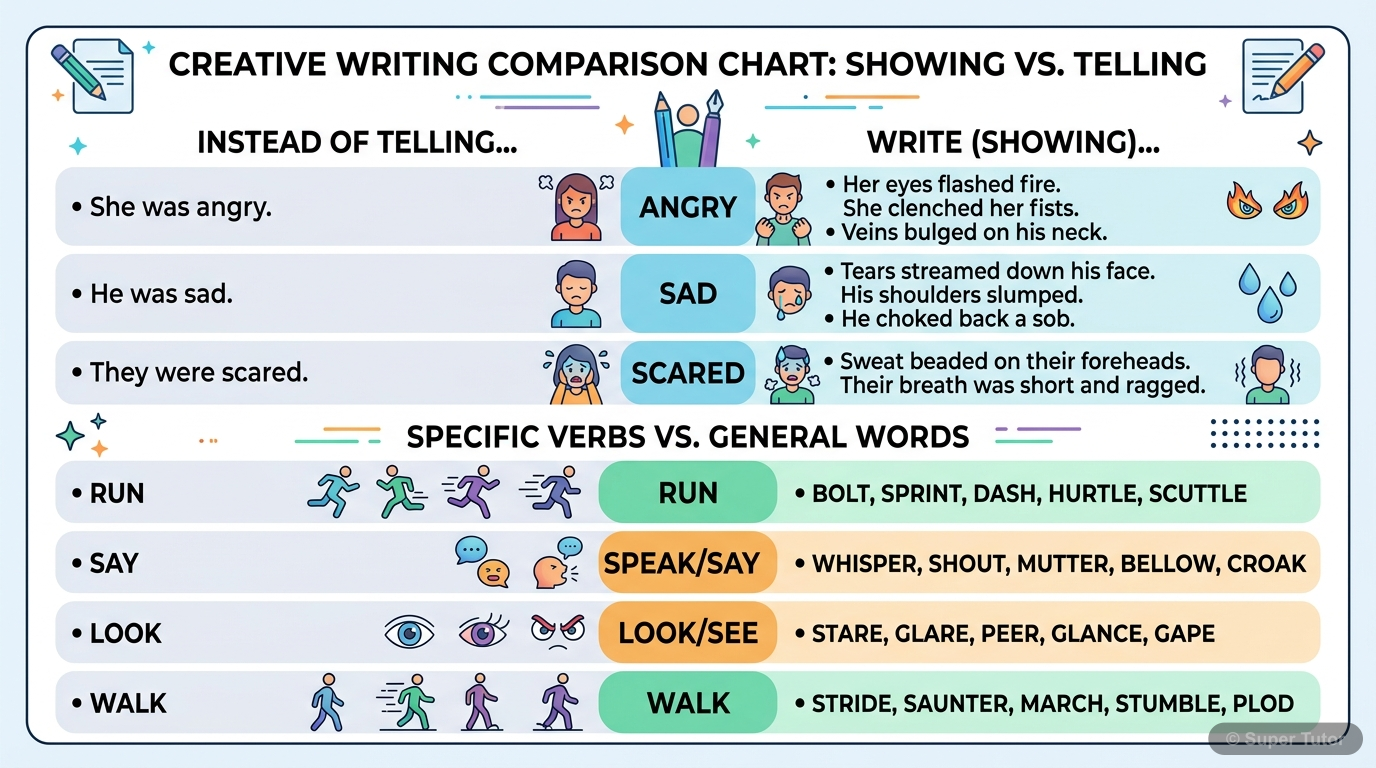
Short story writing depends on clear planning, vivid description, and controlled language. The central idea is the maxim “Show; do not tell,” which makes writing more dramatic and engaging. Good short stories usually begin from a given plot, title, first line, or set of characters, and they stay foc
Key Concepts
This is a widely recommended rule
This is a widely recommended rule in writing. Instead of directly naming an emotion or situation, the writer presents actions, expressions, and detail
Story
Story-writing questions usually contain one of four elements: the characters, the first line, the title, or the plot. The outline should grow from tha
A mind map or word cloud
A mind map or word cloud is an efficient way to draft a story. Words and ideas can be quickly jotted down and later arranged into a full story. A mind
Conversations are an important part
Conversations are an important part of any story because they make the story realistic and reveal character. A short dialogue of about 50 to 60 words
Short story writing requires simple
Short story writing requires simple, sharp, and economical language. Writers should avoid flowery language and long sentences, use fewer adverbs, and
Learning Objectives
- Understand the principle of showing emotions and events instead of simply stating them
- Learn how to plan a story using a mind map or word cloud
- Write short conversations based on given situations in about 50 to 60 words
- Develop a story from hints such as characters, plot, title, or first line
- Use specific words instead of general words for stronger impact
Frequently Asked Questions
What are the important topics in Short Story for ICSE Class 10 English Language - Archer?
How to score full marks in Short Story — ICSE Class 10 English Language - Archer?
Sources & Official References
Content is aligned to the official syllabus. Refer to the board website for the latest curriculum.
More resources for Short Story
Practice Quiz
Test yourself with a quick quiz
Important Questions
Practice with board exam-style questions
Revision Notes
Key points for last-minute revision
Formula Sheet
All formulas in one place
Concept Maps
See how topics connect visually
Study Plan
Step-by-step plan to ace this chapter
Flashcards
Quick-fire cards for active recall
Syllabus
What topics to cover
NCERT Solutions
Every textbook question solved step by step
For serious students
Get the full Short Story chapter — for free.
Quizzes, flashcards, AI doubt-solver and a step-by-step study plan for ICSE Class 10 English Language - Archer.