Act I — Flashcards
ICSE · Class 10 · English Literature: (Play) - Shakespeare's Julius Caesar
40 flashcards for Act I (ICSE Class 10 English Literature: - Shakespeare's Julius Caesar) to test yourself on key terms and facts.
Interactive on Super Tutor
Studying Act I? Get the full interactive chapter.
Quizzes, flashcards, AI doubt-solver and a step-by-step study plan — built for flashcards and more.
Free trial, no card needed.
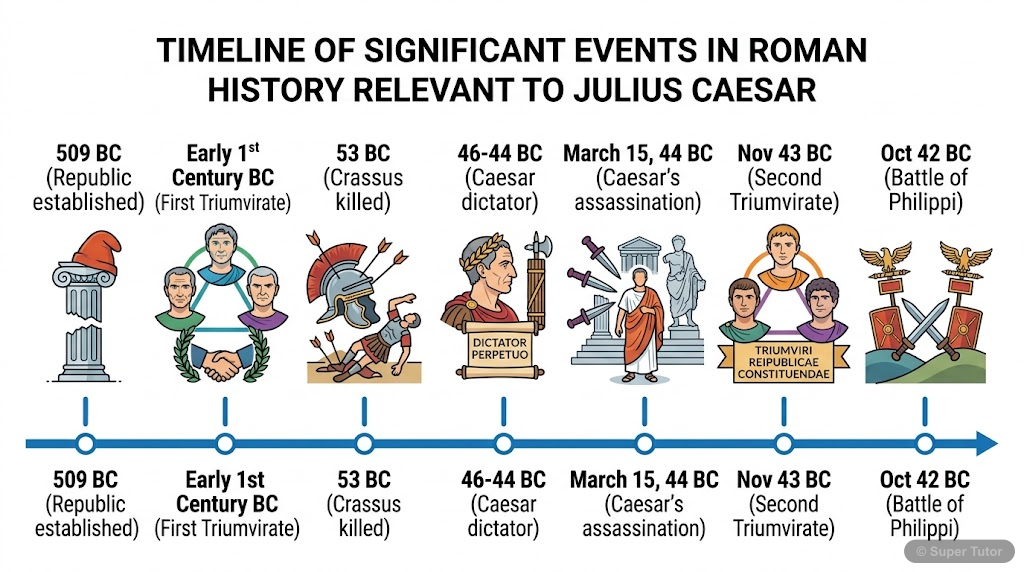
One of 6 illustrations for Act I in Super Tutor — alongside flashcards, concept maps and practice questions.
See them allWhat is characterisation in Julius Caesar?
Answer
Characterisation means revealing a person through speech, actions, silence, what others say about them, and contrast with other characters. In Julius Caesar, this method helps show Caesar, Brutus, Cas…
Why is Julius Caesar presented as an important figure in the play?
Answer
Caesar is shown as a great Roman general and senator. Brutus calls him "the foremost man of all this world." His power, pride, and influence affect the entire action of the play.
How many times does Caesar appear in the play, and what happens to him?
Answer
Caesar makes only three brief appearances, and he is killed in the middle of the play. Even when he is absent, his presence and influence remain very strong.
What are Caesar's main weaknesses in Act I?
Answer
Caesar suffers from a falling-sickness, is deaf in one ear, and appears physically weak in several moments. These details make him seem less invincible than his public image suggests.
What does Caesar's reply to Artemidorus show?
Answer
Caesar says, "What touches us ourselves shall be last served." This shows his pride and self-centredness, because he gives priority to his own matters and ignores warning.
What does Caesar's reply to Metellus Cimber show?
Answer
Caesar answers, "Caesar did never wrong but with just cause." This shows his arrogance and refusal to listen to the petition for Cimber's banished brother.
What important detail shows Caesar's deafness?
Answer
Caesar asks Antony to come on his right hand because one ear is deaf. This shows that his deafness is only in one ear, not total deafness.
Why is Caesar shown as superstitious?
Answer
Caesar is affected by omens, dreams, and warnings, even though he tries to hide it. He sends a man to consult priests and considers staying away from the senate for a time.
+32 more flashcards
Practise AllFrequently Asked Questions
What are the important topics in Act I for ICSE Class 10 English Literature: (Play) - Shakespeare's Julius Caesar?
How many flashcards are available for Act I?
How should I revise Act I for the ICSE Class 10 board exam?
Sources & Official References
Content is aligned to the official syllabus. Refer to the board website for the latest curriculum.
More resources for Act I
Practice Quiz
Test yourself with a quick quiz
Important Questions
Exam-style questions with answers
Revision Notes
Key points for last-minute revision
Chapter Summary
Understand the chapter at a glance
Concept Maps
See how topics connect
Study Plan
Step-by-step plan for this chapter
Syllabus
What topics to cover
For serious students
Get the full Act I chapter — start free.
Quizzes, flashcards, an AI doubt solver and a study plan for ICSE Class 10 English Literature: (Play) - Shakespeare's Julius Caesar. Free to start, no card needed.