Act I
ICSE · Class 10 · English Literature: (Play) - Shakespeare's Julius Caesar
Step-by-step guide to study Act I in ICSE Class 10 English Literature: (Play) - Shakespeare's Julius Caesar. Topics to cover, practice strategy, and time allocation.
Interactive on Super Tutor
Studying Act I? Get the full interactive chapter.
Quizzes, flashcards, AI doubt-solver and a step-by-step study plan — built for study plan and more.
1,000+ Class 10 students started this chapter today
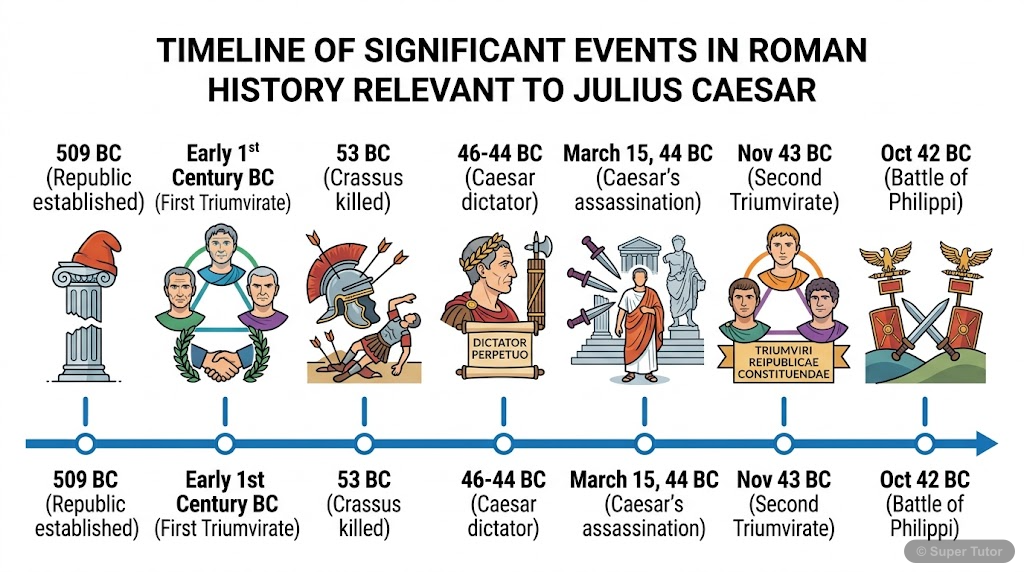
This is just one of 6+ visuals inside Super Tutor's Act I chapter
Explore the full setStudy Plan
Learn the Theory
Read the textbook chapter carefully. Note down definitions, formulas, and key concepts.
Practice Problems
Solve textbook exercises and additional practice questions. There are 56 questions available for this chapter.
Revise & Test
Revise key formulas and concepts without looking at notes. Take a practice quiz to test your understanding. Mark weak areas for re-revision.
Spaced Revision
Revisit Act I after a week. Use flashcards for quick recall. Solve previous year questions from this chapter.
What to Focus On
- Character is revealed through speech, action, silence, and contrast.
- The tragedy grows from the nature of the characters.
- The play has four leading figures: Caesar, Brutus, Cassius, and Antony.
- Caesar is a great general and senator.
- His greatness is acknowledged by others.
- He appears only briefly and dies in the middle of the play.
- Caesar participates in the Lupercalia scene.
- He ignores the Soothsayer's warning twice.
- He judges Cassius as dangerous.
Common Mistakes to Avoid
Caesar is shown as a fully strong and fearless ruler with no weakness.
Brutus joins the conspiracy because he hates Caesar personally.
Cassius is also a patriot like Brutus, so both are equally motivated by Rome’s welfare.
Memory Tips
Caesar's public greatness and private weakness
Brutus as honourable but misguided
Cassius as practical, shrewd, and self-interested
Antony as loyal friend and future strategist
Want a personalised study plan?
Super Tutor creates a day-by-day plan for ICSE Class 10 English Literature: (Play) - Shakespeare's Julius Caesar that adapts to your exam date and pace.
Create My Study Plan — FreeFrequently Asked Questions
What are the important topics in Act I for ICSE Class 10 English Literature: (Play) - Shakespeare's Julius Caesar?
How to score full marks in Act I — ICSE Class 10 English Literature: (Play) - Shakespeare's Julius Caesar?
Sources & Official References
Content is aligned to the official syllabus. Refer to the board website for the latest curriculum.
More resources for Act I
Practice Quiz
Test yourself with a quick quiz
Important Questions
Practice with board exam-style questions
Revision Notes
Key points for last-minute revision
Formula Sheet
All formulas in one place
Chapter Summary
Understand the chapter at a glance
Concept Maps
See how topics connect visually
Flashcards
Quick-fire cards for active recall
Syllabus
What topics to cover
NCERT Solutions
Every textbook question solved step by step
For serious students
Get the full Act I chapter — for free.
Quizzes, flashcards, AI doubt-solver and a step-by-step study plan for ICSE Class 10 English Literature: (Play) - Shakespeare's Julius Caesar.