Sole Trader or Sole Proprietorship — Important Questions
ICSE · Class 11 · Commerce
45 important questions from Sole Trader or Sole Proprietorship for ICSE Class 11 Commerce, with answers. Includes multiple choice questions.
Interactive on Super Tutor
Studying Sole Trader or Sole Proprietorship? Get the full interactive chapter.
Quizzes, flashcards, AI doubt-solver and a step-by-step study plan — built for important questions and more.
Free trial, no card needed.
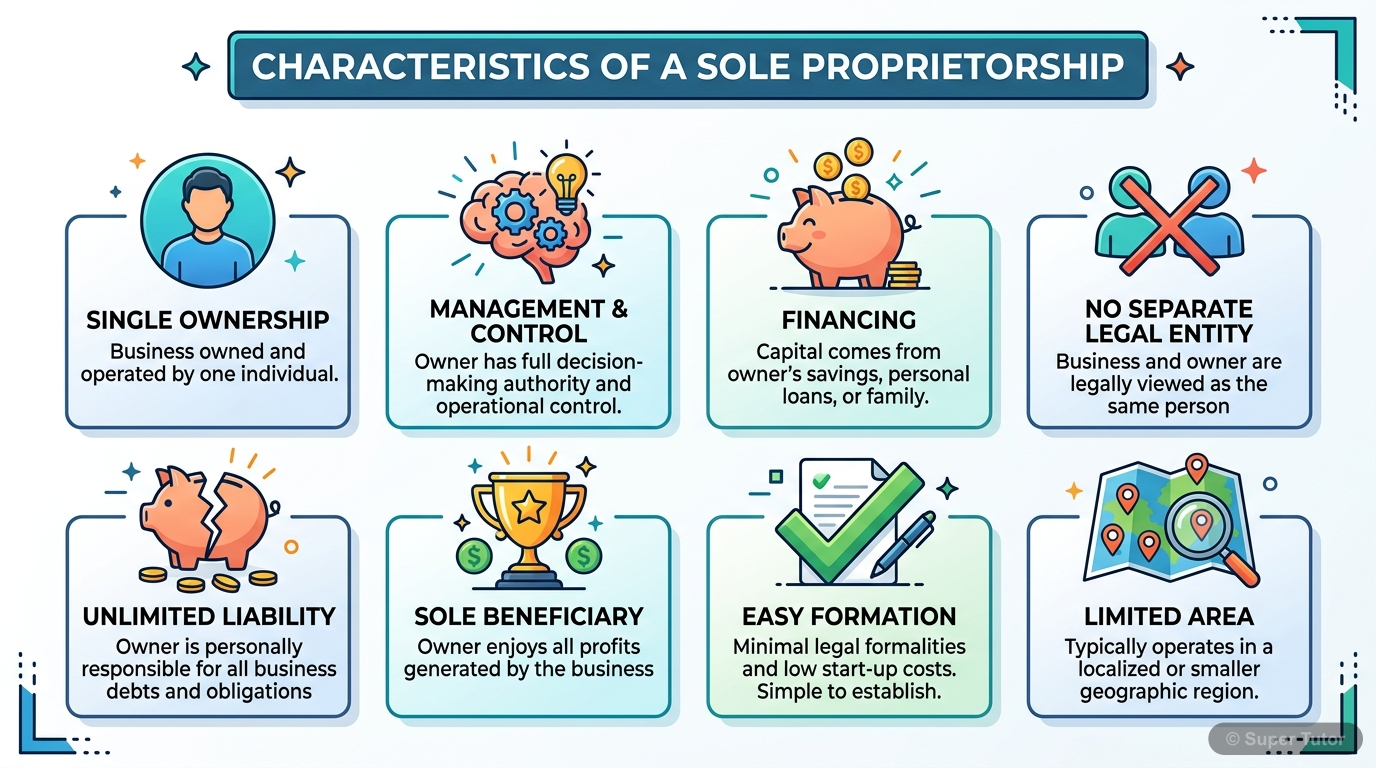
Learn better with visuals Super Tutor pairs illustrations like this with notes and quizzes for Sole Trader or Sole Proprietorship.
Important Questions from Sole Trader or Sole Proprietorship
Which of the following correctly distinguishes 'No Separate Entity' from 'Unlimited Liability' in sole proprietorship?
Show answer
No Separate Entity means there is no legal distinction between owner and business; Unlimited Liability means the owner's personal assets can be used to pay business debts
Step 1: 'No Separate Entity' is a legal concept – it means the law does not recognise the business as different from its owner. Step 2: 'Unlimited Liability' is a financial concept – it means there is no cap on the owner's financial responsibility; personal assets can be seized to pay business debts. Step 3: While both are interrelated (no separate entity often leads to unlimited liability), they are distinct concepts. Step 4: Option A reverses the definitions, which is incorrect. Step 5: Option C wrongly equates them as the same concept – they are related but distinct. Option B correctly diff
The merit 'Easy to Get Loans' in sole proprietorship is PARADOXICALLY related to which major demerit?
Show answer
Unlimited liability
Step 1: The merit 'Easy to Get Loans' states that banks are willing to lend to sole traders because 'legally debts can be recovered from his personal property.' Step 2: This means lenders feel secure because the trader's personal assets back the loan. Step 3: This very reason – personal assets being attached to business debts – is the definition of 'Unlimited Liability,' which is a major demerit. Step 4: So, the same feature (personal assets backing debts) creates both the merit (easy loans) and the demerit (unlimited liability). Step 5: This is a paradox – what makes loans easier to get simul
The saying 'Hurry makes curry' is used in the context of sole proprietorship to describe which demerit?
Show answer
Loss by quick decision
Step 1: One of the merits of sole proprietorship is 'Prompt Decisions' – the owner can decide quickly without consulting anyone. Step 2: However, this same feature becomes a demerit when hasty decisions lead to losses. Step 3: The demerit 'Loss by Quick Decision' explains that while quick decisions are possible, the sole trader has no one to consult, so decisions may go wrong. Step 4: The saying 'Hurry makes curry' implies that rushing leads to mistakes, perfectly describing this demerit. Step 5: Limited managerial ability refers to lack of expertise, instability refers to business closure on
Which merit of sole proprietorship directly contributes to preventing the concentration of wealth in few hands, thereby serving a social purpose?
Show answer
Social importance
Step 1: The merit 'Social Importance' specifically mentions two social benefits: (i) possibility of doing business with less capital and providing employment to others, and (ii) sole tradership prevents concentration of wealth in few hands. Step 2: By allowing many individuals to start small businesses, wealth gets distributed across society rather than accumulating with a few large corporations. Step 3: Tax advantage benefits the individual owner financially but does not address wealth distribution. Step 4: Ease of dissolution relates to winding up the business, not social wealth distribution
+41 more questions on Sole Trader or Sole Proprietorship (ICSE Class 11 Commerce)
Practise AllFrequently Asked Questions
What are the important topics in Sole Trader or Sole Proprietorship for ICSE Class 11 Commerce?
How many important questions are there in Sole Trader or Sole Proprietorship?
Sources & Official References
Content is aligned to the official syllabus. Refer to the board website for the latest curriculum.
More resources for Sole Trader or Sole Proprietorship
For serious students
Get the full Sole Trader or Sole Proprietorship chapter — start free.
Quizzes, flashcards, an AI doubt solver and a study plan for ICSE Class 11 Commerce. Free to start, no card needed.