Basic Concepts of Economics — Practice Quiz
ICSE · Class 11 · Economics
Try a 4-question quiz on Basic Concepts of Economics for ICSE Class 11 Economics: tap an answer to check it and see why.
Interactive on Super Tutor
Studying Basic Concepts of Economics? Get the full interactive chapter.
Quizzes, flashcards, AI doubt-solver and a step-by-step study plan — built for practice quiz and more.
Free trial, no card needed.
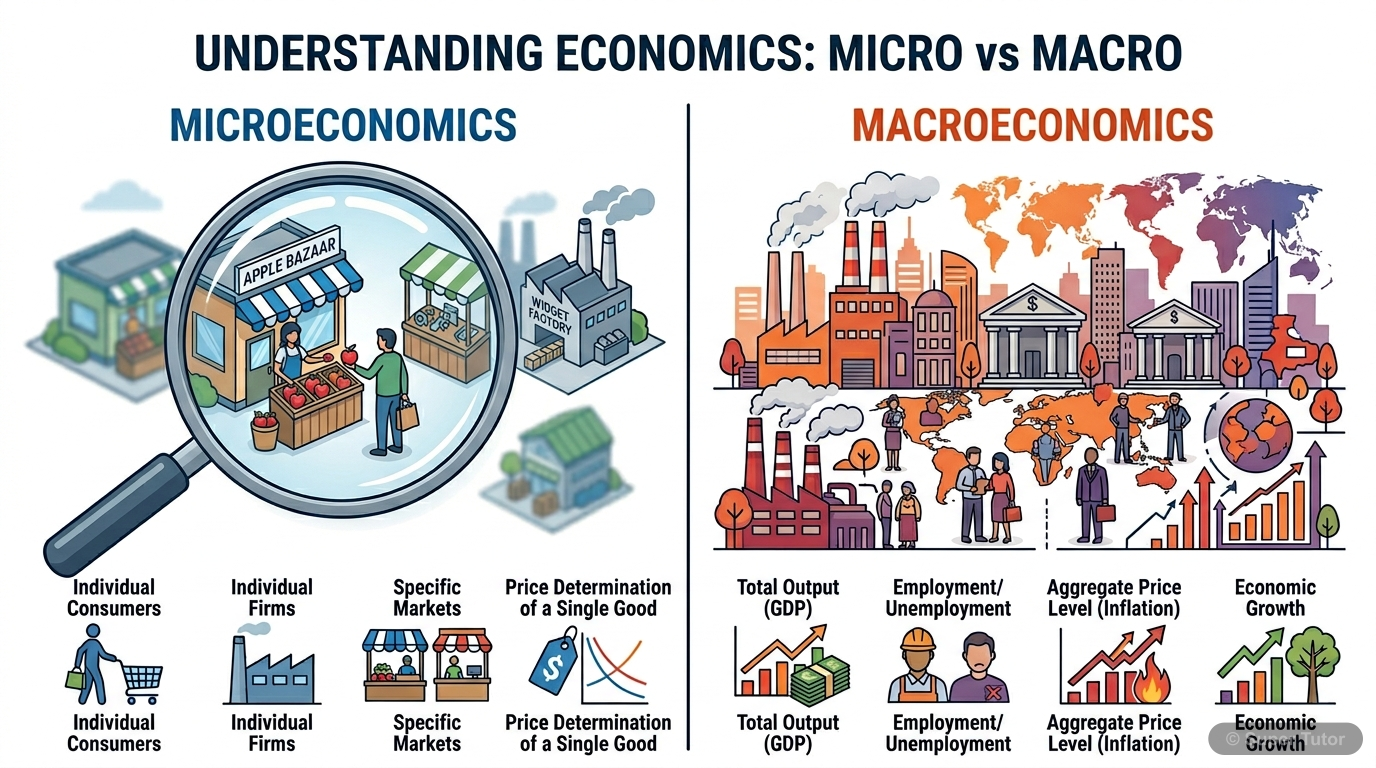
One of 4 illustrations for Basic Concepts of Economics in Super Tutor — alongside flashcards, concept maps and practice questions.
Quick Quiz: Basic Concepts of Economics
0/4Tap an answer to check it instantly. No sign-up needed for these 4.
The term 'microeconomics' was first coined by which economist?
Microeconomics is also known as:
Which of the following is an example of a MACROECONOMIC study?
Which of the following correctly describes the relationship between Total Utility (TU) and Marginal Utility (MU)?
Sample Questions
In economics, which of the following is NOT considered 'wealth'?
Show answer
A B.A. degree
Step 1: For something to be 'wealth' in economics, it must possess four characteristics: Utility, Scarcity, Transferability, and Externality. Step 2: A B.A. degree has Utility (it is useful) and Scarcity (not everyone has it), BUT it lacks Transferability — you cannot transfer your degree to another person. Step 3: Since a B.A. degree fails the transferability test, it is NOT wealth in economics. Step 4: Why others are wrong — A DDA flat has all four characteristics (utility, scarcity, transferability, externality) → it IS wealth. A rare painting has all four characteristics → it IS wealth. Co
Which attribute of value states that a commodity has exchange value ONLY when it is scarce relative to demand?
Show answer
Scarcity
Step 1: Value in economics has three main attributes — Utility, Scarcity, and Transferability. Step 2: Scarcity means a commodity must be limited in supply relative to its demand for it to command value. Step 3: Classic example: Air is extremely useful (high utility) but it is available in unlimited quantity, so it has NO exchange value (no price in normal conditions). Step 4: Why others are wrong — Utility means the ability to satisfy wants (necessary but not sufficient for value). Transferability means the commodity can change hands (also necessary for value). Externality is a characteristic
Human wants are classified into three categories. Which of the following is the CORRECT classification?
Show answer
Necessaries, Comforts, and Luxuries
Step 1: The standard economic classification of human wants is into three groups. Step 2: Necessaries — goods essential for survival and efficiency (food, cloth, shelter, milk, fruits). These are further divided into necessaries of life, necessaries of efficiency, and conventional necessaries. Step 3: Comforts — goods that do not increase efficiency but whose absence decreases efficiency (furniture, electric fan, refrigerator, washing machine). Step 4: Luxuries — goods used for a lavish lifestyle (costly cars, gold ornaments, expensive clothes, large houses). Step 5: Why others are wrong — 'Se
Which of the following is described as an ACTIVE factor of production that makes production possible in cooperation with other factors?
Show answer
Labour
Step 1: Factors of production are classified as active or passive based on their role in production. Step 2: Labour is described as an ACTIVE factor of production. It is labour which, in cooperation with land and capital, actually makes production happen. Without labour, land and capital cannot produce anything. Step 3: Why others are wrong — Land is a PASSIVE factor; it cannot produce anything on its own and requires labour and capital. Capital is also a PASSIVE factor; it becomes effective only when used by labour. Organisation (entrepreneurship) coordinates the other factors but is a coordi
+39 more questions on Basic Concepts of Economics (ICSE Class 11 Economics)
Practise AllFrequently Asked Questions
What are the important topics in Basic Concepts of Economics for ICSE Class 11 Economics?
How many practice questions are there for Basic Concepts of Economics?
Sources & Official References
Content is aligned to the official syllabus. Refer to the board website for the latest curriculum.
More resources for Basic Concepts of Economics
Important Questions
Exam-style questions with answers
Revision Notes
Key points for last-minute revision
Formula Sheet
The chapter's formulas in one place
Chapter Summary
Understand the chapter at a glance
Concept Maps
See how topics connect
Study Plan
Step-by-step plan for this chapter
Flashcards
Quick-fire cards for active recall
Syllabus
What topics to cover
For serious students
Get the full Basic Concepts of Economics chapter — start free.
Quizzes, flashcards, an AI doubt solver and a study plan for ICSE Class 11 Economics. Free to start, no card needed.