Types of Economies — Practice Quiz
ICSE · Class 11 · Economics
Try a 4-question quiz on Types of Economies for ICSE Class 11 Economics: tap an answer to check it and see why. 45 questions in the full chapter test.
Interactive on Super Tutor
Studying Types of Economies? Get the full interactive chapter.
Quizzes, flashcards, AI doubt-solver and a step-by-step study plan — built for practice quiz and more.
Free trial, no card needed.
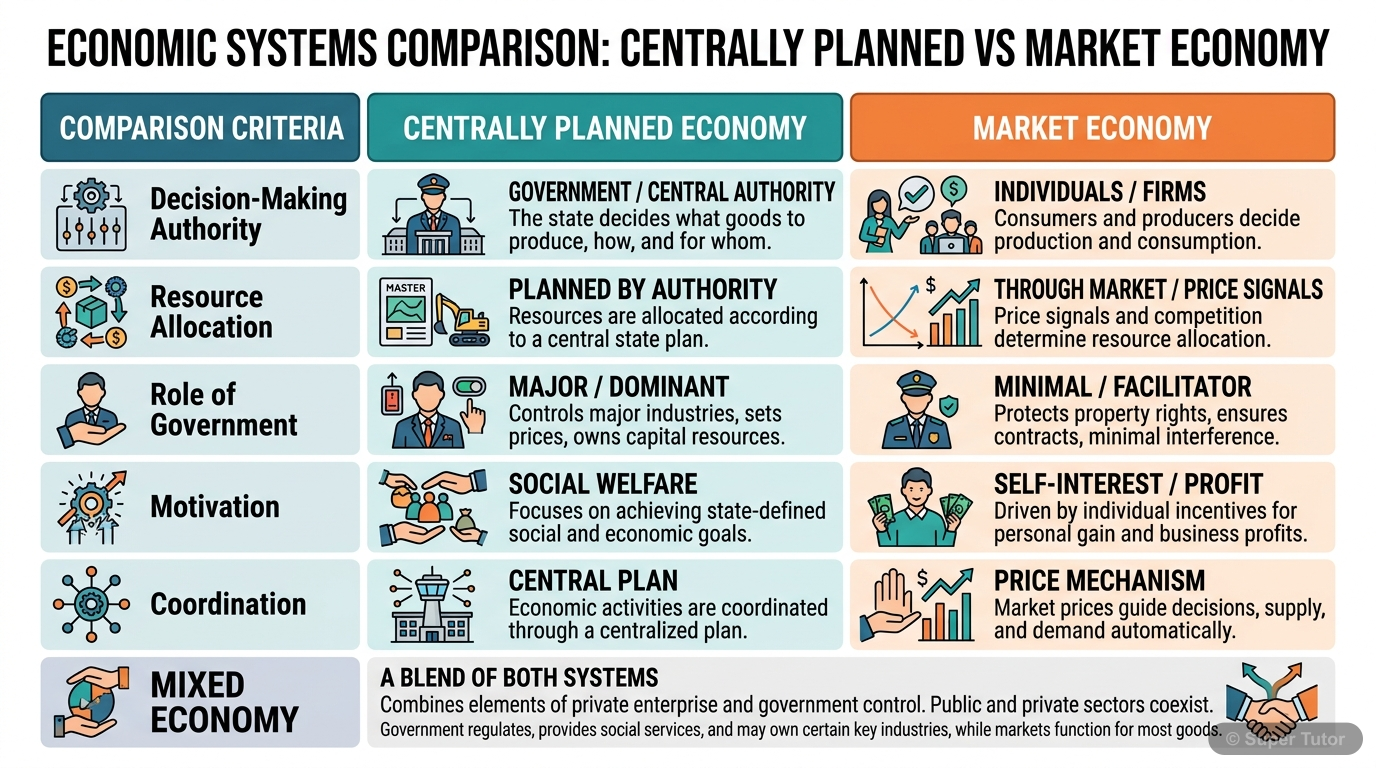
Learn better with visuals Super Tutor pairs illustrations like this with notes and quizzes for Types of Economies.
Quick Quiz: Types of Economies
0/4Tap an answer to check it instantly. No sign-up needed for these 4.
In a capitalist economy, the problem of 'For Whom to Produce' is ultimately determined by which of the following?
Which of the following statements correctly distinguishes a Socialist Economy from a Capitalist Economy with respect to price mechanism?
The concept of Mixed Economy was propounded by J.M. Keynes. Which of the following BEST describes the second type of mixed economy that exists in most developing countries like India?
Which of the following is NOT a demerit of a Capitalist Economy?
Sample Questions
According to the World Bank classification (as of July 2020), which income group would a country with a GNI per capita of $5,000 belong to?
Show answer
Upper middle income ($4,046 – $12,535)
Step 1: The World Bank classifies countries into four income groups based on GNI per capita. Step 2: The categories are – Low income: less than $1,036; Lower middle income: $1,036–$4,045; Upper middle income: $4,046–$12,535; High income: more than $12,535. Step 3: The given GNI per capita is $5,000. Step 4: $5,000 falls between $4,046 and $12,535. Step 5: Therefore, the country belongs to the Upper Middle Income group. This is important because low and middle income countries are called 'developing' while upper middle and high income are called 'developed'.
In a Socialist Economy, complete equality of income does NOT exist because:
Show answer
Income differences based on differences in skill, efficiency, and productivity of individuals are considered necessary and acceptable
Step 1: Socialism aims at reducing inequalities but NOT at achieving absolute equality of income. Step 2: Under socialism, there is no private property and the law of inheritance does NOT exist – so those sources of inequality are eliminated. This rules out Option A. Step 3: The central planning authority does NOT deliberately create inequality for competition – that is a feature of capitalism. This rules out Option C. Step 4: Foreign trade inequalities are not the textbook reason given here. This rules out Option D. Step 5: Socialism accepts that skilled workers deserve more wages than unskil
Which of the following correctly explains why China's manufacturing sector grew remarkably compared to India and Pakistan?
Show answer
The GLF campaign (1958) and the 'Reforms and Opening Up' policy (1978) together gave a major push to manufacturing and exports
Step 1: China is often called the 'Factory of the World' due to its dominant manufacturing sector. Step 2: The Great Leap Forward (GLF) campaign of 1958 encouraged large-scale industrialisation, including setting up industries at the community level. Step 3: The 'Reforms and Opening Up' policy of 1978 allowed private firms, local collectives, and foreign investors (through SEZs) to set up manufacturing units, dramatically boosting exports. Step 4: Option A is wrong – India and Pakistan followed a service-sector-led growth path, NOT China. Step 5: Option C is wrong – China did NOT completely pr
India's Industrial Policy of 1956 is significant in the context of Mixed Economy because:
Show answer
It made provision for co-existence of public and private sectors, giving public sector a dominant role in strategic and basic industries
Step 1: India adopted economic planning in 1951 and its industrial policies shaped the mixed economy framework. Step 2: The Industrial Policies of 1948 and 1956 made formal provision for the co-existence of public and private sectors. Step 3: Strategic, heavy, and basic industries (like steel, mining, defence) were reserved for the public sector under government control. Step 4: Agriculture, consumer goods, and certain industries were left for the private sector. Step 5: Option A is wrong – India never became a pure socialist state. Option C is wrong – controls were actually imposed. Option D
+41 more questions on Types of Economies (ICSE Class 11 Economics)
Practise AllFrequently Asked Questions
What are the important topics in Types of Economies for ICSE Class 11 Economics?
How many practice questions are there for Types of Economies?
Sources & Official References
Content is aligned to the official syllabus. Refer to the board website for the latest curriculum.
More resources for Types of Economies
Important Questions
Exam-style questions with answers
Revision Notes
Key points for last-minute revision
Chapter Summary
Understand the chapter at a glance
Concept Maps
See how topics connect
Study Plan
Step-by-step plan for this chapter
Flashcards
Quick-fire cards for active recall
Syllabus
What topics to cover
For serious students
Get the full Types of Economies chapter — start free.
Quizzes, flashcards, an AI doubt solver and a study plan for ICSE Class 11 Economics. Free to start, no card needed.