Joint Stock Accounts : Issue of Debentures — Important Questions
ICSE · Class 12 · Accountancy
45 important questions from Joint Stock Accounts : Issue of Debentures for ICSE Class 12 Accountancy, with answers. Includes multiple choice questions.
Interactive on Super Tutor
Studying Joint Stock Accounts : Issue of Debentures? Get the full interactive chapter.
Quizzes, flashcards, AI doubt-solver and a step-by-step study plan — built for important questions and more.
Free trial, no card needed.
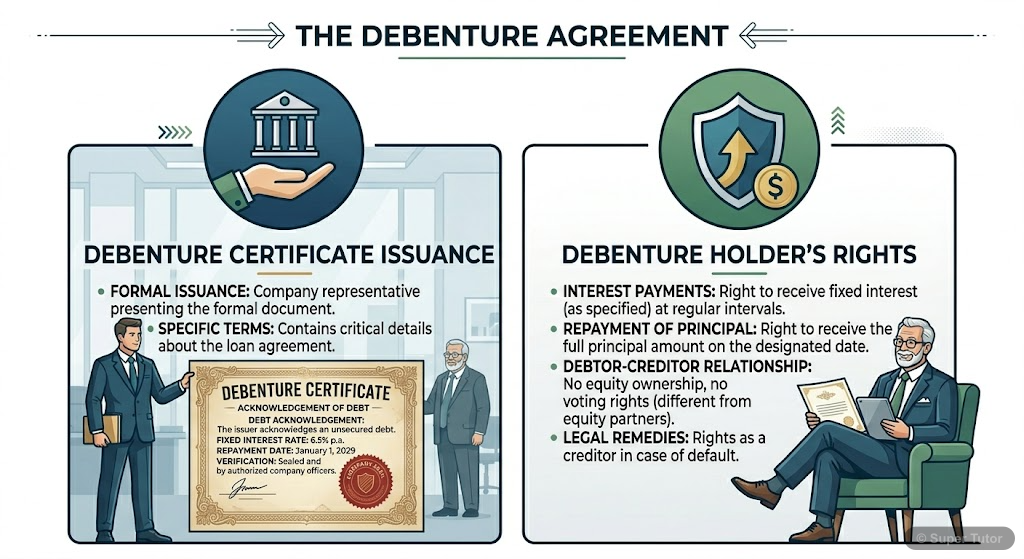
Learn better with visuals Super Tutor pairs illustrations like this with notes and quizzes for Joint Stock Accounts : Issue of Debentures.
Important Questions from Joint Stock Accounts : Issue of Debentures
When debentures are issued at par and redeemable at par, the Securities Premium Reserve Account is:
Show answer
Neither debited nor credited
Step 1: When debentures are issued 'at par', the issue price equals the face value (e.g., ₹100 issued for ₹100). Step 2: Securities Premium Reserve is only created when debentures are issued at a premium (i.e., above face value). Step 3: Since there is no premium involved in this case (issued at par), there is no need to credit Securities Premium Reserve. Step 4: Similarly, there is no loss or discount either, so no debit arises. Step 5: The journal entry simply involves Bank A/c Dr. to Debentures A/c. Therefore, Securities Premium Reserve is neither debited nor credited.
When debentures are issued at a premium, the premium amount is credited to:
Show answer
Securities Premium Reserve Account
Step 1: When debentures are issued at a price higher than face value, the extra amount is called 'premium on issue'. Step 2: This premium is a capital profit (not earned from regular business operations). Step 3: Capital profits are NOT transferred to Profit and Loss Account. Step 4: As per accounting rules, this premium must be credited to 'Securities Premium Reserve Account'. Step 5: Capital Reserve Account is used for other capital gains (like profit on revaluation), not for issue premium. Hence, the correct answer is 'Securities Premium Reserve Account'.
Discount on Issue of Debentures Account is a:
Show answer
Capital loss
Step 1: When debentures are issued at a price below face value (at discount), the company receives less money than it will have to repay. Step 2: This shortfall is a financial loss for the company. Step 3: Since this loss arises from a financial/funding transaction (not regular business operations), it is classified as a 'Capital Loss'. Step 4: Revenue losses arise from day-to-day business operations. Step 5: Capital profits arise from capital transactions like selling assets at a gain. Since discount on issue is a capital transaction loss, the correct classification is 'Capital Loss'.
When debentures are issued at par but redeemable at a premium of 5%, the journal entry at the time of allotment will include a debit to:
Show answer
Loss on Issue of Debentures A/c
Step 1: When debentures are issued at par (₹100) but redeemable at premium (₹105), the company will pay ₹5 more at redemption than it received at issue. Step 2: This ₹5 extra payment is a known future loss, which must be recorded at the time of allotment. Step 3: This future loss is debited to 'Loss on Issue of Debentures A/c' (a capital loss). Step 4: Simultaneously, 'Premium on Redemption of Debentures A/c' is credited (as a liability). Step 5: Securities Premium Reserve is credited only when issued at premium; Discount on Issue is debited only when issued at discount. Hence, 'Loss on Issue
+41 more questions on Joint Stock Accounts : Issue of Debentures (ICSE Class 12 Accountancy)
Practise AllFrequently Asked Questions
What are the important topics in Joint Stock Accounts : Issue of Debentures for ICSE Class 12 Accountancy?
How many important questions are there in Joint Stock Accounts : Issue of Debentures?
Sources & Official References
Content is aligned to the official syllabus. Refer to the board website for the latest curriculum.
More resources for Joint Stock Accounts : Issue of Debentures
Practice Quiz
Test yourself with a quick quiz
Revision Notes
Key points for last-minute revision
Formula Sheet
The chapter's formulas in one place
Chapter Summary
Understand the chapter at a glance
Concept Maps
See how topics connect
Study Plan
Step-by-step plan for this chapter
Flashcards
Quick-fire cards for active recall
Syllabus
What topics to cover
For serious students
Get the full Joint Stock Accounts : Issue of Debentures chapter — start free.
Quizzes, flashcards, an AI doubt solver and a study plan for ICSE Class 12 Accountancy. Free to start, no card needed.