The Digestive and Excretory Systems
ICSE · Class 4 · Science
Most important questions from The Digestive and Excretory Systems for ICSE Class 4 Science board exam 2026. MCQs, short answer, and long answer questions with marks.
Interactive on Super Tutor
Studying The Digestive and Excretory Systems? Get the full interactive chapter.
Quizzes, flashcards, AI doubt-solver and a step-by-step study plan — built for important questions and more.
1,000+ Class 4 students started this chapter today
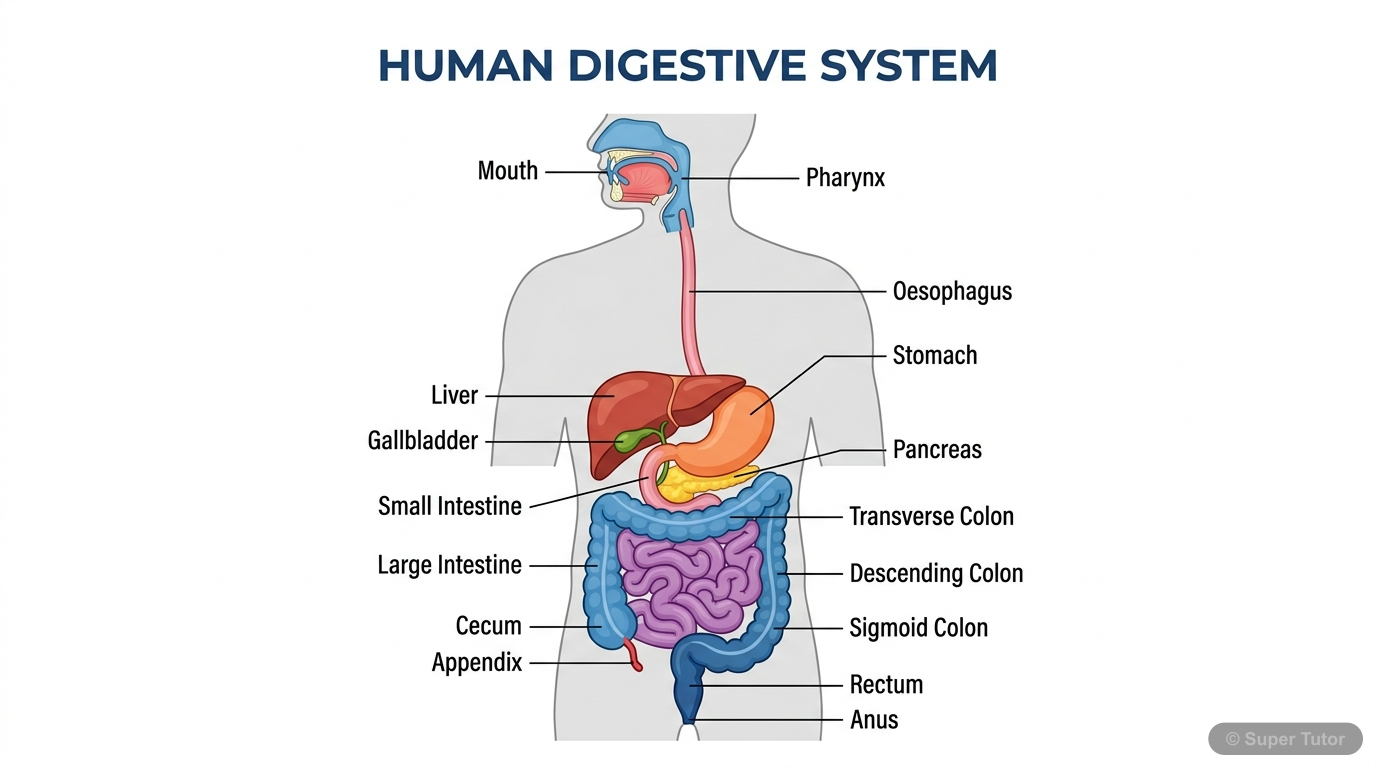
This is just one of 5+ visuals inside Super Tutor's The Digestive and Excretory Systems chapter
Explore the full setSample Questions
The pancreas helps in digestion. What is the specific role of the pancreas?
Show answer
It provides enzymes to digest all sorts of food.
Step 1: The pancreas is a gland that works alongside the small intestine. Step 2: It produces special chemicals called ENZYMES. Enzymes are substances that speed up chemical reactions in the body. Step 3: The enzymes from the pancreas are sent into the small intestine, where they help break down all types of food — carbohydrates, proteins, and fats. Step 4: This is different from the liver, which produces bile specifically for breaking down fats. The pancreas works on ALL types of food. Step 5: Option A is wrong because bile is stored in the GALL BLADDER, not the pancreas. Option B describes t
Which organs are considered the MAIN organs of the excretory system?
Show answer
Kidneys, ureters, bladder, and urethra
Step 1: The excretory system removes waste products formed inside the body. Different organs help in this — the lungs remove carbon dioxide, the skin removes sweat, and the kidneys remove urine. Step 2: However, the lungs and skin have other primary jobs (breathing and protection). Only the kidneys, ureters, bladder, and urethra exist SPECIFICALLY for excreting urine (liquid waste). Step 3: Therefore, the textbook says the MAIN organs of the excretory system are kidneys, ureters, bladder, and urethra. Step 4: Option C (stomach, large intestine, anus) belongs to the DIGESTIVE system. Step 5: Op
Urine is formed in the kidneys and travels out of the body. What is the CORRECT path of urine from kidneys to outside the body?
Show answer
Kidneys → Ureters → Bladder → Urethra → Outside
Step 1: Urine is formed inside the two KIDNEYS. The kidneys filter the blood and remove toxins and excess water as urine. Step 2: From the kidneys, urine travels through thin tubes called URETERS. There are two ureters, one from each kidney. Step 3: The ureters carry urine to the URINARY BLADDER, where it is stored. The bladder can hold 400–600 mL of urine. Step 4: When the bladder is full, urine is released out of the body through the URETHRA. Step 5: All the other options have the organs in the wrong order. Remember: Kidneys → Ureters → Bladder → Urethra — you can use the phrase 'Keep Urine
What important function does the large intestine perform in the digestive process?
Show answer
It absorbs water from leftover food and forms solid waste called faeces.
Step 1: After the small intestine absorbs nutrients, the leftover food material (which the body cannot use) moves to the LARGE INTESTINE. Step 2: The large intestine has a very specific job — it absorbs the WATER from this leftover material. This water goes back into the body so it is not wasted. Step 3: After the water is removed, the remaining solid material forms FAECES (also called stool or waste). Step 4: This faeces is then pushed out of the body through the ANUS. Step 5: Breaking proteins (Option A) is done by the stomach and small intestine. Absorbing nutrients (Option B) is the job of
+41 more questions available
Practice AllFrequently Asked Questions
What are the important topics in The Digestive and Excretory Systems for ICSE Class 4 Science?
How to score full marks in The Digestive and Excretory Systems — ICSE Class 4 Science?
How many important questions are there in The Digestive and Excretory Systems?
Sources & Official References
Content is aligned to the official syllabus. Refer to the board website for the latest curriculum.
More resources for The Digestive and Excretory Systems
Practice Quiz
Test yourself with a quick quiz
Revision Notes
Key points for last-minute revision
Formula Sheet
All formulas in one place
Chapter Summary
Understand the chapter at a glance
Concept Maps
See how topics connect visually
Study Plan
Step-by-step plan to ace this chapter
Flashcards
Quick-fire cards for active recall
Syllabus
What topics to cover
NCERT Solutions
Every textbook question solved step by step
For serious students
Get the full The Digestive and Excretory Systems chapter — for free.
Quizzes, flashcards, AI doubt-solver and a step-by-step study plan for ICSE Class 4 Science.