Plants in the Surroundings and Environment — Practice Quiz
ICSE · Class 4 · Science
Try a 4-question quiz on Plants in the Surroundings and Environment for ICSE Class 4 Science: tap an answer to check it and see why.
Interactive on Super Tutor
Studying Plants in the Surroundings and Environment? Get the full interactive chapter.
Quizzes, flashcards, AI doubt-solver and a step-by-step study plan — built for practice quiz and more.
Free trial, no card needed.
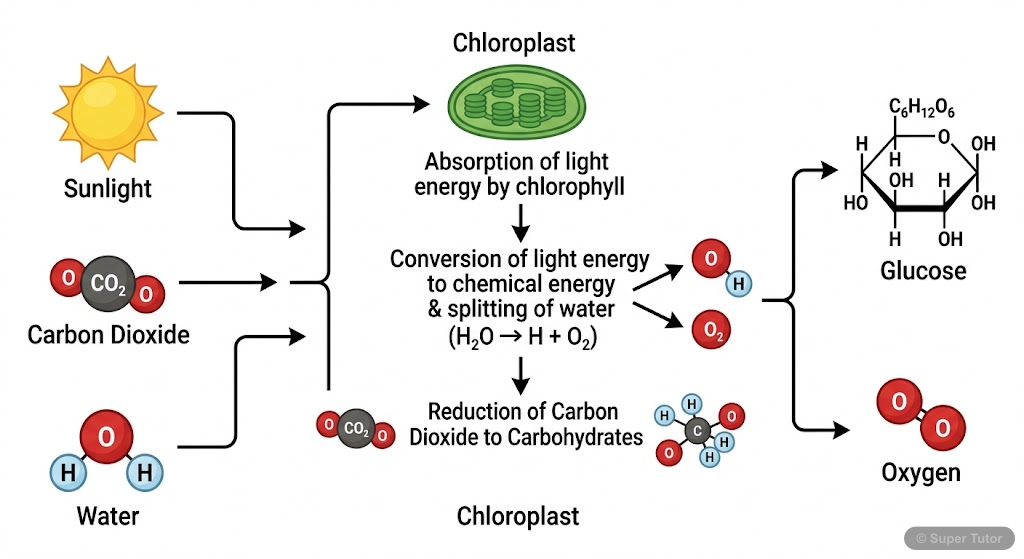
An illustration from Super Tutor's Plants in the Surroundings and Environment chapter — alongside flashcards, concept maps and practice questions.
Quick Quiz: Plants in the Surroundings and Environment
0/4Tap an answer to check it instantly. No sign-up needed for these 4.
A scientist covers one half of a leaf with black paper and places the plant in sunlight for 4 hours. She then performs the iodine test on the entire leaf. What will she observe?
Which of the following is the correct equation that represents photosynthesis?
Riya notices that a potato plant stores food in its underground part, but a mango tree stores food in its fruits. Which statement BEST explains why iodine solution would turn blue-black on a raw potato slice?
Transpiration in plants is often compared to sweating in humans. What is the MAIN reason plants undergo transpiration?
Sample Questions
Which of the following groups contains ONLY plants with taproot systems?
Show answer
Carrot, radish, mustard, bean
Step 1: Taproot systems have one main thick root with smaller branches growing out of it. Step 2: Carrot, radish, mustard, and bean all have taproots with a prominent main root. Step 3: Grass, wheat, rice, and onion have fibrous roots – a bunch of thread-like roots of similar size with no main root. Step 4: In Option B, grass and wheat have fibrous roots, so the group is mixed. Step 5: In Options C and D, rice, wheat, grass, and onion all have fibrous roots, making those groups incorrect.
A plant is described as having a weak stem that needs a wall or stick for support and cannot spread on the ground. Which type of plant is this?
Show answer
Climber
Step 1: Plants with weak stems need support to grow upright. Step 2: These plants are divided into two groups – creepers and climbers. Step 3: Creepers have weak stems but spread along the ground (e.g., pumpkin, watermelon, strawberry). Step 4: Climbers have weak stems and use walls, sticks, or other structures for vertical support (e.g., money plant, grapevine). Step 5: The question says the plant needs a wall or stick and cannot spread on the ground – this clearly describes a climber, not a creeper. Herbs have soft stems but stand on their own. Bushes have thin, hard stems.
The word 'photosynthesis' is made of two Greek words. 'Photo' means light and 'synthesis' means putting together. Based on this, which statement BEST describes photosynthesis?
Show answer
The process of using light energy to put together carbon dioxide and water to make food
Step 1: 'Photo' = light, 'synthesis' = putting together. So photosynthesis literally means 'putting together using light'. Step 2: In this process, plants use light energy (from the Sun) to combine (put together) raw materials. Step 3: The raw materials are carbon dioxide (from air) and water (from soil). Step 4: The output is glucose (food) and oxygen. Step 5: Option A is wrong because oxygen is a product, not a raw material. Option C is wrong as soil and sunlight don't make CO₂. Option D describes respiration (breaking down food), which is the opposite of photosynthesis.
Stomata are described as tiny pores on the undersurface of leaves. Which TWO functions do stomata perform? (Choose the BEST answer that covers both functions.)
Show answer
Allow exchange of gases and release of water vapour during transpiration
Step 1: Stomata are tiny openings (pores) found mostly on the undersurface of leaves. Step 2: First function: They allow gases to enter and leave the plant. Carbon dioxide (needed for photosynthesis) enters through stomata, and oxygen (produced during photosynthesis) exits through them. This is called gas exchange. Step 3: Second function: Excess water vapour is released through stomata during transpiration. Step 4: Option A is wrong – stomata do not absorb sunlight (chlorophyll does that) or store food. Step 5: Option C describes the function of roots, not stomata. Stomata are on leaves, not
+39 more questions on Plants in the Surroundings and Environment (ICSE Class 4 Science)
Practise AllFrequently Asked Questions
What are the important topics in Plants in the Surroundings and Environment for ICSE Class 4 Science?
How many practice questions are there for Plants in the Surroundings and Environment?
Sources & Official References
Content is aligned to the official syllabus. Refer to the board website for the latest curriculum.
More resources for Plants in the Surroundings and Environment
Important Questions
Exam-style questions with answers
Revision Notes
Key points for last-minute revision
Chapter Summary
Understand the chapter at a glance
Concept Maps
See how topics connect
Study Plan
Step-by-step plan for this chapter
Flashcards
Quick-fire cards for active recall
Syllabus
What topics to cover
For serious students
Get the full Plants in the Surroundings and Environment chapter — start free.
Quizzes, flashcards, an AI doubt solver and a study plan for ICSE Class 4 Science. Free to start, no card needed.