Plant Reproduction: Fertilization — Practice Quiz
ICSE · Class 5 · Science
Try a 4-question quiz on Plant Reproduction: Fertilization for ICSE Class 5 Science: tap an answer to check it and see why.
Interactive on Super Tutor
Studying Plant Reproduction: Fertilization? Get the full interactive chapter.
Quizzes, flashcards, AI doubt-solver and a step-by-step study plan — built for practice quiz and more.
Free trial, no card needed.
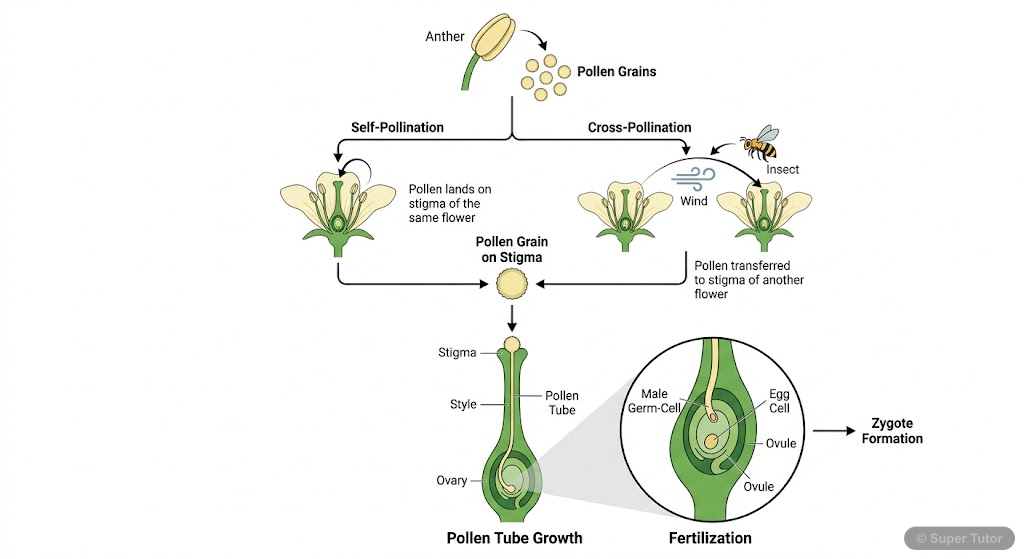
Learn better with visuals Super Tutor pairs illustrations like this with notes and quizzes for Plant Reproduction: Fertilization.
Quick Quiz: Plant Reproduction: Fertilization
0/4Tap an answer to check it instantly. No sign-up needed for these 4.
During fertilization in a flower, the pollen tube travels from the stigma to the ovary through which part of the pistil?
What is the correct term for the fertilized female reproductive cell that develops into a seed?
After fertilization, the ovary of a flower develops into a fruit. What happens to the sepals and petals in most plants after fertilization?
A student says: 'All fruits must be sweet and fleshy.' Which of the following examples BEST proves this statement WRONG?
Sample Questions
The seed coat of a seed is called the testa. What is the PRIMARY function of the seed coat?
Show answer
To protect the seed from injury, germs, and harsh weather
Step 1: The seed coat (testa) is the outermost covering of a seed. Step 2: Its PRIMARY job is protection — it protects the seed from physical injury, harmful germs (bacteria/fungi), and harsh weather conditions like heat, cold, and dryness. Step 3: The food for the baby plant is stored in the cotyledons (seed leaves), NOT in the seed coat. Step 4: Water absorption during germination is mainly done by the embryo/seed, and the seed coat actually becomes softer when soaked. Step 5: Floating in water for dispersal is a special feature of coconut seeds due to fibres, not the general function of all
Seeds with only one cotyledon are called monocotyledons. Which of the following is an example of a monocot seed?
Show answer
Maize
A monocotyledon seed has only one seed leaf, also called one cotyledon. Maize is a monocot seed, while mango, pea and gram are dicot seeds with two cotyledons. So the correct example of a monocot seed is maize.
During germination, in what ORDER do the following events occur? (1) Shoot emerges from the ground (2) Seed coat bursts (3) Root develops first (4) Seed absorbs water and swells
Show answer
4 → 2 → 3 → 1
Step 1: The correct order of germination is: First, the seed absorbs water and swells up (event 4). Step 2: The swelling causes the seed coat to burst open (event 2). Step 3: The baby plant inside then develops its root first — roots always develop before the shoot (event 3). Step 4: Finally, the tiny green shoot emerges and pushes upward out of the ground (event 1). Step 5: This sequence — water absorption → seed coat bursting → root first → shoot emerging — is the standard germination process. Roots develop first to anchor the plant and absorb water before the shoot needs to grow upward.
Riya planted a seed but it did not germinate. She provided water, sunlight, and good soil. Which additional factor is MOST LIKELY missing that prevented germination?
Show answer
The seed was damaged or unhealthy
Step 1: For germination to occur, a seed must have all the right conditions: healthy seed, right soil with minerals, adequate water, air, light, and warmth. Step 2: Riya already provided water, sunlight, and good soil — so most external conditions were met. Step 3: The most likely missing factor is that the seed itself was damaged or unhealthy. Step 4: A damaged seed cannot germinate even if all external conditions are perfect — the embryo inside must be alive and healthy. Step 5: Fertilizer is not a requirement for germination (seeds use food stored in cotyledons), and 'too many minerals' or
+39 more questions on Plant Reproduction: Fertilization (ICSE Class 5 Science)
Practise AllFrequently Asked Questions
What are the important topics in Plant Reproduction: Fertilization for ICSE Class 5 Science?
How many practice questions are there for Plant Reproduction: Fertilization?
Sources & Official References
Content is aligned to the official syllabus. Refer to the board website for the latest curriculum.
More resources for Plant Reproduction: Fertilization
Important Questions
Exam-style questions with answers
Revision Notes
Key points for last-minute revision
Chapter Summary
Understand the chapter at a glance
Concept Maps
See how topics connect
Study Plan
Step-by-step plan for this chapter
Flashcards
Quick-fire cards for active recall
Syllabus
What topics to cover
For serious students
Get the full Plant Reproduction: Fertilization chapter — start free.
Quizzes, flashcards, an AI doubt solver and a study plan for ICSE Class 5 Science. Free to start, no card needed.