Evolution of communication — Practice Quiz
ICSE · Class 5 · Social Studies
Try a 4-question quiz on Evolution of communication for ICSE Class 5 Social Studies: tap an answer to check it and see why.
Interactive on Super Tutor
Studying Evolution of communication? Get the full interactive chapter.
Quizzes, flashcards, AI doubt-solver and a step-by-step study plan — built for practice quiz and more.
Free trial, no card needed.
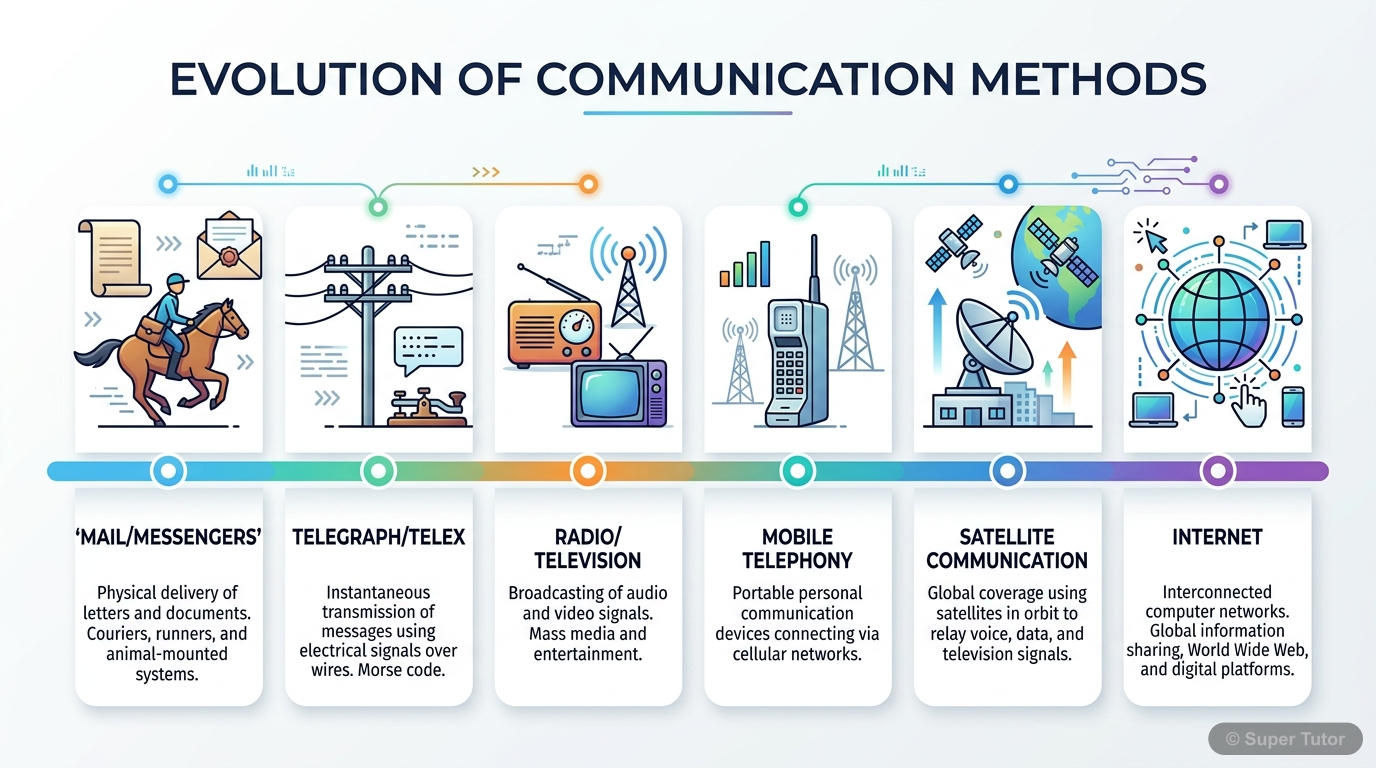
An illustration from Super Tutor's Evolution of communication chapter — alongside flashcards, concept maps and practice questions.
Quick Quiz: Evolution of communication
0/4Tap an answer to check it instantly. No sign-up needed for these 4.
Johannes Gutenberg invented the printing press around 1440. Which of the following best describes the MOST important impact of this invention on society?
Samuel F.B. Morse and Sir Charles Wheatstone invented the telegraph in 1835. What was the system of codes used to send telegraph messages called?
Which of the following correctly identifies the country of origin and the year of invention of the printing press?
Alexander Graham Bell developed the first practical telephone in 1876. Why did the telephone become the most widely used means of communication in the history of mankind?
Sample Questions
Early humans used cave paintings to communicate their thoughts and ideas. Which site in India is famous for its prehistoric cave paintings that depict the lives and times of ancient people?
Show answer
Bhimbetka, Madhya Pradesh
Step 1: The chapter mentions that archaeologists have found cave paintings from prehistoric sites. Step 2: One famous Indian site mentioned in the chapter is Bhimbetka, located in Madhya Pradesh. Step 3: These paintings depict the lives and times of ancient people and are considered an early form of language. Step 4: Serra da Capivara is a site in northeast Brazil, not in India — it is a common trap in this question. Step 5: Hampi and Ajanta Caves are famous historical sites but are not mentioned in the context of prehistoric cave paintings in this chapter.
Homing pigeons were used as messengers for thousands of years. Which civilisation is credited with being the FIRST to train and use pigeons for communication?
Show answer
Persians
Step 1: The chapter clearly states that Persians were the FIRST ones to train and use pigeons for communicating. Step 2: Romans also used pigeons, but they came after the Persians — Romans used them to help their military over 2000 years ago. Step 3: The Mughals in India also used pigeons for communicating, but they were not the first. Step 4: Egyptians are mentioned in the context of papyrus (writing material), not pigeon communication. Step 5: Therefore, the correct answer is Persians, as they pioneered pigeon-based communication.
The word 'paper' has its origins in an ancient writing material. From which ancient civilisation did this writing material originate, and what was it made of?
Show answer
Ancient Egypt; woven from papyrus plants
Step 1: The 'Do You Know?' section in the chapter tells us that the word 'paper' comes from an ancient Egyptian writing material. Step 2: This material was called 'papyrus'. Step 3: Papyrus was woven from papyrus plants that grew along the River Nile in Egypt. Step 4: This ancient material was used for writing long before modern paper was invented. Step 5: The other options describe writing materials from other civilisations, but the word 'paper' specifically traces back to Egyptian papyrus. So, Ancient Egypt and papyrus plants is the correct answer.
During World War I, pigeons were used extensively as military messengers. Approximately how many pigeons were used in World War I?
Show answer
Over 100,000 pigeons
Step 1: The chapter provides a specific fact about the use of pigeons during World War I. Step 2: It states that the use of pigeons for delivering messages was popular even in the 20th century. Step 3: The chapter specifically mentions that over 100,000 pigeons were used in World War I as messengers. Step 4: This large number shows how important and reliable pigeons were as a means of communication even during a major war in the 1900s. Step 5: The other numbers (10,000; 50,000; 200,000) are all incorrect as per the textbook information.
+39 more questions on Evolution of communication (ICSE Class 5 Social Studies)
Practise AllFrequently Asked Questions
What are the important topics in Evolution of communication for ICSE Class 5 Social Studies?
How many practice questions are there for Evolution of communication?
Sources & Official References
Content is aligned to the official syllabus. Refer to the board website for the latest curriculum.
More resources for Evolution of communication
Important Questions
Exam-style questions with answers
Revision Notes
Key points for last-minute revision
Chapter Summary
Understand the chapter at a glance
Concept Maps
See how topics connect
Study Plan
Step-by-step plan for this chapter
Flashcards
Quick-fire cards for active recall
Syllabus
What topics to cover
For serious students
Get the full Evolution of communication chapter — start free.
Quizzes, flashcards, an AI doubt solver and a study plan for ICSE Class 5 Social Studies. Free to start, no card needed.