The Story of Human Evolution — Practice Quiz
ICSE · Class 5 · Social Studies
Try a 4-question quiz on The Story of Human Evolution for ICSE Class 5 Social Studies: tap an answer to check it and see why.
Interactive on Super Tutor
Studying The Story of Human Evolution? Get the full interactive chapter.
Quizzes, flashcards, AI doubt-solver and a step-by-step study plan — built for practice quiz and more.
Free trial, no card needed.
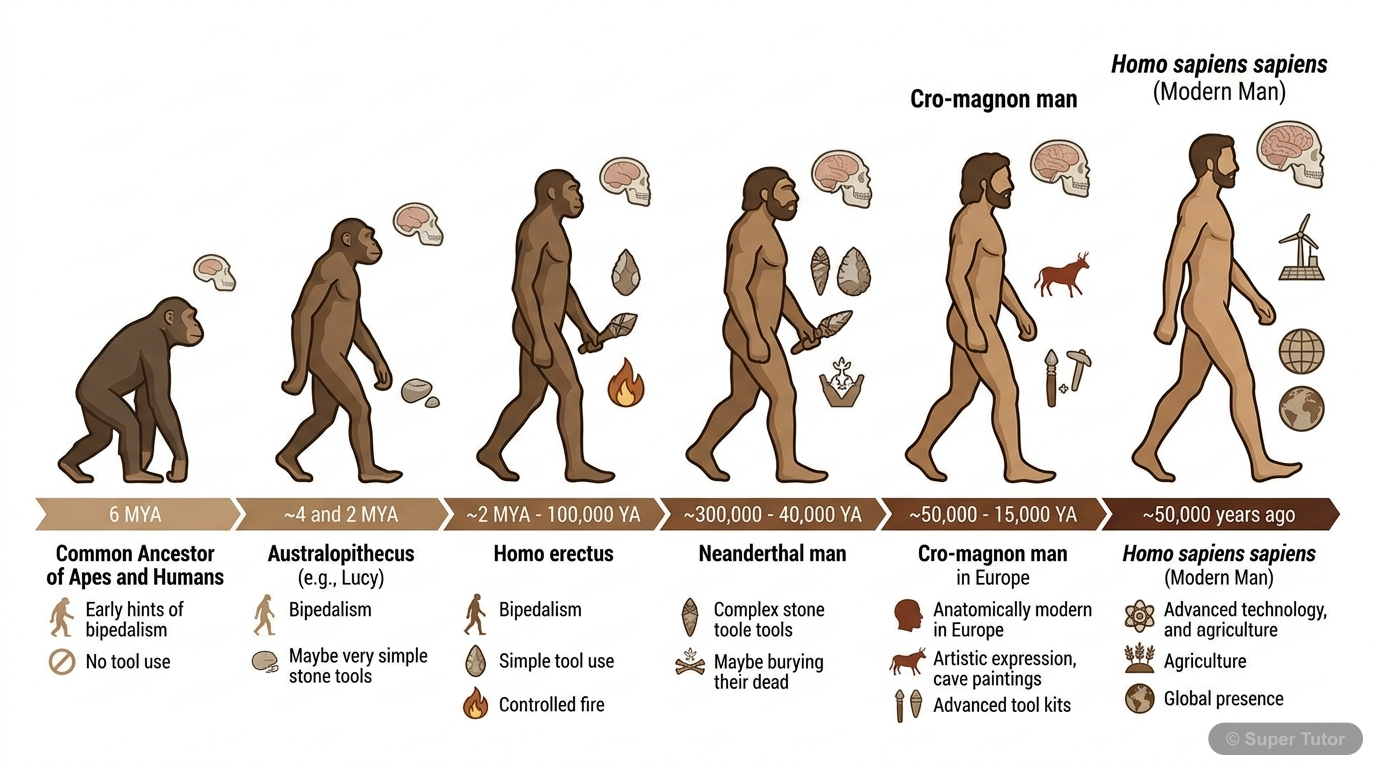
Learn better with visuals Super Tutor pairs illustrations like this with notes and quizzes for The Story of Human Evolution.
Quick Quiz: The Story of Human Evolution
0/4Tap an answer to check it instantly. No sign-up needed for these 4.
What is human evolution?
About how many years ago did the common ancestor of humans and apes live?
Where did scientists believe the common ancestor of humans and apes lived?
Which stage of human evolution walked on two legs but had longer arms and a small brain like apes?
Sample Questions
What does the name 'Homo erectus' mean?
Show answer
The upright man
Step 1: The name 'Homo erectus' comes from Latin words. 'Homo' means human and 'erectus' means upright or straight. Step 2: So Homo erectus means 'the upright man'. Step 3: This name was given because this stage of human evolution could stand erect and walk over long distances. Step 4: 'The wise man' is the meaning of Homo sapiens, which is the name for modern humans. Step 5: So the correct answer is 'the upright man'.
Which stage of human evolution are all modern human beings part of?
Show answer
Homo sapiens
Step 1: The stages of human evolution go from Australopithecus to Homo erectus to Neanderthals to Homo sapiens. Step 2: Homo sapiens is the most advanced and latest stage of human evolution. Step 3: All modern human beings — including you and me — belong to the group called Homo sapiens. Step 4: Homo sapiens have smaller teeth, a round skull, a more defined chin, and the largest brain size. Step 5: So, Homo sapiens is the correct answer.
What are fossils?
Show answer
Remains of earliest plants and animals buried under the earth that hardened over time
Step 1: Fossils are one of the most important sources of evidence for human evolution. Step 2: When plants and animals died millions of years ago, their bodies were buried under layers of soil and rock. Step 3: Over thousands of years, these remains hardened and turned into fossils. Step 4: Cave paintings and stone tools are different types of evidence — not fossils. Prehistoric humans did not leave written records. Step 5: So the correct answer is that fossils are the hardened remains of earliest plants and animals buried under the earth.
What is the study of fossils called?
Show answer
Palaeontology
Step 1: Different sciences have different names for their areas of study. Step 2: The study of fossils — the ancient hardened remains of plants and animals — is called Palaeontology. Step 3: People who study fossils are called Palaeontologists. Step 4: Archaeology is the study of ancient human history through objects and remains. Biology is the study of living things. Geography is the study of Earth's surface and environments. Step 5: So, Palaeontology is the correct answer for the study of fossils.
+37 more questions on The Story of Human Evolution (ICSE Class 5 Social Studies)
Practise AllFrequently Asked Questions
What are the important topics in The Story of Human Evolution for ICSE Class 5 Social Studies?
How many practice questions are there for The Story of Human Evolution?
Sources & Official References
Content is aligned to the official syllabus. Refer to the board website for the latest curriculum.
More resources for The Story of Human Evolution
Important Questions
Exam-style questions with answers
Revision Notes
Key points for last-minute revision
Chapter Summary
Understand the chapter at a glance
Concept Maps
See how topics connect
Study Plan
Step-by-step plan for this chapter
Flashcards
Quick-fire cards for active recall
Syllabus
What topics to cover
For serious students
Get the full The Story of Human Evolution chapter — start free.
Quizzes, flashcards, an AI doubt solver and a study plan for ICSE Class 5 Social Studies. Free to start, no card needed.