Nouns: Number — Practice Quiz
ICSE · Class 6 · English Language- Grammar
4 MCQs on Nouns: Number for ICSE Class 6 English Language- Grammar: tap an answer to check it and see why. The full chapter test has 88 questions.
Interactive on Super Tutor
Studying Nouns: Number? Get the full interactive chapter.
Quizzes, flashcards, AI doubt-solver and a step-by-step study plan — built for practice quiz and more.
Free trial, no card needed.
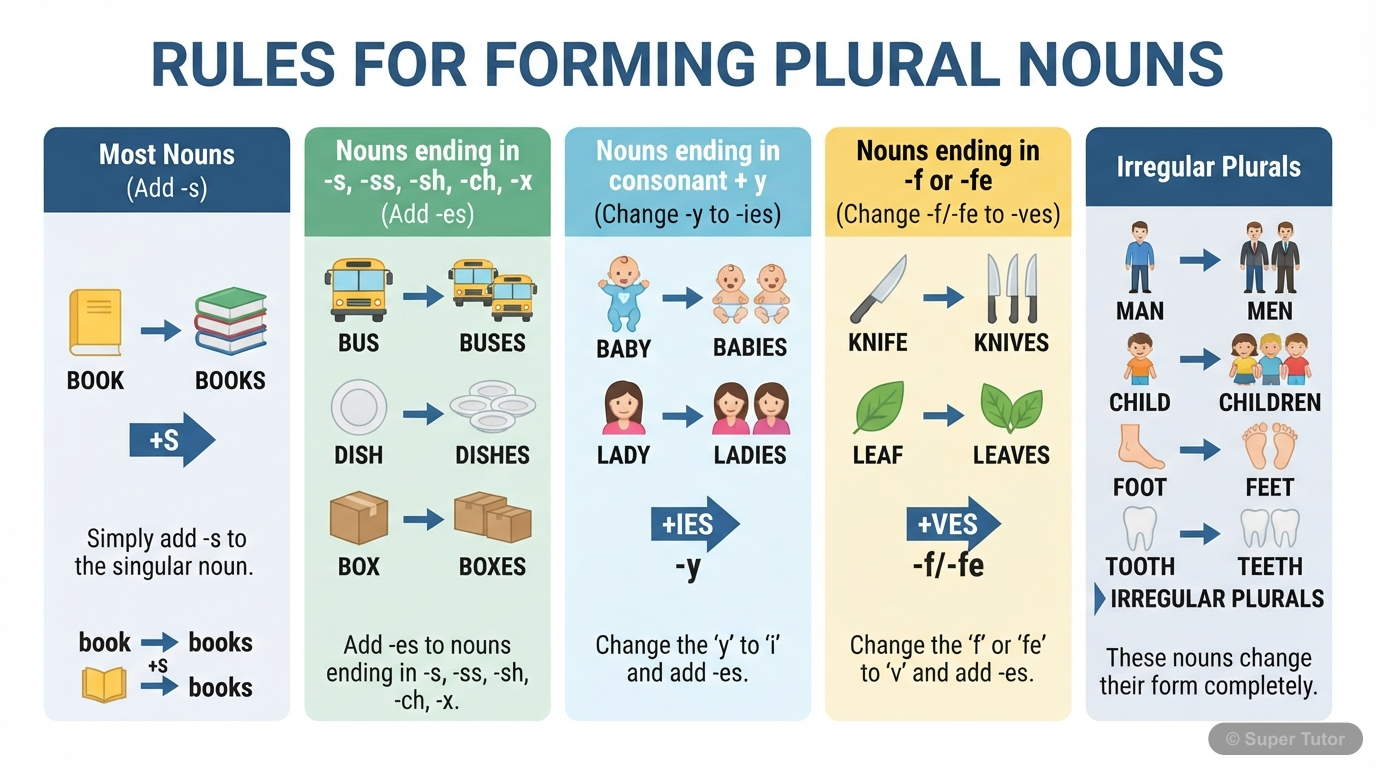
Learn better with visuals Super Tutor pairs illustrations like this with notes and quizzes for Nouns: Number.
Get startedQuick Quiz: Nouns: Number
0/4Tap an answer to check it instantly. No sign-up needed for these 4.
What is the plural form of the noun 'book'?
What is the plural form of the noun 'box'?
Which of the following is the correct plural of 'baby'?
What is the plural of 'boy'?
Sample Questions
What is the plural form of 'leaf'?
Show answer
leaves
Step 1: Identify the noun – 'leaf'. Step 2: Check the ending – 'leaf' ends in -f. Step 3: Apply Rule 4 – Most nouns ending in -f or -fe change the -f or -fe to -ves. Step 4: Remove -f and add -ves: 'lea' + 'ves' = 'leaves'. Step 5: 'Leafs' is wrong because this noun follows the -f to -ves rule. 'Leafes' and 'leafe' are not valid forms.
What is the correct plural of 'roof'?
Show answer
roofs
Step 1: Identify the noun – 'roof'. Step 2: Check the ending – 'roof' ends in -f. Step 3: Remember the exception – Some nouns ending in -f form their plural in the normal way (just add -s). Roof, chief, and gulf are examples of this exception. Step 4: So 'roof' becomes 'roofs', not 'rooves'. Step 5: Always check if a word is an exception to the general -f rule.
What is the plural of 'mango'?
Show answer
mangoes
Step 1: Identify the noun – 'mango'. Step 2: Check the ending – 'mango' ends in -o. Step 3: Apply Rule 3 – Most nouns ending in -o add -es to form the plural. Step 4: So 'mango' becomes 'mangoes'. Step 5: 'Mangos' would be the plural of exceptions like 'piano' → 'pianos', but mango follows the regular -o rule and takes -es.
Which of these nouns has the same form in both singular and plural?
Show answer
sheep
Step 1: The question asks for a noun with the same singular and plural form. Step 2: 'Cat' → 'cats' (different forms). Step 3: 'Tooth' → 'teeth' (different forms, changes the vowel). Step 4: 'Knife' → 'knives' (different forms). Step 5: 'Sheep' is correct – both singular and plural are 'sheep'. Other examples include deer, fish, dozen, and aircraft. These are called invariable plurals.
+84 more questions on Nouns: Number (ICSE Class 6 English Language- Grammar)
Practise AllFrequently Asked Questions
What are the important topics in Nouns: Number for ICSE Class 6 English Language- Grammar?
How many practice questions are there for Nouns: Number?
Sources & Official References
Content is aligned to the official syllabus. Refer to the board website for the latest curriculum.
More resources for Nouns: Number
Important Questions
Exam-style questions with answers
Revision Notes
Key points for last-minute revision
Chapter Summary
Understand the chapter at a glance
Concept Maps
See how topics connect
Study Plan
Step-by-step plan for this chapter
Flashcards
Quick-fire cards for active recall
Syllabus
What topics to cover
For serious students
Get the full Nouns: Number chapter — start free.
Quizzes, flashcards, an AI doubt solver and a study plan for ICSE Class 6 English Language- Grammar. Free to start, no card needed.