Weathering and Soil Formation — Important Questions
ICSE · Class 7 · Geography
45 important questions from Weathering and Soil Formation for ICSE Class 7 Geography, with answers. Includes multiple choice questions.
Interactive on Super Tutor
Studying Weathering and Soil Formation? Get the full interactive chapter.
Quizzes, flashcards, AI doubt-solver and a step-by-step study plan — built for important questions and more.
Free trial, no card needed.
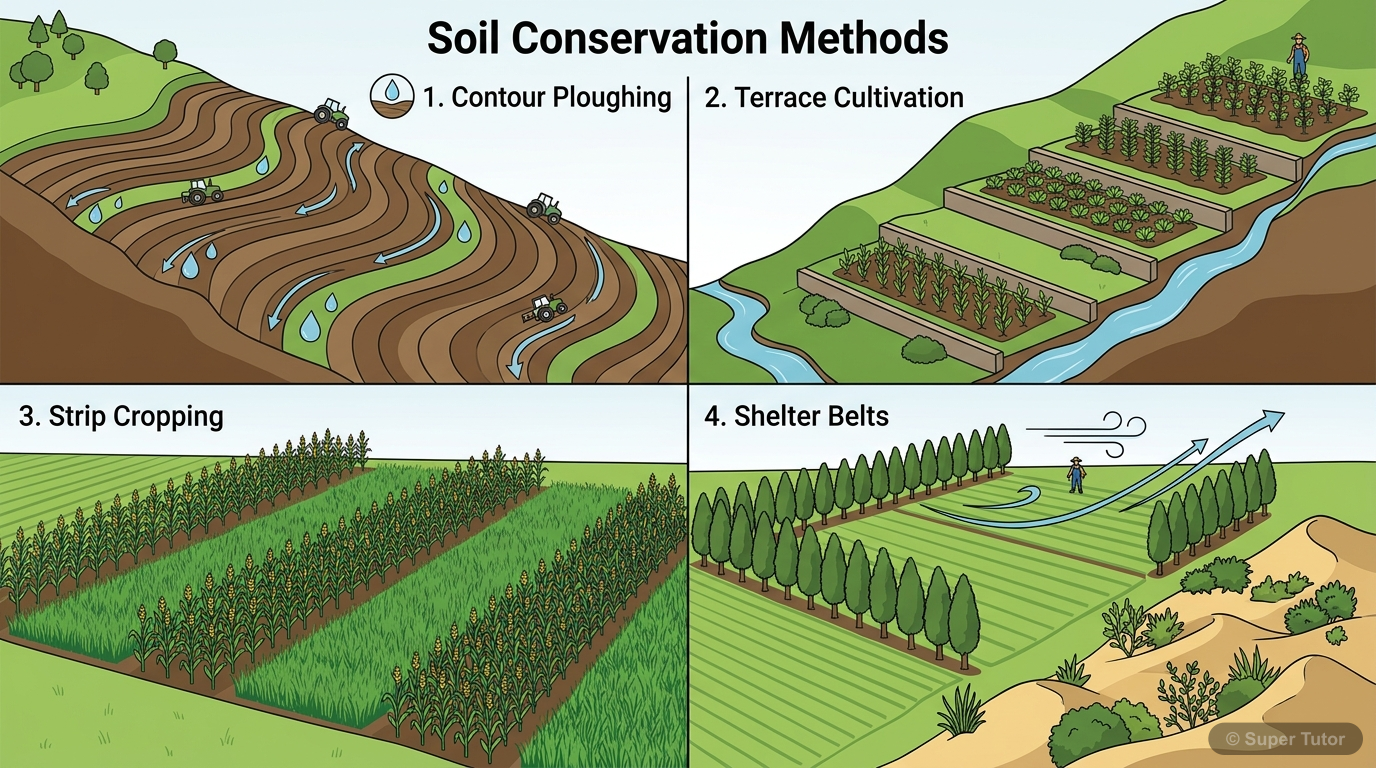
One of 5 illustrations for Weathering and Soil Formation in Super Tutor — alongside flashcards, concept maps and practice questions.
Important Questions from Weathering and Soil Formation
What is the organic matter found in the soil called? It adds to the fertility of the soil.
Show answer
Humus
Step 1: Soil contains both inorganic matter (like sand, silt, clay) and organic matter. Step 2: The organic matter in soil is called humus. Step 3: Humus is dark brown or black in colour and is derived from the decomposition (breaking down) of dead plants and animals. Step 4: Humus is very important because it adds nutrients to the soil and improves its fertility, helping crops grow well. Step 5: Regolith is the subsoil (B-horizon), silica is a mineral, and kaolin is clay formed from feldspar — none of these are the organic matter in soil.
In a soil profile, which horizon (layer) is the richest in humus and minerals, and is most important for plant growth?
Show answer
A-horizon
Step 1: A soil profile shows the different layers of soil from top to bottom. Step 2: The O-horizon is the very top layer, made of decayed organic matter (humus). It is missing in dry/arid areas. Step 3: The A-horizon, also called topsoil, lies just below the O-horizon. It is rich in both humus and minerals, and contains most of the nutrients needed for plant growth. Farmers value this layer greatly. Step 4: The B-horizon (subsoil) is poor in humus but has some minerals washed down from above. Step 5: The D-horizon is solid, unweathered bedrock — no plants can grow there. So, A-horizon is the
Weathering is described as a 'static' process. What does this mean?
Show answer
Rocks are broken down at the place where they exist, without being moved
Step 1: Weathering is the process of disintegration and decomposition of rocks. Step 2: The key feature of weathering is that it happens in situ — meaning 'in place'. The rocks break down right where they are, without being moved to another location. Step 3: This is why it is called a 'static' process — 'static' means not moving. Step 4: Denudation, on the other hand, is a dynamic process — it not only breaks down rocks but also transports the weathered material and deposits it elsewhere. Step 5: The other options describe transportation and deposition, which are features of denudation, not we
Which type of weathering does NOT change the chemical composition of rocks?
Show answer
Mechanical weathering
Step 1: There are three types of weathering — mechanical, chemical, and biological. Step 2: Mechanical weathering (also called physical weathering) involves the physical breaking apart of rocks due to factors like temperature changes, frost, and wind. Step 3: Importantly, mechanical weathering only changes the SIZE of the rock — it breaks rocks into smaller pieces. It does NOT change the chemical composition of the minerals in the rock. Step 4: Chemical weathering, on the other hand, changes the chemical composition and mineral makeup of rocks through processes like oxidation, hydration, and c
+41 more questions on Weathering and Soil Formation (ICSE Class 7 Geography)
Practise AllFrequently Asked Questions
What are the important topics in Weathering and Soil Formation for ICSE Class 7 Geography?
How many important questions are there in Weathering and Soil Formation?
Sources & Official References
Content is aligned to the official syllabus. Refer to the board website for the latest curriculum.
More resources for Weathering and Soil Formation
For serious students
Get the full Weathering and Soil Formation chapter — start free.
Quizzes, flashcards, an AI doubt solver and a study plan for ICSE Class 7 Geography. Free to start, no card needed.