Chapter 4 of 10
Revision Notes
Weathering and Soil Formation — Revision Notes
ICSE · Class 7 · Geography
Weathering and Soil Formation revision notes for ICSE Class 7 Geography: 4 topics in quick points. Part of the ICSE Class 7 Geography syllabus.
45 questions35 flashcards5 concepts
Interactive on Super Tutor
Studying Weathering and Soil Formation? Get the full interactive chapter.
Quizzes, flashcards, AI doubt-solver and a step-by-step study plan — built for revision notes and more.
Free trial, no card needed.
Super Tutor
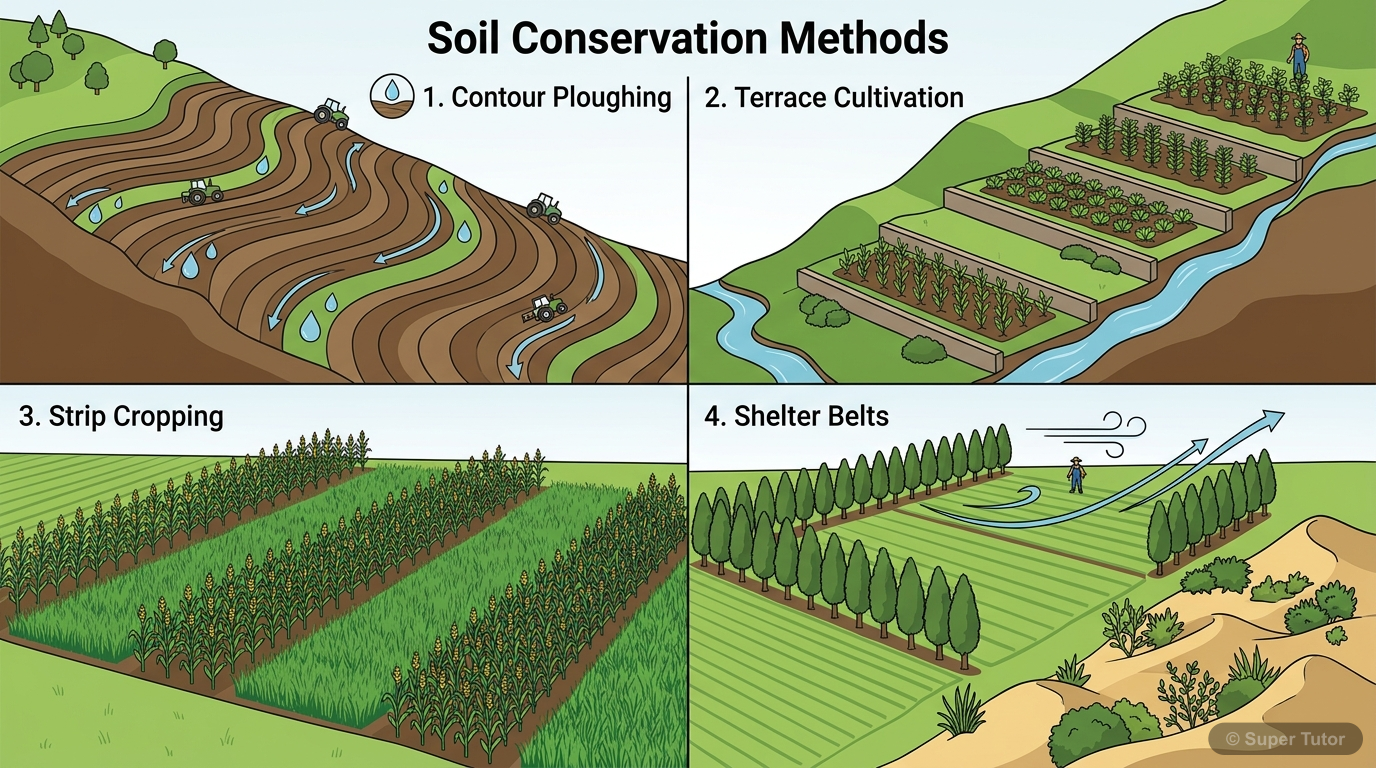
One of 5 illustrations for Weathering and Soil Formation in Super Tutor — alongside flashcards, concept maps and practice questions.
Key Topics to Revise
1
1. Earth, Rocks, and Minerals
- The Earth has three main components: lithosphere, hydrosphere, and atmosphere.
- The biosphere is the zone where land, water, and air meet and interact. It contains all forms of life.
- Rocks make up most of the solid materials of the lithosphere.
2
2. Types of Rocks
- Rocks are classified into three types by formation: igneous, sedimentary, and metamorphic.
- Igneous rocks form when molten magma solidifies either inside or on the surface of the Earth.
- Igneous rocks make up 85 per cent of the Earth's crust.
3
3. Weathering and Denudation
- Weathering is the breaking down or dissolving of rocks and minerals on the surface of the Earth by physical and chemical processes.
- Weathering is a static process because it happens where rocks exist.
- Weathering is important because it leads to the formation of soil.
4
4. Types and Factors of Weathering
- Weathering has three types: mechanical, chemical, and biological.
- Mechanical weathering is the physical disintegration of rocks by heat, frost, and wind.
- Mechanical weathering does not change the composition of rocks.
Get complete notes with diagrams and examples
Full NotesKey Concepts
Rocks are aggregates of mineralsIgneous rocks form when molten magmaSedimentary rocks form from sediments depositedMetamorphic rocks form when igneousWeathering is the static process
Frequently Asked Questions
What are the important topics in Weathering and Soil Formation for ICSE Class 7 Geography?
Key topics in Weathering and Soil Formation include Earth, Rocks, and Minerals, Types of Rocks, Weathering and Denudation, Types and Factors of Weathering. Study these first, then practise questions on each for Class 7 exams.
How should I revise Weathering and Soil Formation for Class 7 exams?
Learn the core ideas first, then work through the 45 practice questions on Weathering and Soil Formation. Revise definitions regularly and use flashcards for quick recall before the exam.
Sources & Official References
Content is aligned to the official syllabus. Refer to the board website for the latest curriculum.
More resources for Weathering and Soil Formation
For serious students
Get the full Weathering and Soil Formation chapter — start free.
Quizzes, flashcards, an AI doubt solver and a study plan for ICSE Class 7 Geography. Free to start, no card needed.