Rise and Spread of Islam — Important Questions
ICSE · Class 7 · History & Civics
42 important questions from Rise and Spread of Islam for ICSE Class 7 History & Civics, with answers. Includes multiple choice questions.
Interactive on Super Tutor
Studying Rise and Spread of Islam? Get the full interactive chapter.
Quizzes, flashcards, AI doubt-solver and a step-by-step study plan — built for important questions and more.
Free trial, no card needed.
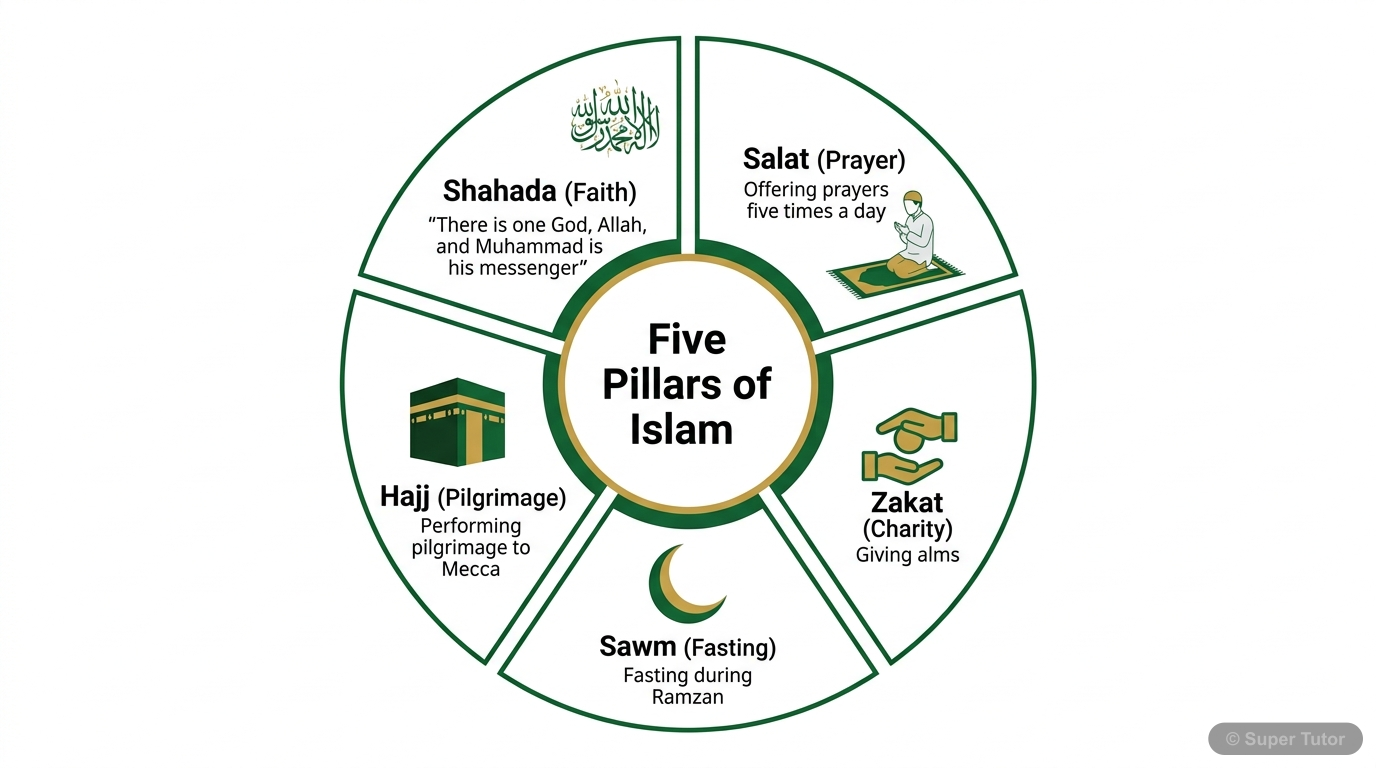
Learn better with visuals Super Tutor pairs illustrations like this with notes and quizzes for Rise and Spread of Islam.
Important Questions from Rise and Spread of Islam
The Umayyad dynasty ruled the Islamic empire from CE 661 to CE 750. Which city served as their capital?
Show answer
Damascus
Step 1: The Umayyad dynasty took power after the first four Caliphs and ruled from CE 661 to CE 750. Step 2: They chose Damascus (in present-day Syria) as their capital. Step 3: Mecca is incorrect — it is Islam's holiest city but was not a political capital of the Umayyads. Step 4: Baghdad is incorrect — Baghdad became the capital of the next dynasty, the Abbasids, after they overthrew the Umayyads. Step 5: Jerusalem is also incorrect — while it holds great religious significance in Islam, it was not the Umayyad capital.
Before the rise of Islam, Arabia was characterised by which of the following conditions?
Show answer
Arabia was divided into warring tribes with no central government, and religion was a mix of polytheism, Judaism and Christianity
Step 1: Before Islam arose in the 7th century, the people of Arabia lived in separate tribes and were not united. Step 2: These tribes often fought wars over land and pastures — there was no central government to maintain peace. Step 3: The religion of the time was a mixture — polytheism (worship of many gods), Judaism, and Christianity all coexisted. Step 4: Option A is wrong because there was no central government and religion was not only Judaism. Step 5: Options C and D are wrong — Arabia was not peaceful, and it was not ruled by a single king following Christianity.
The Five Pillars of Islam include 'Sawm' or 'Siyam'. What does this pillar specifically require Muslims to do?
Show answer
Observe fasting from dawn to dusk during Ramadan, the ninth month of the lunar year
Step 1: The Five Pillars of Islam are Shahada, Salat, Zakaat, Sawm, and Haj — each with a distinct meaning. Step 2: 'Sawm' or 'Siyam' specifically refers to fasting. Step 3: Muslims must fast (not eat or drink) from dawn to dusk during Ramadan, which is the ninth month of the Islamic lunar calendar (also called Ramzan in India). Step 4: Option A describes 'Zakaat' (alms giving), not Sawm. Option B describes 'Salat' (prayer). Option C describes 'Haj' (pilgrimage). Step 5: Students often confuse the five pillars — each one has a very specific meaning and it is important to know each one separate
Which dynasty overthrew the Umayyads, and what significant change did they make to the capital of the Islamic empire?
Show answer
The Abbasids overthrew the Umayyads and moved the capital from Damascus to Baghdad
Step 1: The Umayyad dynasty (CE 661–750) ruled from Damascus. Step 2: The Abbasid dynasty rose to power by overthrowing the Umayyads. Step 3: After taking control, the Abbasids established their new capital at Baghdad (in present-day Iraq). Step 4: Option A is wrong — the Ottoman Turks came much later; they conquered Baghdad and ended Arab rule, but did NOT overthrow the Umayyads. Step 5: Option C is wrong because the Abbasids did NOT keep Damascus; they moved the capital to Baghdad. Option D is completely wrong — Safavids are not part of this chapter.
+38 more questions on Rise and Spread of Islam (ICSE Class 7 History & Civics)
Practise AllFrequently Asked Questions
What are the important topics in Rise and Spread of Islam for ICSE Class 7 History & Civics?
How many important questions are there in Rise and Spread of Islam?
Sources & Official References
Content is aligned to the official syllabus. Refer to the board website for the latest curriculum.
More resources for Rise and Spread of Islam
For serious students
Get the full Rise and Spread of Islam chapter — start free.
Quizzes, flashcards, an AI doubt solver and a study plan for ICSE Class 7 History & Civics. Free to start, no card needed.