Administration, Society and Culture under the Delhi Sultanate — Important Questions
ICSE · Class 7 · History & Civics
43 important questions from Administration, Society and Culture under the Delhi Sultanate for ICSE Class 7 History & Civics, with answers.
Interactive on Super Tutor
Studying Administration, Society and Culture under the Delhi Sultanate? Get the full interactive chapter.
Quizzes, flashcards, AI doubt-solver and a step-by-step study plan — built for important questions and more.
Free trial, no card needed.
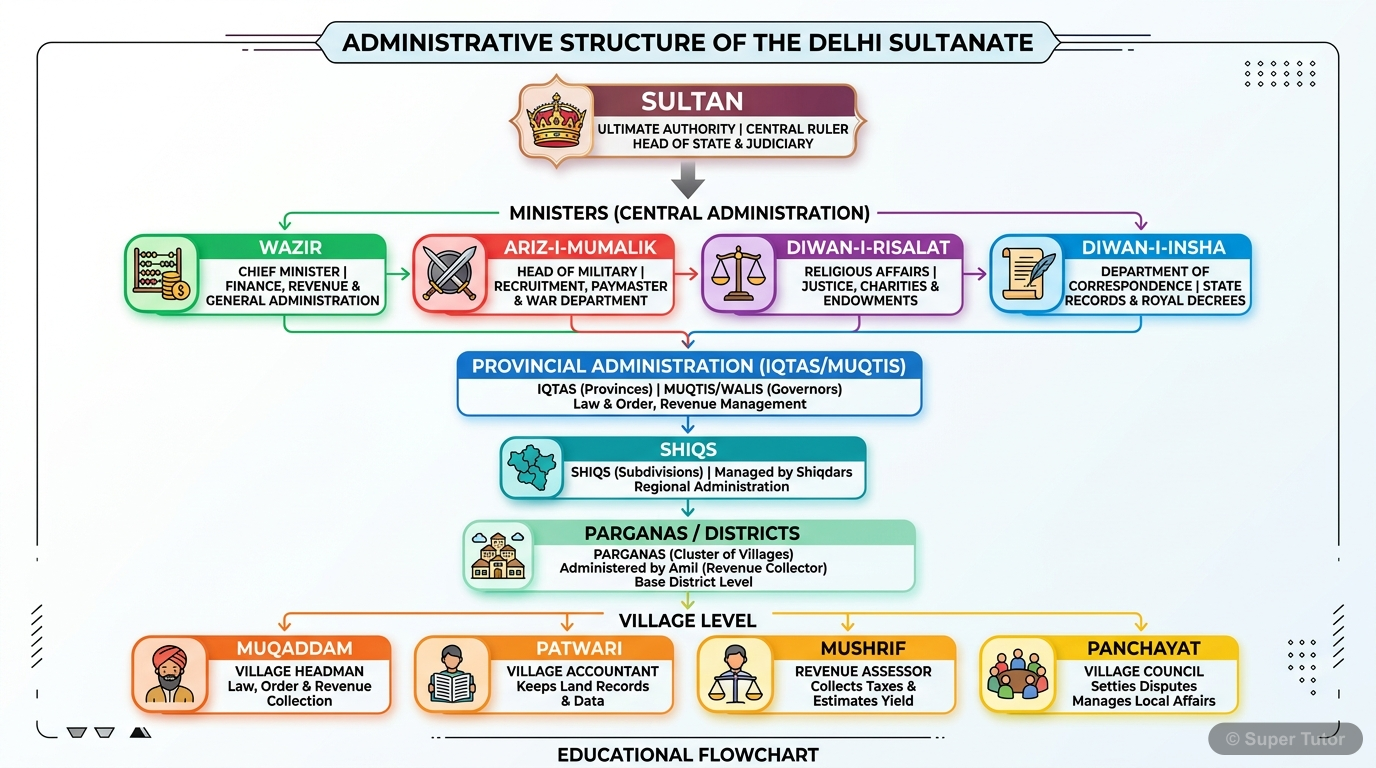
Learn better with visuals Super Tutor pairs illustrations like this with notes and quizzes for Administration, Society and Culture under the Delhi Sultanate.
Important Questions from Administration, Society and Culture under the Delhi Sultanate
What new language was born from the blending of Persian and Hindi during the Sultanate period?
Show answer
Urdu
Step 1: During the Sultanate period, people of different cultures — Persians, Turks, and Indians — lived and interacted together in cities and markets. Step 2: Persian was the language of the administration and the nobility, while Hindi was spoken widely by the common people of India. Step 3: As these two languages mixed and blended over time, a new language called Urdu was born. Step 4: Arabic was used mainly by traders from Western Asia, and Sanskrit was the language of high learning among Hindus — neither was a blend of Persian and Hindi. Pali was an even older ancient language. Step 5: Urd
Which department of the Delhi Sultanate was responsible for recruiting, equipping, and paying the army?
Show answer
Diwan-i-Arz
Step 1: The Delhi Sultanate had four main departments, each with a specific function. Step 2: The Diwan-i-Arz was the military department — its responsibilities included recruiting soldiers, equipping them with weapons and supplies, and paying their salaries. Step 3: It was headed by the Ariz-i-Mamalik. Step 4: The other options are wrong — Diwan-i-Wazarat dealt with revenue (money matters), Diwan-i-Risalat handled religious matters and correspondence with scholars, and Diwan-i-Insha dealt with domestic and foreign correspondence (letters). Step 5: So, any question about army management points
What was the silver coin introduced by Iltutmish that was widely used in markets during the Sultanate period?
Show answer
Tanka
Step 1: A strong economy needs a reliable currency for trade and transactions. Step 2: During the Sultanate period, Iltutmish introduced a silver coin called the 'Tanka' which became the standard currency widely used in markets across the empire. Step 3: This coin helped encourage trade by providing a common medium of exchange. Step 4: The other options are wrong — Rupiya became common in a later period (during the Mughals and British era), Dinar was a coin used in Arab regions, and Paisa is a modern Indian currency unit. Step 5: The Tanka was an important contribution of Iltutmish to the econ
Which famous traveller from Morocco described the practice of sati in India during the Sultanate period?
Show answer
Ibn Batuta
Step 1: Several foreign travellers visited India during the medieval period and wrote about what they observed. Step 2: Ibn Batuta was a traveller from Morocco (a country in North Africa) who visited India during the Sultanate period. Step 3: He specifically described the horrifying practice of sati — a woman burning herself on the funeral pyre of her dead husband — in his writings. Step 4: Marco Polo was an Italian traveller who visited India but is more famous for his travels to China. Hiuen Tsang was a Chinese monk who visited India during the Gupta period, much earlier. Al-Biruni was a sch
+39 more questions on Administration, Society and Culture under the Delhi Sultanate (ICSE Class 7 History & Civics)
Practise AllFrequently Asked Questions
What are the important topics in Administration, Society and Culture under the Delhi Sultanate for ICSE Class 7 History & Civics?
How many important questions are there in Administration, Society and Culture under the Delhi Sultanate?
Sources & Official References
Content is aligned to the official syllabus. Refer to the board website for the latest curriculum.
More resources for Administration, Society and Culture under the Delhi Sultanate
For serious students
Get the full Administration, Society and Culture under the Delhi Sultanate chapter — start free.
Quizzes, flashcards, an AI doubt solver and a study plan for ICSE Class 7 History & Civics. Free to start, no card needed.